Chalk Paint vs Milk Paint: Which Holds Up Better on Furniture?
Chalk Paint often holds up well on furniture after proper sealing; milk paint can be just as durable on raw wood, but it often chips more predictably on slick or sealed surfaces unless you use a bonding agent. Pick the wrong finish and drawers scuff early, tabletops mark faster, and touch-ups turn into routine work. This guide compares durability, prep effort, and finish style so you can choose the right paint for the piece.
This guide is part of our Drying Time Chart: Paint, Stain & Polyurethane By Coat series.
| Factor | Chalk Paint | Milk Paint | Winner |
|---|---|---|---|
| Prep on previously finished furniture | Usually needs cleaning and scuff sanding; priming helps on glossy or sealed surfaces | Often needs scuff sanding and priming; adhesion is less forgiving on slick finishes | Chalk Paint |
| Scratch and handling resistance | Better when sealed; unsealed paint can easily scratch off | Can hold well on raw wood, but chips or flakes more when bonding is weak | Chalk Paint |
| Water resistance | Needs a topcoat for better moisture resistance | Must topcoat for protection and water marks | Tie |
| Finish control | Works for smooth finishes and distressed looks | Can look naturally rustic, with more unpredictable chipping | Chalk Paint |
| Beginner ease | Ready to use out of the can, thick, and simple to apply | Powdered paint that must be mixed and timed carefully | Chalk Paint |
Trade-off between control and rustic character
The real trade-off is control versus character. Chalk paint comes ready to use, goes on thick, and suits a matte finish with either distressed looks or smooth finishes. Milk paint is a powdered finish you mix before use, dries quickly, and can give a natural rustic look, but it chips more unpredictably when adhesion is weak.
Chalk Paint
Chalk Paint is usually the easier path when you want predictable coverage on furniture that gets touched often. It is described as offering a matte finish with low VOCs, and it is often treated as beginner-friendly because you do not mix it before use. That convenience does not replace prep, though, especially on sealed or glossy pieces.
Milk Paint
Milk Paint suits raw wood and looks best when you want a matte finish with a natural rustic look. Because it is powdered milk paint, it needs mixing, and it often needs scuff sanding and primed surfaces when the substrate is slick or already coated. It can dry quickly, which helps project speed, but it also means you need to plan your work.
Furniture durability decision table
This table separates surface type from furniture use, because a dresser front and a table top do not fail the same way. The key question is not only which paint sticks, but which finish keeps its film after hands, water, and abrasion start working on it.
| Use case | Prep level | Topcoat need | Scratch risk | Water resistance | Recommended choice |
|---|---|---|---|---|---|
| Dresser fronts | Light to moderate; clean and scuff sand if previously finished | Recommended for both | Moderate | Moderate after sealing | Chalk Paint |
| Table tops | Higher; clean, scuff sand, and prime as needed | Required | High | High only with sealer | Chalk Paint |
| Chairs | Higher; edges and rungs need careful sanding | Required for wear control | High | Moderate with topcoat | Chalk Paint |
| Cabinets | Moderate; clean well and scuff sand glossy film | Recommended | Moderate | Moderate to high with sealer | Chalk Paint |
| Child furniture | Higher; avoid weak adhesion on slick coatings | Required | High | Moderate | Chalk Paint |
| Decorative pieces | Low to moderate | Optional if handling is light | Low to moderate | Low to moderate | Milk Paint |
| Humid rooms | Moderate; surface cleaning matters more than looks | Required | Moderate | Better with a moisture-resistant sealer | Chalk Paint |
| Heavily handled surfaces | Higher; prep is not optional | Required | High | Moderate to high with proper topcoat | Chalk Paint |
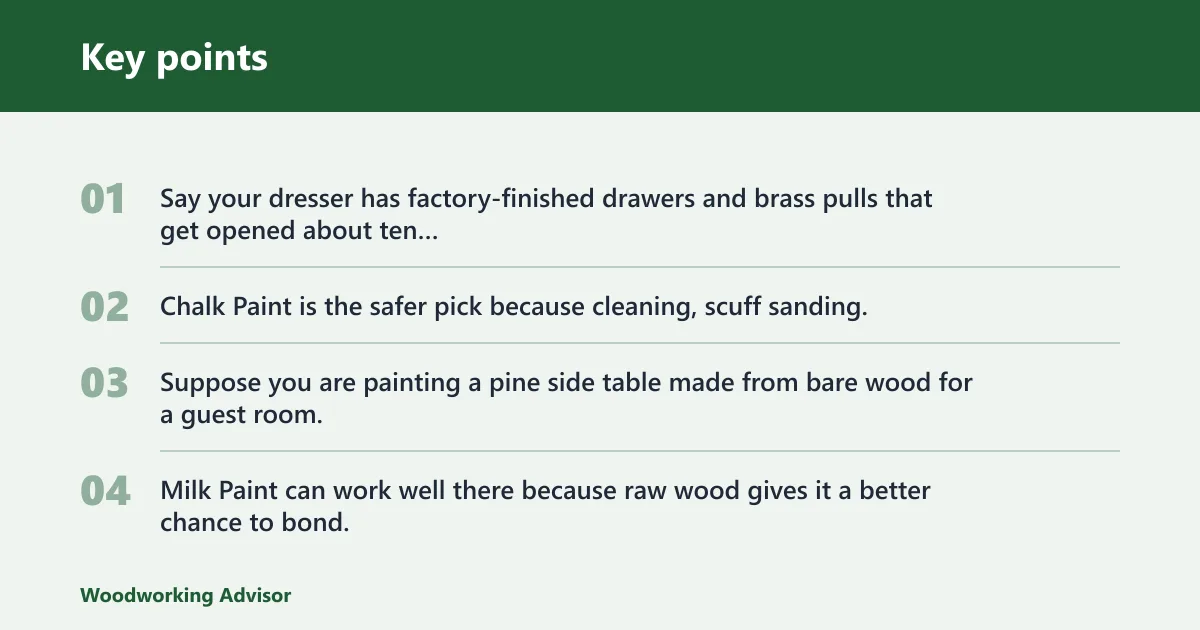
Say your dresser has factory-finished drawers and brass pulls that get opened about ten times a day. Chalk Paint is the safer pick because cleaning, scuff sanding, and a topcoat let you control adhesion, while Milk Paint is more likely to chip where hands and hardware keep rubbing.
Suppose you are painting a pine side table made from bare wood for a guest room. Milk Paint can work well there because raw wood gives it a better chance to bond, and the natural rustic look may suit a light-use piece; just do not skip the topcoat if water rings are a concern.
Does chalk paint last longer?
Chalk Paint often lasts longer on furniture that gets regular use, especially after the surface is prepared and sealed. Without a topcoat, it can scratch, burnish, or wear at edges faster than people expect. On sealed or varnished wood, the prep step matters as much as the paint itself.
Where Chalk Paint holds up well
It does well on dresser fronts, cabinet doors, and painted furniture that is cleaned, scuff sanded, and topcoated. The thick consistency helps it cover, and the matte finish hides minor brush movement better than high-gloss coatings. Durability comes from the system: prep, paint, and sealer.
Where Chalk Paint needs a sealer
Table tops, chairs, kids’ furniture, and humid rooms need a topcoat more than decorative pieces do. Chalk paint may easily scratch off if you skip prep on slick surfaces, and the film is not meant to take constant moisture or abrasion on its own. A sealer also changes sheen, which matters if you want a softer or tougher final look.
Does milk paint need a topcoat?
Yes, milk paint must topcoat for most furniture that will be handled or cleaned. On raw wood, it can bond well and stay attractive, but a topcoat helps prevent scratching, water marks, and uneven wear. On sealed or glossy furniture, the need is even greater because weak adhesion can lead to chipping.
When Milk Paint can stay unsealed
Unsealed milk paint can work on low-touch decorative pieces where the goal is a matte finish and a natural rustic looking finish. Even there, the look should be a choice, not an accident. If the piece may be wiped often or sit in a humid room, leaving it bare invites wear.
When a topcoat helps prevent wear and water marks
A topcoat is the better choice for tabletops, cabinets near sinks, and children’s furniture. It reduces scratching and helps water bead instead of soaking into weak areas of the film. It also limits how much chipping spreads once the finish starts to lift at an edge or corner.
Prep for sealed, stained, and bare wood
Prep decides whether the paint bonds or fails early. Cleaning removes wax, grease, and dust; scuff sanding gives the surface tooth; priming helps when you are dealing with sealed, stained, or glossy furniture. Bare wood is usually the easiest substrate, but even there, uneven grain or stain bleed-through can change the result.
Cleaning and scuff sanding
Start by washing away residue, then scuff sand enough to dull the sheen on previous finishes. This matters for both paints, especially on sealed versus unsealed surfaces. A quick pass with abrasive paper is not about stripping the piece; it is about giving the coating a better grip.
When priming matters
Priming becomes more important on stained wood, glossy painted furniture, and older sealed pieces that resist bonding. It can also help control bleed-through from tannins or old stain. If the surface is already unstable, paint alone is not a fix for it.
Which finish style do you want?
Finish style changes the decision almost as much as durability does. Chalk Paint is the cleaner choice for smooth solid finish work, while Milk Paint is better when you want rustic character and are comfortable with some chippy variation. The more you want the piece to look worn on purpose, the more Milk Paint fits.
Smooth solid finish
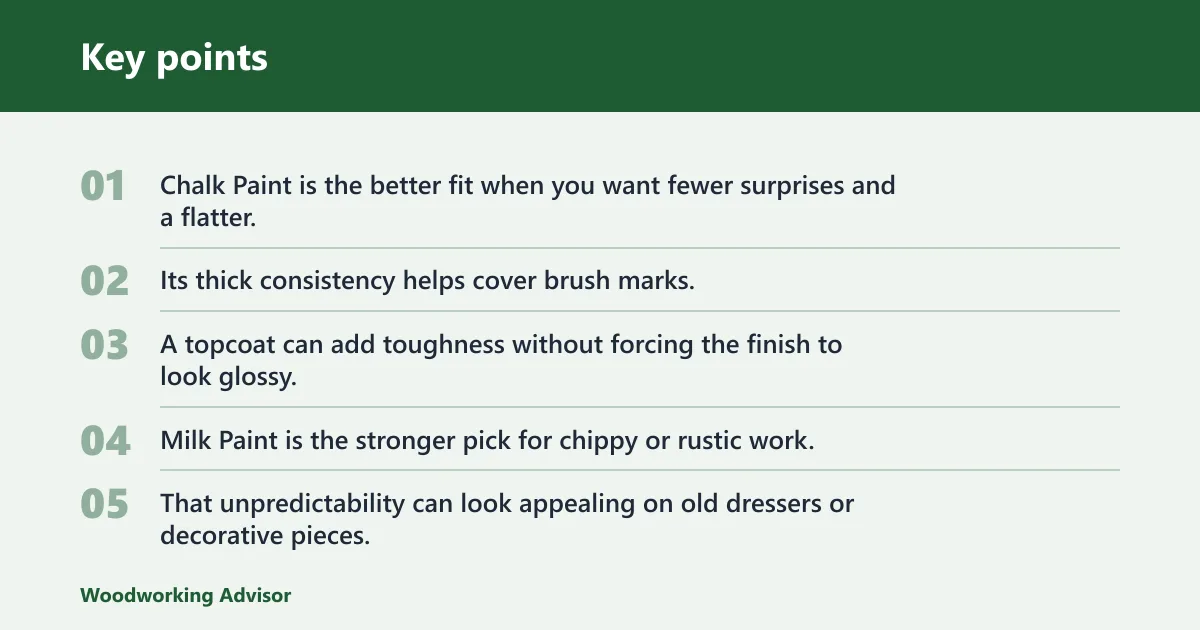
Chalk Paint is the better fit when you want fewer surprises and a flatter, more even result. Its thick consistency helps cover brush marks, and it is easier to sand lightly between coats if you want a cleaner look. A topcoat can add toughness without forcing the finish to look glossy.
Distressed or chippy finish
Milk Paint is the stronger pick for chippy or rustic work, but the chipping is not always neat or even. That unpredictability can look appealing on old dressers or decorative pieces, yet it is a liability on tabletops and chairs. If you want only controlled distressing, Chalk Paint gives you more say in where wear appears.
Why milk paint chips more unpredictably
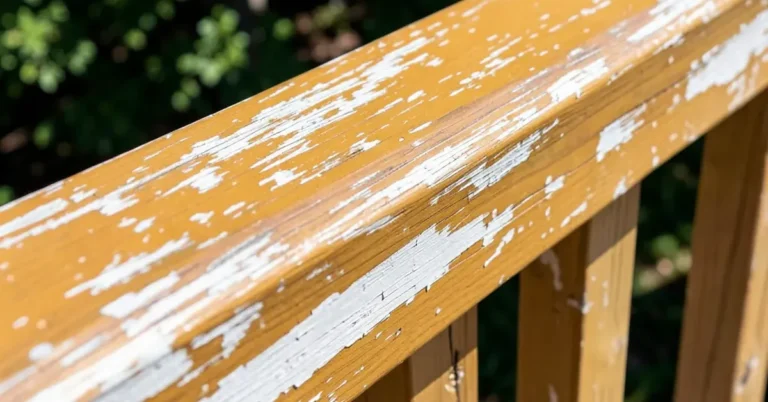
Milk Paint depends heavily on bonding to the substrate. On raw wood, it may stay tight; on slick or sealed surfaces, it can let go in flakes. That is why the same paint can look intentional on one project and uneven on another.
Choose Chalk Paint if… / Choose Milk Paint if…
Choose Chalk Paint if the piece gets regular handling, if you want fewer prep headaches, or if you need a smooth finish on a dresser, cabinet, or chair. Choose Milk Paint if the piece is raw wood, lightly handled, or meant to look naturally rustic, and you are willing to manage mixing, bonding, and topcoating carefully.
- Choose Chalk Paint if the furniture is a dresser front, cabinet door, child furniture, or another high-touch surface.
- Choose Chalk Paint if the wood is sealed, varnished, or previously painted and you plan to scuff sand and prime.
- Choose Chalk Paint if you want a smoother, more predictable finish with less project setup.
- Choose Milk Paint if the project is decorative, raw wood, or meant to have a natural rustic looking finish.
- Choose Milk Paint if you want chippy character and can accept more variation in adhesion and wear.
- Choose Milk Paint if you are comfortable using a topcoat to control scratching and water marks.


Frequently asked questions
Does chalk paint or milk paint last longer on furniture?
Chalk Paint usually lasts longer on furniture that gets touched often, but only after proper prep and sealing. Milk Paint can last well on raw wood, yet it is less forgiving on sealed or glossy surfaces. For durability, the substrate and topcoat matter as much as the paint choice.
Do you need to sand furniture before chalk paint?
Yes, scuff sanding is usually wise before Chalk Paint, especially on sealed or varnished furniture. It helps the paint grip and reduces early scratching. Cleaning first matters too, because dust, wax, and grease can block adhesion even when the surface looks fine.
Does milk paint need a topcoat on furniture?
Yes, Milk Paint must topcoat on most furniture if you want better protection. A topcoat helps against water marks, scratching, and wear at edges. It is especially important on tabletops, chairs, humid rooms, and any piece that gets cleaned often.
Will chalk paint stick to sealed or varnished wood?
Chalk Paint can stick to sealed or varnished wood, but not reliably without prep. Cleaning and scuff sanding are the minimum steps, and priming is often wise on glossy surfaces. Skipping those steps raises the chance that the paint will scratch off early.
Which paint is better for a dresser or table top?
For a dresser, Chalk Paint is usually the better choice because it balances prep effort and wear resistance well. For a table top, Chalk Paint also has the edge, but only with a durable topcoat. Milk Paint is usually a better fit for decorative tops or low-use pieces.
Can you get a smooth finish with chalk paint?
Yes, Chalk Paint can produce a smooth finish if you apply it carefully and sand between coats where needed. Its thick consistency helps cover well, but surface prep still matters. A sealer can protect the finish without forcing it into a high-gloss look.
How do you stop milk paint from chipping too much?
Use proper prep, especially cleaning and scuff sanding, and add a bonding agent when the surface is slick. A topcoat helps lock down weak spots and limits water damage. If the goal is a stable finish rather than a chippy look, do not rely on bare Milk Paint alone.
Which is easier for beginners, chalk paint or milk paint?
Chalk Paint is usually easier for beginners because it is ready to use out of the can and has a thick consistency that is simple to apply. Milk Paint adds mixing and adhesion decisions before the first coat goes on. That extra setup is manageable, but it is less forgiving.
Sponsored / affiliate links. As an Amazon Associate I earn from qualifying purchases. I may earn additional commission from eligible campaigns.