Can You Spray Polyurethane in Cold Weather?
Spraying polyurethane in cold weather is generally only appropriate if the air, wood, and finish stay within the product label’s minimum, often around 50°F. Below that, atomization, drying, and cure suffer. Ignore that rule and you risk poor flow, clouding, slow cure, runs, and a soft film that stays vulnerable to damage. This guide gives a winter go/no-go checklist for air temperature, substrate temperature, material temperature, and setup changes before you spray.
How cold weather disrupts solvent release and film cure


Why cold changes the result
Cold slows solvent release and chemical cure. That affects both oil-based and water-based polyurethane, because the film can stay wet too long, trap moisture, or cure unevenly. In a spray setup, cold material can also thicken enough to spray poorly, especially through a long hose or a cold gun.
Ventilation still matters indoors, but it has to be controlled. You need enough air movement to clear solvent fumes, and you also need to avoid chilling the work, stirring dust, or pushing cold, damp air across the wet film.
Winter poly spray checklist
Use this table as a go/no-go screen before you load the gun. Treat air temperature, substrate temperature, relative humidity, dew point spread, and material temperature as separate checks. A shop can feel warm while the wood is still cold enough to condense moisture and ruin adhesion.
| Air temp | Substrate temp | Relative humidity | Dew point spread | Material temp | Action |
|---|---|---|---|---|---|
| 70°F to 85°F | Within a few degrees of air temp and fully dry | 85% or lower | At least 5°F above dew point | About 20°C to 25°C | Go |
| 50°F to 69°F | Cold but dry, no frost or condensation | 85% or lower | At least 5°F above dew point | Warmed to stable spray flow | Warm up first |
| Below 50°F | Below 50°F or colder than the room air | Any elevated humidity, or near saturation | Less than 5°F | Cold finish, cold hose, or cold gun | Stop |
| Any air temp | Damp, frosted, fogged, or condensation visible | 85% or higher | At or below dew point | Any | Stop and dry the surface |
| Any air temp | Dry and warm enough | 85% or lower | Safe spread | Too cold for stable atomization | Warm material and equipment |
What each column is telling you
Air temperature is only part of the picture. Many wood-finishing products are meant for a minimum around 50°F, with one competitor stating 50F to 65F as the lowest application temperature and 70F to 85F as the ideal range. Below 5°C, curing can become extremely slow and adhesion can suffer.
Substrate temperature is often the deciding factor. Cold wood pulls heat from the film, slows cure, and raises condensation risk. If the surface is near the dew point, moisture can appear even when the room air seems acceptable. That can lead to bubbling, adhesion failure, shrinkage, or delamination.
Relative humidity matters because high moisture load slows drying and increases the chance of soft cure, cloudiness, or blushing. Competitor guidance commonly keeps relative humidity at 85% or lower, and a dehumidifier can help in cold conditions. Rain, fog, frost, and snow stop exposed work.
Simple winter setup checks
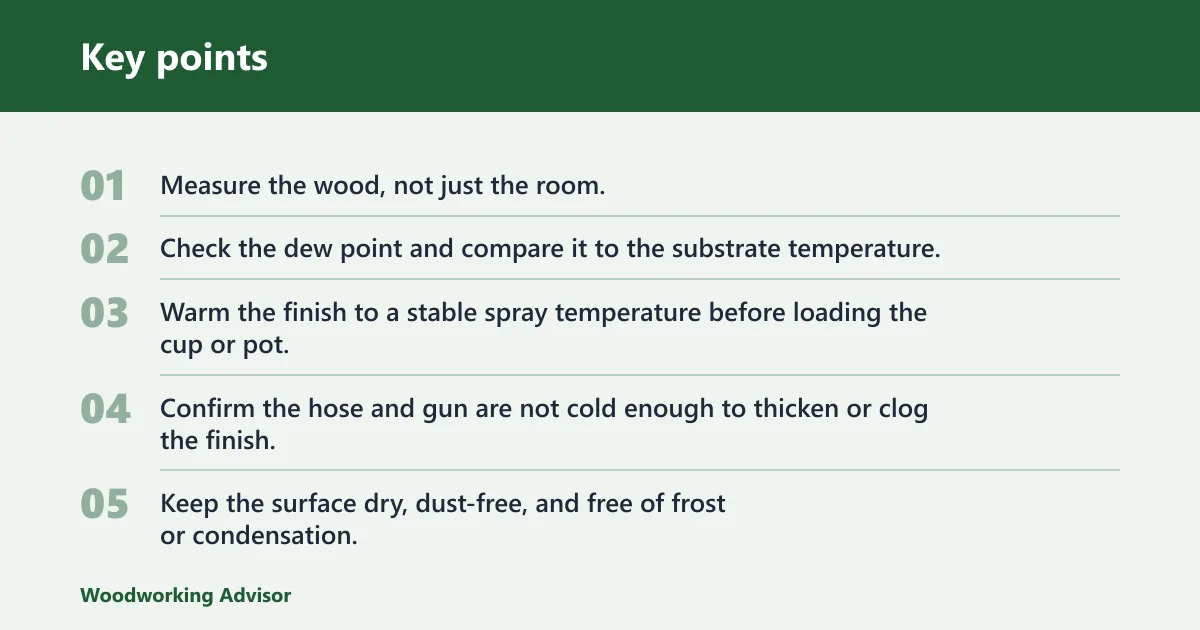
- Measure the wood, not just the room.
- Check the dew point and compare it to the substrate temperature.
- Warm the finish to a stable spray temperature before loading the cup or pot.
- Confirm the hose and gun are not cold enough to thicken or clog the finish.
- Keep the surface dry, dust-free, and free of frost or condensation.
- Verify that ventilation clears fumes without blasting cold air across the part.
What temperature is too cold?
For many wood-finishing polyurethanes, below about 50°F is a practical stop point unless the label says otherwise. One competitor warns that below 50°F it is difficult to get a good application, and another notes that work below 5°C can cure extremely slowly and stick poorly. If the wood is colder than the air, treat that as a separate warning sign.
Why wood, finish, and room air need separate checks
Air temperature changes fastest. The substrate changes more slowly, especially on sheet goods, solid hardwood, or a piece stored in an unheated room. A finish can also sit cold in the can or cup, which changes flow and atomization before it ever reaches the wood.
Picture a cabinet door stored in a 45°F shop overnight. If the room warms to 55°F, the air may look acceptable, but the door can still pull moisture from the air and cool the fresh film. That is how a film that looks fine at spray time ends up soft or tacky later.
When to wait instead of forcing it
Stop and wait if the wood is cold, damp, frosted, or too close to the dew point. Stop if the hose or gun is cold enough to disrupt atomization. Stop if the room cannot stay within the label’s range for the whole dry and cure window, not just during spraying.
A controlled heated setup can be acceptable for interior furniture work when the air, wood, and material stay stable. It is not a shortcut around a wet surface or a cold substrate. Heating the finish alone does not fix condensation or poor cure conditions.
Does humidity matter as much as temperature?
Yes. High humidity slows drying and raises the chance of clouding, soft cure, and finish failure, especially when the substrate is already cold. A dehumidifier can help, but it does not replace temperature control or dry wood. Keep relative humidity at 85% or lower, and watch the dew point spread before you spray.
How to use dew point spread
If the wood is close to the dew point, moisture can form on the surface even in a heated shop. A practical rule is to keep the substrate at least 5°F above the dew point. If you cannot maintain that spread, do not spray.
Cold weather can also hide moisture problems. A surface can feel dry while still carrying condensation from a temperature swing. That is one reason a quick visual check for fogging, frost, or bead formation matters before each coat.
Interior furniture versus exterior work
For interior furniture spraying, the main concerns are stable temperature, controlled ventilation, and dry wood. For exterior or construction-grade polyurethane systems, weather exposure becomes part of the decision. Some work should not proceed if rain is expected within 4 to 6 hours, because fresh film can be damaged before it has a chance to set.
Oil-based vs water-based polyurethane
Neither type is immune to cold. Oil-based polyurethane usually dries and cures more slowly, so cold can leave it wet for too long and delay handling or recoating. Water-based polyurethane often flashes differently, but it still depends on warm enough air, a dry surface, and a stable substrate. Damp wood is not acceptable for either one.
Which type is less forgiving in the cold?
Oil-based products are often less forgiving when temperatures fall because they already cure more slowly. Water-based products may seem faster at first, but that does not mean they are safe on a cold or damp surface. Cold can still produce poor flow, weak adhesion, or a soft film that never really hardens.
Do not assume water-based polyurethane can rescue a chilly shop. The product still needs the wood to be dry and above the label minimum. If the shop is below 50°F, both types can become unreliable unless the manufacturer specifically allows a lower temperature.
How warming changes spray quality
Spray equipment often performs better when the finish is warmer and more consistent. Heated hoses are described as essential for long hose runs in winter, and a cold gun can clog or spit. Warm material usually atomizes more cleanly, with fewer ridges, dry spray edges, and uneven fan patterns.
That said, material warming is only one part of the setup. A warm cup cannot fix a cold board, a wet surface, or a room with high humidity. You need the whole system in range.
Cold-weather spray defects and fixes
Winter defects usually point back to temperature, moisture, or spray setup. Use the symptom to narrow the cause, then correct the condition before the next coat. If the defect appears right after spraying, do not assume more finish will solve it.
| Defect | Likely cold-weather cause | Fix |
|---|---|---|
| Orange peel | Cold finish, poor atomization, or finish drying before it levels | Warm the material, check spray pressure and fan pattern, and bring air and wood into range |
| Fisheyes | Surface contamination, moisture, or condensation on the wood | Stop, dry the surface, clean contamination, and improve dew point control |
| Blushing | High humidity, trapped moisture, or rapid temperature change | Lower humidity, stabilize temperature, and avoid spraying near condensation conditions |
| Bubbles | High temperature swing, trapped solvent, or coating sprayed over moisture | Check substrate dryness, keep within the working window, and avoid over-accelerating cure |
| Tacky film | Cold air, cold wood, or material that cannot finish curing | Raise temperature, wait for a better window, and do not stack coats too soon |
| Poor adhesion | Cold substrate, condensation, or very slow cure below the recommended range | Warm and dry the substrate before respraying |
What to do after a bad winter spray
If the coat looks rough but is still curing, stop adding more finish until you know why the first coat failed. A cold setup can create orange peel that tempts you to bury the surface with more material, but that can trap defects and extend tack time. Fix the condition first.
Say your small cabinet door is sprayed at 48°F air temperature with a cold door and a cold hose. The coat may look acceptable for an hour, then turn sticky and dull as cure stalls. The right fix is not a heavier second coat; it is to warm the room, the door, and the material before retrying.
Winter workflow for small shops
Start with the substrate. Bring the wood to a dry, stable temperature, then warm the finish and check the hose and gun. Verify the humidity and dew point, confirm ventilation, and spray only when the whole setup stays inside the safe window for the full cure period.
A common first-timer mistake is warming the can while leaving the board cold. That creates a false sense of readiness. The film may spray better at first, then fail later because the wood was never ready.
Frequently asked questions
Can you spray polyurethane in cold weather?
Yes, but only within the product label’s minimum and only when the wood is dry, the material is warm enough to spray, and the room stays stable through cure. Below about 50°F, many wood-finishing polyurethanes become difficult to apply and may cure too slowly.
Can you use polyurethane in cold weather?
You can use it in cold weather if you control air temperature, substrate temperature, humidity, and material temperature separately. If any one of those falls out of range, the finish can stay wet too long, cloud, bubble, or cure weakly.
What is the lowest temperature to apply polyurethane?
There is no universal minimum for every product, so the label controls. One competitor states 50F to 65F as the lowest application temperature, and another warns that below 50°F it is difficult to get a good application. Below 5°C, curing and adhesion become very poor.
Will polyurethane dry if the shop is below 50°F?
It may dry eventually, but not reliably. Cold can leave polyurethane wet for too long and may prevent full curing, especially if the wood is cold or the humidity is high. That often leads to a soft or tacky surface that stays vulnerable to damage.
Does water-based polyurethane work better than oil-based in the cold?
Not by default. Water-based polyurethane can still fail on a cold or damp surface, and damp wood is not acceptable for either type. Oil-based products often cure more slowly, so cold can be even harder on them, but both need warm, dry conditions.
How warm should the wood and finish be before spraying poly?
Keep the wood dry and within the label range, with the finish warmed enough for stable spraying. The material temperature should be kept around 20°C to 25°C for stable spraying. More important than a single number is keeping the wood, finish, and room from drifting cold during cure.
Sponsored / affiliate links. As an Amazon Associate I earn from qualifying purchases. I may earn additional commission from eligible campaigns.