Best Paint Sprayers for Cabinets (2026): we compared
For cabinet repainting, I reach for the sprayer that atomizes finely, keeps overspray down, and stays out of defect trouble; in this ranking, a fine-finish HVLP or a quality airless with a fine-finish tip usually wins on finish quality. Pick poorly, and you get orange peel, runs, dusty overspray, and hours of sanding and rework. This guide ranks cabinet sprayers by finish quality using a practical score that weighs atomization, overspray, and defect risk over raw speed.
Quick comparison
| Product | Badge | Best for | Price | ||
|---|---|---|---|---|---|
 |
Graco Magnum X5 Airless Paint Sprayer, Interior & ExteriorGraco | Our pick | Airless · 75 ft hose · 1-5 gal bucket | $322.00
Price as of 8 Oct 2026
|
View |
 |
Wagner Spraytech Control Pro 150 HEA Airless Paint Sprayer,Wagner | Also great | Low overspray · 1500 PSI · 175 gal/year | $294.68
Price as of 8 Oct 2026
|
View |
 |
Hudson 38501 JD9-CT Heavy-Duty Spray Gun for Use withHudson | Budget pick | Heavy-duty spray gun · Adjustable stream | $195.99
Price as of 8 Oct 2026
|
View |
 |
Tilswall Cordless Paint Sprayer Shark700, Fits Dewalt 20VTILSWALL | Pair with it | Cordless · Dewalt 20V · Side-feed | $99.99
Price as of 8 Oct 2026
|
View |
 |
PNTGREEN HVLP Mini Spray Gun Air Paint Sprayer with 0.8 mmPNTGREEN | Upgrade pick | Mini HVLP · 125 cc cup · Gravity feed | $21.99
Price as of 8 Oct 2026
|
View |
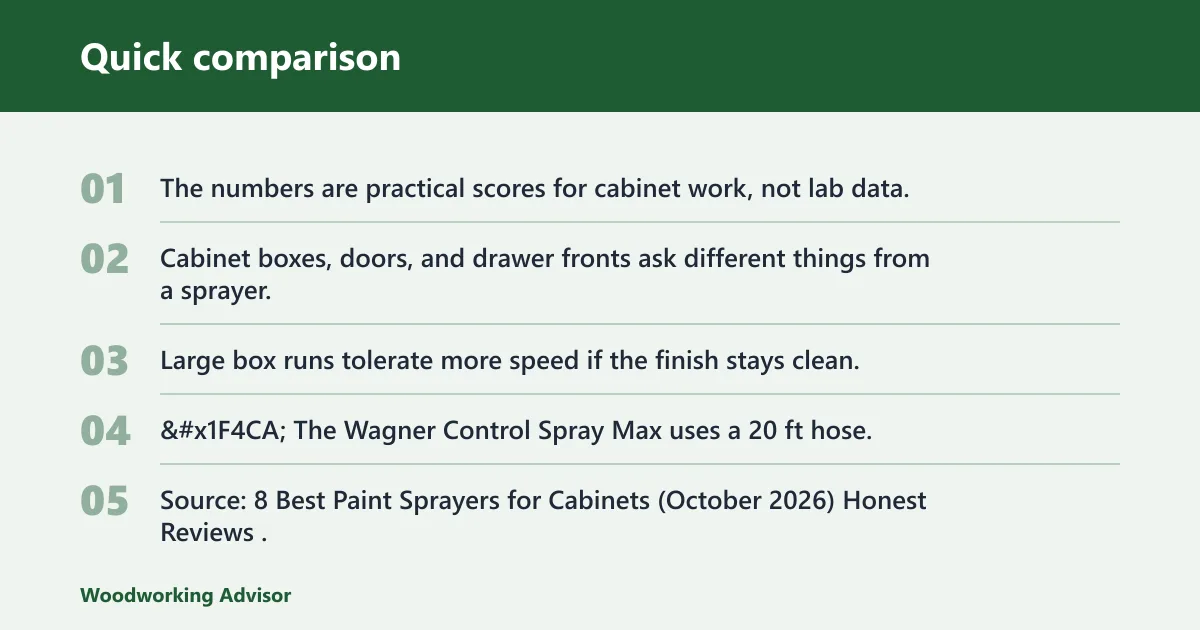
This comparison puts finish quality first. The numbers are practical scores for cabinet work, not lab data, and they reflect how each sprayer tends to behave on doors, frames, and drawer fronts when prep and technique are solid.
Cabinet boxes, doors, and drawer fronts ask different things from a sprayer. Doors reward the finest atomization. Frames reward edge control. Large box runs tolerate more speed if the finish stays clean.
📊 The Wagner Control Spray Max uses a 20 ft hose. Source: 8 Best Paint Sprayers for Cabinets (October 2026) Honest Reviews.
How we chose
Cabinet finish quality came first. That means atomization, overspray, and defect risk were weighted above raw coverage speed.
I also separated cleanup burden, control on flat doors versus narrow frames, and the practical cost of ownership. Tip wear, masking supplies, and paint waste matter when the job is inside a kitchen.
Project size changes the winner. A small batch of doors can favor a cup-fed HVLP, while a whole kitchen sometimes pushes the job toward an airless setup with a fine-finish tip.

Graco Magnum X5: best for large cabinet runs
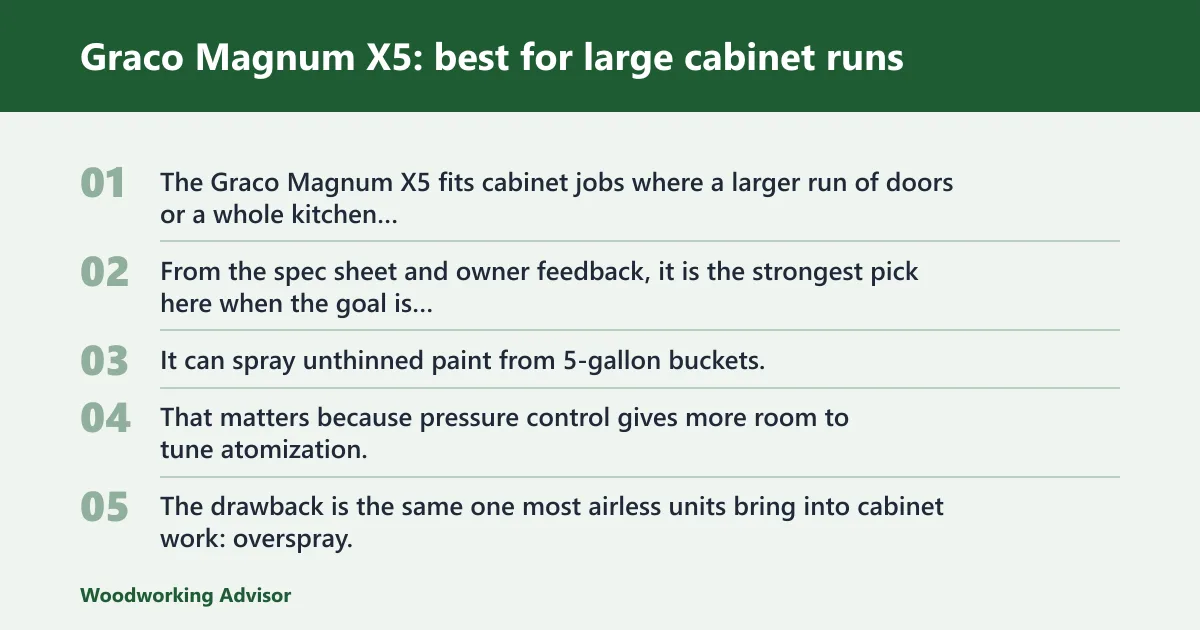
The Graco Magnum X5 fits cabinet jobs where a larger run of doors or a whole kitchen needs steady output and direct bucket feeding. From the spec sheet and owner feedback, it is the strongest pick here when the goal is moving a lot of material without refilling cups every few minutes.
It can spray unthinned paint from 5-gallon buckets, and it is listed at 3000 PSI with adjustable pressure control. That matters because pressure control gives more room to tune atomization, and the long hose helps keep the rig parked away from the work area.
The drawback is the same one most airless units bring into cabinet work: overspray. On doors and drawer fronts, the spray pattern can get away from a beginner fast, and tip choice becomes part of finish quality rather than a side detail.
Wagner Control Pro 150: best budget low-overspray airless option
The Wagner Control Pro 150 suits homeowners who want airless speed but care about keeping the mist cloud under control. From specs and reviews, it is a practical middle ground for larger kitchens where masking is already part of the plan.
It is described as a low-overspray airless sprayer and listed at 1500 PSI. That lower pressure helps cabinet work more than raw output alone, because it trims waste and makes edge control less punishing on frames and inside corners.
The drawback is that it is still an airless sprayer. It can be excellent for large runs, but it is not the first choice for small batches, and the finish will still depend heavily on tip choice, distance, and trigger discipline.
PNTGREEN HVLP mini spray gun: best for small doors and trim
The PNTGREEN HVLP mini gun is the smallest, simplest option in this group for small cabinet doors, face-frame touchups, and narrow trim. Its gravity-feed layout and compact cup make sense when the job is local and the priority is a fine, controlled pattern rather than speed.
The listed 0.8 mm nozzle and 125 cc cup point to a detail-oriented tool. That helps on small parts, but it also means refill frequency rises quickly on a full kitchen, and larger cabinet boxes can feel inefficient with this size gun.
The drawback is capacity. A mini gun can give good control, but it becomes tedious when the project grows, and thin materials are usually easier to spray through it than heavy cabinet enamel without careful adjustment.
Tilswall Cordless Paint Sprayer Shark700: best for quick portable touchups
The Tilswall cordless sprayer fits jobs where mobility matters more than absolute finish perfection. It is useful for quick touchups, detached doors in a garage, or small cabinet parts where cords and hoses would slow the work.
Its side-feed design helps with refills, and the adjustable settings give some room to tune the pattern. That said, cordless convenience often comes with tradeoffs in atomization consistency compared with a better HVLP turbine or a stronger airless setup.
The drawback is finish risk on fine cabinet work. For doors and visible face frames, cordless convenience is not the same thing as a glass-smooth finish, and masking and cleanup still matter just as much.
Graco TrueCoat 360 Variable Speed: best for quick small batches
This model is useful when cabinet work is limited to a few pieces, hardware-adjacent touchups, or small repairs where cleanup time matters more than speed. The FlexLiner bag system points to a setup that is meant to be quick to load and quick to put away.
The 4 FlexLiner bags are the most notable ownership detail here. They reduce the mess of cup cleanup, which helps for small jobs, but the bag system also makes this less attractive for larger kitchen runs where repeated refills would slow the work.
The drawback is capacity and flexibility. Small-batch convenience is real, but it is still a poor match for a whole kitchen unless the goal is portability and limited material waste rather than faster completion.
Which one should you buy
For a whole kitchen, the Graco Magnum X5 is the strongest fit if the finish can tolerate an airless learning curve. For a few cabinet doors or a small vanity, the PNTGREEN mini gun is the better match because control matters more than speed. For the smoothest finish, a well-tuned HVLP style setup usually has the edge on doors and drawer fronts. For the lowest ownership cost, the best choice is often the one that cuts masking waste, cleaning time, and rework, not the cheapest sticker price.
If the kitchen is large and the coating is thick, the airless units become more appealing. If the kitchen is small, the doors are the priority, and overspray is a concern, the smaller cup-fed sprayers make more sense. A cheaper HVLP can beat a pricier airless when the project is compact and the finish goal is high.
What is the best paint sprayer for cabinets?
The best cabinet sprayer is usually a fine-finish HVLP for doors and drawer fronts, or a quality airless unit with a fine-finish tip for larger runs. Cabinets reward atomization and control more than raw speed. If orange peel and overspray are unacceptable, finish quality should outrank output every time.
Is HVLP or airless better for cabinets?
HVLP is usually better for cabinet finish quality because it gives finer control and less overspray. Airless is better when the job is large and speed matters, but it is messier and harder to keep clean around edges. For most indoor cabinet repainting, HVLP wins on finish.
What paint sprayer do professionals use for cabinets?
Professionals often use fine-finish HVLP setups for doors, frames, and trim, then move to airless sprayers for larger jobs or raw speed on big cabinet runs. The choice depends on the coating, the room layout, and masking tolerance. Good pros match the tool to the part, not the other way around.
What PSI do I need for painting cabinets?
Cabinet spraying usually benefits from enough pressure to atomize cleanly without fogging the room. Too little pressure gives spitting and coarse texture; too much can drive overspray and dry spray. Adjustable pressure control matters because the right setting changes with the coating, tip size, and distance from the surface.
Do I need to thin paint for cabinet sprayers?
Often yes, but it depends on the sprayer and the coating. Latex and heavy cabinet enamels may need thinning to atomize cleanly through smaller guns, while some airless units can spray thicker material unthinned. Chalk paint is often easier to spray, but it still needs testing for flow and finish.
Which sprayer gives the smoothest finish on cabinets?
A fine-finish HVLP sprayer usually gives the smoothest cabinet finish because it lays down a softer fan with less overspray and better edge control. That matters on doors and drawer fronts where surface appearance is front and center. Airless can look excellent too, but it takes more setup and technique.
How do I reduce overspray when spraying cabinets?
Mask more than seems necessary, keep the gun at a consistent distance, and adjust pressure only as high as needed for clean atomization. Move at a steady pace with even overlap. Overspray falls fast when the fan is too wide, the pressure is too high, or the trigger is pulled too close to the edge.
What size nozzle is best for cabinets?
The best nozzle or tip size is the one that matches the coating viscosity and still gives a smooth fan. Smaller tips can produce a finer finish on doors and trim, while larger tips may be needed for thicker cabinet enamel. If the finish looks coarse or spitting starts, the tip is often part of the problem.
Is a paint sprayer worth it for kitchen cabinets?
Yes, if the goal is a smoother finish than brushing can usually deliver. A sprayer can cut brush marks and speed up even coverage, but it also adds masking, cleanup, and the risk of overspray. For kitchens, the real payoff comes when prep, technique, and cleanup are treated as part of the job.
How to choose the right cabinet sprayer
Start with the part you are painting. Doors and drawer fronts favor fine atomization and low defect risk; box interiors and larger runs can tolerate more output if masking is solid.
- Match the sprayer type to the job size. HVLP for smaller, cleaner cabinet work; airless for larger runs.
- Check the coating. Latex, enamel, chalk paint, and urethane-alkyd all behave differently.
- Look at the cup or bucket system. Cup-fed tools suit smaller jobs; bucket-fed tools cut refill stops.
- Factor cleanup. Flush cycles, disassembly, and tip wear all add cost.
- Plan for masking and waste. Overspray can cost more than the sprayer over time.
Cabinet prep before spraying
Good cabinet prep starts with degreasing. Kitchen films defeat adhesion quickly, especially near handles, stove sides, and sink bases.
After cleaning, sand or degloss the surface, then wipe with a tack cloth. Primer compatibility matters as much as topcoat choice, because a good finish still fails if the coating cannot bond to the surface below it.
- Remove hardware and label parts.
- Degrease thoroughly.
- Sand or degloss the existing finish.
- Wipe dust with a tack cloth.
- Use primer that matches the topcoat system.
Spray technique and common defects
Technique changes finish quality more than many buyers expect. Hold a steady distance, overlap passes evenly, and keep the gun moving before and after the trigger pull.
Orange peel usually points to poor atomization or material that is too heavy. Runs come from moving too slowly or laying on too much material. Spitting often points to clogging, bad thinning, or a feed issue. Dry spray shows up when the material partly dries before it lands.
| Model | Atomization | Overspray | Control on doors/frames | Cleanup burden | Defect risk |
|---|---|---|---|---|---|
| Graco Magnum X5 | 8/10 | 5/10 | 7/10 | 6/10 | 6/10 |
| Wagner Control Pro 150 | 7/10 | 7/10 | 6/10 | 6/10 | 6/10 |
| PNTGREEN HVLP mini gun | 8/10 | 8/10 | 8/10 | 7/10 | 5/10 |
| Tilswall cordless sprayer | 6/10 | 6/10 | 6/10 | 6/10 | 7/10 |
| Graco TrueCoat 360 | 7/10 | 7/10 | 7/10 | 8/10 | 6/10 |
One practical note: cabinet doors and drawer fronts are where finish flaws show first. Frames hide a little more, but the edges and inside corners punish poor trigger control. For that reason, the smoothest-looking tool is often the one that sprays a narrower, cleaner fan with less bounce-back.
Sponsored / affiliate links. As an Amazon Associate I earn from qualifying purchases. I may earn additional commission from eligible campaigns.