Wood Filler vs Paint Compatibility Chart by Brand
Use a paintable, sandable filler for latex or oil topcoats, and match the filler label to the primer; solvent-heavy lacquer or stain systems usually need a two-part or solvent-rated filler. Get it wrong and you can end up with flashing, telegraphing, cracking, or stain bleed that forces a full redo. This guide maps common filler brands and filler types to latex, oil, alkyd, and spray finishes, with the failure risks called out for each pairing.
| Decision factor | Wood Filler | Paint Compatibility Chart By Brand | Winner |
|---|---|---|---|
| Choosing the right topcoat | Depends on the filler label, filler type, and substrate. | Maps brand, primer, and paint chemistry in one place. | Paint Compatibility Chart By Brand |
| Avoiding flashing and sheen mismatch | Can work when the patch is small and fully sealed. | Flags where satin and semi-gloss are likely to reveal the repair. | Paint Compatibility Chart By Brand |
| Handling larger defects | Good for many holes and shallow gouges, if shrinkage is controlled. | Shows when a one-part filler is the wrong choice. | Paint Compatibility Chart By Brand |
| Speed on a simple touch-up | Direct material choice with fewer steps. | Adds a decision layer before you fill. | Wood Filler |
| Best fit for trim, cabinets, and furniture repairs | Useful as the repair material, but not enough by itself. | Better for matching patch size, primer, and topcoat. | Paint Compatibility Chart By Brand |
Compatibility chart and finish guidance
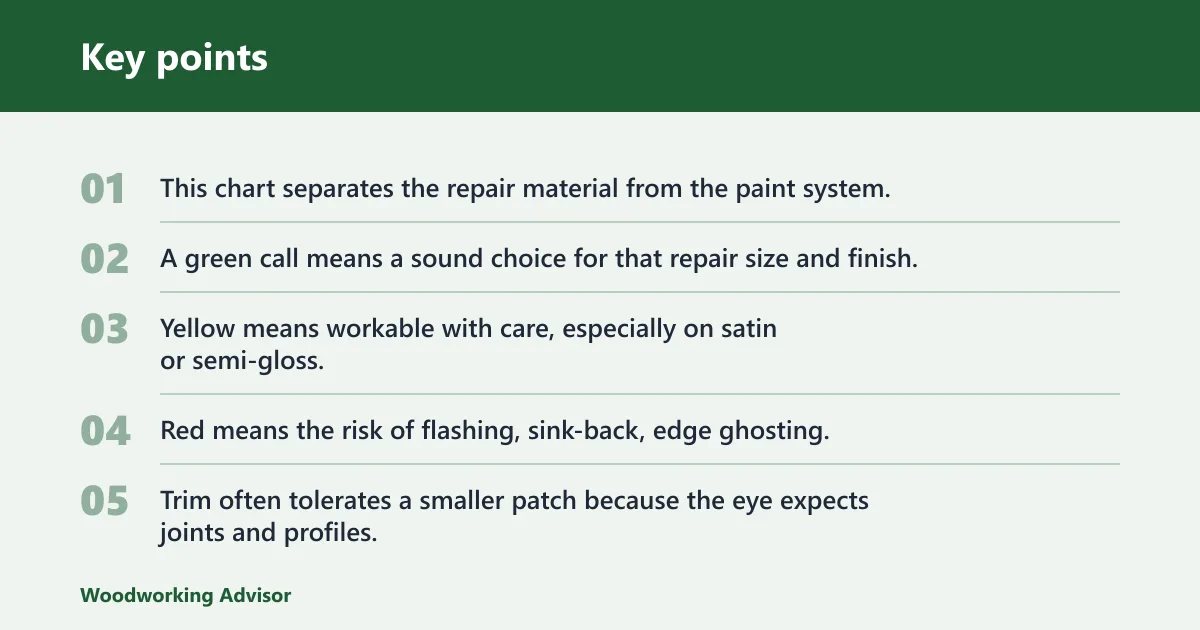
Chart columns and decision codes
This chart separates the repair material from the paint system, because the same filler can behave differently under latex, oil, alkyd, or spray enamel. A green call means a sound choice for that repair size and finish. Yellow means workable with care, especially on satin or semi-gloss. Red means the risk of flashing, sink-back, edge ghosting, or sheen mismatch is generally too high for the use case.
| Filler brand or type | Recommended primer | Compatible paint chemistry | Best use case | Dry time concerns | Shrink or flash risk | Trim | Cabinets | Furniture |
|---|---|---|---|---|---|---|---|---|
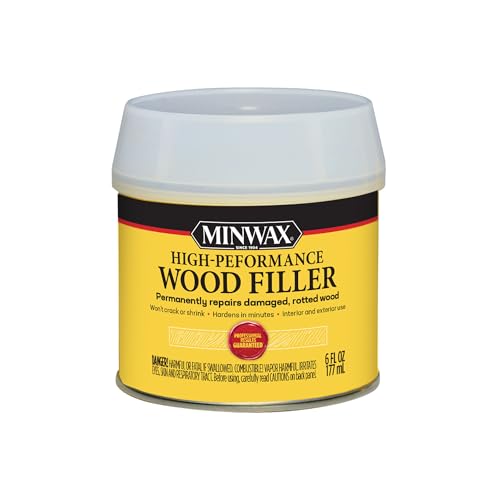
| Minwax wood filler, paintable water-based type | Bonding primer | Latex/acrylic, alkyd, some spray enamel | Nail holes, pinholes, shallow trim defects | Needs full dry time before sanding; deeper spots may stay soft longer | Moderate shrink risk in larger fills | Green | Yellow | Green |
| DAP Plastic Wood, solvent-based paintable filler | Bonding primer or shellac primer on problem areas | Latex/acrylic, oil-based, alkyd | Trim touch-ups, edge chips, small gouges | Solvent odor and cure time matter before priming | Low-to-moderate shrink risk if applied thin | Green | Yellow | Green |
| Elmer’s Carpenter’s Wood Filler, water-based | Bonding primer | Latex/acrylic, alkyd | Interior trim, nail holes, small dents in paint grade work | Can need a second pass if the repair sinks after drying | Moderate flash risk under satin and semi-gloss | Green | Yellow | Green |
| Bondo wood filler or two-part filler | Bonding primer or shellac primer | Latex/acrylic, oil-based, alkyd, spray enamel | Deep voids, edge rebuilds, damaged cabinet corners | Mix ratio and pot life matter; sand soon after cure window | Low shrink risk, but poor finishing can still telegraph | Yellow | Green | Green |
| Famowood latex filler, paint-grade type | Bonding primer | Latex/acrylic, alkyd | Cabinet doors, furniture repairs, broad paint-grade patches | Needs full cure before sanding flush on larger areas | Low-to-moderate sink risk if overfilled | Green | Green | Green |
Trim, cabinet, and furniture ratings
Trim often tolerates a smaller patch because the eye expects joints and profiles. Cabinet doors and furniture are less forgiving, especially under satin or semi-gloss, where a patch can show as a dull spot or a ridge. That is why the same filler can be green on trim and only yellow on cabinets.
What counts as paintable filler?
Paintable filler is made for a primer-plus-topcoat paint system, while stainable filler is meant to mimic wood color under a stain schedule. Wood putty usually stays flexible and is often used after finishing, not before paint. Spackle is a wall repair product, not a wood default, because it can crumble, shrink, or leave a weak edge on trim.
Wood filler vs wood putty vs spackle
Paintable wood filler sands hard enough for a flush repair and accepts primer well when fully cured. Wood putty is usually a final-step product for minor surface defects, and many versions resist paint adhesion. Spackle can work on tiny interior blemishes, but it is not the right pick for cabinet doors, edge chips, or repair zones that need wood-like sandability.
Water-based vs solvent-based filler
Water-based fillers wipe up with plain water, and they are common for nail holes, small dents, and interior trim. Solvent-based fillers and two-part fillers usually handle larger repairs better and often shrink less. If the repair is more than a pinhole, the filler’s cure behavior matters as much as its brand name.
When stainable products are the wrong choice
Stainable filler is the wrong match when the plan is a uniform painted finish. The color blend that helps under stain can still flash under paint, especially in satin or semi-gloss. If the surface will be primed and painted, choose a paintable filler instead of forcing a stainable one into a paint system.
Which filler works with each paint type?
Latex and acrylic paints are often the easiest match for many paintable fillers, especially on small repairs that get a bonding primer first. Oil-based and alkyd paints tolerate more filler types, but they still show sink-back and sheen mismatch if the patch is not fully cured. Spray enamel can be unforgiving because it lays down a thin, smooth film that reveals any edge ghosting.
Latex and acrylic paint
Most paintable, sandable fillers are compatible with latex and acrylic topcoats when you prime the patch first. The main failure mode is flashing, which happens when the filler absorbs or reflects paint differently than the surrounding wood. Satin and semi-gloss make this more visible than flat paint.
Oil-based and alkyd paint
Oil and alkyd paints can work over water-based or solvent-based fillers, but the surface must be cured and sealed well. A shellac or bonding primer helps block uneven absorption, especially on porous pine or MDF. If the filler is still soft inside, the topcoat can crack or sink as the repair continues to dry.
Spray enamel and sheen matching
Spray enamel often exposes patch edges because the film is thin and the sheen is consistent. That makes edge feathering and sanding quality matter more than the brand label. For glossy or semi-gloss trim, the repair should be nearly invisible before paint goes on, not after.
How primer changes the result
Primer is the control point between the filler and the topcoat. It evens out porosity, reduces flashing, and gives paint a more uniform base. On patched wood, skipping primer is the fastest way to create a dull or shiny square where the repair sits.
Bonding primer for sanded patches
Bonding primer is the default choice for most paint-grade filler repairs because it grips sanded filler and surrounding wood. It is the best all-purpose answer for nail holes, small gouges, and patched trim. Use it when the surface is clean, dry, and already sanded flush.
Shellac primer for problem areas
Shellac primer helps when the repair area includes stains, resin bleed, or tricky substrate changes. It dries fast and locks down problem spots that might otherwise telegraph through paint. A shellac primer is especially useful on knotty pine, resinous trim, and older surfaces with unknown finish layers.
Stain-blocking primer over resinous wood
Stain-blocking primer is the safer pick when wood movement or bleed is part of the risk. MDF edges, pine knots, and old trim can all cause uneven absorption that shows up after topcoating. The primer does not fix a bad fill, but it can stop the topcoat from making the problem worse.
Does the repair size change the choice?
Yes. Pinholes and nail holes are mostly about adhesion and flashing. Gouges and edge chips add shape, so sandability and shrink resistance matter more. Deep voids often need a second application or a two-part filler because a single coat can sink below the surface after drying.
Pinholes and nail holes
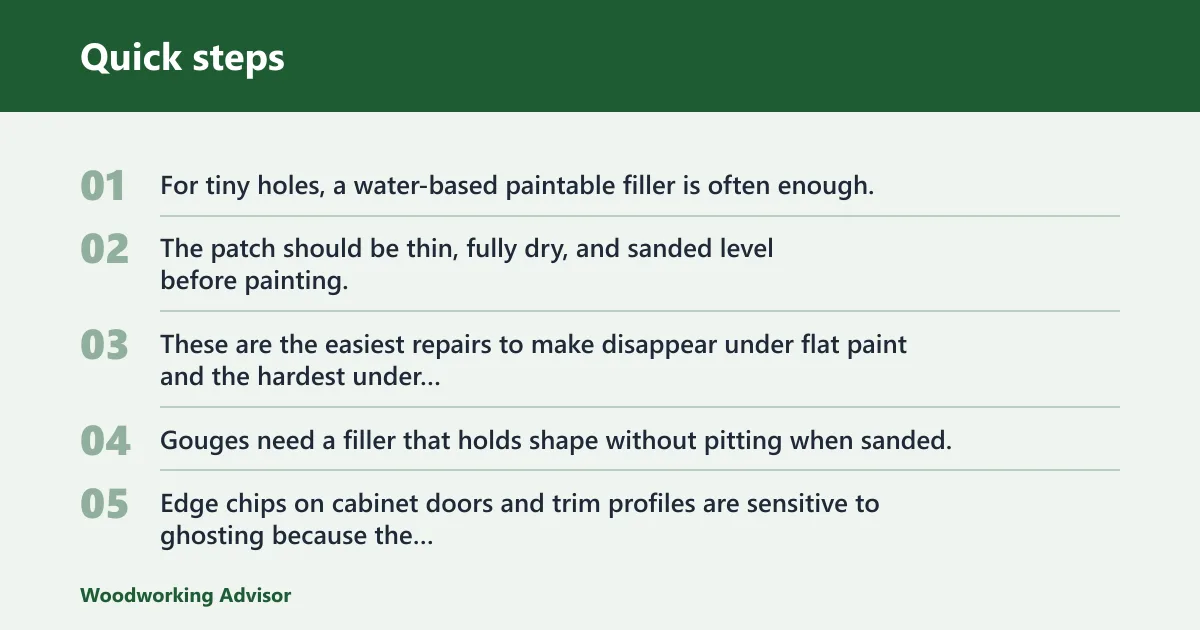
For tiny holes, a water-based paintable filler is often enough, especially under a bonding primer. The patch should be thin, fully dry, and sanded level before painting. These are the easiest repairs to make disappear under flat paint and the hardest under satin if the primer is skipped.
Gouges and edge chips
Gouges need a filler that holds shape without pitting when sanded. Edge chips on cabinet doors and trim profiles are sensitive to ghosting because the surrounding profile throws light across the patch. A harder filler or two-part system is usually safer than a soft, lightweight paste.
Deep voids and second coats
Deep voids are where sink-back shows up most often. A single coat may look level, then sink as water or solvent leaves the patch. A second fill is often needed, and for large missing sections, a standard one-part filler may be the wrong tool.
Say your oak baseboard has three nail holes and one shallow dent near a corner. A paintable water-based filler can work if you sand it flush, prime the patch, and topcoat with a flat or low-sheen paint. The same filler on about a 1/4-inch-deep chip would be more likely to sink and show a rim.
Brand-by-brand filler
This matrix focuses on the brands most readers compare first. The right pick depends less on the name on the package and more on whether the filler is water-based, solvent-based, or two-part, plus how large the repair is and what finish will cover it.
Minwax, DAP, and Elmer’s
Minwax paintable filler is a solid small-repair choice when you want straightforward sanding and a clean primer base. DAP Plastic Wood is often a stronger match for trim touch-ups and slightly larger defects because it is built for paint-grade work and handles oil or alkyd topcoats well. Elmer’s paintable filler is best treated as a small-hole and small-dent product, especially where the final coat is flat or eggshell.
Bondo and Famowood
Bondo-type filler and other two-part repairs are the better answer when the patch must stay stable in a deeper void or a damaged edge. Famowood paint-grade filler is often a better bridge between small repairs and larger cabinet work because it sands predictably and can take a primed paint system well. These products are less about stain matching and more about shape retention under paint.
Best picks by substrate and finish
MDF favors a filler that will not crumble at the edge and a primer that seals absorbent spots. Pine often needs stain-blocking or shellac primer because knots and resin can bleed. Oak’s open grain can telegraph under semi-gloss unless you fill, sand, and prime carefully. On prefinished trim and cabinet doors, the failure mode is usually adhesion plus sheen mismatch, not just the fill itself.
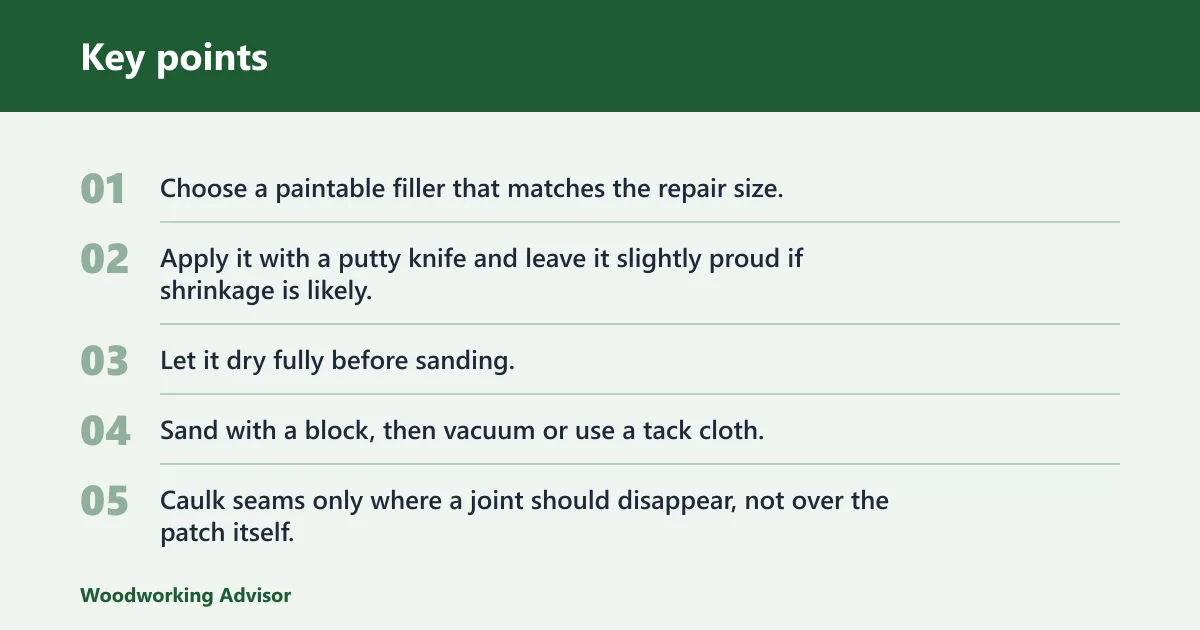
- Choose a paintable filler that matches the repair size.
- Apply it with a putty knife and leave it slightly proud if shrinkage is likely.
- Let it dry fully before sanding.
- Sand with a block, then vacuum or use a tack cloth.
- Caulk seams only where a joint should disappear, not over the patch itself.
- Prime the repair, then paint with a brush or roller matched to the sheen.
A common first-timer mistake is filling a cabinet door chip, sanding it smooth, and painting right over it with semi-gloss. The patch may look fine at first, then show a dull halo after the topcoat dries because the filler soaked paint differently than the surrounding panel.
Choose Wood filler if…
Choose Wood Filler if your main task is making the repair itself, especially for small holes, shallow gouges, or trim touch-ups where you already know the topcoat system. It is the right pick when you need a material that sands cleanly and can be primed before paint, not a decision guide for different brands and finishes.

Choose paint Compatibility Chart by Brand if…
Choose Paint Compatibility Chart By Brand if you need to match filler type, primer, substrate, repair size, and paint chemistry in one place. That is the better pick for cabinet work, satin or semi-gloss finishes, and any repair where flashing, sink-back, ghosting, or sheen mismatch would be costly.
Frequently asked questions
What wood filler can I paint over without it flashing or showing through?
Choose a paintable filler that sands flush and prime it before topcoating. Small repairs in water-based or solvent-based filler are the safest bets, especially under flat or eggshell paint. Satin and semi-gloss make flashing more visible, so primer and careful sanding matter more than brand alone.
Is all wood filler compatible with latex paint?
No. Many paintable fillers work under latex paint, but stainable putties and some flexible fillers are poor matches. Latex is most forgiving when the repair is fully dry, sanded smooth, and sealed with a bonding primer. Larger patches still need more care than tiny nail holes.
Can you paint over wood filler with oil-based paint?
Yes, if the filler is paintable and fully cured. Oil-based and alkyd paints can cover many filler types, but they can still reveal sink-back or uneven absorption if the patch is not primed. Shellac or bonding primer helps on resinous wood and mixed substrates.
Does filler brand matter for cabinet painting?
Yes, because cabinet doors are unforgiving. A filler that is fine on trim can still flash or telegraph under cabinet sheen levels, especially satin or semi-gloss. Two-part or harder paint-grade fillers are often safer for chips, corners, and larger repairs on cabinets.
How long should wood filler dry before priming and painting?
Follow the product label, then give deeper repairs extra time. Surface dryness is not enough if the patch is thick. If the filler is still soft under the skin, it can sand poorly, sink later, or cause the primer and topcoat to fail around the edge.
Why does wood filler sink or shrink after paint?
Most sink-back comes from a thick repair drying unevenly. As water or solvent leaves the patch, the surface can settle below the surrounding wood. That is why deep voids often need a second fill, and why a proud initial fill is safer than trying to get perfect level in one pass.
Sponsored / affiliate links. As an Amazon Associate I earn from qualifying purchases. I may earn additional commission from eligible campaigns.