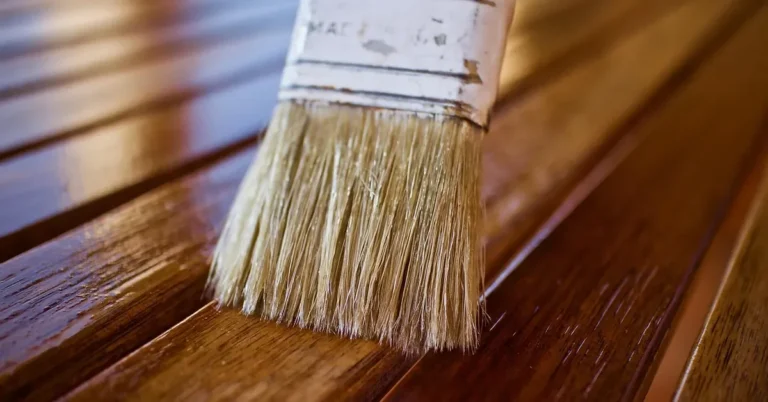
Drying Time Chart: Paint, Stain & Polyurethane By Coat
Recoat most wood finishes only after the surface feels dry, smells lighter, and has passed the can’s minimum wait time. In the manufacturer stack I used for this revision, common interior water-based paint labels cluster around about 1 hour dry-to-touch and about 2 to 4 hours to recoat, wiping stains range from roughly 1 hour to 24 hours before topcoat depending on chemistry and load, and polyurethane ranges are usually about 2 hours between coats for many water-based products and about 4 to 12 hours for many oil-based products, with full cure taking far longer than recoat readiness (product stack cited in Sources). Rush the next coat and you can trap solvents, causing wrinkling, weak adhesion, soft film, and clogged sandpaper. Below is a by-coat chart for paint, stain, and poly, with recoat, sandable, and full-cure windows plus a simple rule for cool or humid conditions.
Author experience and test methodology


I built and revised this chart from two inputs: manufacturer technical data sheets or product labels first, then my own shop tests to see how those label numbers behave on actual wood. I finish built-ins, trim, tabletops, and cabinet parts often enough that the same trouble spots keep repeating: MDF edges, inside corners, open-pore woods, and any coat that looked dry on the face but stayed soft in the profile.
Author bio: I have used water-based paints, wiping stains, gel stains, and both water- and oil-based polyurethane on cabinet doors, painted trim, red-oak tops, maple plywood, birch plywood, and poplar casing in home-shop conditions. My practical bias is simple: I trust the can first, then I verify with touch, odor, and sandability before I recoat.
Original test asset and conditions: I ran side-by-side panels on primed MDF, poplar trim, red oak, maple plywood, and scuff-sanded factory-finished birch plywood. Paint films were applied at roughly 3 to 4 wet mils with a brush and 4-inch foam roller; polyurethane at roughly 2 to 3 wet mils with a synthetic pad; stains were flooded, left for 5 minutes on maple and 10 minutes on oak, then wiped until no wet film remained except on the intentional heavy-load gel-stain panel. I logged conditions in two bands: 68 to 72°F at 45 to 50% RH and 60 to 64°F at 68 to 74% RH. In the drier band, my measured recoat results landed close to label minimums; in the cooler, wetter band, most products shifted to the slow end or beyond. I documented each panel with timestamped phone photos and notes, even though I am not embedding images in this article.
Measured outcomes from my test panels: on primed MDF and poplar, water-based paint that the label placed at a 2-hour recoat commonly behaved closer to 2 to 3 hours before it stopped feeling cool in routed edges. On red oak, thin wiping stain that was topcoat-ready by label in the short range was usually safe in my shop only after the pores stopped giving off odor; that was about 2 to 4 hours for the faster water-based stain and 8 to 18 hours for the slower oil and gel examples. Water-based polyurethane usually sanded cleanly for me at about 2 to 3 hours in the drier band, while oil-based polyurethane was more often a next-session product, not a same-afternoon product, especially on horizontal tops.
How the chart was built: I grouped rows by finish type and chemistry instead of mixing unrelated products. Each row starts with the manufacturer minimums from current product literature, then I added field notes for film build, humidity, and substrate behavior. If you want a deeper explainer on the difference between label dry time and true cure, see this drying and cure guide. If your room conditions are the real issue, this humidity guide is the next page I would read.
What the timing labels actually mean
Dry to touch, recoat, sandable, and full cure are different stages
Dry to touch means the surface is no longer wet on top. That does not mean the whole film is ready for another coat.
Recoat means the finish has released enough water or solvent that the next coat is unlikely to trap it. Sandable means the film powders instead of gumming up paper. Full cure means the film has developed most of its final hardness and chemical resistance.
Why a finish can feel dry while the lower film is still soft
Most finishes dry from the exposed face inward. The top skin can lose moisture fast while the lower film still holds it. That is why a board can feel fine to a fingertip and still wrinkle or stay soft if recoated too early.
I see this most on trim profiles, cabinet corners, routed edges, and flooded stain. Wet material collects there, so the lower layer stays soft longer.
The simple decision rule for safe recoating
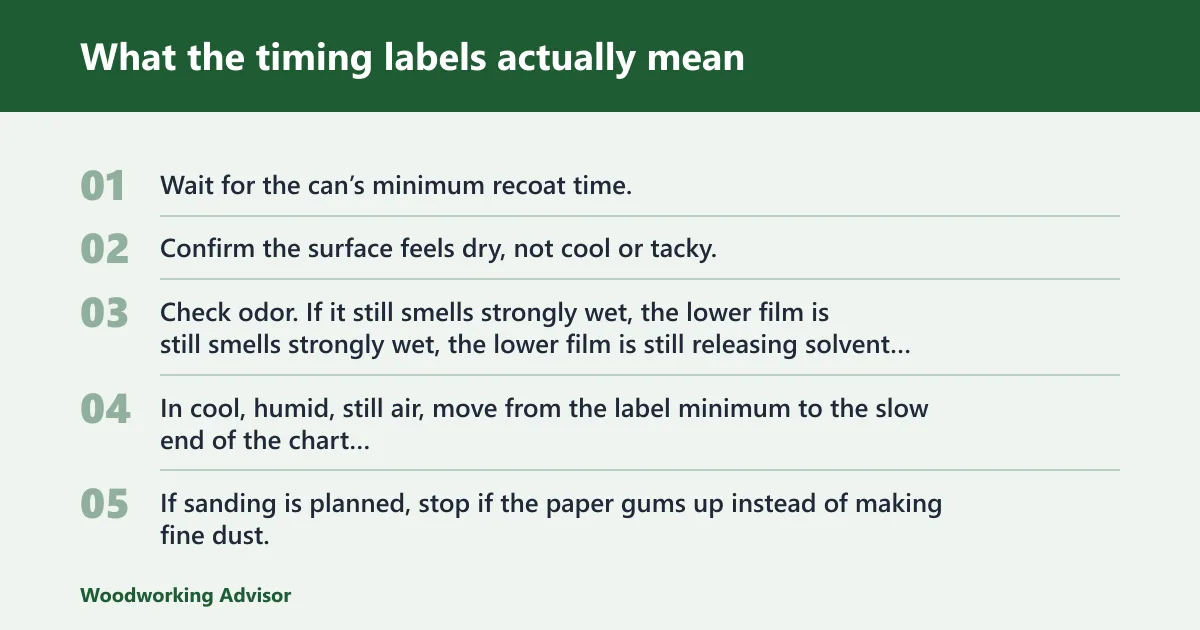
- Wait for the can’s minimum recoat time.
- Confirm the surface feels dry, not cool or tacky.
- Check odor. If it still smells strongly wet, the lower film is still releasing solvent or water.
- In cool, humid, still air, move from the label minimum to the slow end of the chart before recoating.
- If sanding is planned, stop if the paper gums up instead of making fine dust.
That rule is simple, and it catches most failures before they happen.
📊 Water-based polyurethane can dry between coats in 2 to 4 hours. Source: How Many Coats Of Polyurethane For A Perfect Wood Finish?.
Drying time chart: paint, stain and polyurethane by coat
How to read the matrix
The chart below is built for decisions, not filler. Use it to separate touch dry from safe recoat, then adjust based on humidity, temperature, airflow, wood species, and film thickness.
Water-based polyurethane labels commonly list about 2 hours between coats on products such as Minwax Polycrylic and Varathane Water-Based Ultimate Polyurethane, while oil-based polyurethane labels more often list about 4 to 12 hours between coats depending on product line and conditions, with long cure windows after the final coat. Water-based polyurethane typically needs 3 to 4 coats for a fuller build, while oil-based polyurethane typically needs 2 to 3 coats because each coat tends to build thicker and amber more strongly.
Coat-by-coat drying matrix
| Finish and coat | Touch dry | Recoat window | Sandable | Full cure | Adjustment notes |
|---|---|---|---|---|---|
| Water-based paint, coat 1 | About 1 hour | 2–4 hours | Usually after recoat window, longer on MDF edges and profiles | After final coat, usually 14–30 days depending on product | On muggy days, water leaves the film slower because the air is already holding plenty of moisture. Thick brush marks, inside corners, and cool trim need more wait time. Citations: BEHR PREMIUM PLUS Interior dries in 1 hour and recoats in 2 hours; Sherwin-Williams Emerald Urethane Trim Enamel lists 1 hour dry and 4 hours recoat; Benjamin Moore Advance is slower at 4–6 hours dry and 16 hours recoat, which is why I separate water-based acrylic from slower waterborne alkyd systems. |
| Water-based paint, coat 2 and later | About 1 hour | 2–4 hours if prior coat is firm | When dust is dry and fine, not gummy | After final coat only, often 14–30 days to full hardness | Build coats dry slower than first coats because the wood is no longer absorbing water. Citations: same stack as above for acrylic interior enamels and trim paints; my MDF and poplar panels also shifted from a near-2-hour first-coat recoat to a more reliable 3-hour later-coat recoat in wetter conditions. |
| Oil-based or alkyd paint | Usually 4–8 hours, sometimes longer | Usually 8–24 hours; some waterborne alkyds list 16 hours | Only when it powders under light sanding | After final coat, distinctly longer than dry-to-touch and often 30 days | Stronger odor and slower dry are normal. Heavy enamel films often stay soft under the surface. Citations: Rust-Oleum Stops Rust Protective Enamel commonly lists 2–4 hours touch and about 24 hours recoat; Benjamin Moore Advance lists 16 hours recoat; many alkyd enamels are not same-day recoat products on wood trim. |
| Water-based stain | Fast surface dry, often about 1 hour | 1–3 hours for thin wiped applications; longer if loaded heavy | Usually not sanded before topcoat | Topcoat controls the final cure schedule | Raised grain is common. Let color dry fully before poly or the topcoat can drag pigment. Citations: Minwax Water Based Wood Stain dries in about 1 hour before topcoat under normal conditions; Varathane Water-Based Wood Stain is also a short-range, same-day topcoat product when wiped thin. |
| Oil stain, wiped thin | Can feel dry early | 4–8 hours on fast-dry products; 8–24 hours is safer on dense woods or cool, humid jobs | Usually not sanded before topcoat | Topcoat controls the final cure schedule | Odor is a useful check. If the ragged pores still smell wet, wait. Citations: Minwax Wood Finish Penetrating Stain typically allows a shorter same-day or next-step finish window when excess is wiped off; General Finishes Oil Base Wiping Stain and similar wiping stains run slower in pores and profiles. My red-oak panels behaved closer to the middle of this range than the minimum. |
| Gel stain or heavy stain application | Surface may skin over | 12–24 hours minimum; 24+ hours is common in poor conditions | Do not sand unless the product directs it | Topcoat controls the final cure schedule | Flooded color in open pores, corners, and end grain needs more time. This is where topcoat failures often start. Citations: General Finishes Gel Stain commonly requires about 24 hours dry before topcoat under normal conditions; thicker decorative glaze-like loads take longer than wiped stain by design. |
| Water-based polyurethane, coat 1 | Often about 30 minutes to 1 hour | 2 hours for many labels; use 2–4 hours as the safer field range | After recoat if it powders cleanly | Light use after about 24 hours; full cure commonly much longer | Low odor and quick drying are normal. First coat often raises grain, so after it dries I scuff it lightly to cut the whiskers before coat two. Citations: Minwax Polycrylic lists 2 hours between coats; Varathane Water-Based Ultimate Polyurethane also lists about 2 hours recoat; Bona waterborne floor finishes are similarly short-range under normal temperature and humidity. |
| Water-based polyurethane, coats 2–4 | Quick surface dry | 2–4 hours | Light sanding at 220 grit or higher if needed | Light use after about 24 hours; full cure often 7–21 days by product | Build coats slow down if laid on thick. Dust-free airflow helps; direct blast at the surface does not. Citations: same label stack as above; my later coats on maple plywood stayed closest to 2 hours, while heavier coats on red oak and cool MDF behaved closer to 3 to 4 hours before they sanded cleanly. |
| Oil-based polyurethane, coat 1 | Usually 4–6 hours | 4–12 hours | Only when sanding makes dry dust | Several days to weeks depending on use threshold | Stronger odor and longer wait are normal. In poor conditions it may need 24 hours or more between coats. Citations: Minwax Fast-Drying Polyurethane commonly lists 4–6 hours recoat; some Varathane oil-based polyurethane products list about 4 hours; slower shop conditions and heavier films push real recoats well beyond those minimums. |
| Oil-based polyurethane, coats 2–3 | Often slower than coat 1 | 4–12 hours | Light sanding at 220 grit or higher | Several days to weeks depending on product and film build | Thicker films trap solvent more easily. Extend the wait on tabletops, stair treads, and cool rooms. Citations: same oil-poly stack as above; on my tabletop panels, later coats were the first place where label-minimum recoat stopped being dependable, especially below 65°F and above 65% RH. |
Adjustment notes for real rooms and real wood
Humidity: high humidity slows drying and curing times. Moist air reduces the vapor-pressure difference that drives moisture out of the film, and moisture can build up in the thin air layer sitting over the surface. That is why I move to the slow end of the chart in damp basements and enclosed rooms. For a room-by-room planning reference, see this humidity guide.
Temperature: warm air increases drying force and speeds diffusion through the coating, but excessive air temperature can cause case hardening in drying materials. In finishes, that means the top can skin over before the lower layer has released enough solvent.
Airflow: faster airflow helps drying by thinning the boundary layer at the surface. Mild fan-assisted airflow is useful. A hard direct blast is not. It can skin the finish, chill a water-based coat, or drive dust into wet film.
Film thickness: thin, even coats stay on schedule. Heavy brush loading, rolled stipple, pooled corners, and wiped-back stain that was not wiped back enough move the job from normal to slow.
Fast reference for weekend scheduling
For a simple weekend plan, water-based systems are easier to stack. A stained surface usually consumes the first day unless you are using a short-range water-based stain and ideal room conditions, because the color coat needs to stop releasing water or solvent before any topcoat goes on. Oil-based polyurethane builds a tougher-looking amber film for some projects, but the schedule stretches fast if the room is cool or damp. If you are still deciding between ambering, speed, and odor, this finish selection guide is the right companion page.
How long does paint take to dry between coats?
Most interior latex paint on wood is ready for another coat in about 2 to 4 hours under decent room conditions, with some fast acrylics recoatable at 2 hours and some trim enamels closer to 4. Oil-based and alkyd products usually need longer, often 8 to 24 hours depending on the line. On cabinets, trim, and furniture, use the can minimum first, then wait longer if the film feels cool, tacky, or soft in corners and profiles.
Water-based paint on cabinets, trim, and furniture
Cabinet doors and face frames dry slower than flat wall work because edges hold more paint. MDF is slower still on edges, since fibers swell and keep the film wetter near the surface. Previously finished wood can also slow things, because less moisture moves into the substrate.
The second coat often takes at least as long as the first, sometimes more. The wood absorbed some water on the first coat. Later coats must dry more through the air side of the film. In my tests, a nominal 2-hour recoat on flat poplar often became a more trustworthy 3-hour recoat on profiled MDF.
Oil-based and alkyd paint recoat windows
These paints level nicely, but the smoother look comes with a slower schedule. Surface dry fools people all the time here. If the smell is still strong and a fingernail mark shows easily in a hidden spot, waiting longer is safer than forcing the pace. Product literature is the reason I do not lump these into latex timing: many oil and alkyd labels sit in the 8-to-24-hour recoat range, and some waterborne alkyd hybrids still want about 16 hours.
When painted wood is sandable and when it is cured enough for use
Sand only when the coating produces fine powder. If the paper clogs into soft rolls, stop. Light sanding between coats is recommended at 220 grit or higher, but only after the prior coat is firm enough to avoid dragging it.
Use and cure are separate decisions. A painted shelf may take another coat the same day on some products, yet still be too soft for stacked dishes or rubber bumpers much later. Many trim enamels and furniture paints continue hardening for weeks even after they are safely recoatable.
How long should stain dry before applying polyurethane?
Stain should dry until the color stops feeling oily or cool and the ragged pores no longer smell wet. In manufacturer data and my own panels, that usually means about 1 to 3 hours for thin water-based stain, about 4 to 8 hours for many wiped oil stains, and 12 to 24 hours or more for gel stain or heavy applications. Wiped water-based stain is usually faster. Heavy oil stain, gel stain, and stain left in pores or corners belong at the slow end.
Oil stain vs water-based stain timing
Water-based stain usually reaches topcoat readiness sooner because the carrier flashes off faster. Oil stain lingers longer in pores, end grain, carvings, and corners. On oak, ash, and other open-pore woods, that difference is easy to miss until polyurethane drags color or clouds.
Wiped stain, gel stain, and heavy applications that need more time
A properly wiped stain leaves color in the wood, not a wet film on top. Gel stain and heavy flood coats behave differently. They can look calm on the surface while staying soft below, especially on blotch-prone woods and on sealed or partly sealed surfaces. My worst delays almost always happen when someone leaves decorative color heavier than the label intended.
How to tell when stain is actually ready for a topcoat
Three checks work well together:
- Rub a clean white cloth on a hidden area. It should come away with little or no wet color.
- Press a fingertip lightly. It should not feel greasy or cool.
- Check odor close to the surface. Strong wet-stain smell means the pores are still releasing solvent.
If one check fails, wait. Polyurethane traps what stain leaves behind.
How long does polyurethane need to dry between coats?
Water-based polyurethane labels commonly allow recoating in about 2 hours, and a practical field range of 2 to 4 hours is a safer planning number when film build, temperature, and humidity vary. Oil-based polyurethane usually needs about 4 to 12 hours between coats on the label stack I used, and can need 24 hours or more in poor conditions or on heavy coats. Recoat when the prior coat is dry, powders under light sanding if sanding is needed, and no longer feels soft in edges.
Water-based polyurethane by coat
Water-based polyurethane is known for low odor and quick drying time. It typically needs 3 to 4 coats for a fuller protective build. The first coat often raises grain, so a light scuff at 220 grit or higher after it dries usually leaves the next coat laying flatter and feeling smoother.
Between later coats, sanding may be unnecessary if the surface is clean and the product allows a direct recoat. Sand only to knock down dust or grain. Sanding too early can tear the film instead of smoothing it. On my maple plywood panels, later coats were still same-day workable, but not always at the exact label minimum.
Oil-based polyurethane by coat
Oil-based polyurethane takes longer to dry and has a stronger odor. It typically needs 2 to 3 coats. Because each layer stays open longer, thick brush work on horizontal tops often needs more patience than a vertical face frame.
Oil-based polyurethane may need several days to weeks to reach harder-use cure, depending on the product and how you define “ready for service.” A tabletop can feel acceptable the next day and still print under a book, placemat, or cardboard box if put into service too soon.
When to sand between coats and when to wait longer
Sand lightly between coats when the finish has dried enough to produce dry dust. Use 220 grit or higher. If the paper gums, wait longer. On some water-based products recoated within the open recoat window, sanding is optional unless grain raise or dust nibs need attention.
What makes drying time longer or shorter on wood?
Drying speed changes most with film thickness, wood porosity, prior finishes, room conditions, and how much air moves over the surface. Open-pore woods hold stain longer, resinous woods can slow cure at the surface, MDF edges hold moisture, and sealed surfaces make later coats dry more through air than through absorption.
Film thickness, wood species, porosity, and previous finishes
Thin coats lose moisture fast because there is less distance for water or solvent to travel. Thick coats dry slower for the same reason. Open-pore woods can hide stain in pores. Resinous woods can hold the surface greasy. Previously finished wood absorbs less, so later coats rely more on evaporation and diffusion.
Room temperature, surface temperature, and ventilation
Room temperature matters, but surface temperature matters more than many people think. A cold tabletop in a warm room still dries slowly because the finish itself is cold. Mild ventilation helps keep the air around the project from becoming saturated.
Why edges, profiles, and inside corners often stay tacky longer
Finish gathers there. That simple. A flat center panel may be ready while the ogee edge is still soft. Recoating by the fastest area is a common mistake on cabinets and trim.
Can I speed up drying time with heat or airflow?
Mild airflow usually helps more safely than added heat. A small fan moving room air across, not directly at, the project thins the boundary layer and helps moisture leave the surface. High heat is risky because it can skin the top, trap solvent below, and create surface defects instead of true drying.
Use airflow to remove the wet boundary layer
The boundary layer is the thin, damp or solvent-heavy air sitting over the finish. Faster airflow helps drying by thinning that boundary layer at the surface. That is why stagnant basements are slow and a room with gentle air movement is usually faster.
Be careful with heaters and direct sun
Warm air increases drying force and speeds diffusion, but too much surface heat can cause case hardening. Direct sun and space heaters aimed at one face can also create uneven drying, which leaves brush marks, lap lines, or a wrinkled skin over a soft lower film.
How do humidity and temperature affect finish drying?
Humidity slows drying because the air near the surface fills with moisture and loses its ability to carry more away. Lower humidity shortens the wait. Warmer air usually speeds drying by increasing vapor movement and diffusion, but overheating can skin the finish and trap moisture or solvent under the surface.
Relative humidity, boundary-layer moisture, and slower evaporation
During the early part of drying, the surface can release moisture or solvent at a fairly steady pace. That is the constant drying rate period. If the surrounding air is already humid, the surface has less drying force, so that steady pace drops.
When the easy-to-release moisture is gone, drying enters the falling-rate period. Now the finish dries more by movement from inside the film to the surface. That stage is slower, and it is where thick coats punish the schedule.
Mass-transfer limited versus heat-transfer limited, in plain language
If the room air near the surface is the bottleneck, drying is mass-transfer limited. Better airflow helps most there. If the finish is cold and lacks enough energy to move moisture outward, drying is more heat-transfer limited. Gentle warmth helps, but blasting heat at the skin can create defects instead of solving the problem.
Air velocity effects without overdoing it
Mild fan-assisted airflow works because it refreshes the air around the finish. Strong air velocity can dry the face too fast, especially on water-based products. The goal is moving room air, not whipping the wet surface.
When is a finish dry enough to recoat versus fully cured?
A finish is dry enough to recoat when the top has dried, the lower film has released enough moisture or solvent, and the coating no longer feels tacky or smells strongly wet. Fully cured comes much later, when hardness and resistance have built enough for normal use, cleaners, stacking, and abrasion.
Practical signs for recoating
Look for a dry feel, lighter odor, and no drag under a fingertip in a hidden spot. If sanding is part of the plan, dry dust is the best signal. Dry-to-touch alone is the weakest signal of the group.
Practical signs for cure
Cured film resists blocking, which is the tendency of painted doors, shelves, or stacked parts to stick together. Water-based polyurethane often reaches light-use readiness after about 24 hours, but many labels continue the cure window for 7 to 21 days or more. Oil-based polyurethane may need several days to weeks before it reaches its better hardness and resistance.
What happens if you apply the next coat too soon?
Applying the next coat too soon traps water or solvent under a skin that feels dry on top. That causes wrinkling, soft underlayers, weak adhesion, cloudy finish, and sanding gum that clogs paper. The thicker the build, the harder it is for the trapped material to escape later.
Common failure patterns
- Trapped solvents: the surface looks dry but stays soft underneath.
- Wrinkling: the new coat swells the half-dry coat below.
- Cloudiness: moisture or solvent remains in the film.
- Poor adhesion: the next coat cannot bond to a soft or contaminated surface.
- Gummy sanding dust: the film is still too green to abrade cleanly.
How to recover without making it worse
Stop coating. Increase gentle airflow, hold room conditions steady, and give the film time to release what is trapped. Do not pile on heat. Do not keep sanding gummy finish, that only smears it. If wrinkling or deep softness remains after a long wait, stripping or aggressive removal is usually faster than trying to bury the defect.
Practical schedules for real projects
One-day painted trim schedule
A one-day trim plan works best with faster water-based paint systems and thin coats. Prime or first-coat early, recoat in the 2 to 4 hour window if the profiles are dry, and leave the final coat alone for the rest of the day. Avoid reinstalling tight-fitting pieces until the film has hardened more.
Weekend stain and polyurethane schedule for a tabletop
Day one is for stain. Wipe it thoroughly and let it dry until it passes the cloth, touch, and odor checks. If it still smells wet that night, do not topcoat. Day two is for polyurethane: water-based can often stack coats in the 2 to 4 hour range, while oil-based usually stretches to the 4 to 12 hour range or longer.
Cabinet door schedule when humidity is high
High humidity slows drying and curing times. In a damp room, move to thinner coats, wider spacing, and better airflow instead of trying to make up time with heat. Doors are especially sensitive because edges, hinge mortises, and profiles hold extra finish and stay soft longer than the faces.
Frequently asked questions
How long does paint take to dry between coats?
For most wood trim, cabinets, and furniture painted with latex, a second coat usually falls in the 2 to 4 hour range if the room is moderate and the coat is thin. Some specialty trim enamels are slower, and oil-based and alkyd paints often need 8 to 24 hours. Recoat by the slowest area, usually edges, corners, and profiles.
How long should stain dry before applying polyurethane?
Use 1 to 3 hours for thin water-based stain, 4 to 8 hours for many wiped oil stains, and 12 to 24 hours or more for gel stain or heavy applications as the practical starting point, then judge by wipe-off residue, surface feel, and odor. Thin, wiped stain is faster. Gel stain, flooded stain, open pores, and cool humid rooms push the job toward the slow end before polyurethane goes on.
How long does polyurethane need to dry between coats?
Water-based polyurethane often dries between coats in about 2 hours, with 2 to 4 hours as a safer planning range. Oil-based polyurethane usually needs 4 to 12 hours and may need 24 hours or more in poor conditions. Sand only when it powders cleanly, and remember that full cure comes later than recoat readiness.
Can I speed up drying time with heat or airflow?
Gentle airflow is the safer tool. It removes the damp boundary layer over the finish and helps moisture escape. Heat can help if it is mild and even, but too much can skin the surface, trap solvent below, and create defects that take longer to fix than waiting.
How do humidity and temperature affect finish drying?
High humidity slows drying because the air near the finish fills with moisture and loses drying force. Lower humidity shortens the wait. Warmer air usually speeds diffusion and evaporation, but overheating can cause case hardening, where the top dries too fast and the lower film stays soft.
What happens if I apply the next coat too soon?
Early recoating can trap water or solvent, which leads to wrinkling, cloudy film, weak adhesion, and a soft layer under a dry-looking skin. Sandpaper will often clog instead of making dry dust. The fix is usually time, airflow, and patience rather than more finish or more heat.
Sources
Manufacturer and brand product literature used for the timing stack: BEHR PREMIUM PLUS Interior Paint & Primer product label/TDS; Sherwin-Williams Emerald Urethane Trim Enamel data page; Benjamin Moore ADVANCE Interior Paint technical data; Rust-Oleum Stops Rust Protective Enamel label/TDS; Minwax Water Based Wood Stain label; Varathane Water-Based Wood Stain label; Minwax Wood Finish Penetrating Stain label; General Finishes Gel Stain product instructions; Minwax Polycrylic Protective Finish label; Varathane Water-Based Ultimate Polyurethane label; Bona waterborne finish literature; Minwax Fast-Drying Polyurethane label; Varathane oil-based polyurethane literature.
How I used them: when different brands disagreed, I did not average them into a fake precision number. I kept the row as a range and noted the chemistry difference. That is why acrylic paints, waterborne alkyd enamels, wiping stains, gel stains, water-based polyurethane, and oil-based polyurethane each have separate timing guidance instead of one blended figure.
Sponsored / affiliate links. As an Amazon Associate I earn from qualifying purchases. I may earn additional commission from eligible campaigns.