Ardex vs Henry Feather Finish: Real Differences (2026)
Ardex and Henry Feather Finish are made by the same company, and their data sheets read almost alike, but they are not literally one product in two bags. Both are Portland cement patch-and-skim compounds that you trowel on and feather out to nothing, and both stop at 1/2 inch over large areas.
This guide is written for woodworkers and floor installers dealing with wood subfloors: which bag to buy, what the manufacturer data sheets actually say (including a few things older guides get wrong, like calling it self-leveling), and how to prep plywood or plank floors so the patch bonds. Numbers below come from the Ardex Feather Finish data sheet (updated Feb 2024), the Henry 549 FeatherFinish data sheet and Ardex’s Proper Prep brochure.
Ardex vs Henry Feather Finish: Which Should You Buy?
Short answer: buy whichever one you can actually find, then mix it exactly as its own data sheet says. The published performance is close enough that availability and bag size matter more than brand. The Ardex 10 lb bag is the better value for skim coating a whole room; the 7 lb Henry 549 is the one you will more often see in home center listings, because the Ardex data sheet states it is not sold by Ardex through home improvement centers.
Ardex vs Henry Feather Finish Side by Side
Here is every comparable number that the two manufacturer data sheets publish. Where a cell says “not stated,” the data sheet does not give a figure, so treat it as unknown rather than assuming the two match.
| Spec | Ardex Feather Finish | Henry 549 FeatherFinish |
|---|---|---|
| Bag size | 10 lb | 7 lb |
| Water per bag | 2.5 quarts | 1.75 quarts |
| Mix ratio (small batch) | 2 parts powder : 1 part water by volume | 2 parts powder : 1 part water by volume |
| Max thickness, large areas | 1/2 inch | 1/2 inch |
| Thicker than 1/2 inch | Small, well-defined areas on absorbent porous substrates only | Any thickness in small, well-defined areas (thresholds, birdbaths) |
| Coverage at 1/8 inch | 33.3 sq ft per bag | 24 sq ft per bag |
| Coverage at 1/4 inch | 16.7 sq ft per bag | not stated |
| Skim coat coverage | 100 to 300 sq ft per bag | 70 to 110 sq ft over concrete, up to 198 sq ft over plywood |
| Pot life | 15 to 20 minutes at 70 F | not stated |
| Ready for tile, vinyl, carpet | About 15 to 20 minutes once hard | 15 to 20 minutes once it can be worked on |
| Ready for wood or epoxy/urethane adhesive | 16 hours | 16 hours (parquet, athletic flooring, epoxy or urethane) |
| Primer | Not needed for most jobs; required for gypsum, very absorbent concrete, metal and epoxy coatings | Data sheet says no primers needed |
| Minimum temperature | 50 F substrate and air, during install and cure | 50 F surface temperature |
Do the per-pound math and the two land in the same place: Ardex covers about 3.3 sq ft per pound at 1/8 inch (33.3 sq ft from 10 lb) and Henry about 3.4 (24 sq ft from 7 lb). Both use 0.25 quart of water per pound of powder. That closeness is why people call them the same product, but a few rows above show they are documented differently, and the Henry sheet is an older document (revision dated 08/05), so check the bag for current instructions.
Are Ardex and Henry Feather Finish the Same Product?
Not exactly. What is confirmed is that both data sheets list the same address, 400 Ardex Park Drive in Aliquippa, Pennsylvania, so both sit under ARDEX Americas. What the sources do not say is that the powders are the same formula. The two documents differ on bag size, coverage, primer guidance and who is meant to buy them, and coverage per pound differs slightly (3.3 versus 3.4 sq ft at 1/8 inch).
Two claims that circulate online do not survive a check against the data sheets. One is that Ardex is “much stronger” for heavy loads while Henry is smoother for DIY: neither sheet publishes a strength figure, so that comparison has no source. The other is that Ardex is the pro product and Henry the DIY product. That one has a grain of truth, since Ardex says its Feather Finish is intended for trained professional contractors and is not sold through home improvement centers, but you can still order it online.
Feather Finish Is Not a Self-Leveling Compound
The most common mistake in older articles, including an earlier version of this one, is calling Feather Finish self-leveling. It is not. The Ardex data sheet tells you to apply it with the flat side of a steel trowel, and Henry says to apply it with a steel trowel and featheredge it into the subfloor. It goes where you spread it. It will not flow across a floor and settle flat.
- Use Feather Finish for: filling open joints, screw and nail dimples, gouges and small dips; smoothing ridges at seams; skim coating a surface that is basically flat already.
- Use a self-leveling underlayment for: a whole floor that is out of level and needs to flow flat. Read self-leveling compound for wood floors first, since that job has stricter subfloor requirements.
- Do not use either as a wear surface. Ardex says Feather Finish must be covered with a suitable floor covering.
Using Feather Finish on a Wood Subfloor
Both products list wood as an approved substrate: the Ardex sheet names untreated plywood subfloors and solid hardwood, and the Henry sheet names wood generally. Ardex’s Proper Prep brochure adds that Feather Finish can be used over any type of wood, as long as the finished-flooring manufacturer approves that subfloor and the surface just needs smoothing or flash patching. The patch is only as good as the surface under it, so the prep is the real work.
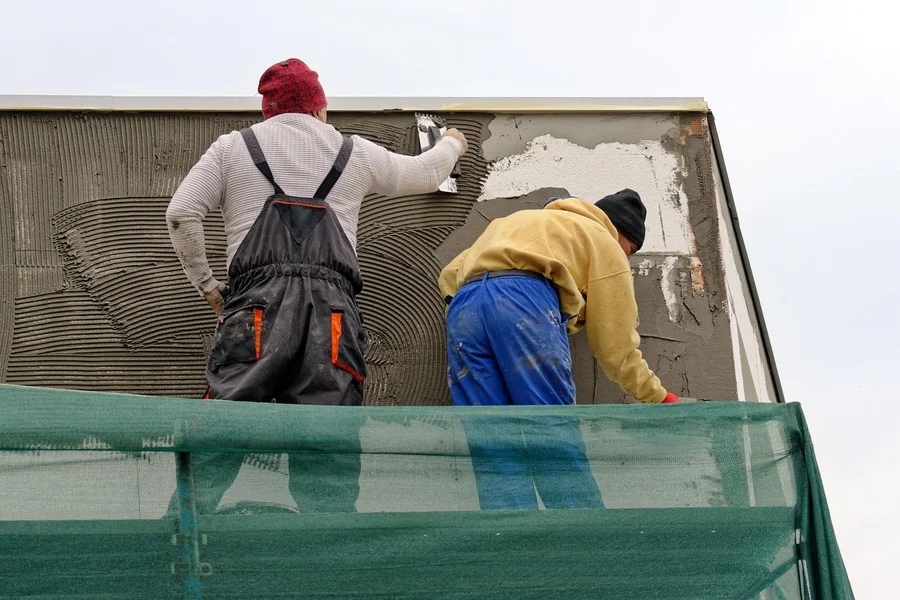
- Make the subfloor rigid first. Ardex requires the substrate to be rigid, well supported and anchored, free of undue flex and vibration. The Proper Prep brochure says to re-nail any boards or plywood panels that move. A skim coat over a springy panel will crack, and no patching compound fixes flex.
- Strip it to clean bare wood. Remove oil, grease, wax, dirt, varnish and shellac. The brochure says to sand down to bare wood if needed, vacuum all dust, and not to use solvents, strippers or cleaners on the wood.
- Fill joints and low spots. The brochure specifically recommends filling open joints in a wood subfloor with Feather Finish.
- Check the temperature. Both sheets set 50 F as the minimum surface temperature.
- Mix small batches. Add powder to water, mix 2 to 3 minutes to a lump-free cream, and do not overwater. The Ardex sheet warns that extra water weakens the compound.
- Press it in first, then feather. Apply with the flat of a steel trowel using enough pressure to fill defects and get a mechanical bond, then build the thickness you need.
- Wait the right time. Tile, vinyl and carpet can go down in as little as 15 to 20 minutes, but wood flooring, parquet and epoxy or urethane adhesives need 16 hours.
One more caveat from the Ardex sheet: Feather Finish is not a vapor barrier and lets moisture vapor pass freely. That matters over wood, because you must find and fix leaks or a damp crawlspace before you cover anything. For related subfloor work, see how to level a subfloor for wood flooring, hardwood floor leveling and sealing gaps in wood floors.
How Much Feather Finish Do You Need?
Coverage swings a lot with thickness, so estimate from the published figures rather than the bag front. These are calculated from the Ardex data sheet and assume a 100 sq ft room:
| Job (100 sq ft) | Ardex coverage | Bags needed |
|---|---|---|
| Skim coat only (thin) | 100 to 300 sq ft per bag | 1 bag (buy 1 spare for waste) |
| 1/8 inch over the whole floor | 33.3 sq ft per bag | 3 bags |
| 1/4 inch over the whole floor | 16.7 sq ft per bag | 6 bags |
Because the pot life is only 15 to 20 minutes, mixing a full bag for a spot repair wastes product. At the $41.99 listing price for the 10 lb bag on Amazon, 3 bags for a full 1/8 inch coat on 100 sq ft cost about $126, which is why leveling a whole floor with a skim compound gets expensive fast compared with fixing only the low spots.
Mistakes That Ruin a Feather Finish Job
- Overwatering. Both sheets warn that extra water weakens the patch and slows hardening.
- Patching over moving joints or cracks. Ardex states that moving joints and cracks must be honored up through the flooring; cracks will telegraph in any area that moves, and there is no known way to prevent it.
- Skipping the flooring maker’s rules. The Proper Prep brochure says not to use Feather Finish as a shortcut around installation steps such as sanding an underlayment board, unless the manufacturer allows a skim coat.
- Using it outdoors or in wet areas. Ardex lists dry, interior applications only.
- Old bags. The data sheet gives a 9 month shelf life for an unopened, properly stored bag.
Frequently Asked Questions About Ardex vs Henry Feather Finish
Is Henry Feather Finish the same as Ardex Feather Finish?
They come from the same company, ARDEX Americas, and their data sheets show almost identical numbers: the same 1/2 inch limit over large areas, the same water-to-powder ratio and roughly the same coverage per pound. They are still two separate products with separate data sheets, bag sizes (7 lb versus 10 lb) and sales channels. The Ardex data sheet says the product is not sold through home improvement centers, while the Henry 549 is the one you will see in home center listings.
Is Ardex Feather Finish self-leveling?
No. The data sheet tells you to apply it with the flat side of a steel trowel, which makes it a troweled skim coat and patch product. If you need a pour-and-spread floor leveler, you need a self-leveling underlayment instead.
Can you use Ardex Feather Finish over a plywood subfloor?
Yes. The data sheet lists untreated plywood subfloors and solid hardwood as suitable substrates, provided the wood is rigid, well fastened and free of undue flex, and is clean bare wood with no wax, finish or oil. Check that the finished flooring maker also approves a skim coat over that subfloor.
How thick can you apply Feather Finish?
Both data sheets give 1/2 inch as the limit over large areas in one application, from a true featheredge. Ardex allows unlimited thickness only in small, well-defined areas on absorbent porous substrates; Henry says any thickness in small, well-defined areas such as thresholds.
How long before you can install flooring over Feather Finish?
Standard coverings such as tile, vinyl and carpet can go down once the patch is hard enough to work on, typically 15 to 20 minutes at 70 F. Ardex calls for 16 hours before wood flooring or high-performance adhesives (epoxies or urethanes), and Henry gives the same 16 hours for parquet, athletic flooring and epoxy or urethane adhesives.
Conclusion
Ardex and Henry Feather Finish are close cousins with nearly matching published numbers, made under ARDEX Americas. Pick by bag size and availability: the 10 lb Ardex for skim coating a room, the 7 lb Henry 549 for a small patch you can grab at a home center. Then spend your effort where it counts, which is a rigid, clean, bare-wood subfloor and the flooring maker’s approval. If your real problem is a floor that is out of level rather than a few dips, read how to level old hardwood floors before you buy either bag.
Sources: ARDEX Feather Finish technical data sheet (updated 2024-02-22), HENRY 549 FeatherFinish technical data sheet (Rev. 08/05), and ARDEX Proper Prep substrate preparation brochure, all from ARDEX Americas.
Sponsored / affiliate links. As an Amazon Associate I earn from qualifying purchases. I may earn additional commission from eligible campaigns.