Best Primer for Bare Wood (2026): research shows
For bare wood, oil-based primer is the safer default when stain blocking and adhesion matter most; choose latex only when the wood is dry, clean, and you need faster drying and water cleanup. Using the wrong primer can leave tannin bleed, raised grain, peeling paint, and extra sanding. This guide compares oil vs latex by stain blocking, adhesion, dry time, cleanup, and the wood conditions that favor each.
Oil, latex, or shellac: the best primer depends on the wood

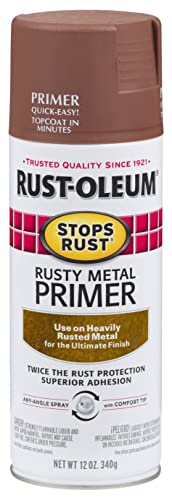
Bare wood is highly porous and absorbs paint at variable rates, so primer evens out that absorption and gives the topcoat a better surface to bond to. The right choice depends less on the label and more on the failure mode you are trying to avoid.
📊 Some oil-based primers dry within 3 hours. Source: Primers.
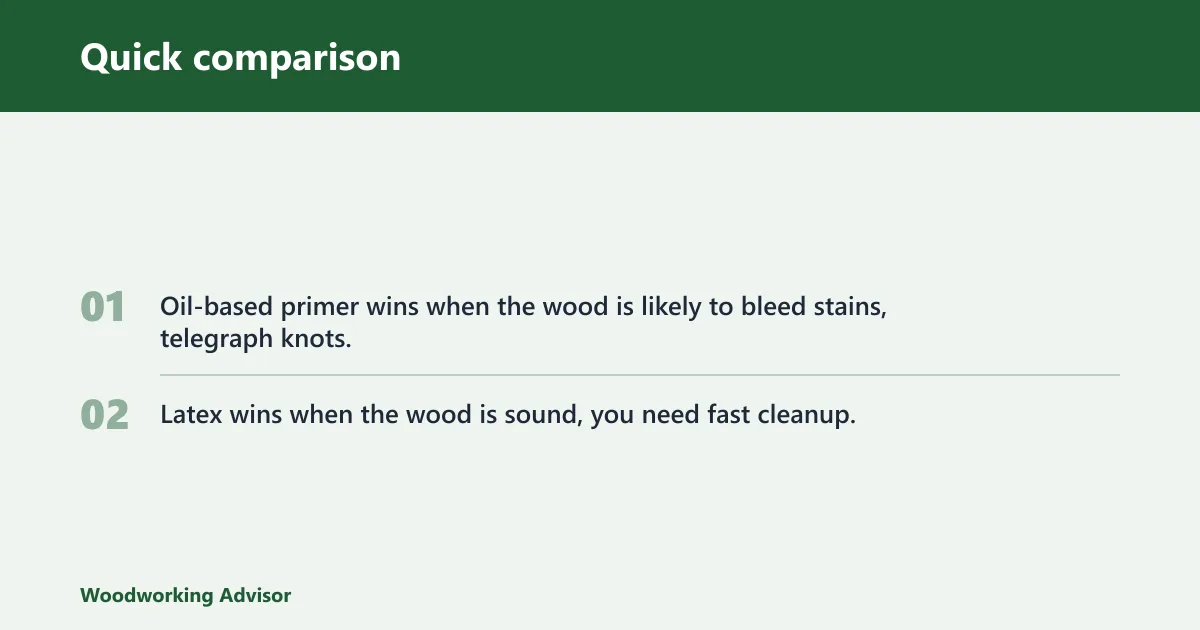
Quick comparison
| Factor | Best Primer For Bare Wood: Oil | Latex Compared | Winner |
|---|---|---|---|
| Stain blocking | Safer pick when you need stronger stain blocking; helps hide knots, stains, smoke stains, and other discoloration. | Less effective on tannins, knots, and heavily stained substrates; may not seal sap-heavy bare wood. | Best Primer For Bare Wood: Oil |
| Adhesion / penetration | Provides better penetration and is more forgiving over wood defects; good when the wood is not clean enough to trust a fast water-based primer. | Works well only when the wood is clean, dry, properly sanded, and sound; old wood needs correct sanding to bond well. | Best Primer For Bare Wood: Oil |
| Drying time | Slower than latex overall, though some oil-based primers dry within about 3 hours. | Usually dries faster than oil and is preferred when fast work matters. | Latex Compared |
| Cleanup | Requires mineral spirits or another solvent-based cleanup process; harder cleanup and more handling effort. | Cleans up with water and is easier to apply and clean up. | Latex Compared |
| Best-fit use | Best for cedar, redwood, knotty trim, moisture-prone areas, humidity swings, occasional dampness, repeated repaint cycles, and surfaces with knots, resin, or old stains. | Best for new pine trim, shelving, interior casing, and other sound, dry, properly sanded bare wood where the job is mainly sealing fresh material before paint. | Tie |
| Maintenance / durability | Better when durability matters more than fast cleanup; safer choice for exterior-style durability needs and moisture exposure. | Flexible and useful on stable wood that may move slightly with seasonal humidity, but less protective against stain-related failures. | Best Primer For Bare Wood: Oil |
| Surface prep sensitivity | More forgiving over wood defects and porous bare boards that soak up paint unevenly. | Needs correct sanding on old wood; old finishes, glaze residue, loose fibers, and contamination can block adhesion. | Best Primer For Bare Wood: Oil |
| Common failure modes | Trade-offs are higher VOCs, harder cleanup, and a longer wait before recoating than many latex primers. | Can let stain bleed through, raise the grain, and fail on old trim if not sanded correctly. | Best Primer For Bare Wood: Oil |
Oil-based primer wins when the wood is likely to bleed stains, telegraph knots, or see moisture. Latex wins when the wood is sound, you need fast cleanup, and the main job is to seal fresh bare wood before paint.
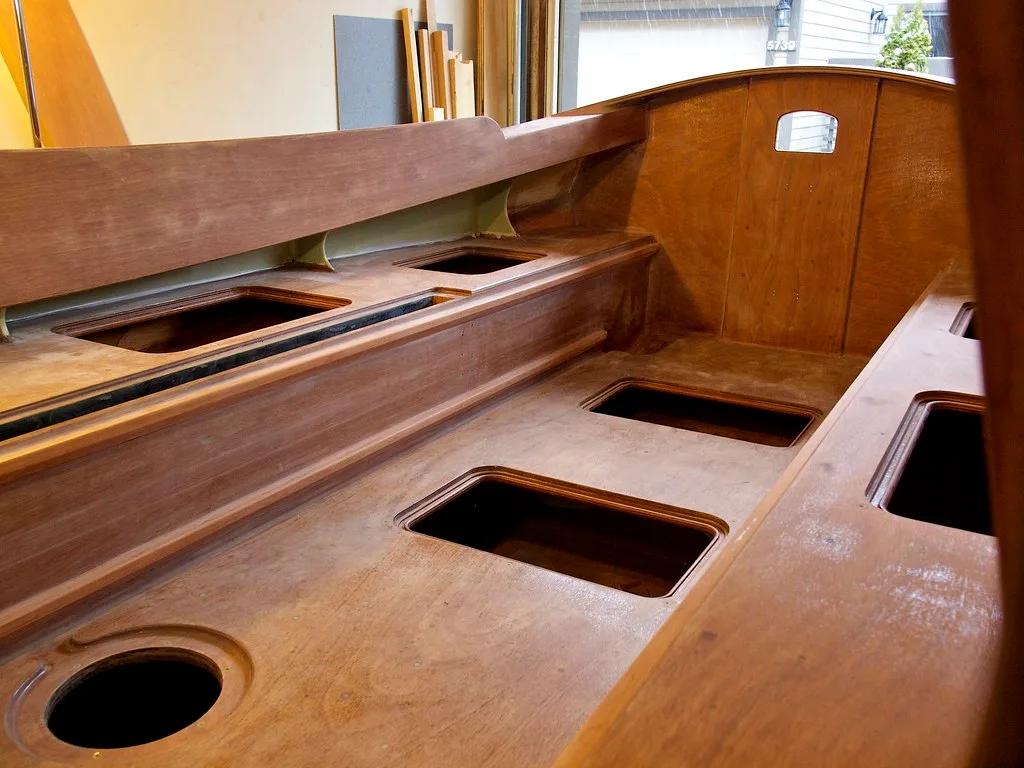
How we chose
This comparison focuses on the issues that actually decide primer performance on bare wood: stain blocking, adhesion, grain raise, drying time, cleanup, and how each primer behaves on different wood conditions. It also weighs failure cases such as cedar tannin bleed, knot bleed, and adhesion loss on old or previously finished wood.
The goal is a decision rule you can use on a real project, not a brand-first ranking. When the substrate is the problem, the substrate should drive the choice.
Oil-based primer: best for stain blocking and knot control
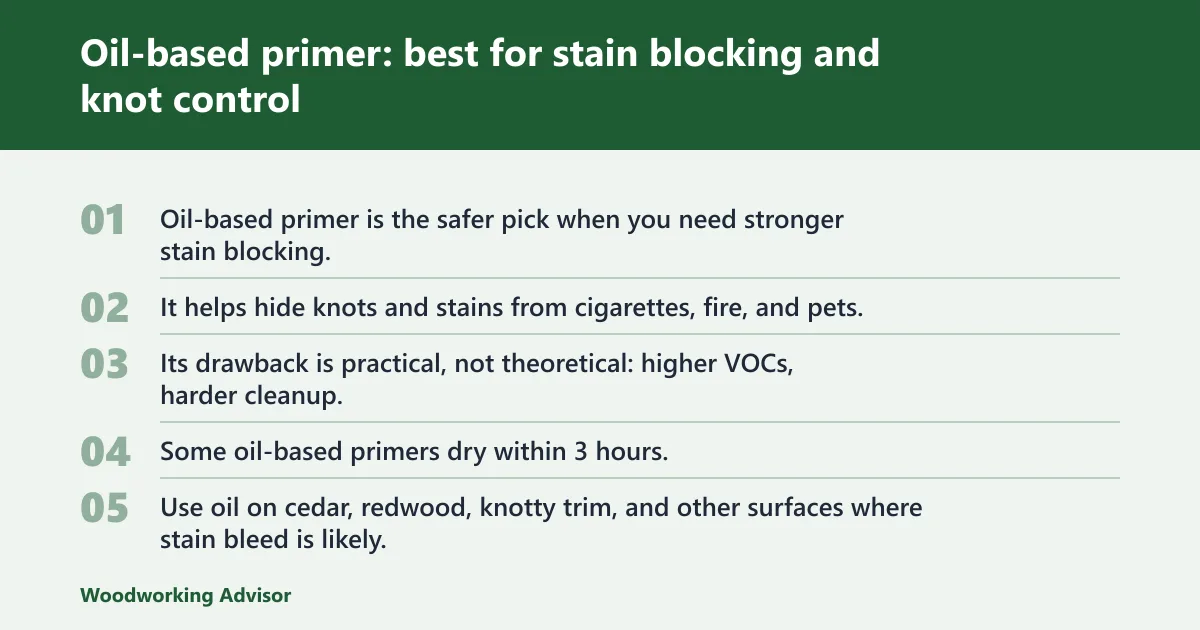
Oil-based primer is the safer pick when you need stronger stain blocking, better penetration, or more forgiveness over wood defects. It helps hide knots and stains from cigarettes, fire, and pets, and it works well in areas subjected to extreme moisture.
Its drawback is practical, not theoretical: higher VOCs, harder cleanup, and a longer wait before recoating than many latex primers. Some oil-based primers dry within 3 hours, but that is still slower than the fastest water-based options and the fumes are part of the trade-off.
Where oil-based primer performs best on bare wood
![Quart Kilz Original Interior Oil Based Sealer-Primer-Stainblocker [Set of 6]6](https://m.media-amazon.com/images/I/51SooP6TsZL._SL500_.jpg)
Use oil on cedar, redwood, knotty trim, and other surfaces where stain bleed is likely. Oil-based primers penetrate wood better than other primers, which helps on porous bare boards that would otherwise soak up paint unevenly.
It also makes sense on moisture-prone areas where durability matters more than fast cleanup. That includes trim or framing that sees humidity swings, occasional dampness, or repeated repaint cycles.
Cleanup, VOCs, and drying time to expect
Oil primer usually means mineral spirits or another solvent-based cleanup process, so prep for brushes, trays, and rags accordingly. The upside is stronger stain control; the downside is more handling effort and more odor during the job.
If your schedule is tight, read the can closely. Some oil formulas are ready for topcoat in about 3 hours, but thicker coats, lower temperatures, and poor airflow stretch that window.
Best-fit projects
Oil is the better fit when the bare wood is not clean enough to trust a fast water-based primer, or when the surface has knots, resin, or old stains that can migrate into paint. It is also the safer choice for exterior-style durability needs and moisture exposure.
Suppose a homeowner is repainting a knotty pine window casing in a laundry room. A fast latex primer may look fine at first, but the knots can ghost through later if the stain blocker is weak. Oil gives more insurance against that failure.
Latex primer: best for fast work on sound bare wood
Latex primer is a good choice on new wood and old wood when the surface is clean, dry, and properly sanded. It is easy to apply on both new wood and old wood, usually dries faster than oil, and cleans up with water.
Its main limitation is stain control. Latex is less effective than oil on tannins, knots, and heavily stained substrates, and it needs correct sanding on old wood to bond well.
Where latex primer works well on new pine and stable interior wood

Choose latex when the bare wood is sound and the job is mainly about sealing fresh material before paint. New pine trim, shelving, interior casing, and other low-risk surfaces often fit this path well.
Latex primers stay elastic after drying, which is useful on stable wood that may move slightly with seasonal humidity. That flexibility helps the film follow small movement without becoming brittle.
Why sanding matters on old wood before latex primer
Latex primers bind well with old wood only if sanded correctly. That matters because old finishes, glaze residue, loose fibers, and surface contamination can block adhesion even when the surface looks clean.
On previously stained or glossy wood, sanding is not cosmetic. It is the step that gives a water-based primer enough tooth to grip instead of sitting on top and failing later.
Common failure modes
Latex can fail by letting stain bleed through, especially on cedar and redwood, because water-based primers do not cover heavy stains and tannins in those woods. It can also raise the grain on bare wood, which means extra sanding before topcoating.
A common first-timer mistake is priming old trim without sanding, then blaming the paint when adhesion fails. The primer may be fine; the surface prep was not.
Shellac primer: best for stain blocking and tough spots
Shellac primer is the strongest option when stain control and adhesion matter most. It is the quickest-drying wood primer, it offers the best adhesion and durability on wood, and it excels at covering heavy stains and blocking knots.
The trade-off is less convenience for large-area work. Shellac is often better as a spot primer or problem-solver than as the default choice for an entire exterior or high-coverage project.
Why shellac is the strongest stain blocker
When nothing else can keep a stain from bleeding through, shellac is usually the next step. It handles heavy discoloration, knot bleed, and other stubborn marks that can defeat standard latex primers.
That makes shellac useful where a small failure would be obvious, such as knotty trim, smoke stains, or isolated dark patches on bare wood.
Where shellac is better as a spot primer than a full-surface choice
Shellac works especially well for spot-priming knots, tannin streaks, and repaired areas before a broader primer coat. That approach keeps the hardest-to-block problems under control without forcing shellac across every square foot.
For full-surface exterior use, temperature tolerance and handling matter. Shellac is fast and durable, but its limits make it less forgiving than oil or latex on large jobs with changing weather.
Drying speed and temperature limits
Shellac dries fastest of the three and can move a project along quickly. That speed helps when you need to sand and recoat the same day or when stain blocking cannot wait.
Fast drying does not remove the need for planning. Thin, even coats and suitable temperature conditions still matter, especially if you want a smooth finish over bare wood with visible grain.
Scenario table: which primer fits each bare-wood project?
The right primer depends on the failure mode. Use this table to match the wood type, prep level, and likely problem to the primer that gives you the best odds of a clean topcoat.
| Project type | Best primer choice | Prep level needed | Likely failure risk | Topcoat compatibility |
|---|---|---|---|---|
| New pine trim | Latex primer | Light sanding and dust removal | Grain raise and uneven absorption | Works well under most interior paints |
| Cedar or redwood | Oil-based primer or shellac | Sand, clean, and remove dust thoroughly | Tannin bleed through weak primers | Compatible with most paint systems after full cure |
| Knotty trim | Shellac for knots; oil for full coverage | Sand knots smooth and spot-prime problem areas | Knot bleed and resin telegraphing | Good under finish coats once sealed |
| Previously stained wood | Shellac or oil-based primer | More sanding than new wood; degrease if needed | Adhesion loss and stain bleed | Best with durable interior or exterior topcoats |
| Humid or moisture-prone areas | Oil-based primer or shellac | Dry wood fully before priming | Peeling, swelling, and finish failure | Use a compatible paint rated for the location |
How long should primer dry before painting bare wood?
The safe answer is to follow the can, but the practical rule is simple: shellac is usually the fastest, latex is next, and oil is often slowest. Some oil-based primers dry within 3 hours, while shellac is the quickest-drying wood primer and latex often sits between the two depending on conditions.
Temperature, humidity, film thickness, and airflow can stretch or shorten the wait. Thick coats and cool, damp rooms slow everything down; thin coats and moving air speed the schedule up.
Typical recoating windows
Shellac often supports the fastest recoat cycle, which is why it is so useful for spot-priming or tight deadlines. Latex is usually the easiest to recoat in a normal workday because it dries quickly and cleans up with water.
Oil usually needs more patience, especially if you applied it heavily or the wood is dense. Do not topcoat before the primer is fully set, or you risk trapping solvent and weakening the bond.
When to sand between coats
Sand between coats when the primer raises grain, leaves nibs, or feels rough after drying. That is common on bare wood, especially after latex primer, because water can swell the fibers.
Use fine sanding and remove the dust before the next coat. That step improves adhesion and gives the topcoat a smoother base.
Do you need primer on bare wood before painting?
Yes, bare wood usually needs primer before painting because it is porous and absorbs paint unevenly. Without primer, the finish can look patchy, the grain can telegraph through, and the topcoat may not bond as well.
Primer also helps control failure modes that paint alone cannot solve. On bare cedar, redwood, or knotty lumber, the right primer is often the difference between a clean finish and stain bleed.
Why bare wood usually needs primer for even absorption and adhesion
Bare wood does not take paint uniformly. Some areas soak in fast, others slower, and that uneven uptake creates blotchiness and weakens the finish film.
Primer levels that behavior out and gives the paint a consistent surface to grip. That matters on trim, cabinets, and any visible surface where patchiness would stand out.
When a bonding primer or stain-blocking primer is the safer call
If the wood is old, stained, or likely to bleed tannins, a basic latex primer may be too weak. A bonding primer or a stronger stain-blocking primer is the safer choice when adhesion or bleed-through is the main risk.
That is especially true for cedar, redwood, knotty boards, and surfaces with old finish residue. The primer needs to solve the problem underneath, not just look white.
When spot priming is enough and when full coverage makes more sense
Spot priming works when the issue is localized, such as a few knots or a small stain. Shellac often fits that role well because it blocks problem areas quickly without forcing you to prime every square inch with the strongest product.
Full coverage makes more sense when the entire board or trim run is porous, uneven, or contaminated. New bare wood with broad absorption differences usually needs a complete coat, not just spot treatment.
Which one should you buy
Choose oil if stain blocking, knot control, or moisture resistance matters most. Choose latex if the wood is clean, sound, and you want faster cleanup and dry time. Choose shellac if prior stains, knots, or bleed-through are the main risk and you need the strongest barrier.
Choose oil if…
Pick oil when you are priming cedar, redwood, knotty trim, or other wood with a high chance of stain bleed. It is also the better fit for moisture-prone areas and for bare wood that needs stronger penetration to support the topcoat.
Choose latex if…
Pick latex when the bare wood is new, dry, and already in good shape, and the main goal is to move quickly with easy cleanup. It is the practical choice for many interior projects, but only if you sand properly on older wood and do not need heavy stain blocking.
Choose shellac if…
Pick shellac when the main problem is a stubborn stain, a knot that keeps bleeding, or an adhesion challenge on a spot that cannot fail. It is the fastest-drying and strongest stain-blocking option, but it is often best used where its speed and strength matter most, not automatically on every surface.
Frequently asked questions
Is oil-based or latex primer better for bare wood?
Oil-based primer is better when stain blocking, knot control, or moisture resistance matters most. Latex is better when the wood is clean and sound and you want faster drying and easier cleanup. For bare wood, the right choice depends on the risk you are trying to stop.
Do I need primer on bare wood before painting?
Yes, bare wood usually needs primer because it is porous and absorbs paint unevenly. Primer improves adhesion and helps prevent patchiness, grain show-through, and weak topcoat bonding. Skipping it often means more coats and a less consistent finish.
When should I use an oil-based primer on wood?
Use oil-based primer on cedar, redwood, knotty trim, moisture-prone areas, and wood with stains that could bleed through paint. It is also a strong choice when you need deeper penetration into porous bare wood. Its slower cleanup is the trade-off for that added protection.
Can I use latex primer on bare wood without sanding?
You should not count on it. Latex primer binds well with old wood only if sanded correctly, and sanding helps it grip cleanly instead of failing on contamination or glossy residue. On new wood, light sanding is still smart for a smoother, more reliable bond.
What primer blocks knots and tannin bleed best?
Shellac blocks knots and heavy tannin bleed best, with oil-based primer also performing well on stain-prone wood. Water-based primers do not cover heavy stains and tannins in cedar and redwood as reliably. For the toughest bleed-through cases, shellac is the strongest option.
How long should primer dry before painting bare wood?
Dry time depends on the primer type and the conditions. Shellac is the quickest-drying wood primer, latex is usually faster than oil, and some oil-based primers dry within 3 hours. Humidity, airflow, coat thickness, and temperature can all change the wait time.
Sponsored / affiliate links. As an Amazon Associate I earn from qualifying purchases. I may earn additional commission from eligible campaigns.