Hammer Drill vs Rotary Hammer: Key Differences Explained
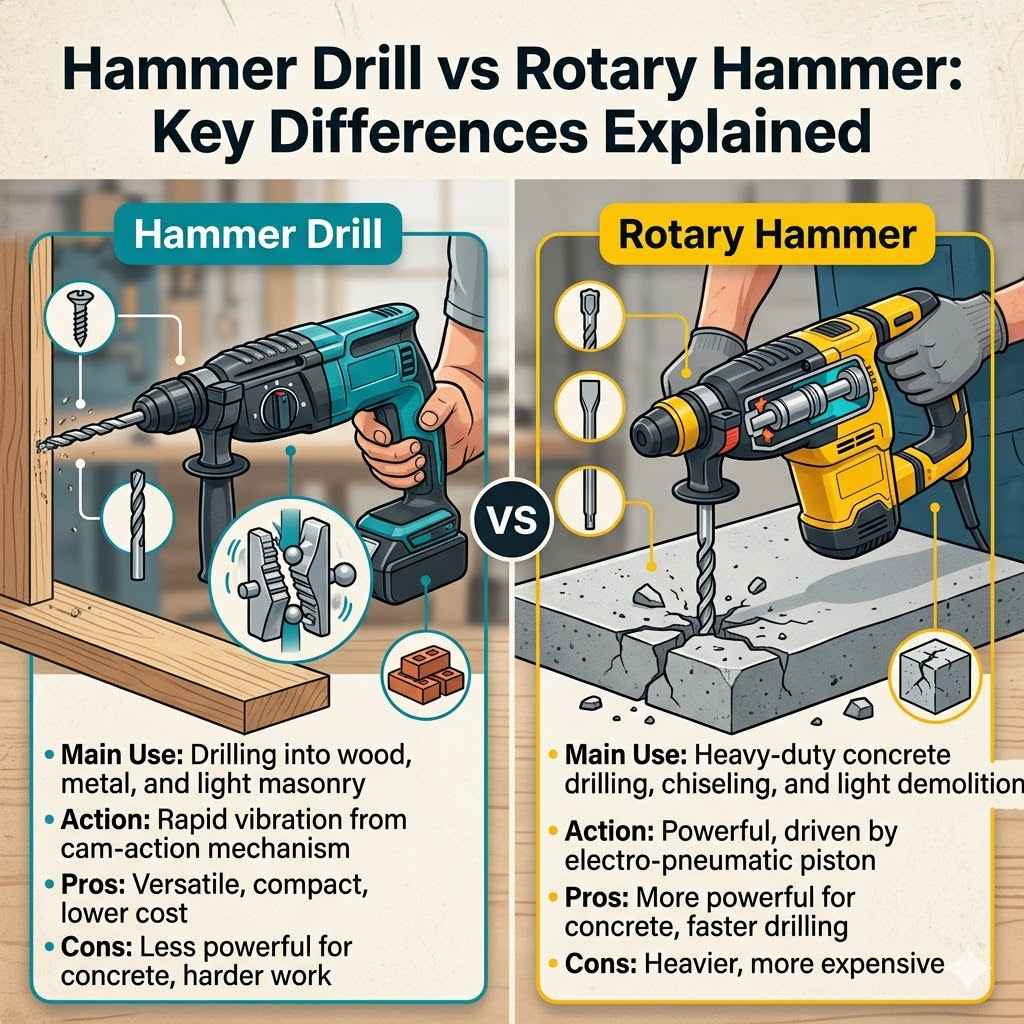
Figuring out the right tool for your project can sometimes feel confusing, especially when you see similar names for powerful tools. The Hammer Drill vs Rotary Hammer: Key Differences Explained is a common question for DIYers and pros alike. These tools look alike and both pound, but they do different jobs.
Don’t worry if it’s unclear right now. This guide breaks it all down super simply, step by step, so you know exactly which one to grab. We’ll cover what makes them tick and when to use each one.
Hammer Drill Versus Rotary Hammer: Understanding the Tools
Many people wonder about the Hammer Drill vs Rotary Hammer: Key Differences Explained because both are designed for tougher drilling tasks than a standard drill. They both offer a hammering action, but the way they deliver that action and the power behind it are very different. This section will introduce you to each tool, explaining its basic function and how it works.
We’ll get into the mechanics of each so you can see why they are not interchangeable.
What is a Hammer Drill
A hammer drill is essentially a power drill with an added hammer mechanism. This mechanism creates a rapid forward and backward pounding motion, called percussive action. This action helps the drill bit to chip away at hard materials like concrete or masonry.
When you pull the trigger, the drill bit spins and hammers at the same time. This combination makes it easier to drill into tough surfaces compared to a regular drill. You can usually turn the hammer function on or off.
This means you can use it as a regular drill for wood or metal, and then switch to hammer mode for brick or stone.
The hammering in a hammer drill is driven by a cam mechanism. Two ribbed plates spin against each other. As they spin, they move forward and backward, pushing the drill chuck in and out.
It’s a somewhat jarring action, and the impact force is not as strong as a rotary hammer. Because of this, hammer drills are best for lighter masonry work or drilling into softer concrete. They are also generally less expensive than rotary hammers.
For example, if you need to hang a shelf on a brick wall or drill a small hole for a picture frame in a concrete block, a hammer drill is usually sufficient. It’s a versatile tool that bridges the gap between a standard drill and a more heavy-duty demolition tool. You might find yourself using it for a wide range of home improvement tasks.
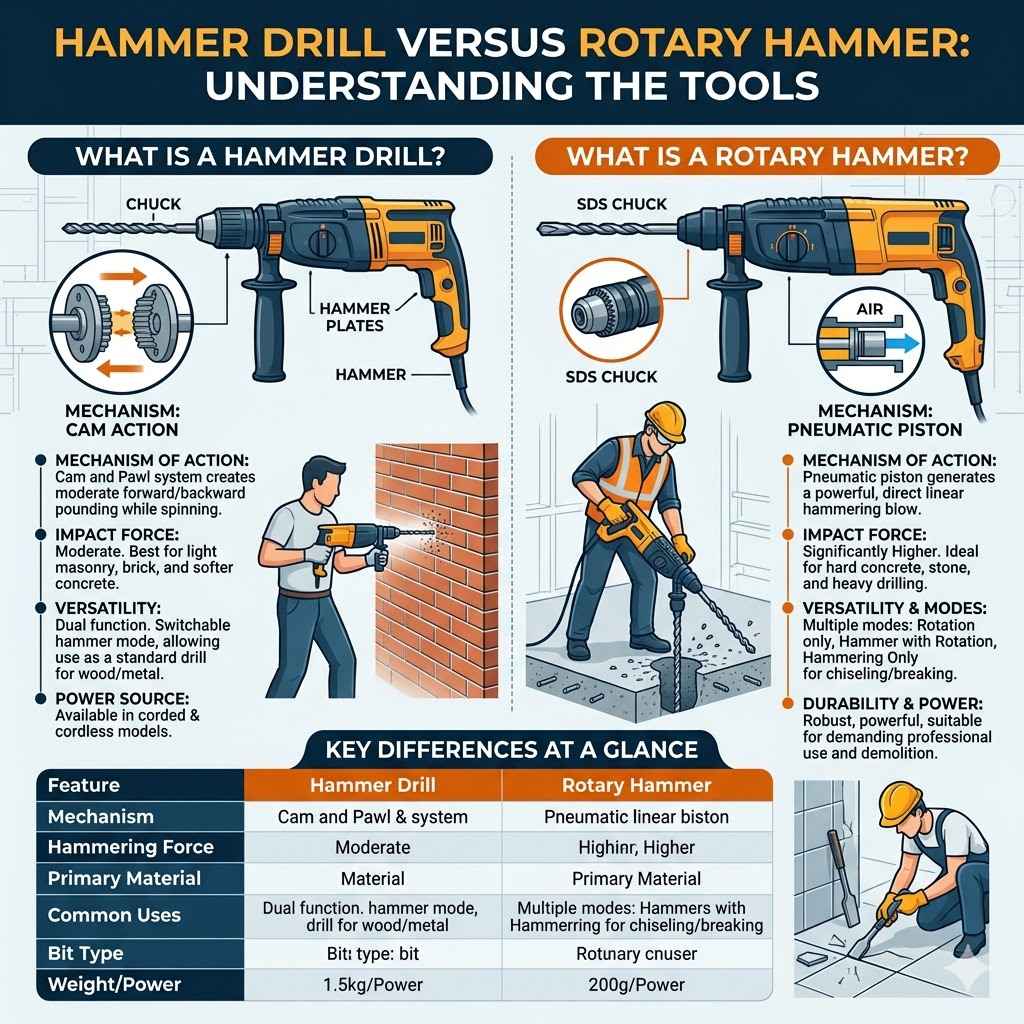
- Mechanism of Action: A hammer drill uses a cam and pawl system to create a forward and backward hammering motion. This motion is applied to the drill bit as it spins.
- Impact Force: The percussive force of a hammer drill is moderate. It’s enough to break through lighter masonry but not designed for heavy demolition or drilling large holes in dense concrete.
- Versatility: It can function as a standard drill for wood, metal, and plastic by disengaging the hammer mode. This dual functionality makes it a popular choice for many homeowners.
- Power Source: Hammer drills are available in both corded and cordless models, offering flexibility for different work environments. Cordless models provide portability, while corded ones offer consistent power.
What is a Rotary Hammer
A rotary hammer, also known as a hammer drill with an SDS chuck, is a much more powerful tool designed for heavy-duty drilling and light demolition. It uses a piston mechanism, similar to a jackhammer, to deliver a much stronger and more forceful hammering action. This piston moves up and down powerfully, driving the drill bit with significant force.
The spinning action is also more robust. This makes rotary hammers ideal for drilling into hard concrete, stone, and other very dense materials.
Rotary hammers typically use SDS (Slotted Drive System) bits. These bits lock into the chuck and are designed to withstand the intense hammering action. The SDS system allows for quick bit changes and provides a more direct transfer of impact energy from the piston to the bit.
Unlike a hammer drill where you can often switch the hammer function off, many rotary hammers have multiple modes, including rotation only, hammering with rotation, and hammering without rotation (like a breaker hammer).
These tools are built for serious work. They can drill large diameter holes quickly, break up concrete floors, or remove tile. If you’re working on a construction site, doing major renovations, or need to drill through thick reinforced concrete, a rotary hammer is the tool you need.
Their power and durability come at a higher cost and weight.
- Mechanism of Action: A rotary hammer employs a pneumatic piston system. This system generates a powerful, linear hammering blow that is transferred directly to the drill bit.
- Impact Force: The impact force of a rotary hammer is significantly higher than that of a hammer drill. This allows it to penetrate very hard materials with ease.
- Versatility and Modes: Rotary hammers usually offer multiple modes. These include drilling with rotation, hammering with rotation, and hammering only for chiseling or breaking.
- Durability and Power: Built for demanding tasks, rotary hammers are generally more robust and powerful, making them suitable for professional use and heavy-duty DIY projects.
Hammer Drill vs Rotary Hammer: Key Differences Explained in Detail
Now that we have a basic understanding of each tool, let’s get into the core of the Hammer Drill vs Rotary Hammer: Key Differences Explained. The most critical distinctions lie in their power delivery, intended applications, and the type of bits they use. Understanding these differences is crucial for selecting the right tool and ensuring you work efficiently and safely.
Impact Mechanism and Power
The fundamental difference between a hammer drill and a rotary hammer is their impact mechanism. A hammer drill uses a cam-and-pawl system. Imagine two ribbed discs that spin against each other.
As they turn, they push apart and then come back together, creating a hammering effect on the drill chuck and bit. This results in a rapid, but less powerful, series of impacts. The force is distributed across the spinning action.
A rotary hammer, on the other hand, uses a piston driven by a cam or electromagnet. This piston moves back and forth powerfully, essentially acting like a miniature jackhammer. This creates a much more direct and forceful hammering blow.
The piston strikes a striker, which then hits the back of the drill bit. This pneumatic action delivers significantly more impact energy. For instance, a typical hammer drill might deliver between 0-60 BPM (blows per minute) with about 2-3 Joules of impact energy, while a rotary hammer can deliver thousands of BPM with impact energy ranging from 1-20+ Joules.
This vast difference in impact energy is why a rotary hammer can drill through reinforced concrete much faster and easier.
The power output directly affects what materials you can drill through and how quickly. For light masonry, a hammer drill is adequate. For dense concrete, thick stone, or frequent drilling of larger holes, a rotary hammer is necessary.
- Hammer Drill Impact: Uses a cam mechanism for a lighter, more diffused percussive action.
- Rotary Hammer Impact: Uses a piston mechanism for a powerful, direct hammering blow.
- Energy Transfer: Rotary hammers transfer energy more efficiently to the bit due to their piston design, leading to faster drilling in hard materials.
- Force Comparison: Rotary hammers deliver significantly higher impact force, measured in Joules, making them superior for dense materials.
Applications and Use Cases
The intended applications for a hammer drill and a rotary hammer are quite different, even though they both drill into hard surfaces. A hammer drill is best suited for lighter tasks. This includes drilling small to medium-sized holes in brick, block, mortar, and softer concrete.
You might use it to install anchors for cabinets, mount light fixtures, or drill holes for concrete screws. It’s a good all-around tool for many home improvement projects where some masonry drilling is required.
A rotary hammer is built for more demanding work. This includes drilling large diameter holes in hard concrete, breaking up old concrete or tile, chiseling away mortar, or performing demolition tasks. For example, if you’re running conduit through a thick concrete wall, installing heavy-duty anchors, or renovating a kitchen where you need to remove tile from a concrete subfloor, a rotary hammer is the appropriate tool.
They are also used by professionals in construction for tasks like setting rebar anchors.
Think of it this way: a hammer drill is like a strong nudge, while a rotary hammer is like a powerful punch. You wouldn’t use a punch to hang a small picture, and you wouldn’t use a nudge to break down a wall.
Here’s a simple breakdown:
| Application | Recommended Tool | Reason |
|---|---|---|
| Hanging a shelf on brick | Hammer Drill | Lighter task, sufficient power. |
| Drilling anchor bolts into concrete for a deck | Rotary Hammer | Harder material, requires more force and speed. |
| Removing old tile from a concrete floor | Rotary Hammer (in chisel mode) | Demolition task, requires significant impact. |
| Drilling small holes for picture frames | Hammer Drill (or standard drill) | Easy task, hammer function optional but helpful. |
| Drilling large holes (1/2 inch or larger) into dense concrete | Rotary Hammer | Efficiency and ability to power through tough material. |
Bit Types and Chuck Systems
The type of bits and the chuck system are critical differentiators. Hammer drills typically use standard drill chucks, often with three jaws that grip a round or hex shank drill bit. While some hammer drills have a specific SDS chuck option, most common ones use the standard three-jaw chuck.
This means you can use standard drill bits and masonry bits designed for this type of chuck. The chuck design is adequate for the moderate hammering action of a hammer drill.
Rotary hammers, however, almost exclusively use SDS chuck systems. SDS stands for Slotted Drive System. There are different versions, like SDS-Plus and SDS-Max.
These chucks have grooves or slots that allow the bit to slide forward and backward freely, while also locking it in place. This free-floating action is essential for the rotary hammer’s piston mechanism to deliver its full impact force directly to the bit. The SDS system also allows for much faster and easier bit changes.
You simply push the bit into the chuck, and it locks. To remove it, you pull back a collar on the chuck.
Using a standard masonry bit in a rotary hammer (if it even fits) would likely result in premature wear or damage to both the bit and the tool, and you wouldn’t get the full hammering power. Conversely, using an SDS bit in a standard hammer drill chuck is impossible, and attempting to force it would damage the chuck.
The compatibility of bits is a non-negotiable aspect when choosing between these tools. Always ensure your bits match the tool’s chuck system for optimal performance and safety.
- Hammer Drill Chucks: Commonly use standard three-jaw chucks that grip bits with round or hex shanks.
- Rotary Hammer Chucks: Primarily use SDS (Slotted Drive System) chucks, such as SDS-Plus and SDS-Max.
- SDS Bit Design: SDS bits have grooves that lock into the chuck and allow for free forward and backward movement, crucial for the piston’s impact.
- Bit Compatibility: Standard bits fit hammer drills; SDS bits are required for rotary hammers. Mixing them can damage tools and bits.
When to Choose a Hammer Drill
Deciding when to opt for a hammer drill involves assessing the scale and toughness of your task. If your projects involve drilling into softer masonry materials like brick, concrete block, or stucco, and you’re not drilling excessively large or deep holes, a hammer drill is likely your best choice. It offers a significant step up in power from a standard drill without the heavy cost or weight of a rotary hammer.
Consider the frequency of your masonry work. If you only occasionally need to drill a few holes in a brick wall for things like hanging a shelf or mounting a small planter, a hammer drill will serve you well. It’s also a great option if you need a tool that can perform both standard drilling tasks (on wood, metal, plastic) and light masonry work, thanks to its switchable hammer function.
For example, imagine you’re installing a television mount on a brick fi
Think about the types of fasteners you’ll be using. If you’re using standard masonry anchors, concrete screws, or lag shields that require holes up to about 1/2 inch in diameter, a hammer drill is typically up to the job. For anything larger or requiring deeper penetration into harder concrete, you might need to consider a rotary hammer.
- Material Softness: Ideal for brick, concrete block, mortar, and lighter concrete.
- Hole Size and Depth: Best for small to medium-sized holes (typically up to 1/2 inch).
- Frequency of Use: A good choice for occasional masonry drilling needs.
- Dual Functionality: Useful when you need a tool that can also act as a standard drill.
Common Hammer Drill Applications
Hammer drills are incredibly handy for a wide variety of home and light-duty professional tasks. Their ability to punch through common building materials makes them a go-to for many DIYers. You’ll find yourself reaching for it when you need to secure something to a wall made of denser materials than drywall.
One very common use is hanging heavy items. This includes everything from large mirrors and wall cabinets to outdoor furniture or even swing sets attached to a concrete patio. Installing electrical boxes or conduit runs in a cinder block foundation is another typical application.
You might also use it for drilling holes to run plumbing lines or cables through a concrete wall or floor. In older homes with plaster and lath, the embedded wood or brick lath can be tough, and a hammer drill makes drilling through it much easier.
Even for seemingly small tasks, like drilling out a rusted bolt head or creating pilot holes for larger fasteners in concrete, a hammer drill can save you time and effort. Its versatility means it often gets used for a broader range of jobs than a specialized rotary hammer.
Here are some typical scenarios:
- Mounting a Large Flat-Screen TV: Drilling pilot holes into a brick or concrete wall for robust TV mount brackets.
- Installing Shelving Units: Creating secure anchor points for heavy-duty shelving in a basement or garage with concrete walls.
- Home Renovation Projects: Drilling holes for electrical wiring, plumbing pipes, or small demolition tasks like removing old mortar.
- Outdoor Projects: Securing a fence post to a concrete footing or drilling into a concrete patio for outdoor lighting.
Hammer Drill vs Rotary Hammer in DIY Projects
For the average homeowner tackling weekend projects, a hammer drill is often the sweet spot. It provides enough power to handle common DIY tasks involving masonry without the significant investment or learning curve associated with a rotary hammer. If your DIY aspirations include building a deck, renovating a bathroom, or adding shelving, a hammer drill will likely suffice for drilling into concrete patios, cinder block walls, or brick foundations.
A DIYer might use a hammer drill to install a new mailbox post in a concrete base, drill holes for garden trellises, or even to help with minor concrete repair by creating channels for patching material. It’s a significant upgrade from a standard drill for these types of tasks, making the process much faster and less physically demanding. The ability to switch off the hammer function also means it can still be used for more conventional drilling jobs around the house, making it a true multi-tasker for the home workshop.
However, if a DIY project involves significant concrete work, like breaking up an old concrete patio or drilling many large holes through a thick foundation wall, then a rotary hammer might be a worthwhile rental or purchase. But for the majority of typical home improvement tasks, the hammer drill is the more practical and economical choice.
- Cost-Effectiveness: Generally more affordable than rotary hammers, making them accessible for DIY budgets.
- Ease of Use: Simpler operation and less intimidating for beginners compared to the power of a rotary hammer.
- Sufficient Power: Adequate for most common household tasks involving brick, block, and lighter concrete.
- Space Saving: Can often replace a standard drill for many applications, saving tool collection space.
When to Choose a Rotary Hammer
A rotary hammer is the tool you need when the job demands serious power and durability. If you’re working with hard, dense materials like reinforced concrete, granite, or thick natural stone, a rotary hammer is essential. It’s designed to chew through these materials with speed and efficiency that a hammer drill simply cannot match.
Consider the scale of your project. If you’re involved in major renovations, new construction, or demolition, a rotary hammer is a standard piece of equipment. This includes tasks like breaking up concrete slabs, removing tile and mortar from large areas, chiseling away old concrete, or drilling numerous large holes for structural purposes.
Professionals in the construction trades, electricians running conduit through thick walls, and plumbers installing large pipes in concrete foundations rely heavily on rotary hammers.
For instance, if you are planning to install a large commercial-grade air conditioning unit that requires bolting into a thick concrete foundation, or if you need to create openings in a concrete wall for structural changes, a rotary hammer is the only practical tool. It handles the intense vibrations and demanding workload far better than a hammer drill, preventing tool damage and completing the job faster.
If your work involves frequent drilling of holes larger than 1/2 inch, especially into hard concrete, a rotary hammer will save you a tremendous amount of time and effort. The pneumatic hammering action and SDS bit system are engineered for this exact purpose.
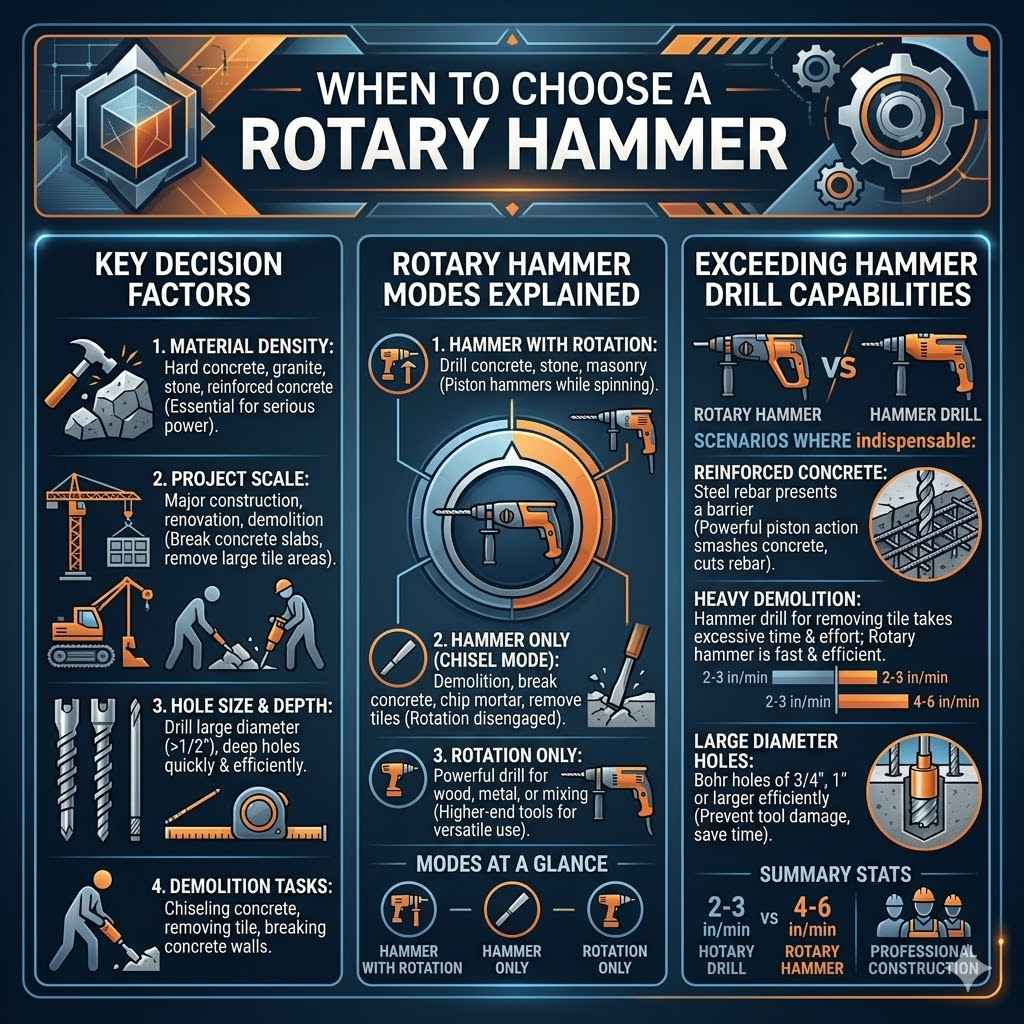
- Material Density: Necessary for drilling into hard concrete, stone, granite, and reinforced concrete.
- Project Scale: Ideal for heavy-duty construction, renovation, and demolition projects.
- Hole Size and Depth: Required for drilling large diameter or deep holes efficiently.
- Demolition Tasks: Essential for chiseling, breaking concrete, and removing tile.
Rotary Hammer Modes Explained
One of the key advantages of a rotary hammer is its versatility through different operating modes. This allows the tool to adapt to various tasks beyond just drilling. Understanding these modes ensures you use the tool most effectively and safely.
The most common mode is Hammer with Rotation. This is used for drilling into concrete, stone, and masonry. The piston hammers while the chuck spins, driving the drill bit through the material.
This is the mode you’ll use for most drilling applications where a hammer drill might struggle.
Another important mode is Hammer Only, also known as chisel mode. In this mode, the rotation is disengaged, and the tool functions purely as a hammer. This mode is used for demolition tasks like breaking up concrete, chipping away old mortar, removing tiles, or scraping away stubborn material.
You would use a chisel bit designed for this purpose.
Some rotary hammers also feature a Rotation Only mode. This allows the tool to function like a powerful standard drill. This is useful for drilling into wood or metal, or for tasks like mixing concrete or mortar if the rotary hammer has a suitable attachment and enough torque.
This mode is less common on basic hammer drills and is more prevalent in higher-end rotary hammers.
The ability to switch between these modes makes a rotary hammer a powerful all-in-one tool for many construction and heavy-duty renovation tasks.
- Hammer with Rotation: The primary mode for drilling into hard materials like concrete and stone.
- Hammer Only (Chisel Mode): Used for demolition, breaking concrete, removing tile, and chiseling mortar.
- Rotation Only: Functions like a powerful standard drill for wood, metal, or mixing applications.
- Mode Selection: Most rotary hammers have a dial or switch to easily select the desired mode.
When Rotary Hammer Exceeds Hammer Drill Capabilities
There are specific scenarios where a hammer drill simply won’t cut it, and a rotary hammer becomes indispensable. The most obvious is when dealing with thick, reinforced concrete. The steel rebar within the concrete presents a significant obstacle that the moderate hammering action of a hammer drill cannot effectively overcome.
A rotary hammer’s powerful piston action can smash through concrete and even cut through embedded rebar, allowing you to drill larger or deeper holes where needed.
Demolition tasks are another area where rotary hammers shine. Imagine needing to remove a large area of old tile from a concrete subfloor, break up a section of a concrete wall, or chisel away stubborn mortar. A hammer drill might eventually accomplish this, but it would take an extremely long time, be very inefficient, and could overheat and damage the tool.
A rotary hammer in hammer-only mode with a chisel bit can perform these tasks much faster and with less strain on the user and the tool.
Drilling very large diameter holes is also a key differentiator. If you need to bore holes of 3/4 inch, 1 inch, or even larger into concrete, a rotary hammer is necessary for efficiency and to prevent tool damage. A hammer drill would struggle immensely, likely overheating or failing to make significant progress.
The power and specialized bits of a rotary hammer are designed for these demanding applications.
Here are some statistics illustrating the difference:
A typical 1/2-inch hammer drill might drill 2-3 inches into concrete per minute, depending on the concrete’s hardness. In contrast, a comparable rotary hammer might drill 4-6 inches into the same material in the same amount of time, and can handle much larger bit diameters.
- Reinforced Concrete: Rotary hammers are essential for drilling through concrete with steel rebar.
- Heavy Demolition: Ideal for breaking concrete, removing tile, and heavy chiseling.
- Large Diameter Holes: Necessary for drilling holes 3/4 inch and larger into hard materials.
- Professional Construction: The standard tool for many repetitive and demanding drilling/chiseling tasks on job sites.
Hammer Drill vs Rotary Hammer Key Differences Explained Frequently Asked Questions
Question: Can I use a hammer drill for small demolition jobs
Answer: A hammer drill can handle very light demolition, like removing a few loose bricks or chipping away small amounts of mortar. However, for any significant demolition work, like breaking up concrete slabs or removing large areas of tile, a rotary hammer is much more effective and efficient.
Question: What is the main difference in how they hammer
Answer: A hammer drill uses a cam mechanism that creates a lighter, more diffused pounding. A rotary hammer uses a pneumatic piston for a much stronger, more direct, and powerful hammering blow, similar to a jackhammer.
Question: Which tool is better for hanging drywall in a concrete block wall
Answer: For hanging drywall on a concrete block wall, a hammer drill is generally sufficient. It can easily create the pilot holes needed for the anchors or screws to secure the drywall or furring strips.
Question: Can I use any drill bit with a rotary hammer
Answer: No, rotary hammers typically require special SDS-Plus or SDS-Max bits that are designed to lock into the chuck and withstand the powerful hammering action. Using standard bits can damage the tool and the bit.
Question: Which tool is more expensive
Answer: Rotary hammers are generally more expensive than hammer drills because they have a more complex and powerful internal mechanism, are built for heavy-duty use, and often come with SDS chucks.
Summary
The Hammer Drill vs Rotary Hammer: Key Differences Explained boils down to power, mechanism, and intended use. A hammer drill offers a lighter hammering action for brick and lighter concrete, while a rotary hammer delivers a powerful piston-driven blow for heavy-duty concrete and demolition. Always choose the tool designed for your material and task to work effectively and safely.