How to Charge a Drill Battery With a Different Charger (Safely)
A different charger works fine when it’s the same brand and voltage platform as your battery — a DeWalt 20V MAX charger charges any DeWalt 20V MAX pack, even from a different tool’s box. Cross-brand charging is the real danger: a lithium-ion battery’s BMS won’t recognize a foreign charger, and mismatched voltage can trigger overheating or lockout. This guide covers what’s safe, what isn’t, and how to test before you plug in.
Same Platform, Different Tool’s Charger: This Works
Best Replacement Charger Pick
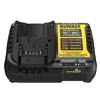 |
DEWALT 12V/20V MAX Lithium Ion Charger (DCB1104) – $27.09 If your original charger is lost or dead, the safe fix is a genuine same-platform replacement, not a cross-brand universal charger — exactly the distinction this guide walks through above.
|
As an Amazon Associate we earn from qualifying purchases.
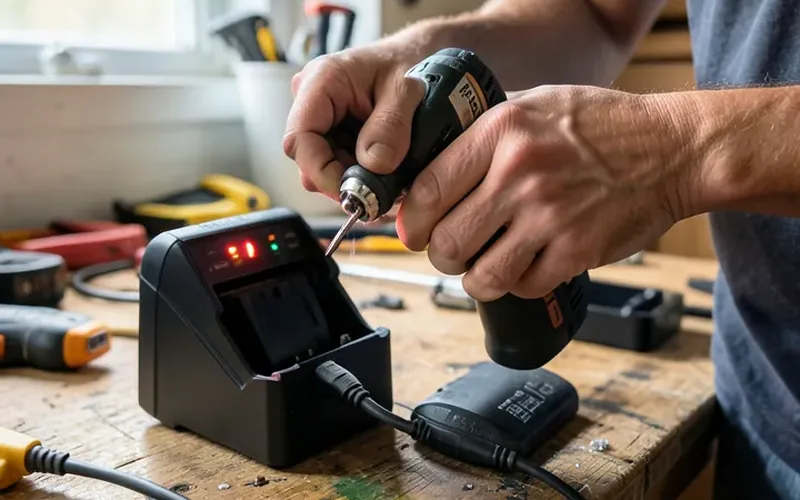
The most common real-world version of this question isn’t “can I use any charger” — it’s “can I use the charger from my Craftsman circular saw to charge my drill battery.” If both tools share the same brand and voltage platform (both DeWalt 20V MAX, both Craftsman 20V, both Hyper Tough 20V, and so on), the answer is yes. That’s the entire point of a shared battery platform — one charger works across every tool and battery in that lineup.
Cross-Brand Chargers: Why the Battery’s BMS Says No
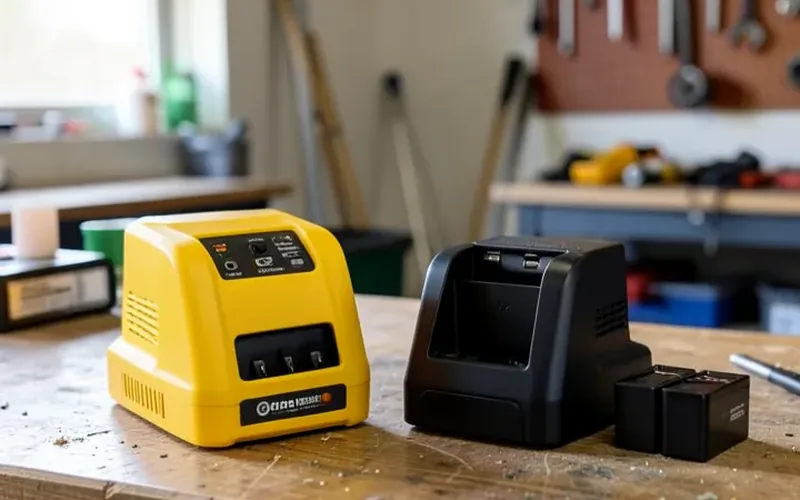
Cross-brand compatibility doesn’t really exist in modern lithium-ion power tools, and it’s not just a voltage mismatch problem. Every lithium-ion battery pack has a Battery Management System (BMS) that communicates with the charger — authenticating the pack, reporting cell temperature, and confirming individual cell voltage balance before allowing current to flow. A DeWalt charger simply won’t recognize a Makita battery’s BMS handshake, even in the rare case the physical connector could be forced to fit.
- Charging voltages differ by brand even at the “same” nominal voltage — DeWalt 20V MAX batteries charge to roughly 20.5V, while Makita 18V LXT charges to roughly 21.0V
- Putting one brand’s battery on another brand’s charger, even if it physically connects, can overcharge the cells and trigger a BMS lockout or, in a worst case, thermal runaway
- A charger that doesn’t recognize the pack at all will usually just refuse to charge — that’s the BMS doing its job, not a malfunction to work around
The bottom line from every major manufacturer is the same: use the charger built for that battery’s specific platform, not a generic or cross-brand substitute.
NiCd/NiMH vs. Lithium-Ion: Why Old Chargers Are More Forgiving
If your drill uses an older NiCd or NiMH battery, the compatibility rules are looser. These “dumb” chemistries don’t have a BMS handshake requirement — a charger just needs to supply a compatible voltage and a reasonable current. That’s why generic NiCd/NiMH chargers exist and work across multiple brands, while a universal lithium-ion charger claiming the same is a much bigger gamble.
- Check your battery’s label for its chemistry (NiCd, NiMH, or Li-ion) and voltage before assuming any compatibility rule applies
- NiCd/NiMH: match voltage and stay at or below the charger’s rated current — more forgiving, but still monitor for excess heat
- Lithium-ion: match brand and platform, not just voltage — the BMS handshake is the real gatekeeper, not the number printed on the label
How to Check Compatibility Before You Plug In
- Read the battery’s label for chemistry, voltage, and platform name (e.g. “20V MAX,” “18V LXT”)
- Read the charger’s label for the same information — both must match, not just be “close enough”
- Check that the physical connector and pin layout match — a battery that doesn’t seat fully and click into place isn’t a safe fit even if the voltage happens to line up
- If it’s a lithium-ion pack from a different brand than the charger, stop — don’t force it, and don’t assume a firm push means it’s working correctly
Step-by-Step: Charging With a Compatible Charger
- Inspect the charger’s cord and the battery’s contacts for damage before connecting anything
- Set both on a flat, dry surface away from water and flammable material
- Seat the battery fully into the charger until it clicks or the charging LED activates
- Plug the charger into the wall outlet, not the other way around, to avoid a spark at the battery contacts
- Check in periodically — the battery should feel warm at most, never hot, during a normal charge
- Unplug and remove the battery once the charger’s indicator shows a full charge; don’t leave it on the charger indefinitely
Warning Signs to Unplug Immediately
- The battery or charger feels hot to the touch, not just warm
- Any swelling, bulging, or deformation of the battery casing
- A hissing sound, smoke, or an unusual chemical smell
- The charger’s LED behaves erratically (rapid flashing, no light at all with a known-good outlet)
If you see any of these, disconnect the battery, move it away from flammable material, and do not attempt to charge it again. A battery that’s shown these signs should be replaced, not reused.
Troubleshooting Common Issues
Battery won’t charge: check for a loose connection or dirty contacts first — clean them with a dry cloth. If the charger and battery are genuinely the same platform and it still won’t charge, the battery has likely reached end of life and needs replacing.
Charger runs hot: a warm charger during use is normal; a hot one may be failing internally. Unplug it, let it cool, and inspect the cord and housing for damage before using it again. Poor ventilation around the charger while in use can also trap heat unnecessarily.
Frequently Asked Questions
Can You Charge a Drill Battery With Any Charger?
No. A different charger is safe only when it’s built for the same brand, voltage, and chemistry as your battery. Lithium-ion batteries add a further requirement — the charger must be recognized by the battery’s BMS, which cross-brand chargers generally are not, even at a matching nominal voltage.
Why Won’t My Battery Charge on a Different Brand’s Charger?
On lithium-ion tools, the battery’s internal BMS has to authenticate with the charger before it allows current to flow. A different brand’s charger doesn’t speak the same authentication protocol, so the safest outcome is that it simply refuses to charge — that’s the protection system working as intended, not a defect.
Is It Safe to Use a Universal Battery Charger?
For older NiCd or NiMH tools, a generic charger that matches voltage and current is usually fine. For lithium-ion tools, treat “universal” claims with skepticism — a charger that bypasses the BMS handshake to force a charge across brands can undermine the exact safety protections the battery was designed with.
What Happens If I Use the Wrong Charger Anyway?
Best case, the charger simply won’t recognize the battery and nothing happens. Worst case, a mismatched voltage overcharges the cells, triggering a BMS lockout or overheating that shortens the battery’s life or creates a genuine fire risk. Neither outcome is worth the money saved versus buying the correct replacement charger.
Conclusion
A different charger is genuinely fine when it shares your battery’s brand, voltage, and chemistry — that’s exactly what a shared tool platform is built for. What isn’t safe is crossing brands on a lithium-ion pack, since the battery’s own BMS is what’s refusing that connection, not an arbitrary manufacturer restriction. If your original charger is gone, replace it with the correct platform charger rather than reaching for a universal one.
Sponsored / affiliate links. As an Amazon Associate I earn from qualifying purchases. I may earn additional commission from eligible campaigns.
 20V Cordless Drill, Electric Power Drill Set with Battery Charger and Carrying Case, 3/8” Keyless Chuck, 2 Variable Speed, 18+3 Torque, 72pcs Driver Bits and Belt Hook, Red
 FYIOGXG Cameron Sino Battery Charge for Ryobi BBL-120, BD-120, BD-121, BD-122, BD-123, BD-125, BD-126, BD-127, BFL-127, BID1211, BID-122, BID-1225