What Size Hole Saw for 3/4-Inch EMT? (The Correct NEMA Size)
A 3/4-inch EMT connector needs a 1-1/8-inch hole saw — the NEMA-referenced knockout size, not the 7/8-inch figure widely repeated online. Cutting the wrong size strips the connector’s locknut threads or leaves the tubing binding against sheet metal. This guide covers the correct size for knockouts and wood-stud pass-throughs, why 7/8-inch is undersized for the tubing’s real 0.922-inch outside diameter, and the NEC clearance rule for framing holes.
What Size Hole Saw Do You Need for 3/4-Inch EMT?
Best EMT Hole Saw Kit Pick
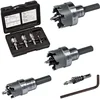
Klein Tools 31872 Heavy Duty Hole Saw Kit
Carbide hole cutters built specifically for conduit knockouts, with the exact 7/8″, 1-1/8″, and 1-3/8″ sizes this guide covers.
- Best for: cutting clean knockouts in steel boxes and panels for 1/2″ to 1″ conduit
- Why we picked it: the 1-1/8″ size for 3/4″ EMT is included by default, no guessing which size to buy separately
- Main drawback: carbide cutters cost more than a bi-metal set and are overkill for a single wood-stud pass-through
Compare more conduit hole saw options
 Option 1 Spyder 17-Pc Master Electrician Kit
|
 Option 2 KATA 18-Piece Bi-Metal Kit
|
 Option 3 Milwaukee Hole Dozer 20-Pc Kit
|
As an Amazon Associate we earn from qualifying purchases.
Electrical Metallic Tubing (EMT) is a thin-wall steel conduit that protects electrical wiring, sized by a nominal “trade size” that is smaller than its real outside diameter — the same trade-size-vs-actual-size gap that trips people up when picking a hole saw for a dryer vent. A 3/4-inch EMT does not actually measure 3/4 inch across — per ANSI C80.3, its true outside diameter is 0.922 inches. That single fact is why so much conflicting advice exists about hole saw size.
A 7/8-inch hole saw cuts a hole 0.875 inches across — smaller than the tubing’s actual 0.922-inch outside diameter. The conduit will not pass through cleanly, let alone leave room for a connector locknut. According to American Fittings’ NEMA-referenced sizing chart, the correct knockout size for 3/4-inch trade size conduit is 1-1/8 inches (1.115″, 28.3mm).
Here is the same reference chart for the trade sizes on either side of 3/4-inch, since most electricians buy a multi-size arbored hole saw kit rather than a single blade:
| Conduit Trade Size | Recommended Hole Saw | Exact Diameter |
|---|---|---|
| 1/2 inch | 7/8 inch | 0.885″ (22.5mm) |
| 3/4 inch | 1-1/8 inch | 1.115″ (28.3mm) |
| 1 inch | 1-3/8 inch | 1.362″ (34.6mm) |
Source: American Fittings NEMA-referenced knockout chart. Note the 7/8-inch size belongs to 1/2-inch conduit, not 3/4-inch — the likely source of the mix-up repeated across many hole saw guides.
“For 3/4-inch conduit, drill using a 1-1/8-inch hole saw. Run the drill slow — around 400 RPM or less — so the hole saw doesn’t jam or overheat.”
Knockout Hole vs. Wood-Stud Pass-Through: Same Size, Different Purpose
The 1-1/8-inch figure covers two different jobs that get confused with each other. A knockout hole is cut into a sheet-metal electrical box or panel so a connector can thread through and lock the conduit in place. A wood-stud pass-through is a hole bored through framing lumber so bare EMT can run from one bay to the next with no connector at that point at all. Both use the same 1-1/8-inch hole saw because both need clearance over the tubing’s real 0.922-inch outside diameter — the knockout for the connector threads, the stud hole for the tubing plus a little wiggle room for alignment.
Drilling through wood framing adds a code requirement that a bare knockout does not have. NEC 300.4 requires holes bored in wood framing members to keep at least 1-1/4 inches of wood between the edge of the hole and the nearest edge of the stud. If that clearance is not possible, the conduit must be protected with a 1/16-inch steel nail plate to guard against drywall screws and finish nails puncturing the conduit later.
📊 A 1-1/8-inch hole in a standard 2×4 stud (3.5″ actual width) uses about 32% of the stud’s width — safely under the NEC/structural limit of 40% for bored holes in load-bearing studs, so no additional framing repair is needed at that hole alone.
Does a Set-Screw or Compression Connector Need a Different Hole Size?
No. This is a common point of confusion, and a few hole saw guides get it wrong by claiming set-screw connectors and compression connectors need different clearance holes. Both connector types are manufactured to the same trade-size threaded body and pass through the identical NEMA-sized knockout — a 3/4-inch set-screw connector and a 3/4-inch compression connector both thread into the same 1-1/8-inch knockout. What changes between the two is how the connector grips the conduit (a set screw pinches the tubing; a compression ring cinches around it for a tighter, weatherproof seal), not the size of hole either one needs.
How to Cut a Clean 1-1/8-Inch Hole for 3/4-Inch EMT
The technique changes slightly depending on whether you are cutting sheet metal (a box or panel knockout) or wood framing, but the sequence below works for both:
- Mark and center the pilot point: mark the hole center and seat the arbor’s pilot bit on it before the saw teeth touch the surface, so the hole saw can’t wander off-center.
- Secure the material: clamp the box, panel, or stud so it cannot spin or vibrate once the teeth engage — a hole saw that catches on loose sheet metal can twist violently.
- Start at low speed: run the drill around 400 RPM or slower on metal; higher speeds overheat bi-metal teeth and cause binding.
- Apply light, steady pressure: let the teeth do the cutting. Forcing the saw generates heat that dulls the blade faster than normal use.
- Add cutting oil on metal: a few drops on the teeth when cutting steel reduces friction and roughly doubles blade life compared to a dry cut.
- Clear the plug and deburr the edge: knock the slug out of the arbor — see our guide on getting a stuck plug out of a hole saw if it won’t release — then run a file or reamer around the cut edge to remove sharp burrs before pulling wire or seating a connector.
Bi-Metal or Carbide: Which Hole Saw Should You Buy?
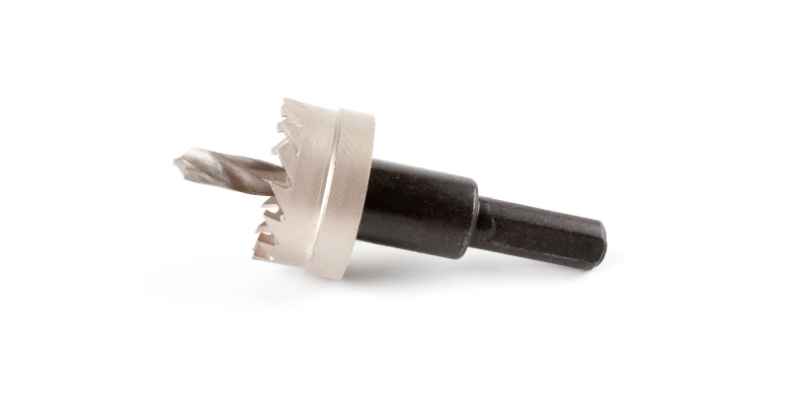
A hole saw is one of several specialty blade types covered in our full guide to woodworking saws, and the material question here is the same one that comes up with bandsaw blades for metal: bi-metal hole saws handle EMT knockouts and wood-stud pass-throughs without trouble and cost less than carbide. Carbide-toothed hole saws are worth the extra cost only if you are cutting stainless steel, cast iron, or repeatedly reaming out the same knockout — overkill for a one-off EMT run but a better long-term buy for an electrician cutting boxes daily. Either material needs to include the 1-1/8-inch size specifically; many general-purpose kits jump from 1 inch straight to 1-1/4 inch and skip it entirely, so check the size list before buying.
Common Mistakes When Cutting Holes for EMT
- Using 7/8-inch on 3/4-inch conduit: the single most common error on this exact topic — the hole ends up smaller than the tubing itself.
- Running the drill too fast on metal: high RPM overheats bi-metal teeth and causes the saw to bind or walk off-center.
- Skipping the pilot bit: without it centered first, the hole saw can wander and cut an oval instead of a circle.
- Drilling closer than 1-1/4 inches from a stud edge: violates NEC 300.4 and leaves the conduit exposed to drywall screws unless a nail plate is added.
- Leaving burrs on a metal cut: sharp edges can nick wire insulation as it’s pulled through — always deburr with a file or reamer.
Frequently Asked Questions
What size hole saw do I need for 3/4-inch EMT?
A 1-1/8-inch hole saw is the correct size for 3/4-inch EMT, per NEMA-referenced knockout sizing. This matches the tubing’s actual 0.922-inch outside diameter with enough clearance for the connector threads or a clean wood-stud pass-through.
Is a 7/8-inch hole saw the right size for 3/4-inch EMT?
No. A 7/8-inch hole saw cuts a 0.875-inch hole, which is smaller than 3/4-inch EMT’s real 0.922-inch outside diameter. The 7/8-inch size is correct for 1/2-inch EMT, not 3/4-inch — a mix-up that shows up in a lot of hole saw guides.
Does a set-screw connector need a different size hole than a compression connector?
No. Both set-screw and compression connectors for 3/4-inch EMT are made to the same trade-size threaded body and pass through the same 1-1/8-inch knockout. The connector type changes how it grips the conduit, not the hole size it needs.
How far from the edge of a stud can I drill for EMT conduit?
NEC 300.4 requires at least 1-1/4 inches of clearance between the edge of a bored hole and the nearest edge of the framing member. If that clearance isn’t possible, cover the conduit with a 1/16-inch steel nail plate to protect it from drywall screws and finish nails.
What size hole saw do I need for 1/2-inch or 1-inch EMT?
Use a 7/8-inch hole saw for 1/2-inch EMT and a 1-3/8-inch hole saw for 1-inch EMT, following the same NEMA-referenced knockout chart used for 3/4-inch conduit.
Can I use a spade bit instead of a hole saw for EMT?
Not for a clean, correctly sized hole. Spade bits are designed to bore through solid wood, not to cut a precise-diameter hole in sheet metal or leave a clean edge in framing for conduit clearance. A hole saw gives you a controlled, repeatable diameter that a spade bit can’t match.
The short answer holds up under every source that actually cites a standard: a 3/4-inch EMT connector or pass-through needs a 1-1/8-inch hole saw, not 7/8-inch. Match the bit to the tubing’s real 0.922-inch outside diameter, keep at least 1-1/4 inches of clearance from a stud edge per NEC 300.4, and run the drill slow on metal to avoid a jammed or oval hole.
Sponsored / affiliate links. As an Amazon Associate I earn from qualifying purchases. I may earn additional commission from eligible campaigns.