Hevea Wood vs Birch: Hardness, Cost & Best Uses
Birch is the better choice when you need more dent resistance, a fine grain, or a paint-ready surface. Hevea—also sold as rubberwood—is usually the value choice for an indoor countertop, desktop, or furniture panel. Yellow birch is roughly 1,260 lbf on the Janka scale versus about 960 lbf for hevea, but the label on the product matters: solid birch, birch butcher block, and birch plywood are not interchangeable.
For most buyers, the practical decision is simple: choose birch for a harder, more refined surface; choose hevea to keep an indoor build affordable. In either case, inspect the actual panel, acclimate it, and seal every face and fresh cut before installation.
Hevea vs Birch: Quick Verdict
For a kitchen top or standing desk, birch wins on hardness and a smoother-looking grain, while hevea wins when a lower purchase price matters. For painted cabinets, birch—especially birch plywood—is the clearer choice. Neither species is naturally waterproof or a good unfinished outdoor wood.


| Decision factor | Hevea (rubberwood) | Birch | Better choice |
|---|---|---|---|
| Janka hardness | About 960 lbf | Yellow birch about 1,260 lbf | Birch |
| Appearance | Pale tan; coarser, sometimes interlocked grain | Fine, even texture; pale sapwood | Preference |
| Dark stain | Test for stave-to-stave variation | Can blotch without a controlled schedule | Neither without a test |
| Painted cabinets | Usable for interior parts | Smooth face; birch plywood is widely used | Birch |
| Budget panel | Often lower priced | Often costs slightly more | Hevea |
| Wet or outdoor use | Needs full protection; low natural decay resistance | Needs full protection; not naturally waterproof | Neither |
Hardness, Weight, and Dimensional Movement
The most defensible numerical difference is hardness. The rubberwood species profile reports about 960 lbf Janka hardness and an average dried weight near 37 lb/ft³. The USDA Forest Products Laboratory describes yellow birch as heavy and hard; its birch technical sheet lists values by birch species. The commonly cited 1,260 lbf figure applies to yellow birch—not every product carrying a generic “birch” label.
Hardness predicts resistance to a steel-ball indentation; it does not by itself predict whether an edge-glued top will cup or whether plywood will sag. Panel thickness, glue quality, grain orientation, support spacing, moisture content, and finish on both faces can matter more than a 300-lbf species difference.
What the movement numbers mean
USDA shrinkage tables list rubberwood near 2.3% radial and 5.1% tangential shrinkage from green to oven-dry. That is useful species context, not a promise that a purchased countertop will stay flat. A factory panel can still move when one face gains moisture faster than the other. Let the panel acclimate according to its installation instructions and seal the underside, edges, sink cutouts, and top—not just the visible face.
Appearance and Finish
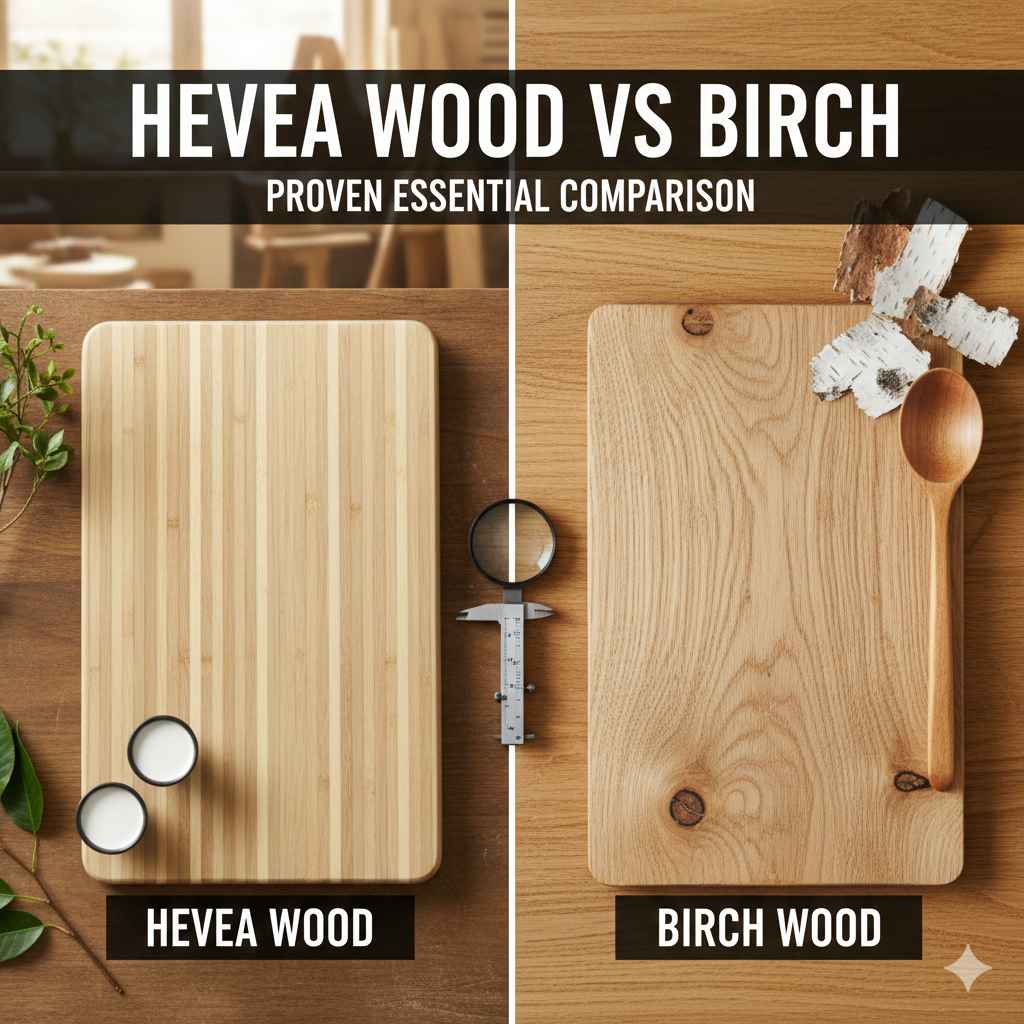
Hevea is usually pale cream to light tan with a moderately coarse texture. Commercial panels often contain many narrow staves, so a clear coat can reveal more color variation than a small sample suggests. Birch has a finer, more uniform texture and a lighter, cleaner look, although heartwood may add reddish-brown areas.
Staining hevea
Hevea machines and finishes reasonably well, but an edge-glued panel is a collection of boards, not one uniform piece. Sand every area to the same final grit, remove dust, and test the stain plus topcoat on the actual underside or an offcut. A gel stain or dye-and-seal schedule can give more control than flooding a dark penetrating stain onto mixed staves.
Staining or painting birch
Birch can absorb pigment unevenly and show blotches under dark stain. A washcoat, conditioner, dye, or gel stain may help, but the only reliable preview is a sample using the same sanding and topcoat schedule. Birch’s fine texture makes it a strong choice under paint, particularly for cabinet doors, drawer parts, and quality plywood panels.
If your goal is a dark walnut look, compare test boards rather than choosing only by species name. Our guide to acacia vs birch wood provides another useful color-and-hardness comparison.
Best Uses by Project
Countertops and butcher-block worktops
Both woods are sold as edge-glued countertops. Birch better resists small dents, while hevea often provides a less expensive route to the same size top. Do not chop directly on a finished countertop unless the manufacturer explicitly designed the finish and construction for that use. Around a sink, seal cutouts before installation and repair any failed finish promptly.
For a deeper kitchen-specific decision, see whether hevea is suitable for butcher-block countertops and compare it with our guide to the best woods for butcher block, or start with what a rubber wood countertop actually is if you are new to the material.
Desktops, tables, and shelves
Hevea is a sensible desktop or table-top material when the panel is flat, well glued, and supported. Birch is preferable where dents are more likely or where a fine grain is part of the design. For a long desktop, calculate support from the panel’s thickness and span; species hardness does not prevent sagging.
Cabinets and built-ins
Birch plywood is usually more efficient for cabinet boxes because it is dimensionally predictable, available in large sheets, and holds fasteners well when the grade and core are appropriate. Solid hevea can work for frames, shelves, doors, or interior furniture, but it is not a direct substitute for sheet goods.
Outdoor and damp locations
Neither wood is a low-maintenance exterior choice. Rubberwood has low natural resistance to decay, and birch also needs protection from repeated wetting. For a bathroom vanity or laundry top, use dry stock, protect every surface, leave appropriate expansion clearance, and fix leaks rather than relying on the coating to make the wood waterproof.
Cost: Compare Like for Like
Hevea is often—but not always—the cheaper option. In a current same-retailer snapshot, a 6-ft × 25-in unfinished hevea top and a comparable unfinished solid-birch top were close enough in price that a promotion could change the winner. See the live hevea listings and birch listings rather than relying on a fixed per-square-foot claim.
- Match length, width, and thickness.
- Separate solid wood, edge-glued butcher block, and engineered or veneered products.
- Check whether the top is unfinished, prefinished, or includes a warranty.
- Add waste, cutout sealing, brackets, finish, and delivery to the real project cost.
Sustainability: A Useful Claim With Limits
Hevea has a credible resource-efficiency advantage: the tree is first cultivated for latex and the trunk can later become timber. That does not automatically make every hevea panel low impact. Plantation management, kiln energy, adhesives, transport distance, and chain-of-custody certification still matter.
Birch can also be a responsible choice when it comes from a verified source. Ask for FSC or PEFC chain-of-custody information when sustainability is a deciding factor. Avoid treating “plantation wood” or “fast growing” as a complete environmental assessment.
A Five-Minute Panel Inspection Before You Buy
Species averages cannot reveal defects in the panel in front of you. This quick inspection adds more decision value than another generic hardness chart:
- Sight along both long edges and reject a panel with obvious bow or twist.
- Inspect both faces for glue-line gaps, end splits, filler, and abrupt stave-color changes.
- Confirm the label states the species, construction, thickness, and intended use.
- Check the installation sheet for acclimation, support, fastening, and finishing requirements.
- Buy enough finishing material to coat every face and every cut from the same batch.
Hevea vs Birch: Final Choice
Choose birch for a harder surface, fine texture, painted cabinetry, or a project where modestly better dent resistance justifies the cost. Choose hevea for an affordable indoor countertop, desk, or furniture panel when you are prepared to test the finish and protect it from moisture.
Before ordering, verify whether the birch product is solid wood, butcher block, or plywood. Then compare two panels of the same size and construction. That one step prevents the most common mistake in a hevea-versus-birch comparison.
Frequently Asked Questions
Is hevea wood harder than birch?
No. Rubberwood, or hevea, is about 960 lbf on the Janka scale, while yellow birch is about 1,260 lbf. Birch therefore resists dents better, although the exact performance of a panel also depends on its construction and finish.
Is hevea or birch better for a butcher-block countertop?
Choose birch when dent resistance and a fine, uniform surface matter most. Choose hevea when budget and a readily available edge-glued top matter more. Either wood needs all faces and cut edges sealed, standing water wiped up, and the finish maintained.
Does hevea wood stain well?
Hevea can accept stain, but color can vary across the finger-jointed or edge-glued staves in a factory panel. Sand consistently and test the complete finish schedule on the actual panel or a supplied offcut before coating the visible face.
Is birch plywood the same as solid birch?
No. Birch plywood is a layered sheet product, while solid birch and birch butcher block are lumber or glued staves. Plywood is usually the better cabinet-box material; solid or edge-glued stock is more appropriate for exposed edges, tops, and furniture parts.
Which costs less, hevea or birch?
Hevea is often cheaper, but species alone does not set the price. Compare panels with the same length, width, thickness, construction, grade, and finish because promotions and local inventory can reverse the difference.
Sponsored / affiliate links. As an Amazon Associate I earn from qualifying purchases. I may earn additional commission from eligible campaigns.
 Howizz 60 x 30 Inch Solid Hevea Wood Table Top – 1 Inch Thick Butcher Block Countertop for Standing Desk, Office Table, Workbench, DIY Furniture Projects, Unfinished Hevea
 Materialix Food Grade Mineral Oil – 8.45 fl oz | Cutting Board, Butcher Block Oil & Wood Conditioner for Bamboo, Knives, Stainless Steel & More