Plywood Sizes, Cuts and Prices Guide for Project Shops
Author: Mark Ellison, homeowner and cabinet-build hobbyist. I have used plywood for garage cabinets, closet shelving, painted built-ins, workbench tops, and small subfloor repairs, and I wrote this version from the same buyer’s perspective I use when I am trying to avoid a second store run.
Methodology and date: To keep the pricing consistent, every sheet-price estimate in this guide uses one method, one date, and one market: posted retail prices I recorded for commodity 4×8 plywood in the Chicago-area market on March 18, 2026 from big-box suppliers including Home Depot, Lowe’s, and Menards, using comparable in-stock categories by thickness and basic use class. Where a product family did not match exactly across stores, I use the midpoint of comparable posted listings and label it as a planning estimate rather than a universal market quote.
Sourcing note: I separate sheet price from store cutting and delivery because those charges are often quote-based, ZIP-code-based, or store-specific. That is why the sheet tables below use posted panel prices only, while the calculator lets you add your own cut and delivery line items.
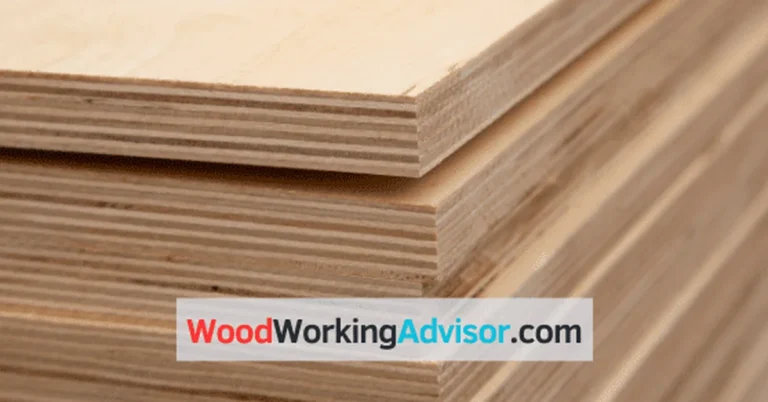
Plywood is often sold in 4×8 sheets, with common thicknesses around 1/4 to 3/4 inch, and the cheapest usable option is the sheet that yields your parts with relatively little waste after kerf, cut fees, and delivery. I have seen a $45 shelf panel turn into a much more expensive store run once offcuts, bad cuts, and transport get counted. Here you’ll get standard sheet sizes, store cut options, current price ranges, and a simple way to price cabinets, shelves, wall panels, and subfloor patches by finished part.
The useful math is simple: total project cost divided by finished parts that actually fit the job. Sheet price is only the starting number.
How to use this guide to buy plywood by usable yield
The four numbers that matter
Plywood quotes move mostly with four things: sheet size, thickness, grade, and region. In this guide, I keep the region fixed to one Chicago-area retail sample from March 18, 2026 so the comparisons stay consistent. To make those numbers useful at the buying stage, convert them into cost per usable part after trimming, saw kerf, retailer cut charges, and any share of delivery.
A cheap sheet that wastes a strip along every edge can cost more per cabinet side than a pricier sheet with a cleaner layout. I run into the same issue when a store charges for each rip, crosscut, or precision trim. If you need help picking face quality first, see our plywood grades guide.
Nominal sheet size versus actual part size
A 4×8 sheet gives a planning area of about 32 square feet. The 1220 x 2440 mm sheet is the most widely produced and traded plywood size, and it tracks the familiar 4×8 format. The 1250 x 2500 mm sheet is the metric standard and is about 5% more panel area.
Finished parts rarely match nominal sheet math perfectly. Layouts lose width to kerf, a little length to squaring cuts, and sometimes whole corners to damage from handling.
Why trim allowance and damaged edges change real cost
Two stores can quote the same panel and still land at different project totals. One may hand over a clean full sheet. Another may pre-cut it, charge for each pass, and leave narrow offcuts that are useless for the parts that matter.
For planning, I count every sheet as a little smaller than its label. That keeps the budget honest and helps compare one larger panel against two standard ones.
📊 The specification guide says thicknesses run from 3 to 40 mm. Source: Vietnam-plywood.
What are the standard plywood sheet sizes?
The standard plywood sheet most buyers will see is 4×8 feet, which matches the 1220 x 2440 mm format. Metric 1250 x 2500 mm sheets add about 5% more area, while 4×9 and 4×10 panels show up in specialty applications where fewer seams or longer parts can cut labor and waste.
4×8 sheets and the 1220 x 2440 mm equivalent
At home centers and most lumberyards, the sheet on the rack is usually 4×8. It works because many walls, cabinets, and floors break down cleanly from 48-inch and 96-inch dimensions.
That 32-square-foot area is the baseline for per-sheet and per-square-foot comparisons. When a quote does not name the sheet size, ask first. A low price can hide a smaller panel or a thin utility-grade sheet.
1250 x 2500 mm sheets
The 1250 x 2500 mm sheet is the metric standard and is about 5% more panel area. That extra area matters when a layout barely misses on a 4×8, such as a long shelf run or cabinet parts that need a wider rip plus a clean trimming margin.
It can also reduce waste when a project needs repeated parts with metric dimensions. The catch is availability. Some buyers pay more for freight or wait longer for stock.
4×9 and 4×10 specialty panels
4×9 sheets give about 36 square feet. 4×10 sheets give about 40 square feet. Those sizes often make sense for tall wall panels, long shelving runs, and jobs where one seam removed is worth more than the higher sheet quote.
They are less friendly to transport. A panel that saves one seam on site can still cost more if delivery is required or if handling damage eats that gain.
Sheet area and layout implications
- 4×8: 32 square feet. Easiest to source, easiest to compare, easiest to fit in common cut plans.
- 4×9: 36 square feet. Useful when one extra foot avoids a butt joint or turns scrap into a usable shelf.
- 4×10: 40 square feet. Good for long runs and fewer seams, but harder to haul and maneuver.
- 1220 x 2440 mm: common global trading size that aligns with 4×8 planning.
- 1250 x 2500 mm: about 5% more panel area, often worth checking when a 4×8 misses by a narrow margin.
How much does a 4×8 sheet of plywood cost?
Using the single-method sample in this guide for the Chicago retail market on March 18, 2026, a planning estimate for a commodity 4×8 sheet is about $14 for 1/4-inch, $28 for 1/2-inch, and $45 for 3/4-inch. Those are not national averages for every grade; they are comparable planning numbers drawn from posted big-box listings in one market on one date so you can compare yield consistently.
Common 4×8 price ranges
| Thickness | Low | Average | High | Approx. cost per sq. ft. at average |
|---|---|---|---|---|
| 1/4 inch | $9 | $14 | $22 | $0.44 |
| 1/2 inch | $16 | $28 | $40 | $0.88 |
| 3/4 inch | $28 | $45 | $65 | $1.41 |
Assumptions for the table: 4×8 sheet, commodity plywood or sheathing class, Chicago-area posted retail sample, March 18, 2026, before tax, before cut charges, before delivery, and excluding premium products such as Baltic Birch and marine plywood. I use the low and high as the observed spread inside that sample set and the average as the midpoint planning number used throughout the rest of the article.
Per-sheet versus per-square-foot pricing
Stores almost always price plywood by the full sheet, one panel at a time. I compare options by square foot instead, because that puts a 4×8 panel, a 4×10 panel, and a metric panel on the same page.
It also reveals when a thick sheet is poor value for the job. If a wall skin only needs 1/4 inch, paying a 3/4-inch rate because the store has it in stock is expensive waste.
Why 4×8 quotes can mislead
A 4×8 quote can hide three things: a lower face grade, an exterior glue line that raises price, or a cut-service charge that lands after checkout. Ask whether the quote is for CDX, sheathing, utility, A-C, B-C, AC exterior, BC exterior, Baltic Birch, or marine plywood. For a deeper side-by-side on panel choices inside cabinets, I would also compare our cabinet materials and MDF vs plywood guides before buying.
How do plywood prices change by thickness?
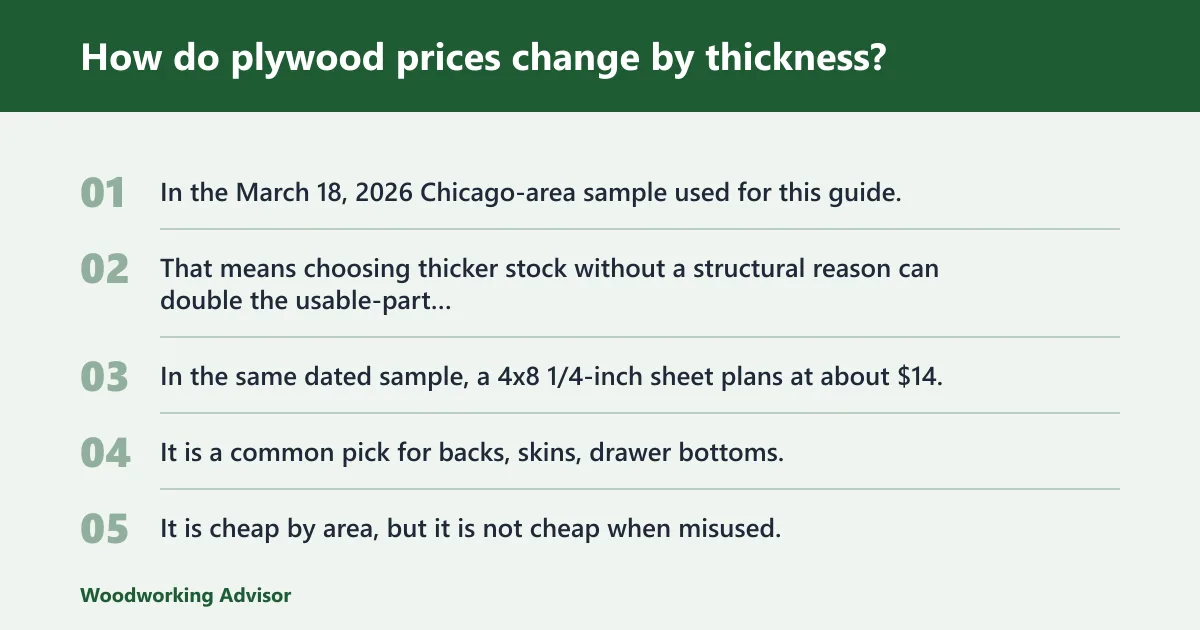
In the March 18, 2026 Chicago-area sample used for this guide, plywood gets more expensive as it gets thicker: about $14 for 1/4 inch, $28 for 1/2 inch, and $45 for 3/4 inch in commodity 4×8 panels. That means choosing thicker stock without a structural reason can double the usable-part cost.
1/4 inch
In the same dated sample, a 4×8 1/4-inch sheet plans at about $14, with observed listings from roughly $9 to $22 depending on panel type and face quality. It is a common pick for backs, skins, drawer bottoms, and wall panel overlays where stiffness comes from framing behind the panel.
It is cheap by area, but it is not cheap when misused. A shelf built from 1/4 inch often needs more framing, more fasteners, or a second layer.
1/2 inch
In the same sample, a 4×8 1/2-inch sheet plans at about $28, with observed listings from roughly $16 to $40. This thickness often lands well for lighter cabinet parts, divider panels, jigs, and shop fixtures.
For buyers who need cabinet sides but not heavy spans, 1/2 inch can cut finished-part cost sharply. The savings disappear if the design then needs extra stiffeners or face frames to make up for flex.
5/8 inch and 3/4 inch
5/8 inch is a middle ground often chosen for some floor and wall work. In my March 2026 store check, it usually sat between comparable 1/2-inch and 3/4-inch panels, but stock was less consistent, so I do not use it as the main benchmark in the calculator.
In the same sample, a 4×8 3/4-inch sheet plans at about $45, with observed listings from roughly $28 to $65. That thickness is common for shelving, cabinets, and subfloor patches where stiffness matters more than panel count.
What plywood thickness is best for walls, shelving, or subflooring?
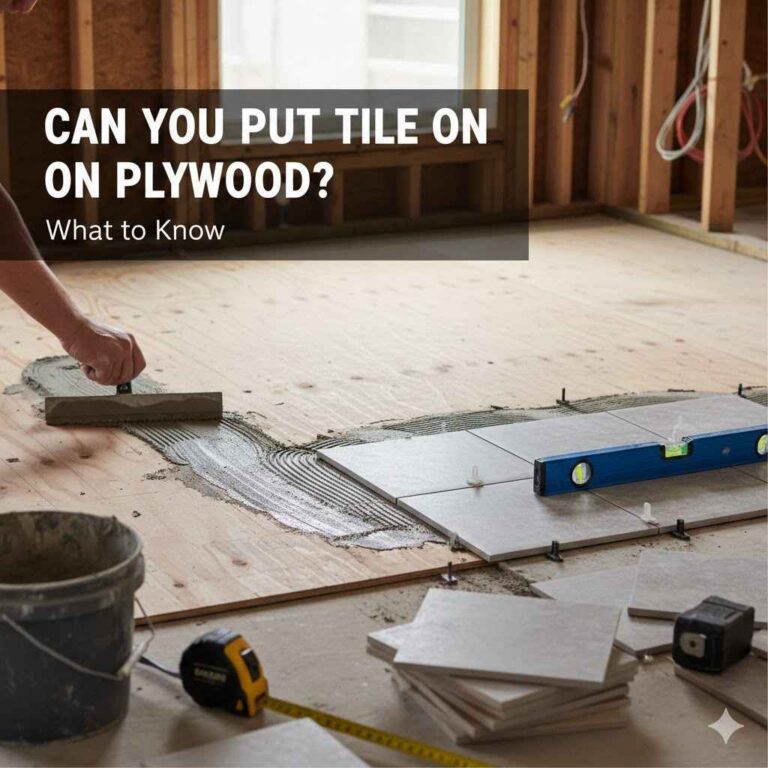
For many wall skins and backs, 1/4 inch is enough when framing supports the panel. Shelving usually works better in 3/4 inch because span stiffness matters. Subfloor patches are commonly bought in 5/8 inch or 3/4 inch so the repair can match surrounding floor height and strength. For code and span context, check our subflooring thickness guide.
Buy the thinnest panel that still does the job without added framing, sag, or deflection fixes. That is the real price line.
What is the difference between interior and exterior plywood pricing?
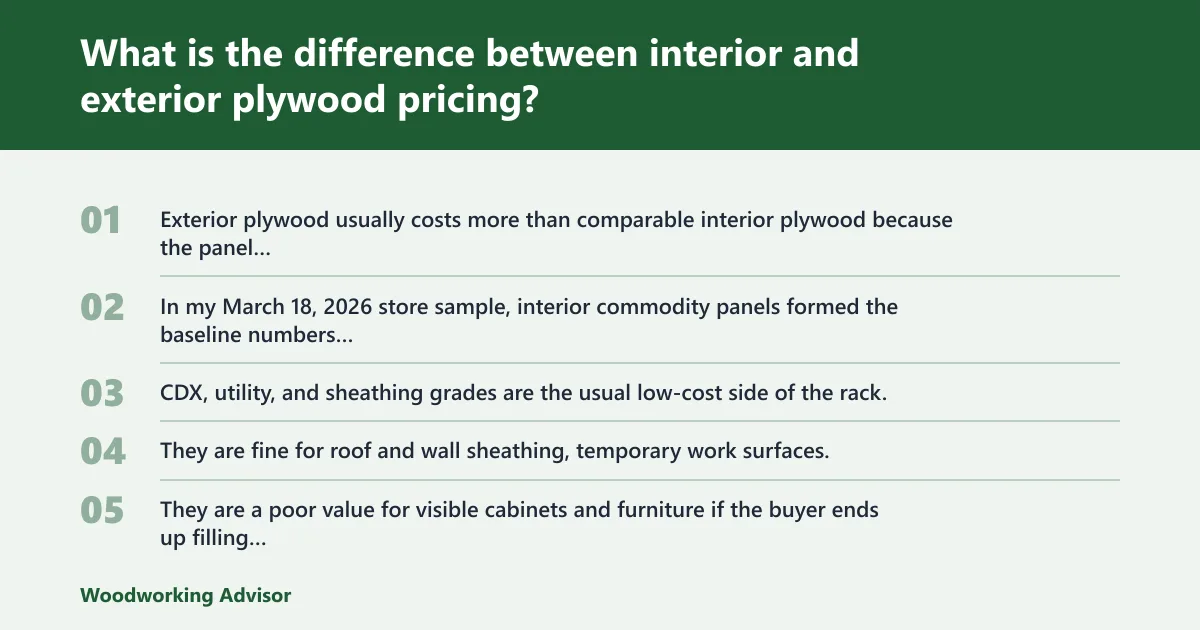
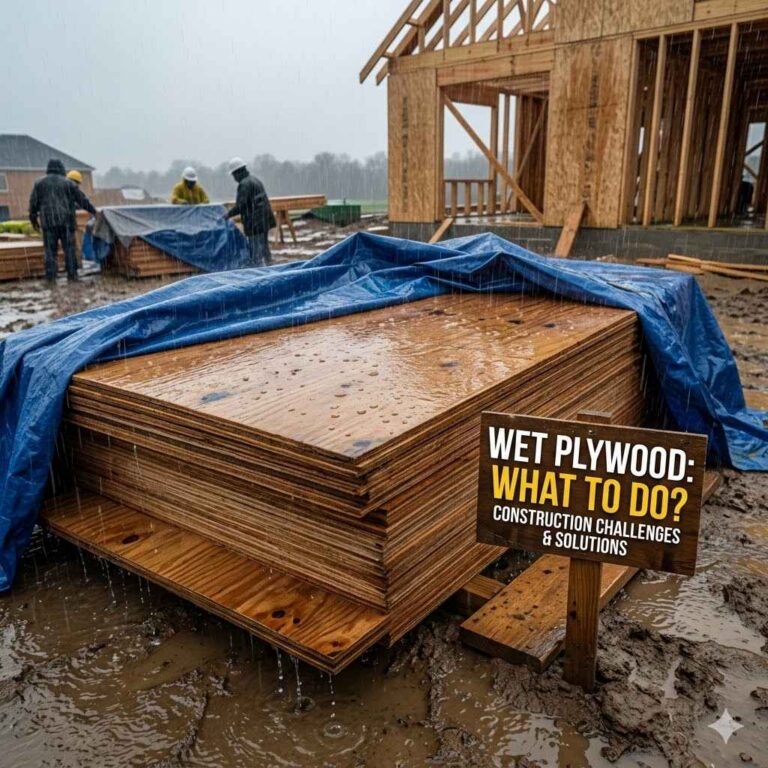
Exterior plywood usually costs more than comparable interior plywood because the panel is built for moisture exposure, with glue, resin, and face quality aimed at harsher service. In my March 18, 2026 store sample, interior commodity panels formed the baseline numbers above, while exterior-rated versions of similar thicknesses were consistently posted above that baseline.
CDX, utility, and sheathing grades
CDX, utility, and sheathing grades are the usual low-cost side of the rack. They are fine for roof and wall sheathing, temporary work surfaces, and rough construction where face appearance is secondary.
They are a poor value for visible cabinets and furniture if the buyer ends up filling voids, trimming around damaged veneer, or applying a face skin later.
A-C, B-C, AC exterior, and BC exterior
A-C and B-C grades trade up for better faces and more predictable finish work. AC exterior and BC exterior add outdoor-rated glue and exposure resistance, which makes them better suited to porch ceilings, utility cabinetry in damp spaces, and protected exterior work.
That price premium only pays back when moisture or finish quality matters. For dry, painted storage shelves in a garage, many buyers overpay here.
Interior versus exterior use cases
Interior plywood is the economical choice for dry cabinets, closet parts, furniture carcasses, and wall skins inside conditioned rooms. Exterior plywood is better for wet basements, utility rooms with repeated humidity swings, exterior soffits, and patch work that may see rain before installation.
If a panel will be constantly wet or live in direct weather, standard exterior plywood may still be the wrong step up. That is where marine plywood enters the picture.
How much does Baltic Birch or marine plywood cost compared with standard plywood?
Compared with the $45 planning baseline for a commodity 3/4-inch 4×8 sheet in this guide’s March 18, 2026 Chicago sample, Baltic Birch and marine plywood are premium products and should be priced as separate categories. Because those items were less consistently stocked across all three sampled retailers, I treat them as specialty quotes rather than folding them into the commodity table above.
Baltic Birch
Baltic Birch is usually bought for cabinetry, drawers, shop fixtures, and furniture where clean edges, stable plies, and a better surface are worth paying for. Compared with a standard 3/4-inch 4×8 sheet planning at $45 in this guide, the premium is obvious.
It can still be cheaper per finished part when the project would otherwise need edge banding, face skins, or extra sorting to avoid voids.
Marine plywood
Marine plywood is priced for repeated wet exposure and stricter panel quality. It is not the automatic choice for every outdoor project. On a potting bench under a roof, exterior plywood may do the job for less.
On a panel that sees constant or repeated wetting, the higher sheet price can be cheaper than rebuilding the same part later.
Plywood cost-and-yield calculator table
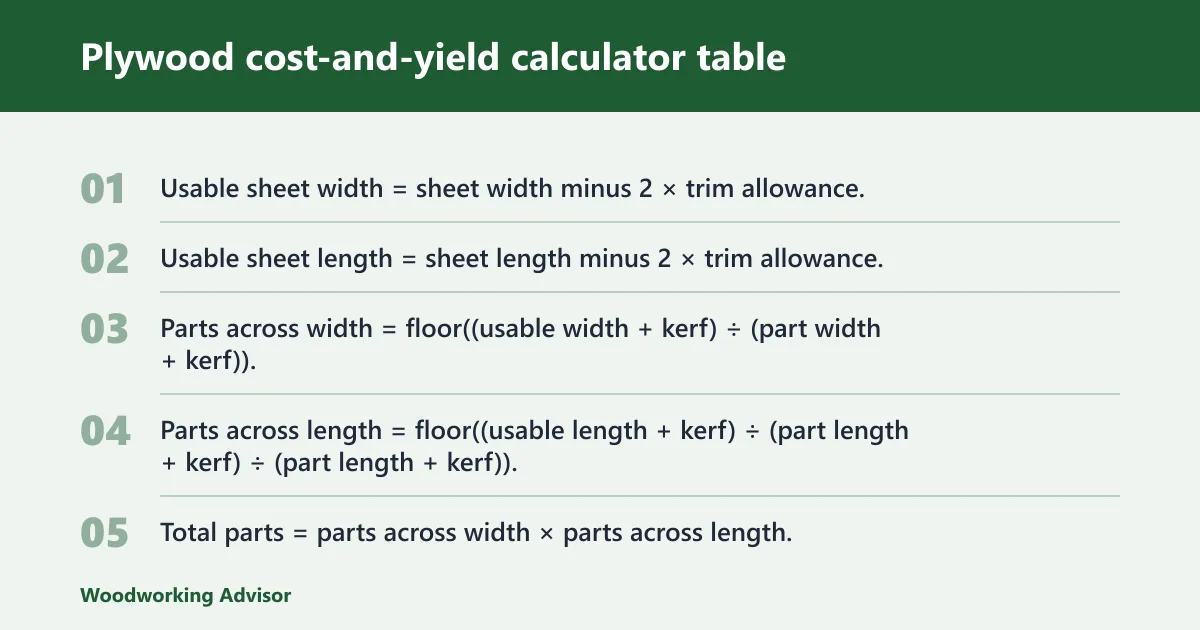
Use this table to convert sheet price into finished-part price
The examples below are planning examples built from common sheet sizes, average 4×8 sheet pricing, and estimated waste from trimming and cut loss. They are meant to compare options, not replace a store quote. The useful number is the last column: cost per finished part after sheet price, cut service, and a share of delivery.
Interactive plywood cost-and-yield calculator
I use this same math when I price cabinet sides and shelf parts for my own shop builds. Enter your sheet, part, and extra-cost numbers below. The calculator uses a default saw kerf of 1/8 inch and lets you add trim allowance separately.
Formula notes:
- Usable sheet width = sheet width minus 2 × trim allowance.
- Usable sheet length = sheet length minus 2 × trim allowance.
- Parts across width = floor((usable width + kerf) ÷ (part width + kerf)).
- Parts across length = floor((usable length + kerf) ÷ (part length + kerf)).
- Total parts = parts across width × parts across length.
- Cost per finished part = (sheet price + extra cut/delivery cost per sheet) ÷ total parts.
- This is a straight-grid calculator. It does not optimize rotated nesting, defects, grain matching, or mixed part sizes.
Downloadable examples:
Download CSV examples
|
Download TXT examples
| Project part | Sheet and thickness | Cut pattern | Estimated waste | Example sheet cost | Example cut/delivery add-on | Finished parts from sheet | Resulting cost per finished part |
|---|---|---|---|---|---|---|---|
| Cabinet sides about 24 x 34 inches | 4×8, 1/2 inch | Rip into two strips, then crosscut | About 12% | $28 | $18 | 4 | $11.50 |
| Cabinet sides about 24 x 34 inches | 1250 x 2500 mm, 1/2 inch | Same pattern with more trim margin | About 8% | About $29.40 at the same area rate | $18 | 4 | About $11.85 |
| Shelves about 12 x 30 inches | 4×8, 3/4 inch | Repeated rips and crosscuts | About 18% | $45 | $20 | 8 | $8.13 |
| Shelves about 12 x 30 inches | 4×10, 3/4 inch | Repeated rips with fewer end offcuts | About 10% | About $56.25 at the same area rate | $25 | 10 | About $8.13 |
| Subfloor patches about 24 x 24 inches | 4×8, 3/4 inch | Half-sheet cuts, then crosscuts | About 10% | $45 | $15 | 7 | About $8.57 |
| Subfloor patches about 24 x 24 inches | 4×9, 3/4 inch | Half-sheet cuts with one extra patch | About 11% | About $50.63 at the same area rate | $20 | 8 | About $8.83 |
How to read the calculator
- Pick the part size first.
- Choose the thinnest workable panel for the load and span.
- Lay out parts by full rip, half-sheet, crosscut, or trim-heavy pattern.
- Add any store cutting or edge-finishing charge.
- Add a fair share of delivery to each sheet in the order.
- Divide the full total by usable finished parts, not by raw square feet.
The table also shows why larger sheets are not automatically cheaper. The 4×10 shelf example cuts waste, yet a higher cut fee or delivery charge can erase the gain. The assumptions stay consistent with the same March 18, 2026 sheet-price baseline used above.
How much extra do cutting and delivery add to plywood costs?
Cutting and delivery can easily outweigh small differences in sheet price, which is why I do not roll them into the pricing table. In practice, I price them as separate line items because retailer policies vary by store, by ZIP code, and by order size more than sheet pricing does.
Store cutting charges
Some sellers include a rough breakdown cut. Others charge by the cut, by the panel, or by a precision-trim service level. A simple half-sheet break is one thing. Multiple clean rips for shelving are another.
Ask whether the quote covers rough sizing only or finish-ready cuts. If the parts still need another trim at home, the first cut fee bought less than expected.
Delivery distance and freight minimums
Delivery is one of the biggest reasons a sheet that looks cheaper online stops being cheaper at checkout. In my own projects, that is often the line item that decides whether I buy one better sheet locally or try to save a few dollars on panel price and pay it back in transport.
Because those charges change by cart, route, and ZIP code, I recommend adding the exact store quote into the calculator above instead of relying on a generic national range.
Watch for minimum order fees, damaged-corner risk, and pre-cut markup. A bargain sheet that arrives with one crushed corner may no longer yield the part count in the cut plan.
Budget a little overage when grain direction matters, when face quality matters, or when the layout has narrow strips that turn into unusable scrap.
Are larger or specialty plywood sheets worth the price?
Larger sheets are worth the price when the extra area removes a seam, saves a whole additional sheet, or raises finished-part yield enough to offset higher freight and handling. They are poor value when the project already nests cleanly in 4×8 sheets or when transport and cut-service charges eat the area gain.
When 4×9 or 4×10 saves money
A taller wall panel, a long closet shelf, or a subfloor patch pattern that barely misses on 4×8 can make a specialty size pay for itself. One sheet with fewer seams can also cut fastener count, patching time, and finish work.
When larger sheets cost more in practice
Bigger panels are heavier to handle, harder to cut accurately on site, and more likely to require delivery. If the project fits a 4×8 layout with only modest waste, the larger sheet may increase labor without adding useful parts.
A simple break-even check
Compare total project cost, not area alone. If the bigger panel avoids buying another sheet or drops the finished-part cost below the 4×8 option after cut and delivery charges, it wins. If it only creates a nicer offcut pile, it does not.
Best plywood choices for common DIY projects
Cabinet carcasses and furniture parts
Use cost per cabinet side or divider, not cost per sheet. For painted or utility cabinets, 1/2 inch or 3/4 inch in a decent face grade usually makes more sense than low-grade sheathing that needs repair work. Baltic Birch can make sense where exposed edges are part of the design. If you are deciding between panel products first, compare our cabinet materials and MDF vs plywood pages.
Shelving and closet builds
Shelves are where underbuying thickness gets expensive. A 3/4-inch panel usually earns its higher sheet price if it avoids sag, front edging, or extra supports. For long closet runs, check whether a 4×10 layout reduces joints enough to pay for the bigger panel.
Subfloor patches and wall paneling
Subfloor patches usually need thickness that matches the surrounding floor, so 5/8 inch or 3/4 inch is the normal starting point. Wall paneling and skins often work well in 1/4 inch when framing supports the panel and the face quality matches the room. Our subflooring thickness guide is the page I would read before buying patch panels.
When to buy pre-cut panels versus full sheets
Pre-cut panels make sense when transport is the main problem or when the retailer can deliver accurate cuts at a low fixed fee. Full sheets are usually cheaper when many repeated parts come from one layout and the buyer can cut them cleanly without paying per cut.
Frequently asked questions
What are the standard plywood sheet sizes?
The common sheet is 4×8 feet, equivalent to the widely traded 1220 x 2440 mm format. A 1250 x 2500 mm sheet adds about 5% more area, while 4×9 and 4×10 panels are specialty sizes used when fewer seams or longer parts reduce waste or labor enough to justify the higher quote.
How much does a 4×8 sheet of plywood cost?
Using the consistent method in this guide, a Chicago-area March 18, 2026 planning estimate for a commodity 4×8 sheet is about $14 for 1/4 inch, $28 for 1/2 inch, and $45 for 3/4 inch. Those numbers become useful only after adding your real cut fees, delivery, and waste, then dividing by the finished parts the sheet actually yields.
What is the difference between interior and exterior plywood pricing?
Interior plywood is cheaper because it is meant for dry conditions. Exterior plywood costs more because it is built for moisture exposure with different glue and panel construction. That premium makes sense for damp or weather-exposed jobs, but it is often wasted on dry indoor shelves, cabinets, and wall skins.
How much extra do cutting and delivery add to plywood costs?
They vary enough by store and ZIP code that I treat them as separate line items rather than a fixed universal range. On small projects, those extras can change the cheapest sheet choice faster than moving up one grade, so always add the actual quote to the calculator.
Are larger or specialty plywood sheets worth the price?
They are worth it when they remove a seam, prevent the purchase of another sheet, or raise usable yield enough to beat a 4×8 layout after freight and cutting charges. They are not worth it when the project already nests cleanly in standard sheets and handling becomes the main extra cost.
How much does Baltic Birch or marine plywood cost compared with standard plywood?
They cost noticeably more than the commodity 3/4-inch planning baseline used in this guide, which is $45 for a 4×8 sheet in the March 18, 2026 Chicago-area sample. Because specialty-panel stock and dimensions vary a lot by seller, I would treat Baltic Birch and marine plywood as quote-required products instead of assuming the commodity table applies.
Sources
- Chicago-area retail plywood price sample collected March 18, 2026 from posted in-stock listings at Home Depot, Lowe’s, and Menards for comparable 4×8 commodity plywood categories by thickness.
- Metric sheet-size and thickness context from Vietnam-plywood.
- All calculator examples in this article use the guide’s single-method baseline: 4×8 commodity panel pricing, before tax, before delivery, before cutting, with user-entered kerf, trim, and extra charges.
Sponsored / affiliate links. As an Amazon Associate I earn from qualifying purchases. I may earn additional commission from eligible campaigns.
 Baltic Birch Plywood Sheets Box of 45 - Laser Engraving Cutting, Scroll Saw Nature Veneer Color, Stronger Than Basswood, A/A Grade,12 x 12 x 1/8”, 3mm Thickness Perfect for Wood Burning
 Double Side Plywood Sheets 4mm or 5mm for Painting Stenciling Wood Burning and Decoration 150x220mm 220x300mm 300x450mm Art Project Wood