What Is Elmer’s Glue Made Of? Ingredients and How PVA Is Made
Elmer’s glue is polyvinyl acetate (PVAc) dispersed in water. Elmer’s safety data sheets call Glue-All a “PVAC based adhesive” but treat the rest of the recipe as proprietary, so many ingredient lists online are guesses. This guide separates what Elmer’s has confirmed, such as pH, density and freezing point, from how PVAc emulsions are generally made, and what that means for wood joints.
What Is Elmer’s Glue Made Of?
Best Elmer’s Wood Glue Pick
 |
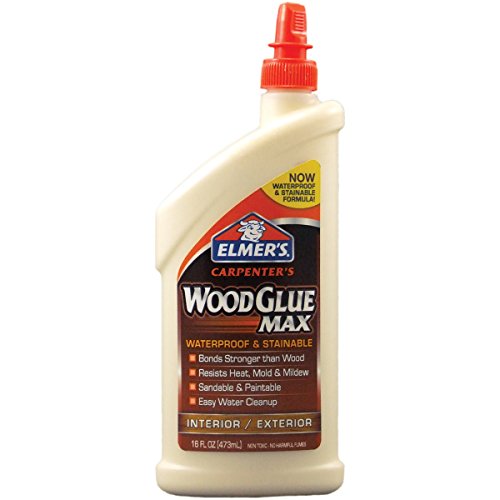
Elmer’s E7310 Carpenter’s Wood Glue Max, 16 oz ($9.30) The woodworking version of the PVA chemistry explained below: a ready-to-use bottle for wood joints rather than paper crafts, sold for interior and exterior use.
|
As an Amazon Associate we earn from qualifying purchases.
The adhesive in Elmer’s glue is polyvinyl acetate, a polymer with the repeating unit (C4H6O2)n that is made by polymerizing vinyl acetate monomer. The polymer is not dissolved in the bottle. It is dispersed as microscopic particles in water, which is why the glue looks like milk. When the water leaves, the particles pack together into a flexible film, and that film is the bond (Wikipedia: polyvinyl acetate).
Everything beyond that is where online ingredient lists get shaky. Elmer’s publishes safety data sheets (SDS), not recipes, and the composition section of those sheets is deliberately vague. Here is what the sheets we could read actually say.
What Elmer’s safety data sheets confirm
| Property | Elmer’s Glue-All (white) | Elmer’s Carpenter’s Wood Glue (yellow) |
|---|---|---|
| Listed composition | Proprietary non-hazardous ingredients, 100% | Non-hazardous substance, 100% |
| Product type | PVAC based adhesive | Carpenter’s wood glue |
| Appearance | Milky white liquid, mild acetic odor | Yellow liquid, mild acetic odor |
| pH | 4.8 to 5.1 | 4.1 to 4.4 |
| Specific gravity (water = 1) | 1.04 to 1.07 | 1.07 to 1.12 |
| Percent volatiles | 63 | Not listed |
| Freezing point | 0 °C (32 °F) | 0 °C (32 °F) |
| Boiling point | 100 °C (212 °F) | 100 °C (212 °F) |
| Water solubility | Dispersible | Dispersible |
Two details matter here. First, both glues are mildly acidic, and both have a mild acetic odor, the same smell people describe as vinegar-like. Second, neither sheet names a single ingredient other than the generic description, which means a table of "PVAc, polyvinyl alcohol, propylene glycol, surfactants, preservatives" is an industry-typical list, not an Elmer’s disclosure.
A number worth knowing: an older Elmer’s MSDS for Glue-All lists percent volatiles at 63. Volatiles are mostly water that evaporates as the glue dries, so roughly 37 percent of the bottle is the material that stays behind as the bond. That is our arithmetic from the sheet, not an Elmer’s statement. Source: Elmer’s Glue-All MSDS.
Is Elmer’s Glue PVA? (Direct Answer)
Yes. Elmer’s Glue-All and Elmer’s Carpenter’s Wood Glue are PVA glues, meaning polyvinyl acetate adhesives. The name causes confusion because "PVA" is also the abbreviation for polyvinyl alcohol, a different polymer that is made by hydrolyzing polyvinyl acetate. In the woodworking and craft aisle, "PVA glue" always means the acetate version.
The alcohol version does show up in PVAc chemistry, though. Research on making PVAc emulsions for wood and paper adhesives describes polyvinyl alcohol as a common protective colloid, a helper that keeps the polymer particles from clumping and improves properties such as shear resistance. Whether a given Elmer’s bottle contains it is not disclosed, so treat it as likely but unconfirmed.
If you are comparing white glue with yellow wood glue for a project, our breakdown of wood glue versus PVA glue covers the practical differences, and the Elmer’s wood glue review covers how the brand performs on furniture.
How Elmer’s Glue Is Made: What Is and Isn’t Public
Elmer’s has not published its plant process, batch sizes, additive packages or quality-control steps, and we are not going to invent them. What is documented in the chemistry literature is how PVAc emulsions in general are produced, and that is the foundation any white or yellow PVA glue sits on.
How a PVAc emulsion is made in general
A published study of PVAc emulsion production (Process Characterization of Polyvinyl Acetate Emulsions, PMC) describes the standard route, called emulsion polymerization. The numbers below come from that lab-scale study and show the method, not Elmer’s own settings.
- Start with monomer: vinyl acetate of at least 99 percent purity is the building block.
- Disperse it in water: a protective colloid, in the study a partially hydrolyzed polyvinyl alcohol, keeps the growing particles apart.
- Start the reaction: a redox initiator pair (ascorbic acid and sodium persulfate in the study) starts radical polymerization at a mild 60 °C.
- Feed gradually: monomer is dosed in slowly, a starved-feed or semi-batch process, which the authors say gives nearly complete conversion and lets you control particle size.
- Check the result: the finished dispersions in the study held more than 40 percent solids, up to about 54 percent, with particles in the 480 to 619 nanometer range.
Notice what that list does not contain: nothing about bottles, labels or factory layout. A commercial glue maker then blends the finished emulsion with its own additives to tune viscosity, open time, color and shelf life. Those additive choices are the trade secrets Elmer’s keeps out of its SDS.
How the glue turns into a bond
Once the glue is spread, water leaves in two ways: it evaporates into the air and it soaks into porous material such as wood. The particles move closer together and fuse into a continuous film. That is why PVA glue works well on wood, paper and cloth, which are porous, and poorly on bare metal or glass, which cannot absorb the water (Wikipedia).
The film has a built-in limit. Polyvinyl acetate has a glass transition temperature between 30 and 45 °C (about 86 to 113 °F), depending on molecular weight. Near and above that range the polymer softens, which is one reason standard PVA joints creep under constant load or in a hot attic. For furniture and boxes that is fine. For a shelf holding a stack of books on a sunny wall, it is worth knowing.
Elmer’s Glue-All vs Carpenter’s Wood Glue for Woodworking
The SDS table above already shows the two bottles are different products: different color, different acidity and a higher specific gravity for the wood glue. Elmer’s does not say why, so we will not guess at cross-linkers or solids. What the brand does state is the intended use, and that is the better guide.
| Glue-All (white) | Carpenter’s Wood Glue Max | |
|---|---|---|
| Sold for | General crafts, paper, light household bonding | Wood joints, repairs and glue-ups |
| Water exposure | Standard PVA: not waterproof | Listed for interior and exterior use, resists heat, mold and mildew |
| After curing | Flexible film | Sandable and paintable |
| Our pick for a wood joint | Only for non-structural trim or crafts | Yes, use this one |
The practical rule: for a joint that carries weight, use the wood glue. For clear-drying results on visible seams, see our guide to clear-drying wood glue. Standard PVA is also not waterproof, so outdoor projects need an exterior-rated glue and a finish.
How to Get the Strongest Joint With Elmer’s Glue
Because the bond forms as water leaves, every tip below is about letting water escape evenly while the surfaces stay tight together.
- Start with clean, bare wood: sand lightly and wipe off dust. Oil, wax or old finish blocks the wood from absorbing water, so the glue cannot grip.
- Spread a thin, even coat: use a brush or roller for full coverage on both faces. A small bead of squeeze-out along the joint line shows you used enough.
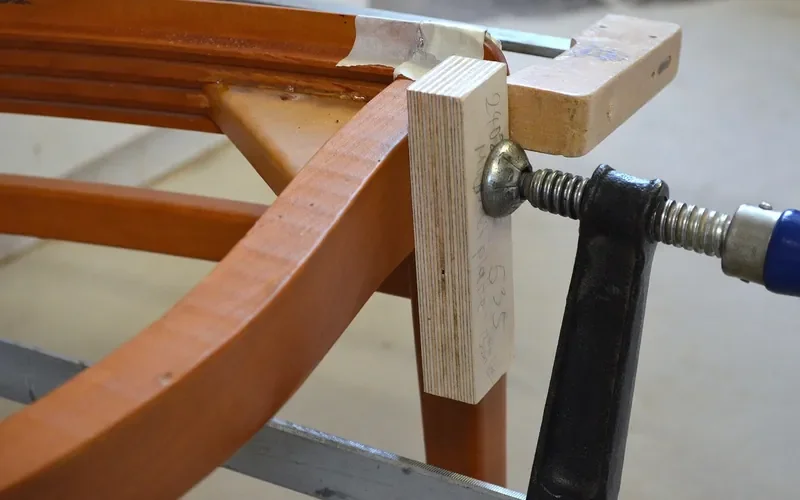
- Clamp right away: close the joint and apply firm, even pressure so the film forms in a tight gap. Wipe squeeze-out with a damp rag before it skins over.
- Mind the temperature: Wikipedia notes that aliphatic resin (yellow) wood glues set between about 50 and 110 °F (10 to 43 °C). Check your bottle’s label for its own minimum.
- Give it time: the same source puts full cure at about 24 hours. Keep stress off the joint until then.
Keep unopened and opened bottles out of freezing temperatures. Elmer’s Glue-All SDS tells you to keep it from freezing and to store it in a cool, dry place with the container tightly closed.
Is Elmer’s Glue Safe to Handle?
Elmer’s Glue-All MSDS says the product is not a health hazard or physical hazard under the OSHA Hazard Communication Standard, and that ingestion is not expected to be harmful under normal use. That is not a reason to eat it: if some is swallowed, the sheet says to dilute with large quantities of water and contact poison control or a hospital. Our can you eat Elmer’s glue page goes deeper on that question.
- Eyes: the Carpenter’s Wood Glue SDS says to remove contact lenses if easy, wash with large amounts of warm water for at least 15 to 20 minutes, and get medical attention.
- Skin: wash with soap and water. The Glue-All MSDS notes prolonged or repeated contact may cause irritation, so wear gloves for long glue-ups.
- Swallowing: do not induce vomiting (wood glue SDS). Call poison control.
- Fire: wet glue will not burn until the water is gone, but the Glue-All MSDS notes that dried material may burn.
- Incompatibilities: Glue-All lists strong acids and alkaline materials, and the wood glue sheet lists strong oxidizers.
Frequently Asked Questions About Elmer’s Glue
What is Elmer’s glue made of?
Elmer’s glue is polyvinyl acetate (PVAc) dispersed in water. Elmer’s safety data sheets describe Glue-All as a PVAc based adhesive and list the remaining ingredients as proprietary, so no full recipe is public.
Is Elmer’s glue PVA glue?
Yes. In woodworking and crafts, PVA glue means polyvinyl acetate white or yellow glue, and Elmer’s Glue-All is one. It is not the same as polyvinyl alcohol, a different polymer made by hydrolyzing polyvinyl acetate.
What are the ingredients in Elmer’s glue?
Elmer’s does not publish a full list. Its safety data sheets for Glue-All and Carpenter’s Wood Glue show only a non-hazardous substance or proprietary non-hazardous ingredients at 100 percent. Lists naming propylene glycol or surfactants are not confirmed by those sheets.
Does vinegar break down Elmer’s glue?
No source we found shows vinegar breaking down Elmer’s glue. Elmer’s Glue-All safety data sheet does list strong acids and alkaline materials as incompatible, but vinegar is a weak acid. Borax-type activators, not vinegar, are what cross-link PVA in slime.
Does freezing ruin Elmer’s glue?
Elmer’s Glue-All safety data sheet gives a freezing point of 0 C (32 F) and says to keep the glue from freezing. Store bottles in a cool, dry place with the cap tightly closed, and do not leave them in an unheated shop in winter.
Is Elmer’s glue waterproof?
Standard PVA white glue is not waterproof. Elmer’s Carpenter’s Wood Glue Max is sold for interior and exterior use and resists heat, mold and mildew, per its Amazon listing, but check the label for the water-resistance rating before using it outdoors.
The Short Version
Elmer’s glue is PVAc particles in water, with an undisclosed additive package, and its safety data sheets confirm the physical numbers but not a full ingredient list. For woodworking, pick the carpenter’s formula, clamp the joint, and give it a day. Treat any page that lists exact percentages for every ingredient with suspicion.
Sponsored / affiliate links. As an Amazon Associate I earn from qualifying purchases. I may earn additional commission from eligible campaigns.