Wood Glue Buying Guide: Which Type Should You Buy?
Quick Answer: For most indoor furniture and cabinetry, buy a PVA wood glue like Titebond Original or Titebond II. Choose Titebond III or another ANSI/HPVA Type I waterproof glue for outdoor projects and cutting boards, epoxy for gap-filling or dissimilar materials, and CA glue only for small, non-load-bearing repairs (see our CA glue vs wood glue strength comparison for the full breakdown).
Scroll a wood glue listing on Amazon and you will find PVA, aliphatic resin, epoxy, polyurethane, cyanoacrylate, and hide glue all labeled “wood glue” with no clear signal about which one fits your project. Picking the wrong type is the single most common wood glue buying mistake, and it usually shows up months later as a joint that creeps apart or a cutting board seam that blackens with water.
What Type of Wood Glue Should You Buy for Your Project?
Match the glue to the project’s moisture exposure and joint type first, then worry about brand. Indoor wood-to-wood joints need PVA. Outdoor or wet-exposed joints need a Type I waterproof PVA or polyurethane. Gap-filling and mixed-material joints need epoxy.
- Indoor furniture, cabinets, panel glue-ups: PVA (yellow) wood glue — Titebond Original or Titebond II.
- Outdoor furniture, planters, decks: Titebond III or another ANSI/HPVA Type I waterproof PVA.
- Cutting boards, butcher blocks, anything food-contact: Titebond III — it is the only Titebond formula rated FDA 21 CFR 175.105 for indirect food contact.
- Bonding wood to metal, glass, or stone, or filling large gaps: two-part epoxy.
- Outdoor structural bonds where the joint fit is imperfect: polyurethane glue.
- Small repairs, wood turning, veneer chips, non-load-bearing joints: CA (super) glue.
- Antique furniture restoration or musical instruments you may need to disassemble later: hide glue.
What Are the Main Types of Wood Glue?
Six adhesive chemistries cover nearly every woodworking task: PVA, aliphatic resin (the Titebond II/III family), epoxy, polyurethane, cyanoacrylate, and hide glue. Each trades off bond strength, water resistance, open time, and reversibility differently. If you only care about maximum bond strength and want the ASTM PSI numbers side by side, see our strongest wood glue comparison.
What Is PVA (Yellow) Wood Glue Best For?
PVA wood glue, sold as Titebond Original, bonds indoor wood joints at roughly 3,600 PSI and is not rated for outdoor or sustained high-humidity use. It has a 15-minute open assembly time, needs temperatures above 55°F to cure properly, and reaches full cure in 24 hours. That bond only holds up on rigid, porous materials, though — if you’re attaching fabric or another soft material to wood instead, see our guide on how to glue material to wood for the adhesives that actually work there. One more thing worth knowing before you glue up a piece you plan to finish: cured PVA dries into a sealed film that blocks stain from soaking in, so any squeeze-out left on a show face will show up as a pale patch later — see why wood glue and stain fight each other for how to avoid it.
In my shop, a Titebond II panel glue-up comes out of the clamps after 30 minutes, but I still leave it on the rack overnight — a full 24 hours — before running it through the planer (see our full breakdown of why wood glue needs a full 24 hours to cure, not just the 30-60 minute clamp time). An early-cure glue line has telegraphed through a finish on a panel I rushed once, and it is not a mistake worth repeating for the sake of saving an evening.
What Is Aliphatic Resin (Titebond II and III) Best For?
Titebond II passes the ANSI/HPVA Type II water-resistance test at 3,750 PSI and suits outdoor furniture and decks that get rained on but are not submerged. Titebond III is the only formula rated ANSI/HPVA Type I fully waterproof, tests at roughly 4,000 PSI, and is FDA 21 CFR 175.105 approved for indirect food contact — the reason it is the standard pick for cutting boards.
Both formulas need a minimum 45°F application temperature, well below Titebond Original’s 55°F minimum, which matters if you glue up in an unheated garage. These figures match Franklin International’s official Titebond III product specifications. Our full Titebond I vs II vs III comparison breaks down every spec side by side if you already know you want a Titebond product and just need to pick the formula.
When Should You Use Epoxy Instead of Wood Glue?
Two-part epoxy tests at roughly 3,000 to 4,000 PSI tensile strength, compared with about 800 to 1,500 PSI for standard PVA wood glue in the same type of test. Epoxy is a two-component resin-and-hardener system that chemically bonds to the wood rather than just gripping the surface, so it fills gaps and bonds wood to metal, glass, or stone in ways PVA cannot.
Reach for epoxy specifically when a joint does not fit tightly, when you are bonding wood to a non-wood material, or when the assembly needs to be structural without clamping pressure. Fast-set epoxies like Gorilla 2 Part Epoxy cure in 5 minutes, which is fast enough for small repairs but too fast for anything needing repositioning time. See our breakdown of epoxy set and cure times by type before deciding how much working time you actually need.
What Is Polyurethane Wood Glue Best For?
Polyurethane glue expands into a foam as it cures, which lets it bond wood to metal, ceramic, stone, and some plastics, and it is fully waterproof once cured. It needs the wood surface lightly dampened before application and clamping pressure while it foams. For bonding a stone slab like marble directly to a wood base, see our guide on how to fix marble on wood, which covers why a flexible adhesive matters more than raw bond strength for that pairing.
The honest limitation: cured polyurethane squeeze-out sets rock-hard and pulls off in a stubborn skin rather than sanding away cleanly — plan cleanup for while it is still tacky, not after it has fully skinned over.
See our full polyurethane glue guide for specific brand picks and the materials it will not bond.
If you are trying to decide between this and a fast-setting cyanoacrylate, see our Gorilla Glue vs. Super Glue head-to-head comparison for a direct breakdown of set time, strength, and gap-filling differences.
When Is CA (Super) Glue the Right Choice?
Cyanoacrylate glue bonds in 10 to 30 seconds with no clamping, which makes it the right choice for small veneer chip repairs, wood turning, and quick tack-ups before a permanent glue sets. It is brittle under sustained stress and is never the right choice for a load-bearing structural joint. It can also craze clear plastics like acrylic – see gluing acrylic to wood for which adhesive to use instead on an acrylic sign or panel.
What Is Hide Glue Used For?
Hide glue is a traditional animal-protein adhesive that stays reversible with heat and moisture long after it cures, which is exactly why furniture restorers and instrument makers still use it — a joint glued with hide glue can be taken apart decades later without destroying the parts (and – unlike PVA – old hide glue residue cleans up with warm water instead of a solvent). Traditionally it was melted hot in a dedicated electric glue pot like the now-discontinued Hold Heet, though today’s ready-to-use liquid hide glue skips that step entirely. Liquid hide glue gives roughly a 10-minute open assembly time, longer than most PVA, which helps on complex multi-part glue-ups, but it is not water-resistant and is a poor choice for anything exposed to moisture.
Cost varies more by chemistry than by brand. On Amazon in 2026, Titebond III Ultimate runs about $0.60 per fluid ounce at its 16-ounce size, standard Gorilla Wood Glue runs about $0.55 per ounce at 8 ounces, Titebond Liquid Hide Glue runs about $1.05 per fluid ounce, and a fast-set two-part epoxy like Gorilla 2 Part Epoxy runs roughly $7.02 per ounce in its small syringe format — about 12 times the cost per ounce of standard PVA. That gap is exactly why epoxy is worth reserving for gap-filling and mixed-material joints rather than routine wood-to-wood glue-ups where PVA does the same job for a fraction of the price.
Wood Glue Comparison Table
Here is how all six types compare on the specs that actually decide which one to buy.
| Glue Type | Best For | Water Resistance | Bond Strength | Open Time | Full Cure | Approx. Cost |
|---|---|---|---|---|---|---|
| PVA (Titebond Original) | Indoor furniture, cabinets | Water-resistant (indoor only) | 3,600 PSI | 15 min | 24 hours | ~$0.50–0.60/oz |
| Aliphatic Resin (Titebond II) | Outdoor furniture, decks | ANSI/HPVA Type II water-resistant | 3,750 PSI | 30 min | 24–48 hours | ~$0.60–0.75/oz |
| Aliphatic Resin (Titebond III) | Cutting boards, boats, marine | ANSI/HPVA Type I waterproof, FDA food-safe | 4,000 PSI | 60 min | 24–48 hours | ~$0.60/oz |
| Epoxy (2-part) | Gap-filling, wood-to-metal/glass | Waterproof once cured | 3,000–4,000 PSI (tensile) | 5–30 min | 1–24 hours | ~$5–7/oz |
| Polyurethane | Outdoor, mixed materials | Waterproof once cured | Meets/exceeds wood strength | 15–20 min | 24 hours | ~$1–2/oz |
| Cyanoacrylate (CA) | Small repairs, turning, veneer | Not water-resistant | Brittle, not load-bearing | 10–30 sec | Seconds–minutes | ~$1–3/oz |
| Hide Glue | Antiques, instruments, reversible joints | Not water-resistant | Strong, wood-fiber failure typical | ~10 min | 24 hours | ~$1.05/oz |
Which Wood Glue Products Are Worth Buying on Amazon?
Three real picks cover every scenario above without overbuying: a waterproof all-rounder, a budget PVA for routine indoor work, and a fast-set epoxy for gap-filling repairs. When you are scanning wood glue on Amazon, these three cover nearly every project a home woodworker takes on.
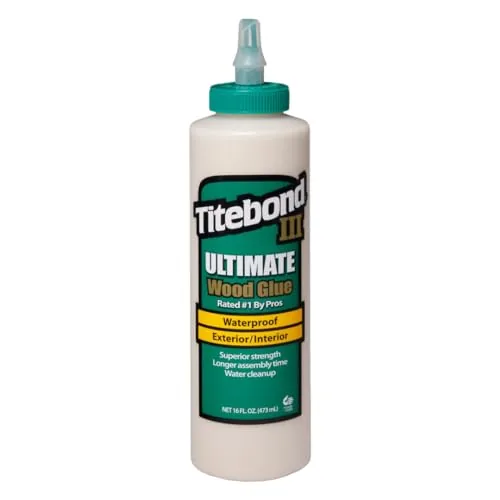
Titebond III Ultimate Wood Glue, 16 oz
$9.58 ($0.60/fl oz)
- ANSI/HPVA Type I waterproof
- FDA-approved for cutting boards
- 4,000 PSI bond strength
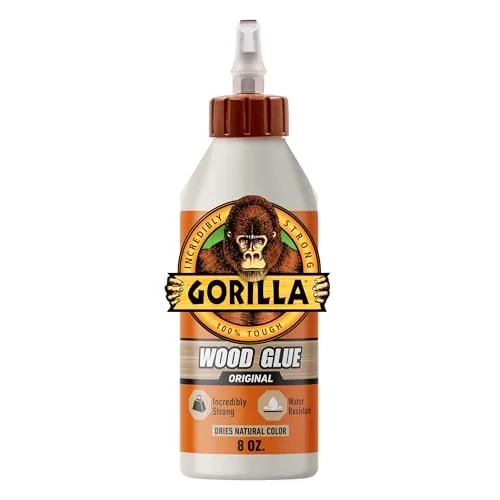
Gorilla Wood Glue, 8 oz
$4.37 ($0.55/oz)
- Water-resistant PVA
- Fast 20–30 min clamp time
- Lowest cost per ounce of the three
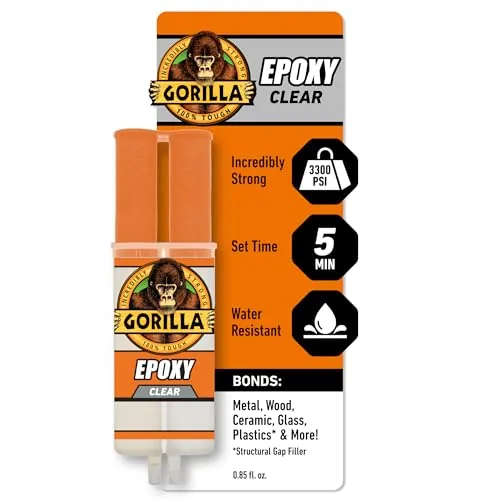
Gorilla 2 Part Epoxy, 0.85 oz Syringe
$5.97 (~$7.02/oz)
- 5-minute set time
- Bonds wood to metal, glass, stone
- Fills gaps PVA glue cannot
How Do You Match Glue to Your Project?
Is Wood Glue Strong Enough for Outdoor Furniture?
Titebond III and other ANSI/HPVA Type I waterproof PVA glues are strong enough for outdoor furniture, planters, and decks, provided the joint is not permanently submerged or buried in soil. For cedar specifically, which has natural oils that can interfere with adhesion, our exterior wood glue guide for cedar projects covers the surface-prep steps that matter most.
Can You Use Wood Glue on Granite or Stone?
No — standard PVA wood glue is formulated to soak into porous wood fiber on both sides of a joint, and granite is dense, non-porous stone with nothing for the glue to grip. For a wood cutting-board insert, trim piece, or bracket that needs to bond to granite, our guide to attaching wood to granite covers the silicone and epoxy adhesives that actually hold, plus when mechanical fasteners are the better choice.
How Long Do You Need to Clamp Wood Glue?
Most PVA and aliphatic resin glues need 20 to 60 minutes of clamp time before the joint can handle light pressure, but full cure — the point where the glue reaches its final strength — takes 24 to 48 hours. Our full clamp-time breakdown covers exact ranges for PVA, polyurethane, epoxy, and CA glue, plus what to do if a joint will not set. If a glue looks too thick straight from the bottle to spread into a tight joint, thinning it slightly with a small amount of water restores workable viscosity without weakening the bond; our guide to thinning wood glue covers exact ratios by glue type.
For a full breakdown of glue cost by type and container size, see our wood glue price guide.
Does Wood Glue Expire?
Yes. Most wood glue bottles list a shelf life of 1 to 2 years, though properly sealed glue stored at room temperature often stays usable for up to 5 years past that date. A bottle of Titebond Original that sat against a garage window for about 14 months in direct summer sun came out of mine thickened into an unusable paste — well before its printed shelf life ran out, because heat and light degrade the emulsion faster than time alone.
- Thickening into a paste that will not spread evenly
- Visible clumping or separation between the water and resin
- A sour or rancid smell (more common in hide glue)
- Weak, chalky adhesion after clamping
Store wood glue below 75°F and never let it freeze — a freeze-thaw cycle permanently breaks down the PVA emulsion even if the bottle looks fine afterward. For the full picture on how long an unopened bottle really lasts and the exact signs it has gone bad, see our wood glue shelf life guide. If you have leftover dried squeeze-out to clean up before finishing, our guide on sanding dried wood glue covers the method that will not gum up your sandpaper.
Frequently Asked Questions
Is epoxy stronger than wood glue?
Two-part epoxy typically tests at 3,000 to 4,000 PSI tensile strength versus roughly 800 to 1,500 PSI for standard PVA wood glue. Epoxy wins on raw strength and gap-filling, but in a tight, clean wood-to-wood joint the wood itself usually fails before a properly applied PVA glue line does.
Is Titebond III better than Titebond II?
Titebond III is the only one of the two rated ANSI/HPVA Type I fully waterproof, with roughly 4,000 PSI bond strength and FDA approval for indirect food contact. Titebond II is Type II water-resistant, generally cheaper per ounce, and enough for outdoor furniture that is not submerged or food-contact.
Does wood glue expire?
Yes. Most wood glue lists a 1 to 2 year shelf life, though sealed glue stored correctly often stays usable for up to 5 years. Signs it has gone bad include thickening into paste, clumping, separation, an odd smell, and weak adhesion — discard it rather than risk a joint failure.
What is the strongest glue for wood?
For pure wood-to-wood joints, aliphatic resin glue (Titebond II or III) is the strongest practical choice at roughly 3,750 to 4,000 PSI. For gap-filling or bonding wood to metal, glass, or stone, two-part epoxy tests stronger at 3,000 to 4,000 PSI tensile strength.
Is PVA glue the same as wood glue?
PVA (polyvinyl acetate) is one specific chemistry inside the broader "wood glue" category, alongside aliphatic resin, epoxy, polyurethane, CA, and hide glue. Standard PVA and the yellow aliphatic resin glues (Titebond II/III) are related PVA-family formulas, but aliphatic resin cures harder and resists heat and water better.
For most home woodworkers, a bottle of Titebond II or III and a small syringe of two-part epoxy cover well over 90% of what comes up in a typical shop — keep both on the shelf and pick between them by moisture exposure, not by habit. Whichever glue you land on, spreading it evenly matters almost as much as the formula — see our guide on how to spread wood glue evenly for brush, roller, and rub-joint techniques, or compare the best wood glue roller applicators for options across width, reservoir design, and glue-type compatibility.
If your project involves setting a glass pane against a wood surface rather than joining two pieces of wood, the picks and cure times differ enough from a wood-only application that we cover glue for glass to wood as its own comparison, with published PSI and cost per ounce for seven products. For real PSI numbers on the wood-to-wood glues themselves, see our strongest wood glue comparison.
Sponsored / affiliate links. As an Amazon Associate I earn from qualifying purchases. I may earn additional commission from eligible campaigns.