How Long After Using Liquid Sandpaper Can You Paint?
Klean-Strip’s own label on its Easy Liquid Sander Deglosser says the product dries in 10 to 15 minutes. Jasco’s version says roughly the same. But most painters who’ve actually used liquid sandpaper on a real project wait longer – 30 minutes to a full hour – because the label time assumes ideal conditions that a garage in October or a bathroom with the shower running an hour earlier rarely has. Get the wait wrong in either direction and you pay for it: paint over a surface that’s still slightly tacky and the trapped solvent bubbles or blisters under the new film; wait too long (more than about 24 hours) and the etch the deglosser created can start to reseal, leaving you back where you started. Below is the actual wait time by brand, what humidity and temperature do to that number, and the upper limit almost no other guide mentions.
Quick Answer: Wait 15 to 30 Minutes, Longer If It’s Humid
Quick Answer
Most liquid sandpaper/deglosser products are safe to paint over 15 to 30 minutes after wiping them off, once the surface is fully dry and no longer smells like solvent. In cold weather or humidity above roughly 70%, extend that to 45–60 minutes. Don’t wait longer than 24 hours — after that, the surface can reseal and you may need to reapply the deglosser before painting.
Recommended Pick
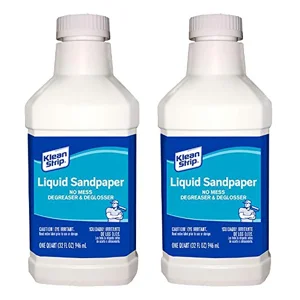 |
Klean-Strip 2-Pack Quart Easy Liquid Sander Deglosser – $22.21 The exact product used for the wait-time figures in this guide — labeled 10–15 minute dry time, currently in stock.
|
Wait Time by Brand
The wait time printed on the bottle isn’t universal — it changes depending on which deglosser you bought, because each brand uses a slightly different solvent blend. Here’s how the two most common brands compare, plus what to do if your bottle doesn’t list a time at all.
| Product | Label Dry Time | Realistic Wait Before Painting |
|---|---|---|
| Klean-Strip Easy Liquid Sander Deglosser | 10–15 minutes | 20–30 minutes |
| Jasco Easy Liquid Sander Deglosser | ~10 minutes | 30–60 minutes |
| Store-brand or unlabeled deglosser | Not stated | 45–60 minutes (default to the longer window) |
Notice that the “realistic wait” column is longer than the label in every case. That’s not the manufacturer being wrong — the label time is how long the solvent takes to flash off under lab conditions (roughly 70°F, moderate humidity, thin even coat). Most garages, basements, and bathrooms don’t match that, which is exactly why the next section matters more than the number on the bottle.
How Humidity and Temperature Change the Number
Liquid sandpaper dries by evaporation, not by curing, so anything that slows evaporation extends your wait. Temperature matters most: below about 50°F, the solvents in most deglossers evaporate at roughly half the rate they do at 70°F, which can turn a 15-minute wait into 30 or more. Humidity has a similar effect — above 70% relative humidity, the air is already carrying more moisture, so it holds less capacity to pull solvent vapor away from the surface. In a humid bathroom or a basement without a dehumidifier running, plan on 45 to 60 minutes even for a fast-drying product like Klean-Strip’s.
Coat thickness is the other variable, and it’s the one most people get wrong. Soaking a rag and flooding the surface instead of wiping it on in a thin, even film doesn’t clean better — it just leaves more liquid that has to evaporate before you can paint. A heavy, pooled application can take twice as long to dry as the same product wiped on thin. If you’re working in a cold or humid space, wipe thinner and let the label time work in your favor instead of fighting it with a soaked rag.
The 24-Hour Rule Nobody Mentions
Most articles on this topic only tell you the minimum wait. There’s also a maximum, and it matters just as much. Liquid sandpaper works by chemically etching the top layer of the old finish so new paint has something to grip. That etched surface stays “open” and receptive to paint for roughly 24 hours. After that window closes, airborne dust settles into the microscopically roughened surface and the etch itself can start to reseal, especially in a dusty workshop or an unfinished basement. Paint applied at that point may not adhere any better than it would have on the untreated surface.
The fix is simple: if more than a day has passed since you wiped on the deglosser, wipe the surface down again with a fresh application before priming, rather than assuming the earlier treatment is still doing its job. This is especially worth remembering on multi-day projects — degloss a cabinet door on Saturday, get busy, and don’t pick the project back up until Tuesday, and you should treat it as a fresh application, not a finished prep step.
How to Tell the Surface Is Actually Ready
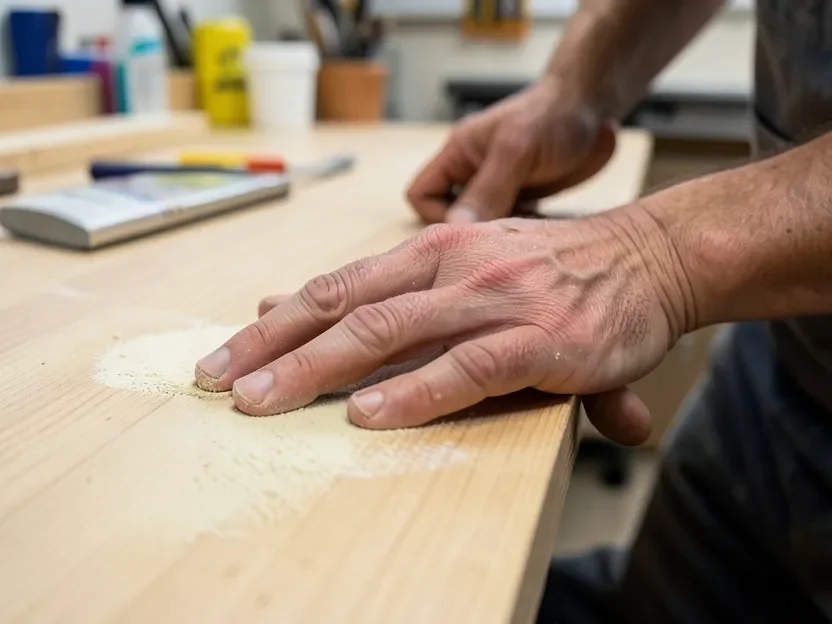
Rather than watching the clock, use a touch test — it’s more reliable than any fixed number because it accounts for your specific room’s temperature and humidity on that specific day. Press the back of a clean, dry finger lightly against the surface in an inconspicuous spot. If any residue transfers to your finger, or the spot feels cool, oily, or slightly tacky, it isn’t ready. A surface that’s genuinely dry feels uniformly dry and slightly rough — almost like the texture of fine-grit sandpaper — with no shine and no smell of solvent left when you lean in close. If you catch any hint of the chemical odor, wait another 10 to 15 minutes and test again before opening the paint can.
What Happens If You Paint Too Soon
Painting before the solvent has fully evaporated is the single most common way this project goes wrong. The wet paint film seals the surface, and any solvent still trying to escape gets trapped underneath it. As that trapped solvent continues to evaporate over the following hours, it pushes up against the new paint film from below, which is what causes bubbling, blistering, or a finish that stays soft and dents easily for weeks after it looks dry. In bad cases, the paint never fully cures and can be peeled off in sheets by hand months later because it never actually bonded to the surface — it bonded to a thin layer of trapped solvent residue instead.
If this has already happened to you, the fix isn’t to add another coat on top and hope it seals better — that traps the problem further. Strip or sand back to the substrate, let it dry out completely (often a full 24–48 hours for a badly trapped case), then start the process over with the correct wait time.
Does the Wait Time Change How You Should Prep?
The wait time is really the trade-off you’re making by skipping mechanical sanding. Physical sandpaper has no dry-time requirement — the surface is paint-ready the moment you finish sanding and wipe away the dust — but it creates airborne dust, takes longer per square foot, and struggles to reach carved details or tight corners. Liquid sandpaper trades that immediate readiness for a 15-to-60-minute wait in exchange for a dust-free process that works into moldings and spindles a sanding block can’t reach. For a deeper walkthrough of the actual wiping technique and which surfaces it does and doesn’t work on, see our full guide to how to use liquid sandpaper on wood.
Frequently Asked Questions
Can you paint immediately after liquid sandpaper?
No. Even fast-drying brands need at least 10 to 15 minutes for the solvent to evaporate, and most projects are safer waiting 20 to 30 minutes. Painting immediately traps solvent under the new coat and causes bubbling or a soft finish that never fully cures.
What if I wait too long to paint after using liquid sandpaper?
Waiting longer than about 24 hours lets the etched surface start to reseal and collect dust, which can reduce how well the new paint adheres. If more than a day has passed, wipe the surface with a fresh coat of deglosser before priming rather than relying on the original application.
Does humidity really double the wait time?
Yes, in practice. Above roughly 70% relative humidity or in temperatures below 50°F, solvent evaporation slows enough that a 15-minute label time can realistically become 45 to 60 minutes. A touch test is more reliable than any fixed number in these conditions.
How do I know the surface is dry enough to paint?
Press a clean, dry finger against an inconspicuous spot. The surface is ready when it feels uniformly dry and slightly rough with no tackiness, no residue transfer, and no lingering solvent smell. If you notice any of those signs, wait another 10 to 15 minutes and test again.
Sponsored / affiliate links. As an Amazon Associate I earn from qualifying purchases. I may earn additional commission from eligible campaigns.