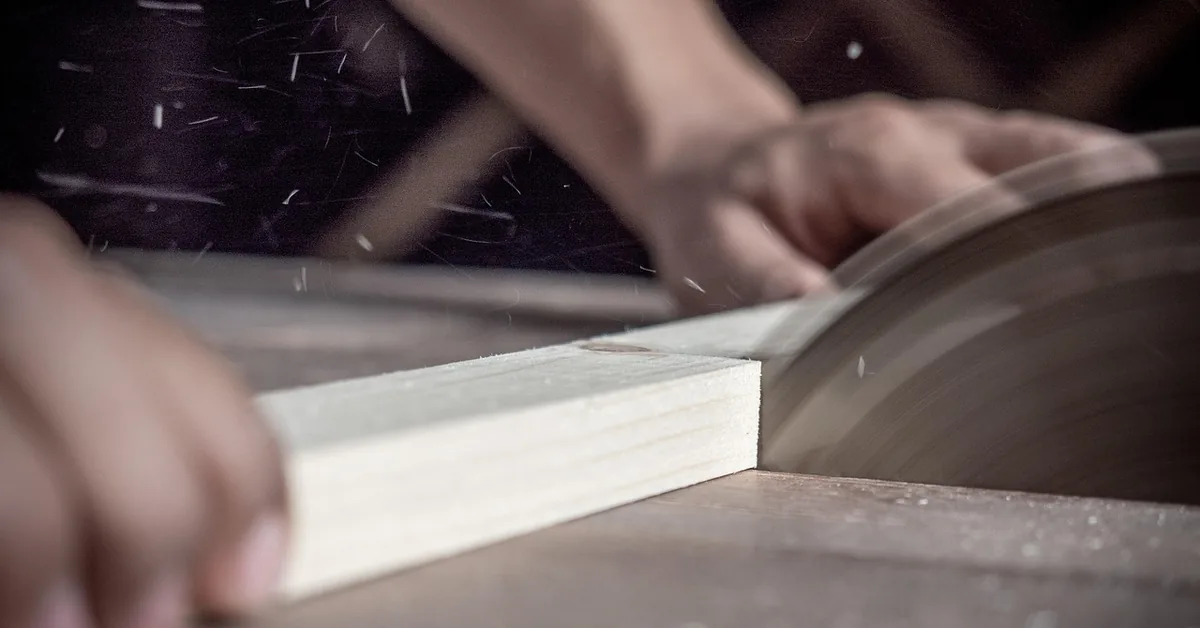
How Long Does MDF Smell For? (1–6 Weeks, Longer If Humid)
MDF smell typically fades within 1 to 6 weeks with good ventilation — but that’s the odor fading, not the formaldehyde off-gassing stopping. Off-gassing itself continues at low, declining levels for months longer, faster in dry rooms and slower in humid, closed ones. This guide covers the real difference between smell and off-gassing, CARB Phase 2 and low-emission MDF options, and how to clear the odor faster.
Understanding MDF and Its Composition
Best Air Purifier for MDF Odor Pick
Levoit Core 300 True HEPA Air Purifier – $89.99
An affordable, quiet purifier sized right for running non-stop through the 1–6 week peak-odor window this guide describes.
- Best for: small-to-medium rooms (up to ~200 sq ft) during the first few weeks after installing new MDF
- Why we picked it: True HEPA plus a washable pre-filter at a price low enough to run continuously during the peak odor window
- Main drawback: the stock filter has no activated carbon stage, so it’s better at dust than at formaldehyde/VOC gas — the carbon units below target odor more directly
Compare more air purifier options for MDF odor
 Option 1 GermGuardian AC4825E – $80.74
|
 Option 2 Daikin MCB50YSAU – $74.50
|
 Option 3 IQAir GC MultiGas XE – $1,599.99
|
As an Amazon Associate we earn from qualifying purchases.
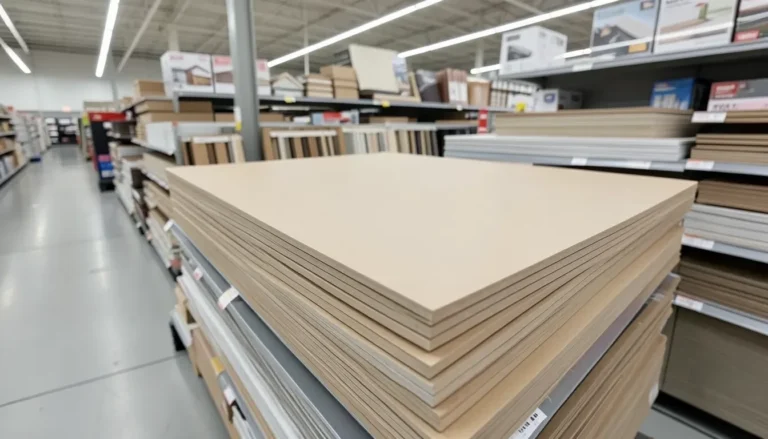
MDF stands for Medium Density Fiberboard. It’s made from wood fibers mixed with resin and pressed into dense, smooth sheets — which is why it takes paint so much better than plywood or particle board. That same resin is the source of the smell this guide is about.
Resins in MDF release formaldehyde as they cure and slowly break down. This is what causes the smell, and it can last for days or weeks. The smell is strongest when MDF is new or freshly cut, since a cut edge exposes more raw fiber and resin than a factory-sealed face. Ventilation helps reduce it fastest, and sealing MDF with paint or primer traps the remaining smell inside rather than letting it escape into the room. For more on where MDF fits among engineered woods, see our MDF guide hub.
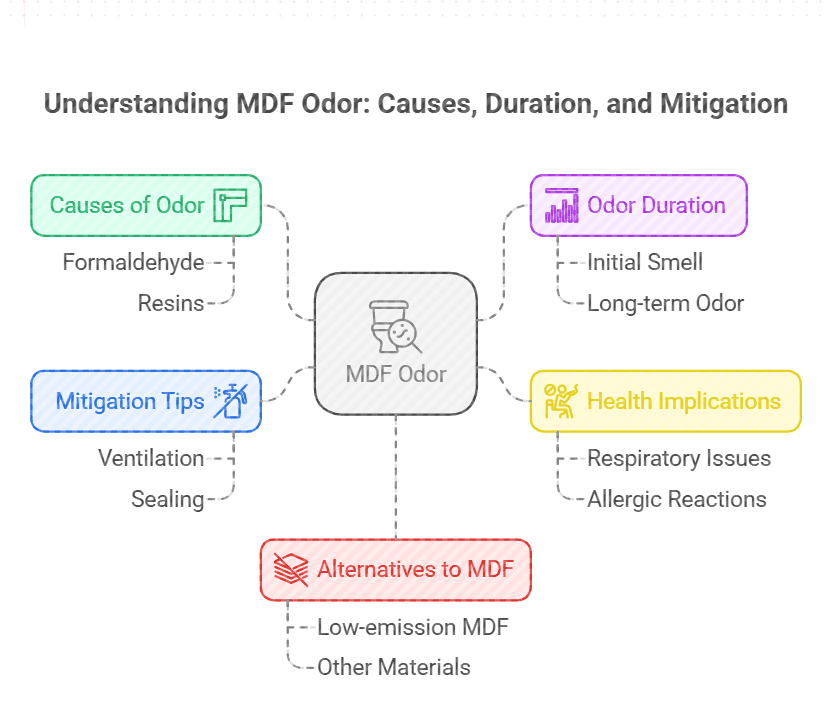
Causes of MDF Odor
MDF releases formaldehyde gas from the glue used to bind its wood fibers. The smell is strongest at first and fades over time. Fresh MDF often smells like fish before that smell mellows into a more generic “new material” odor — that fishy note comes from amine compounds released alongside the formaldehyde resin. Warm rooms make the smell stronger; cool, ventilated rooms reduce it faster.
Factors Influencing Odor Duration
Good ventilation is the single biggest factor. Fresh air moving through a room carries odor molecules outside instead of letting them build up; a closed room with no airflow holds the smell far longer. Opening two windows on opposite sides of a room (cross-ventilation) or running a fan clears the air faster than a single cracked window.
Temperature and humidity matter too. Warm, humid air holds odors and can speed up off-gassing at the same time, so a hot, sticky room often smells worse than a cool, dry one even with the same MDF. Thickness and density play a smaller role: thicker, denser MDF boards hold more resin per square foot and can smell slightly longer than thinner boards of the same grade.

Typical Odor Duration
The smell of MDF is strongest in the first week after installation or cutting — that’s when ventilation matters most. After the first week, the smell fades steadily. Most people can’t notice it anymore after 1 to 6 weeks in a well-ventilated room; in a closed, humid room it can take two to three times longer to fade to the same degree.
Smell Fading vs. Off-Gassing Stopping — They’re Not the Same Thing
The smell you notice and the formaldehyde off-gassing behind it run on two different timelines. The smell you can actually detect fades within 1 to 6 weeks for most MDF. Formaldehyde emissions continue at low, steadily declining levels for months after that — standard MDF is generally considered fully off-gassed within about a year, though trace emissions can be measured longer in an enclosed room with poor airflow. Confusing these two clocks is why “how long does MDF smell” and “how long does MDF off-gas” often get different answers online.
📊 A 2022 chamber-emissions study of MDF measured a “slow-fast-slow” total VOC emission profile, with the fastest decay — up to 29.7% — happening between day 3 and day 7 after the boards were produced. — Source: National Library of Medicine (PMC), 2022
| Timeframe | What You’ll Notice (Smell) | What’s Actually Happening (Off-Gassing) |
|---|---|---|
| Day 1–7 | Strongest, sharpest chemical smell | Peak VOC release; fastest decline (up to ~30%) happens here |
| Week 2–6 | Noticeably fainter with ventilation | Formaldehyde emissions keep dropping, ventilation-dependent |
| 2–6 months | Usually undetectable by smell | Low-level off-gassing continues, especially in humid rooms |
| ~1 year+ | No detectable odor | Most standard MDF is considered fully off-gassed |
Health Implications of MDF Odor
MDF odor can cause headaches and dizziness in the short term. Breathing it in for long stretches can irritate the throat, cause nausea, or make eyes water. Children and pets tend to be more sensitive, so it’s worth keeping a freshly installed piece out of bedrooms and nurseries for the first week or two.
Long-term, repeated exposure to formaldehyde has been linked to respiratory irritation and, in some studies, asthma symptoms. This is exactly why CARB and the EPA regulate formaldehyde emissions from composite wood — see the low-emission options further down this guide. Keeping rooms well-ventilated and using an air purifier with an activated carbon filter (not just HEPA) are the two most effective ways to cut exposure while new MDF off-gasses.
Tips to Mitigate MDF Odor
Open windows on opposite sides of the room to create cross-ventilation — this clears odor faster than a single open window. Point a fan toward the open window rather than just running it in the room; pushing air out speeds up the exchange.
An air purifier can help, but the filter type matters: a standard HEPA filter traps dust and particles, not gas molecules. For formaldehyde and other VOCs, look for a unit with an activated carbon stage, since carbon is what actually adsorbs the gas. A few CARB-compliant options that fit this are compared below.
Sealing the MDF with paint, varnish, or a dedicated MDF primer traps most of the remaining odor inside the material instead of letting it escape into the room — apply it evenly on all faces and edges, including the underside, for the best result. For more removal methods beyond ventilation and sealing, see our full guide on how to stop MDF from smelling.
Alternatives to MDF
If the smell is a dealbreaker, plywood or solid wood offer similar strength and workability with far less odor, since both use much less urea-formaldehyde resin than MDF (solid wood uses none at all). They cost more, but they skip the off-gassing question entirely.
Low-Emission MDF Options
Some MDF is manufactured to release far less formaldehyde than standard boards. When shopping, look for one of these three labels rather than a vague “low-odor” marketing claim:
- CARB Phase 2 compliant — meets the California Air Resources Board’s formaldehyde emission limit for MDF, the same ceiling the EPA adopted nationwide under TSCA Title VI.
- NAF (No-Added-Formaldehyde) — bonded with a resin system that contains no formaldehyde at all, typically a soy- or MDI-based adhesive.
- ULEF (Ultra-Low-Emitting Formaldehyde) — still uses a formaldehyde-based resin, but reformulated to emit at roughly half the CARB Phase 2 limit.
“EPA published in the Federal Register a final rule to reduce exposure to formaldehyde emissions from certain wood products produced domestically or imported into the United States.”
Since June 2018, composite wood sold in the US — including MDF — must be third-party certified to these limits, so a CARB Phase 2 or TSCA Title VI label on the box is a genuine indicator of lower off-gassing, not just marketing language.
Other Material Choices
Plywood is a popular substitute — strong, durable, and commonly used for floors and walls. Solid wood looks nicer and lasts longer but costs more. Bamboo is a fast-growing, eco-friendly option that also carries a much fainter new-material smell than MDF. All three cost more than MDF, but none of them require an off-gassing waiting period.
Frequently Asked Questions
How to Get the Smell Out of MDF?
Sprinkle baking soda on MDF and let it sit overnight to absorb odors, then vacuum thoroughly. Wipe surfaces with a vinegar-water solution and let them air dry. Placing bowls of activated charcoal nearby helps neutralize remaining smells, and good ventilation prevents the odor from building back up.
How Long Does It Take for MDF to Offgas?
The smell from MDF typically fades within 1 to 6 weeks with ventilation, but technical off-gassing at low levels continues for months longer — most standard MDF is considered fully off-gassed within about a year.
Does MDF Stop Off-Gassing?
Yes, eventually. MDF off-gasses formaldehyde for a period after manufacture, and emissions decrease steadily as the material ages. Proper ventilation speeds this up, and choosing CARB Phase 2, NAF, or ULEF-labeled MDF minimizes the amount released in the first place.
How Long Does It Take for Wood Smell to Go Away?
Wood smell typically fades within a few weeks. Ventilating the area and using an air purifier speeds up the process. Regular cleaning and airing out help too, and each species or engineered wood product has a somewhat different scent duration.
Conclusion
MDF smell fades within 1 to 6 weeks in a well-ventilated room, even though low-level formaldehyde off-gassing continues quietly for months after that. Ventilation, an activated-carbon air purifier, and sealing exposed edges are the three moves that make the biggest difference. If the smell is a dealbreaker for your project, CARB Phase 2, NAF, or ULEF-labeled MDF — or a switch to plywood or solid wood — sidesteps the issue almost entirely.
Sponsored / affiliate links. As an Amazon Associate I earn from qualifying purchases. I may earn additional commission from eligible campaigns.
 MECCANIXITY MDF Wood Board for Crafts,3/18"(4mm) Thick Medium Density Fiberboard Unfinished Wood for DIY Projects, Art Classes, Carpentry, Painting (12 x 16 in,2Pcs)
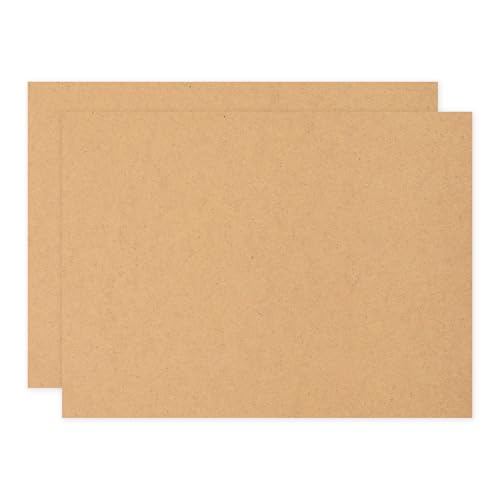 MECCANIXITY MDF Wood Board for Crafts,1/12"(2mm) Thick Medium Density Fiberboard Unfinished Wood for DIY Projects, Art Classes, Carpentry, Painting (12 x 8 in,2Pcs)