How Much Wood to Buy: The Board-Foot Calculation Method
The short answer is: multiply the thickness, width, and length of every part in your project, convert to board feet, add a waste factor – and that waste factor should not be a flat number pulled from a random blog post. It should change based on whether your lumber is rough-sawn or already surfaced, and whether the project has a visible glue-up that needs matching grain. Here is the actual math, not a guess.
The Board-Foot Formula: How Lumber Is Actually Measured
A board foot is a unit of volume, not length: one board foot equals 144 cubic inches, the same as a piece of wood 12 inches long, 12 inches wide, and 1 inch thick. Hardwood lumber for furniture and cabinetry is almost always priced by the board foot at the lumberyard, while dimensional softwood framing lumber (a 2×4 or 2×6) is usually priced per linear foot instead. Knowing which one you are buying changes how you estimate cost, not just quantity.
The formula: thickness (inches) x width (inches) x length (inches), divided by 144. If your length is easier to measure in feet, use thickness (inches) x width (inches) x length (feet), divided by 12 instead – both give the same answer. A rough-sawn board that is 1 inch thick, 8 inches wide, and 6 feet long works out to (1 x 8 x 72) / 144 = 4 board feet.
Best For Pre-Purchase Moisture Checks
 |
General Tools MMD4E Moisture Meter – $39.98 Checks a board’s moisture content before you buy or mill it, so rough-sawn stock you are counting on for board footage does not cup or split during milling.
|
Build a Real Cut List Before You Buy Anything
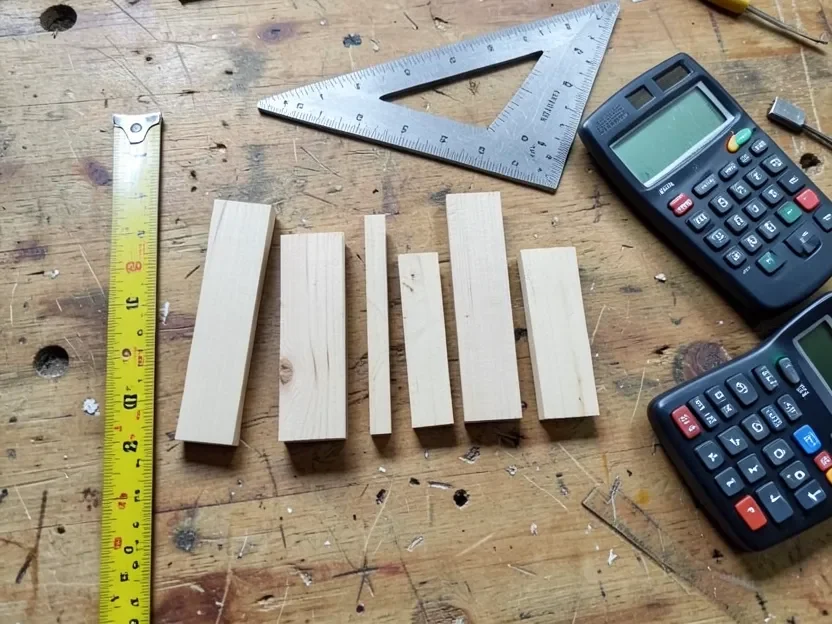
Buying wood off a single “how much do I need” rule of thumb is how people end up short a board on installation day or with an awkward pile of offcuts. The more reliable approach is to write out every part the project actually needs, with its finished dimensions, before you calculate a single board foot.
- List every part by name (legs, aprons, tabletop boards, shelves, rails) with its finished thickness, width, and length.
- Convert each part to board feet using the formula above, then add all the parts together for a raw material total.
- Group parts that need to come from the same board (matching grain, or parts that are too long to rip from a shorter piece) so you know your minimum board lengths, not just total volume.
- Only after you have this raw total do you apply a waste factor – applying it to a guess instead of a real list just compounds the guess.
Why One Flat Waste Percentage Is Wrong
Most guides give a single waste number and move on. That works fine as a rough starting point, but it ignores two things that change the real number a lot: how much milling the lumber still needs, and whether the project needs matched grain.
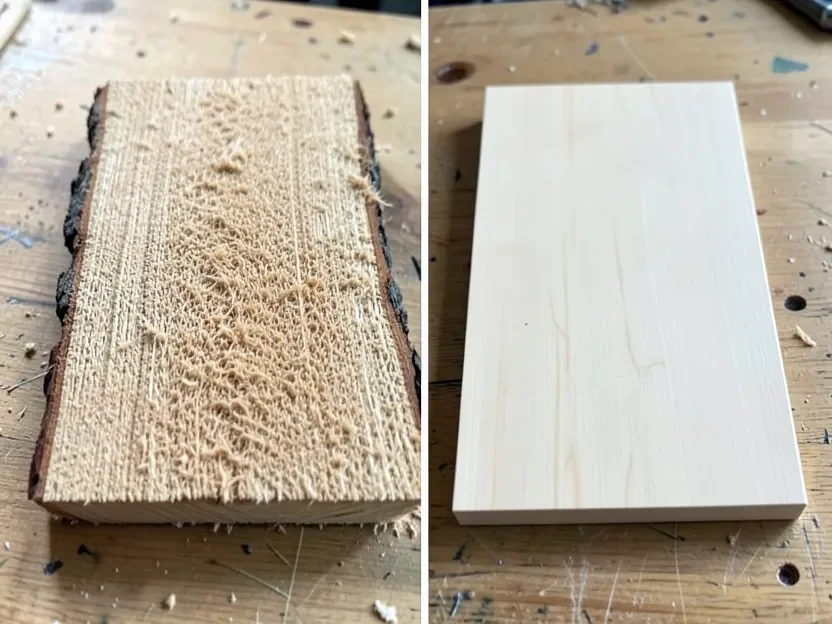
Rough-sawn lumber (20 to 30 percent waste): Rough stock still has to be jointed flat, planed to thickness, and ripped square. That process removes real material from every face – often 1/8 inch or more per side once you account for cupping, twist, and saw marks – before you cut a single finished part. You are also cutting around checks, bark inclusions, and knots that a mill has not already sorted out for you, which is exactly why rough-sawn needs the bigger allowance.
S4S lumber, surfaced four sides (10 to 15 percent waste): Pre-surfaced boards are already flat, square, and at final thickness, so your waste is mostly cutting losses, saw kerf, and the occasional mismeasured cut – not milling loss. That is the main reason S4S costs more per board foot but often ends up close in total project cost once you factor in a rough board’s bigger waste margin.
Grain-matched glue-ups (add another 15 to 25 percent on top): A tabletop, door panel, or any other visible glue-up where color and grain need to flow across the seam is not just an area calculation. You typically need to pick consecutive boards from the same flitch and reject sections with sapwood, a knot, or a grain pattern that breaks the match – which means buying more raw board footage than the finished panel’s square footage alone would suggest.
Worked Example: A Small Table’s Cut List
Say you are building a small side table with four legs at 1.5 x 1.5 x 20 inches, four aprons at 0.75 x 3 x 16 inches, and a top made from three boards at 0.75 x 6 x 30 inches.
- Legs: 4 x (1.5 x 1.5 x 20) / 144 = 1.25 board feet
- Aprons: 4 x (0.75 x 3 x 16) / 144 = 1.0 board feet
- Top: 3 x (0.75 x 6 x 30) / 144 = 2.81 board feet
- Raw total: about 5.06 board feet
If you are buying S4S lumber and the top does not need to be a single matched glue-up, add 10 to 15 percent: about 5.6 to 5.8 board feet, so you would buy 6 board feet to have a margin. If you are starting from rough-sawn stock and want the tabletop boards to match in grain, stack both allowances – roughly 5.06 x 1.25 (rough-sawn milling) x 1.20 (grain matching) works out to about 7.6 board feet, closer to 8 board feet once you round up to what the lumberyard actually sells.
Checking Lumber Before You Buy It
A board-foot total is only useful if the boards you buy actually stay flat once you get them home. Rough-sawn lumber that reads high on a moisture meter is the most common cause of wasted board feet after the fact – a board that measures fine at the yard can cup, twist, or check as it dries further, and now you are short parts you already paid for.
Check several spots on each board, not just one corner, since moisture content can vary noticeably across a single piece. For interior furniture and cabinet work, look for readings in the 6 to 8 percent range so the wood matches typical indoor humidity; framing lumber can run higher, generally under about 19 percent. If you are buying rough-sawn stock specifically to mill down for a project like the small table above, a quick moisture check before you commit to a stack of boards is cheap insurance against having to recalculate your cut list after the fact.
If your project is plywood-based rather than solid lumber – kitchen cabinet boxes, for example – the calculation method is different since you are working in sheet goods, not board feet; see our guide on how many sheets of plywood you need for kitchen cabinets for that math. For framing-specific lumber counts (studs, plates, joists), our lumber calculator for framing handles that directly, and if your project is a deck, the flooring and decking cost calculator converts square footage into boards and cost.
Frequently Asked Questions
How do I calculate board feet for a project?
Multiply a board’s thickness in inches by its width in inches by its length in inches, then divide by 144. For a board measured in feet instead of inches for length, multiply thickness (in) by width (in) by length (ft) and divide by 12. Do this for every part in your cut list, then add the results together for your project total.
How much extra wood should I buy for waste?
There is no single correct number. Pre-surfaced S4S lumber that is already flat and square typically needs 10 to 15 percent extra for cutting losses and mistakes. Rough-sawn lumber that still has to be milled true needs closer to 20 to 30 percent, since squaring the faces and edges and cutting around checks, knots, and twist removes real material before you cut a single finished part.
Do I need to buy extra wood for grain matching?
Yes, if the project has a visible glue-up such as a tabletop or door panel. Matching grain and color across adjacent boards means picking consecutive boards from the same board or flitch and rejecting sections with sapwood or a pattern break, which uses more raw board footage than the finished panel’s area alone would suggest.
Should I buy rough-sawn or S4S lumber?
Rough-sawn lumber costs less per board foot and is sold by full nominal thickness, but you pay for that savings in milling time and a bigger waste factor. S4S (surfaced four sides) costs more per board foot but is ready to cut, which is worth it for smaller projects or when you do not have a jointer and planer.
How do I check lumber for moisture before buying it?
Use a moisture meter on several spots on each board, not just one corner, since moisture content can vary across a single piece. Framing lumber should read under about 19 percent, and lumber for furniture or cabinets should be closer to 6 to 8 percent so it matches typical indoor humidity and will not shrink, cup, or crack after you build with it.
Final Thoughts
Buying the right amount of wood comes down to two honest steps: calculate your real board-foot total from an actual cut list instead of a guess at square footage, and apply a waste factor that matches your material and your process rather than a flat number that treats rough-sawn stock the same as ready-to-cut S4S boards. Get those two right and you will spend less time back at the lumberyard mid-project and less money on boards you never needed.
Sponsored / affiliate links. As an Amazon Associate I earn from qualifying purchases. I may earn additional commission from eligible campaigns.