How Many Sheets of Plywood for Kitchen Cabinets?
Most kitchens need somewhere between 8 and 16 sheets of 3/4-inch plywood for the cabinet boxes, plus 2 to 4 sheets of thinner 1/4-inch plywood for the backs – but that range is too wide to shop from. The real number depends on how many linear feet of cabinets you’re building, how deep and tall the boxes are, and whether you’re building full plywood boxes or a plywood-and-face-frame hybrid. Below is the actual calculation method – surface area of your cabinet boxes divided by the usable area of a sheet, plus a waste factor – so you can work out a number for your specific kitchen instead of guessing from someone else’s.
Quick Answer: Typical Sheet Counts by Kitchen Size
Before the math, here’s what real kitchens tend to use so you have a sanity check for your own calculation:
| Kitchen size (linear feet of cabinets) | 3/4″ plywood for boxes | 1/4″ plywood for backs |
|---|---|---|
| Small (10-14 linear ft, 8-10 cabinets) | 6-9 sheets | 2 sheets |
| Medium (16-20 linear ft, 12-16 cabinets) | 10-13 sheets | 3 sheets |
| Large (22-28+ linear ft, 18-24 cabinets) | 14-18 sheets | 3-4 sheets |
These ranges already build in a cutting-waste allowance. Once you know roughly where your kitchen falls, breaking a full 4×8 sheet into clean, accurate cabinet parts is the part that actually determines whether you land at the low or high end of the range – a guide that keeps your circular saw tracking straight cuts down on ruined parts from wandering cuts.
Best Circular Saw Guide For Breaking Down Sheets
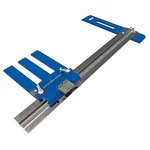 |
Kreg Rip-Cut Circular Saw Guide (KMA2685) – $59.99 Turns a standard circular saw into a straight-line ripping tool, so every cabinet box part you cut from a full sheet actually comes out square – fewer ruined parts means the sheet count you calculate below actually holds.
|
The Actual Calculation: Surface Area Divided by Sheet Coverage
A standard sheet of plywood measures 4 feet by 8 feet, or 32 square feet. Once you subtract the material lost to saw kerf and layout inefficiency, you can realistically use about 28-30 of those square feet for actual cabinet parts. The calculation has three steps:
- Add up the total square footage of every cabinet box panel you need – sides, tops, bottoms, and shelves (backs are usually thinner 1/4″ stock and get calculated separately).
- Divide that total by roughly 28 square feet of usable coverage per 3/4″ sheet.
- Multiply the result by a waste factor of 1.10 to 1.15 to cover cutting mistakes and awkward leftover offcuts, then round up.
Worked Example: A 16-Linear-Foot Kitchen
Say you’re building 12 base and wall cabinet boxes averaging 24″ deep by 34″ tall for the base run, and 12″ deep by 30″ tall for the wall run. Each box (two sides, a top, a bottom, and one fixed shelf) works out to roughly 22-26 square feet of 3/4″ panel material depending on depth. Across 12 boxes, that’s approximately 280-310 square feet of panel material needed.
280 square feet divided by 28 square feet of usable coverage per sheet equals 10 sheets. Multiply by a 1.10 waste factor and you get 11 sheets – round up, and that kitchen needs 11 sheets of 3/4″ plywood for the boxes. Add 3 sheets of 1/4″ plywood for the cabinet backs (backs use less material per box but still need their own sheets since they’re a different thickness), and the full project lands at 14 sheets total. That matches the “medium kitchen” row in the table above – the table isn’t a guess, it’s what this same formula produces across a range of typical layouts.
Why the Same-Size Kitchen Can Need a Different Sheet Count
Two kitchens with the same linear footage can land on different ends of the range for reasons that have nothing to do with the size of the room:
- Construction method. Full plywood boxes (sides, top, bottom, and back all in plywood) use noticeably more material than a plywood-box-plus-face-frame hybrid, where the face frame covers the front edges and lets you use a slightly thinner or lower-grade panel behind it.
- Cabinet depth. Standard base cabinets run 24″ deep and wall cabinets run 12″ deep – a kitchen with deeper-than-standard base cabinets (for an appliance garage or a wider counter overhang) eats more panel per box.
- Shelf count. Adjustable shelves are usually thinner 1/2″ or 5/8″ stock cut from separate sheets, and a cabinet with two shelves instead of one adds real square footage that a flat per-cabinet average won’t catch.
- Sheet grade and size availability. Not every supplier stocks a full 4×8 sheet in cabinet-grade birch or maple – some only carry 4×8 sheets in a lower grade and require special-ordering the good stuff, which can change how much waste you’re willing to tolerate on layout.
Plywood Thickness and Grade for Cabinet Boxes
For the box itself (sides, top, bottom, shelves), 3/4″ plywood is the standard – it’s rigid enough to hold hinge screws and shelf-pin holes without the panel flexing or splitting out. Cabinet backs are almost always thinner, typically 1/4″ or 5/16″, since the back panel just closes the box and doesn’t carry structural load. Going with 3/4″ everywhere, including the back, wastes money and adds unnecessary weight to every box you hang.
On grade: cabinet-grade birch or maple plywood (often sold as “cabinet grade” or “furniture grade,” graded B2 or better on at least the show face) gives you a smoother, more consistent surface for finishing than construction-grade CDX. If the cabinets will be painted, a smooth-face cabinet-grade sheet still saves sanding time even though the paint will hide the wood grain either way.
For a deeper look at how plywood compares to MDF for this exact use case – cost, moisture resistance, and how each holds screws over time – see our plywood vs. MDF for kitchen cabinets comparison.
Cutting Your Sheets Efficiently to Hit Your Calculated Number
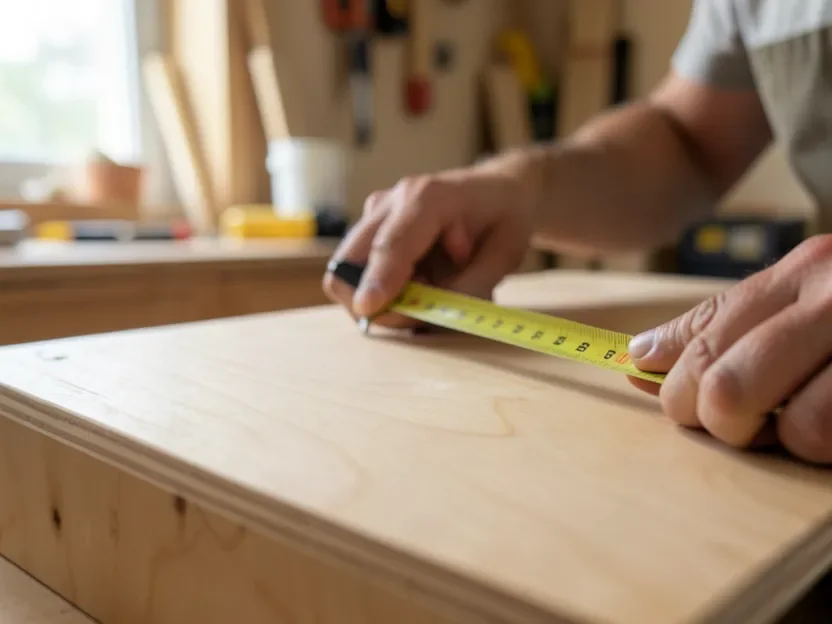
The waste factor built into the calculation above assumes reasonably efficient cutting – not a perfect nesting layout, but not careless cutting either. A few habits make the difference between landing at your calculated sheet count and needing an extra trip to the store:
- Sketch your cutting layout on paper first. Draw the sheet as a rectangle and pencil in where each part goes before you cut anything – it’s much easier to catch an inefficient layout on paper than after the first cut is already made.
- Cut similarly-sized parts from the same sheet. Grouping all your side panels together, then all your shelves, wastes less material than cutting parts in a random order.
- Account for saw kerf. Each cut on a typical circular saw or table saw removes about 1/8″ of material as sawdust – across a dozen cuts on one sheet, that adds up to real square inches you need to plan for, not just an afterthought.
- Break sheets down before ripping to final width. A full 4×8 sheet is awkward to control on a table saw alone; crosscutting it into more manageable sections first, then ripping those to final dimension, produces straighter, safer cuts.
Estimated Cost for Your Plywood
Cabinet-grade 3/4″ plywood typically runs $50 to $90 per sheet depending on species (birch runs cheaper than maple) and local lumber pricing, with 1/4″ sheets for backs usually $25 to $40 each. Using the 14-sheet medium-kitchen example above (11 sheets of 3/4″ plus 3 sheets of 1/4″), that’s roughly $550 to $1,090 in plywood alone, before hardware, edge banding, finish, or hinges. Plywood pricing has stayed volatile since the supply disruptions of the early 2020s, so it’s worth pricing your actual local supplier before finalizing a budget rather than relying on a number from an older article.
Frequently Asked Questions
How many sheets of plywood do I need for kitchen cabinets?
Most kitchens need 8 to 18 sheets total, depending on size. A medium kitchen with 12-16 cabinet boxes typically needs 10-13 sheets of 3/4″ plywood for the boxes plus 3 sheets of 1/4″ plywood for the backs. The exact number comes from dividing your total panel square footage by about 28 usable square feet per sheet, then adding a 10-15 percent waste factor – see the worked example above to calculate your own kitchen.
What thickness of plywood is best for cabinet boxes?
3/4-inch plywood is standard for cabinet box sides, tops, bottoms, and shelves – it holds hinge screws and shelf-pin holes without flexing or splitting. Cabinet backs are typically thinner, at 1/4″ or 5/16″, since the back panel doesn’t carry structural weight.
Can I use MDF instead of plywood for cabinets?
Yes – MDF is common for painted cabinet doors and faces because it has a smoother, grain-free surface, but it’s heavier and holds up worse than plywood in areas exposed to moisture, like under the sink. Many builders use plywood for the boxes and MDF for the doors. Our plywood vs. MDF comparison breaks down cost and durability side by side.
How much does plywood for kitchen cabinets cost?
Cabinet-grade 3/4″ plywood typically costs $50 to $90 per sheet, and thinner 1/4″ plywood for backs runs $25 to $40 per sheet. A medium kitchen using around 14 sheets total usually costs $550 to $1,090 in plywood before hardware and finish.
Conclusion
Skip the flat “5 to 7 sheets” rule of thumb – it only happens to be right for one specific kitchen size. Measure your actual cabinet run, add up the panel square footage, divide by about 28 usable square feet per sheet, and add a 10-15 percent waste factor. That gives you a number that matches your kitchen instead of someone else’s, and a saw guide that keeps your cuts straight is what actually lets you hit that number instead of running short.
Sponsored / affiliate links. As an Amazon Associate I earn from qualifying purchases. I may earn additional commission from eligible campaigns.