How to Fumigate Wood: Licensed-Only, Plus Safer Options
Fumigating wood with gas is a licensed pest-control job, not a DIY project. The fumigants used on houses are restricted use pesticides, and the label limits them to certified applicators. What you can do yourself is inspect the wood, freeze or heat small pieces, and treat bare lumber with a borate.
This page used to read like a how-to for sealing a space and releasing a fumigant. That is not something we can responsibly teach. Below is what fumigation actually involves, what the alternatives can and cannot do, how to tell whether an infestation is still active, and when to pick up the phone. The technical points come from government and university sources linked in the text, and we hedge anything they do not spell out.
What You Can Safely Do Instead of Fumigating
| Best Borate Prevention Pick | |
 |
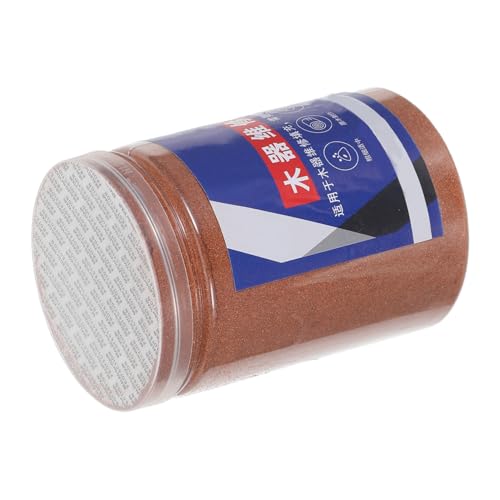
Nisus Tim-BOR Professional Insecticidal Dust, 1.5 lb Best for: protecting bare, unfinished lumber and shop stock against wood-destroying insects and decay. Why we picked it: the listing describes it as a borate (disodium octaborate tetrahydrate) that can be mixed as a liquid for bare wood, and the extension guide below names Tim-bor among the borates used on unfinished wood. Main drawback: it is not a fumigant, it will not reach a hidden colony in a wall, and it will not soak into painted or sealed wood. Follow the label exactly. |
| View Our Pick on Amazon | |
Most woodworkers asking this question have one of three problems: a few pieces of infested lumber, a finished item with exit holes, or a suspected infestation in the building. Only the third is a fumigation-scale problem. For the first two, these options are documented by extension entomologists:
- Freezing small items. The University of Kentucky guide gives 0 F for 3 to 7 days in a deep freezer, depending on thickness. It suits picture frames, carvings, and small stock, not large timbers.
- Heat chambers. The same guide cites 120 to 135 F, with exposure of up to 24 hours depending on wood thickness. A controlled chamber is the point. In our judgment, do not improvise with an oven or a parked car, because the core of the wood has to reach temperature and uneven heat can crack or warp it.
- Borate on bare wood. Borates such as Tim-bor and Bora-Care work best on unfinished surfaces and go deeper into damper wood. They have limited use on finished living areas because sealed or painted surfaces repel the treatment.
- Kiln-dried lumber. Wood heated to about 125 to 140 F before it is used kills all beetle life stages, though it can be reinfested later during storage or transport.
Borate is a preventive and surface-penetrating tool. The UC IPM drywood termite guide states plainly that do-it-yourself treatments are not recommended for drywood termites and that the products needed are not available for homeowner use, so a borate spray on visible wood is not a substitute for a professional inspection of a building.
What Fumigation Actually Is
According to the National Pesticide Information Center, structural fumigation fills the airspace of a structure with a toxic gas, held in by a tarp, so the gas penetrates the wood and reaches pests inside. The main residential fumigant is sulfuryl fluoride, which is colorless and odorless, so chloropicrin is added as an irritating warning agent to clear people out. The EPA describes sulfuryl fluoride as the only structural fumigant with residential uses and classifies it as a restricted use pesticide.
The rules around it are why this is not a DIY job:
- Only certified applicators, or people under their direct supervision, may buy and use it, because the product is restricted for inhalation toxicity.
- The product label calls for two trained people, at least one state-certified, present when the fumigant is introduced and at re-entry before aeration.
- Applicators monitor air levels so sulfuryl fluoride does not exceed the EPA-established limit of 1 part per million (ppm), and nobody re-enters until monitoring confirms it is safe.
- The EPA requires chloropicrin as a warning agent, clearly posted warning signs, and longer aeration times under the updated safety measures.
If a company offers to sell you fumigant, or to let you tent your own house, treat that as a red flag. If you are hiring, the licensing check is simple: ask for the applicator license number and confirm it with your state agency.
What the homeowner does before a fumigation.
The NPIC lists the resident duties. Remove all people, pets, plants, and fish. Bag or seal food and medications that are not in airtight original packaging. Open drawers, cabinets, appliances, and attics, disable pilot lights and heating elements, and notify neighbors. Your applicator gives the definitive checklist for your job, so follow that over any general list.
Fumigation vs Heat vs Local Treatment
These are the options for a real infestation, with only the numbers that our sources state. The right pick depends on the pest, how far it has spread, and whether you can reach the wood.
| Method | What it does | Who does it | Numbers from sources |
|---|---|---|---|
| Whole-structure fumigation | Gas treats hidden infestations throughout a building | Certified applicator only | Residents out for several days; gas limit 1 ppm at re-entry |
| Whole-structure heat | Raises all wood in the structure to a lethal temperature | Pest professional | At least 120 F held for at least 33 minutes; residents out for hours |
| Heat chamber | Treats furniture, lumber or art pieces in a controlled chamber | Company or restorer with a chamber | 120 to 135 F, up to 24 hours by thickness |
| Deep freezing | Kills insects in small wood objects | You | 0 F for 3 to 7 days |
| Borate on bare wood | Preventive and surface-penetrating treatment | You, following the label | Works on unfinished wood; poor on painted or sealed wood |
| Local professional treatments | Liquids, dusts, foams, microwaves, electrocution, wood replacement | Pest professional | Depends on the method and infestation size |
Two corrections to common assumptions. First, fumigation is not automatically the best choice for beetles: the University of Kentucky guide to powderpost beetles says modern sulfuryl fluoride fumigants are less effective against wood-boring beetles than those containing methyl bromide, and it calls whole-house fumigation an extreme and costly option. Second, the same guide notes that pest control companies can fumigate portable items at substantially lower cost than a whole structure. If one heirloom cabinet is infested, ask about treating the cabinet, not the house.
For termite-specific decisions, read our guide on how to kill termites in wood, and for identifying the culprit from the damage, see what insect drills holes in wood and what insect eats wood and leaves sawdust.
How to Tell Whether an Infestation Is Still Active
Treating wood that is no longer infested wastes money and adds chemicals for nothing. The extension guides give these clues:
- Powderpost beetles: fresh powder that matches the color of freshly sawed wood, and exit holes that lack the weathered look of the surrounding wood (University of Kentucky).
- Drywood termites: fecal pellets with six hexagonal sides, pushed out of small kickout holes under 2 mm across. If new pellets appear after you clean up, the infestation is likely active (UC IPM).
- Old, stained, or dusty holes with no fresh material may be historic damage, though only an inspection can confirm that.
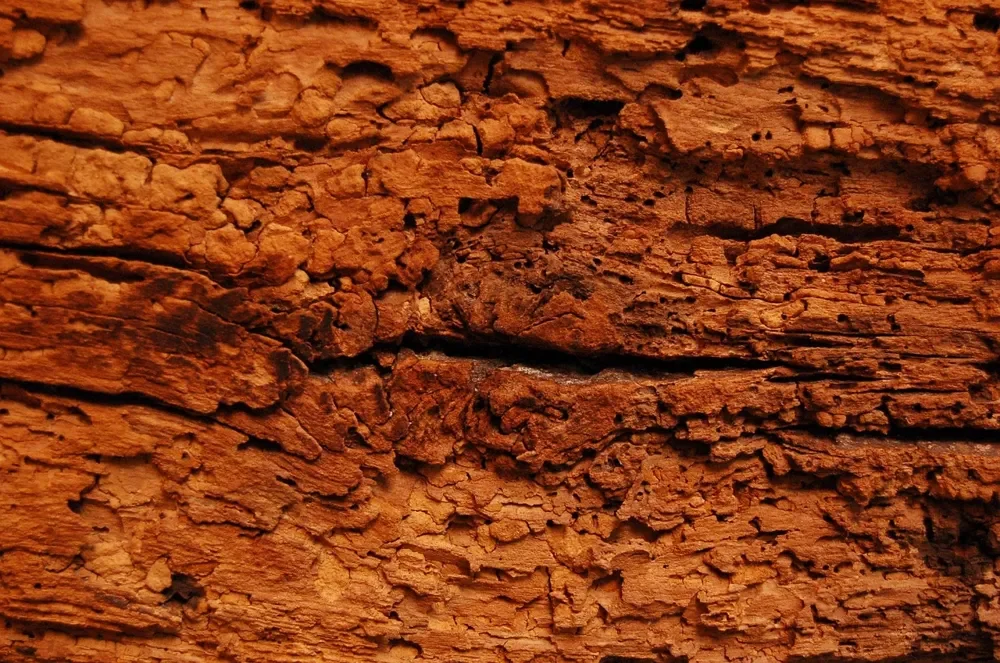
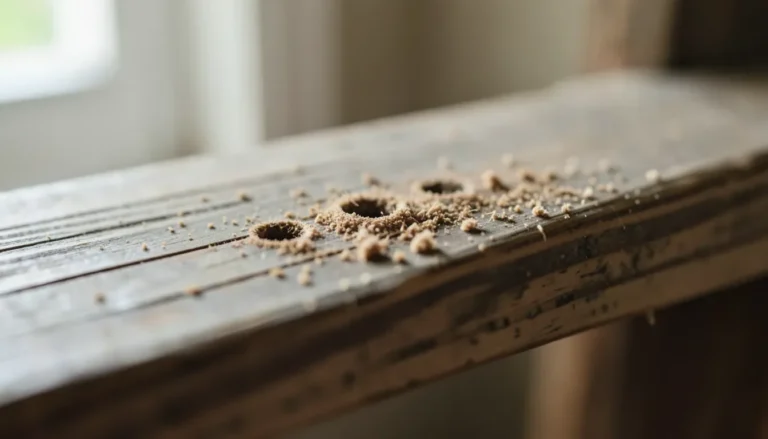
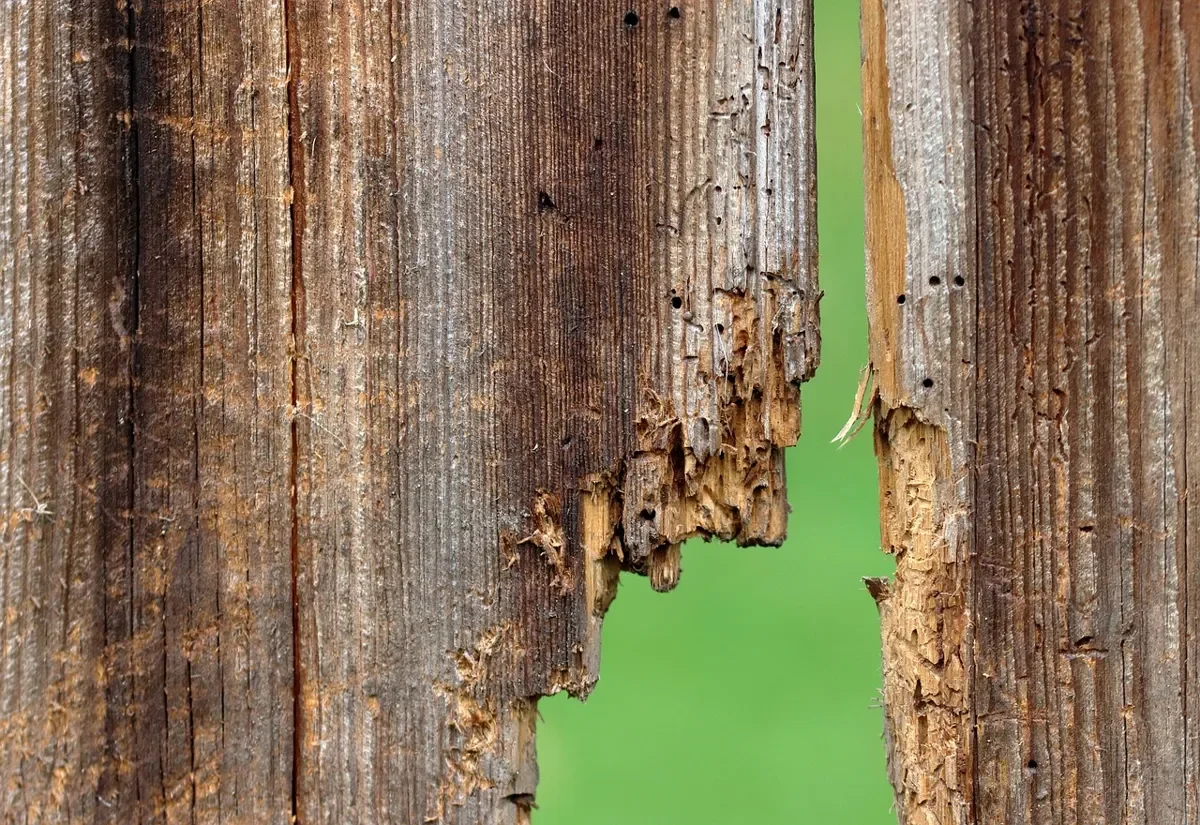
Holes alone are not proof. The photo above shows crumbling timber with many small openings, and from a picture nobody can say whether anything is still alive in it. Sweep the area clean, then check again in a couple of weeks for fresh powder. That simple recheck is our suggestion rather than a sourced protocol, so treat it as a screening step. For more on the beetle side, see how to get bugs out of wood.
Pallets and Wood Packaging: The Standard You Actually See
The word fumigation also shows up on shipping crates and pallets, and this is the one place methyl bromide is named in a wood standard we checked. USDA APHIS says the ISPM 15 standard allows two treatments: heat to a minimum wood core temperature of 56 C for at least 30 minutes, or methyl bromide fumigation by a certified facility. Treatment must be done at a registered facility, and the mark on the wood shows an HT or MB code plus a facility number and country code.
| ISPM 15 item | What it means |
|---|---|
| HT mark | Heat treated: core at least 56 C for at least 30 minutes |
| MB mark | Methyl bromide fumigated at a certified facility |
| Treatment life | Does not expire; repaired or remanufactured wood must be retreated and remarked |
| Who treats | Registered ISPM 15 heat-treatment or fumigation facility |
This is worth knowing if you build with pallet wood: the stamp shows how the wood was treated for pests, and it does not by itself tell you the wood is finish-safe or food-safe. See our guide on whether pallets are treated wood and on whether kiln-dried wood counts as treated.
When to Call a Licensed Professional
The University of Kentucky guide advises calling a professional when an infestation has spread into walls, between floors, or anywhere surface treatment or wood removal is impractical. Get at least two inspections, and ask each company these questions:
- Which pest is it, and what physical evidence supports that identification?
- Is whole-structure treatment needed, or would localized treatment, heat, or replacing a few members work?
- If fumigating, is it a monitored fumigation, and what is the re-entry clearance process? UC IPM reports that monitored fumigation, with gas monitoring lines inside the structure, has higher success rates than unmonitored work.
- What is the applicator license number, and what are the written preparation instructions?
In the shop itself, the practical protection is inspecting incoming lumber for holes and fresh powder, freezing or heat-treating small pieces you are unsure about, and keeping stock dry. Those are our shop-practice suggestions built on the sources above, not a guarantee against pests.
Frequently Asked Questions
Can I fumigate wood myself?
No. The fumigant used in homes, sulfuryl fluoride, is a restricted use pesticide, so its sale and use is limited to certified applicators and people working under their direct supervision. There is no consumer-grade version of a tented gas fumigation. For a small item or a pile of lumber, use a non-gas option such as freezing, a heat chamber, or a borate on bare wood, and hire a licensed pest control company for anything larger.
How long does fumigating a house take?
Sources describe several days. The UC IPM drywood termite guide says residents must vacate the structure for several days, and the University of Kentucky guide describes sealing the home for about 3 days. Your applicator sets the actual schedule, and nobody re-enters until air monitoring confirms the gas level is safe.
Does freezing kill wood-boring beetles?
For small objects, yes, when the cold is held long enough. The University of Kentucky guide recommends a deep freezer at 0 F for 3 to 7 days, depending on wood thickness. That works for a picture frame or a small carving, not for a wall stud or a workbench.
What do the HT and MB marks on pallets mean?
They show how wood packaging was treated under the international ISPM 15 standard. HT means heat treatment, where the wood core reaches at least 56 C for at least 30 minutes. MB means methyl bromide fumigation. USDA APHIS says the mark also carries a facility number and a country code.
Is a pest treatment safe to use on wood that will touch food?
Do not assume so. Check the specific product label for permitted sites, and keep borates and other pesticides off cutting boards, bowls, and utensils. When in doubt, choose an untreated hardwood, and use heat or cold for pest problems in kitchen items.
Bottom Line
Do not try to fumigate wood yourself. Use freezing, a heat chamber, or a borate on bare wood for small problems, verify that an infestation is active before paying to treat it, and bring in a certified applicator for anything inside a structure.
Sources
- National Pesticide Information Center (structural fumigation overview)
- EPA (sulfuryl fluoride)
- UC IPM drywood termite guide
- University of Kentucky guide to powderpost beetles
- USDA APHIS (ISPM 15 wood packaging)
Sponsored / affiliate links. As an Amazon Associate I earn from qualifying purchases. I may earn additional commission from eligible campaigns.