How to Ground a Dust Collection System (PVC vs Metal Ducts)
Grounding a dust collection system means bonding every metal duct and hose to earth ground so static electricity can’t spark inside airborne wood dust — a risk NFPA 654 and NFPA 77 both address. PVC pipe can’t be grounded by wrapping wire around the outside; the wire must touch the inside of the pipe to bleed off charge. This guide covers metal ducts, PVC pipe, flexible hose, and testing the connection.
Quick Answer
Bond every metal duct section together and connect the assembly to a grounding rod or a verified 3-prong outlet’s ground pin. For PVC or plastic pipe, run bare copper wire through the inside of the pipe — not just wrapped around the outside — and anchor it to a grounding lug every 3–4 feet. Test with a multimeter: resistance to ground should read low and stable, not open or fluctuating.
What You’ll Need to Ground a Dust Collection System
Best Dust Collection Grounding Kit Pick
Big Horn D.C. Grounding Kit – $18.79
Ships with 50 ft of bare copper wire, wire nuts, and grounding bolts — enough to run the copper-wire-inside-PVC method covered in this guide for most single-collector shop layouts.
- Best for: PVC or metal ducting up to roughly 50 ft of total run
- Why we picked it: Purpose-built replacement for the common OEM# JW1053 kit, so it fits most single-stage and cyclone collectors without adapting parts
- Main drawback: 50 ft of wire is tight if your shop has long branch runs to multiple machines — measure your total duct length first
Compare more grounding kit options
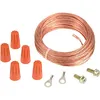 Option 1 Woodstock W1053 Grounding Kit – $18.99
|
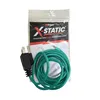 Option 2 Dustopper X-Static Grounding Kit – $29.99
|
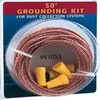 Option 3 ARC-POWER Grounding Wire Kit – $71.22
|
As an Amazon Associate we earn from qualifying purchases.
Most home shops can ground an existing system with a $15–30 kit and an afternoon. If you’re still shopping for the collector itself, our guide to choosing a dust collector for a home shop covers CFM and filtration before you worry about grounding it.
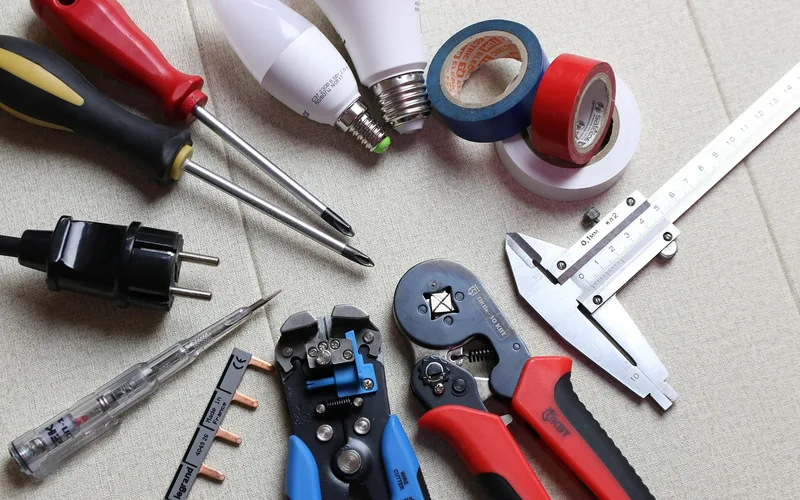
- Bare stranded copper wire, 10–18 AWG
- Wire nuts or crimp-on ring connectors
- Grounding lugs or self-tapping ground screws
- A dedicated grounding rod, or a verified grounded 3-prong outlet
- A multimeter set to resistance/continuity mode
- A drill with a small bit, for anchoring wire inside PVC pipe
- Hose clamps, for bonding flexible hose sections
Why Grounding Matters: Static Electricity and Dust Explosion Risk
As dry wood dust and air move through ductwork at speed, friction between the particles and the pipe wall generates a static charge — a process called triboelectric charging. With nowhere to go, that charge builds until it discharges as a spark. In a cloud of fine, dry, suspended wood dust at the right concentration, that spark is a documented ignition source. OSHA references NFPA 654 (fire and dust explosion prevention) and NFPA 77 (static electricity) as the consensus standards covering it; wood-specific processing facilities fall under NFPA 664, since folded into the consolidated NFPA 660.
📊 NFPA 654 and NFPA 77 guidance calls for resistance-to-ground on bonded dust collection components to stay well under 1 megohm (1,000,000 ohms) — above that, a static charge can accumulate faster than it drains. — Source: Newson-Gale, Mitigating Static Ignitions in Combustible Dust Atmospheres
What’s the Difference Between Bonding and Grounding?
Bonding is connecting two or more conductive parts together with a wire so they sit at the same electrical potential, which stops a spark from jumping between them — but it doesn’t drain the charge away. Grounding (earthing) connects that bonded assembly to the earth itself, through a grounding rod or your electrical system’s ground, so accumulated charge actually has somewhere to go. A dust collection system needs both: every metal part bonded to every other metal part, and the whole bonded assembly grounded to earth.
Do You Actually Need to Ground a Dust Collection System at Home?
NFPA 664, the wood-industry combustible dust standard, applies to facilities with more than 5,000 sq ft of floor space or a dust collection system moving at least 1,500 CFM — well above what a one- or two-person home shop runs. That gap is why documented dust explosions traced to static discharge in home shops are essentially unheard of, while they’re a recorded hazard in industrial-scale wood processing plants. That doesn’t make grounding pointless at home: it’s what stops the shock you feel grabbing a charged plastic hose, and a basic kit costs less than a good sanding disc, so most experienced woodworkers do it regardless of how the numbers work out at hobby scale.
“…wrapped the PVC pipe with braided copper ground wire kit…”
How to Ground Metal Ductwork
- Confirm existing continuity: Set a multimeter to resistance mode and touch the probes to two adjoining metal duct sections — most sealed metal joints already touch and read near zero.
- Bond any loose joints: Where sections are only taped or friction-fit, run a short bare copper jumper across the joint and anchor both ends into bare metal with a screw or clamp, not through paint.
- Ground the collector body: Attach one end of a heavier-gauge copper wire to an unpainted bolt or screw on the dust collector’s metal frame.
- Run the wire to true earth: Connect the other end to a dedicated grounding rod, or to the ground pin of a verified 3-prong grounded outlet — never to a neutral wire.
- Bond every metal fitting downstream: blast gates, Y-fittings, and each machine’s dust port need their own jumper back to the main ground path.
How to Ground PVC or Plastic Dust Collection Pipe
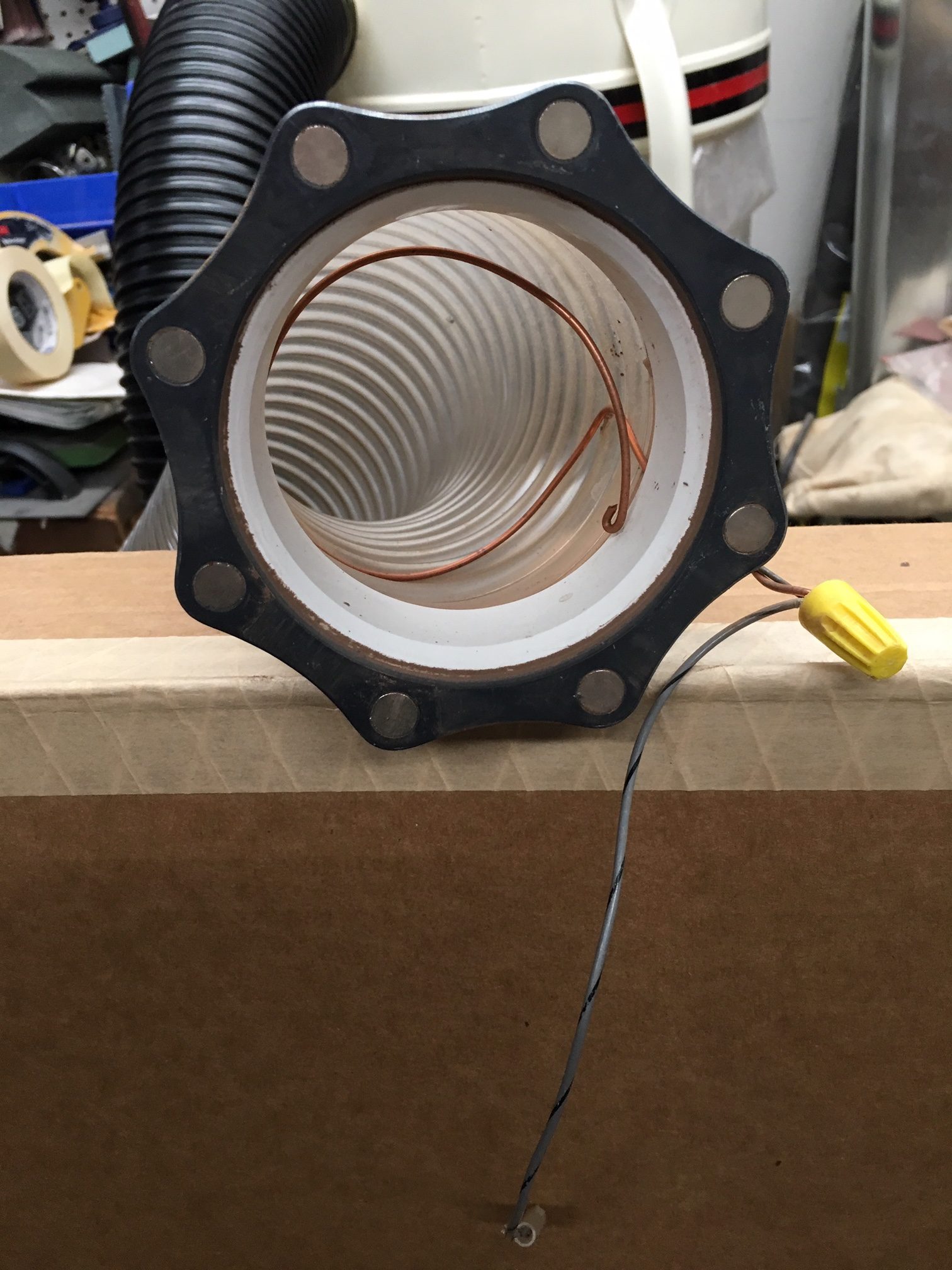
PVC and other rigid plastic pipe can’t conduct a static charge through the pipe wall itself, so wrapping wire around only the outside does very little — the wire has to actually contact the dust stream inside, or pass through the wall at intervals. Clear or see-through plastic dust hose needs the identical treatment; being transparent doesn’t make it conductive.
- Feed the wire inside: Run bare stranded copper wire through the full length of the pipe’s interior — the method most retail PVC grounding kits use.
- Anchor it every 3–4 feet: Drive a self-tapping screw from outside the pipe just far enough to pierce the wall and pin the internal wire in place.
- Or skip the continuous wire: Drive a ¾-inch screw through the wall every 12 inches, alternating sides, so each tip protrudes slightly into the airstream, then jumper each screw to the main ground wire.
- Terminate the same way as metal duct: run the wire to the collector’s ground bolt, then out to a grounding rod or a verified grounded outlet.

Grounding Flexible Hose and the Dust Collector Bag
Most flexible dust collection hose is built with a spiral wire reinforcement wound into the hose wall specifically so it can carry a ground path — check the hose’s spec sheet before assuming it’s there. NFPA 654 and NFPA 77 guidance calls for resistance across that spiral wire to stay under roughly 1 megohm end to end.
Connect the spiral wire at both ends of every hose section with a wire nut or crimp connector, then jumper it into the main ground path — a hose section left floating between two properly grounded fittings still breaks the whole chain.
The fabric or felt collection bag is usually the weakest link in the system: the material itself is non-conductive and can hold its own static charge even when the metal frame it clamps to is perfectly grounded. Static-dissipative bag material exists and is worth the upgrade on a bag-style or cyclone collector; at minimum, make sure the metal ring the bag clamps to is bonded into the rest of the system — see our guide to dust collector bag micron ratings when choosing a replacement.
Metal vs. PVC vs. Flexible Hose: Grounding Method Compared
| Duct Type | Grounding Method | Best For |
|---|---|---|
| Metal (galvanized steel) | Sections bond naturally at sealed joints; add a jumper wire only where tape or a gasket breaks continuity | Shops that want minimal extra wiring |
| PVC / rigid plastic | Bare copper wire run inside the pipe, anchored every 3–4 ft with screws | Budget shops already piped in PVC; matches most retail kits |
| Flexible hose | Use hose with built-in spiral wire reinforcement; bond the wire at both ends | Machine drops and short connector runs between tools and the main duct |
Testing Your Grounding System
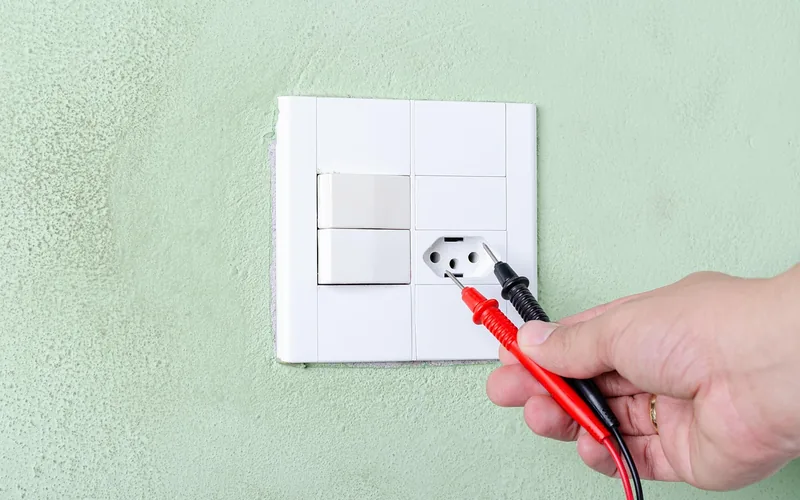
Set a multimeter to resistance (ohms) mode. Touch one probe to a known-grounded point — the ground pin on an outlet, or the grounding rod itself — and the other probe to each bonded component in turn: a duct joint, a blast gate, the collector’s frame, the far end of a hose’s spiral wire.
- A low, stable reading (comfortably under the roughly 1 megohm threshold in NFPA 654/77 guidance) means that point is properly bonded to ground.
- A very high or unstable reading means the connection is broken, painted over, or not actually touching bare metal — recheck that joint.
- Retest after any change: adding a hose, swapping a filter, moving a machine, or repainting anything the ground wire touches.
Common Grounding Mistakes to Avoid
- Wrapping wire around the outside of PVC pipe only, with no contact to the inside surface or a drilled-through screw — this looks like grounding but does almost nothing.
- Clamping a ground wire to painted metal instead of bare metal; paint is an insulator, so the connection looks fine but reads open on a multimeter.
- Grounding the metal ductwork but leaving the fabric dust bag, a plastic Y-fitting, or a hose section unbonded, breaking the path closest to the dust cloud itself.
- Assuming a 3-prong plug alone grounds the ductwork; the plug grounds the motor’s electrical components, not the dust path running through the pipe.
- Skipping the multimeter check and assuming a wire that looks connected is actually reading low resistance.
Frequently Asked Questions
Do dust collection systems need to be grounded?
Industrial and commercial wood-processing systems covered by NFPA 664/660 need documented bonding and grounding. Home shops fall well below that standard’s size and airflow thresholds, so grounding is a strongly recommended best practice rather than a legal requirement — it’s inexpensive and it also stops static shocks.
Does PVC dust collection pipe need a grounding wire?
Yes, if you want the grounding to actually work. PVC itself won’t conduct a charge through the pipe wall, so a wire needs to run inside the pipe or through drilled screws that touch the airstream — wrapping wire around the outside only doesn’t bleed off static from the dust moving inside.
Does the dust collector bag need to be grounded?
The bag fabric itself can’t be grounded because cloth and felt are non-conductive, but the metal ring or frame it clamps to should be bonded into the rest of the system. Static-dissipative bag material is available if bag-related shocks are a recurring problem.
Is a grounding kit necessary for a shop vacuum or dust collector?
A purpose-built kit isn’t strictly necessary — you can build a ground path from bare copper wire and hardware you already own — but a $15–30 kit includes matched connectors and clear instructions, which is usually faster than sourcing parts individually.
What’s the difference between bonding and grounding a dust collector?
Bonding connects conductive parts to each other so they share the same electrical potential and can’t spark between themselves. Grounding connects that bonded assembly to the earth so accumulated charge has somewhere to actually drain. A dust collector needs both, not just one.
Can grounding a dust collector actually prevent a dust explosion?
Grounding removes one ignition source — static discharge — from the fire triangle, but it’s one layer among several NFPA 654/664 controls, including housekeeping and equipment spacing. It measurably reduces risk; it doesn’t make an ungrounded hazard elsewhere in the shop irrelevant.
Conclusion
Grounding a dust collection system comes down to two steps: bond every conductive part together, then connect that bonded assembly to true earth, whether the ducting is metal, PVC, or flexible hose. A home shop’s static-driven explosion risk is low next to an industrial plant regulated under NFPA 664/660, but the shock, the low cost of a kit, and the chance it matters someday make it worth doing properly instead of skipping it.
Sponsored / affiliate links. As an Amazon Associate I earn from qualifying purchases. I may earn additional commission from eligible campaigns.