How to Start an Echo Chainsaw: Cold-Start and Warm-Start Steps
An Echo gas chainsaw starts differently cold than it does warm, and skipping that distinction is the most common reason a saw floods or won’t fire. The short version: engage the chain brake, set full choke and prime the engine for a cold start, pull the cord, then switch to little or no choke for every restart after that while the engine is still warm. Here is the full sequence, plus the chain-brake and gear checks to run before you touch the starter cord.
Chain Brake and Safety Gear: Do This Before You Touch the Starter Cord
Push the front hand guard forward until it clicks before you do anything else. That engages the chain brake and locks the chain in place, and it is the manufacturer-recommended way to start any Echo chainsaw, not an optional extra step. Under ANSI Standard B175.1, the brake on a working saw has to stop the chain within 0.12 seconds at 13,500 rpm, which is the whole point of starting with it engaged: if the engine catches faster than you expect, a locked chain cannot bind or spin.
Best Chainsaw Safety Chaps
 |
Forester Apron-Style Chainsaw Chaps – $53.99 The chain brake protects you at startup, but chaps are what protect you the moment you disengage it and start cutting.
|
Beyond the chain brake, OSHA’s chainsaw-safety guidance calls for head protection, eye and face protection, hearing protection rated to bring exposure to 90 decibels or below, cut-resistant leg protection (chaps), work gloves, and sturdy protective footwear. None of that is overkill for a homeowner saw – a kickback or a slipped chain doesn’t check whether you’re a professional logger first.
Cold Start: The Full Step-by-Step Sequence
A cold engine needs a richer fuel mixture to catch, which is why the choke and primer steps matter more here than on a restart. Work through these in order:
- Set the saw on flat, clear ground and confirm the chain isn’t touching dirt, wood, or anything else.
- Engage the chain brake by pushing the front hand guard forward until it clicks.
- Flip the ignition switch to the ON/START position.
- Pull the choke lever all the way out to the full-choke position.
- Press the primer bulb 5 to 6 times, until you can see fuel moving through the bulb. In near-freezing temperatures, 7 to 8 presses is normal.
- Grip the front handle firmly with your left hand and brace the rear handle under your right foot or knee to hold the saw steady.
- Pull the starter rope with a short, firm stroke until the engine fires – it may only sputter on the first pull or two before catching.
- As soon as it fires, push the choke lever back in to the half-choke or run position so the engine doesn’t flood.
- Let it idle for a few seconds, then squeeze the throttle to settle it into a normal idle, and disengage the chain brake by pulling the front guard back toward the handle before you start cutting.
Warm Restart: What Changes When the Engine Is Already Warm
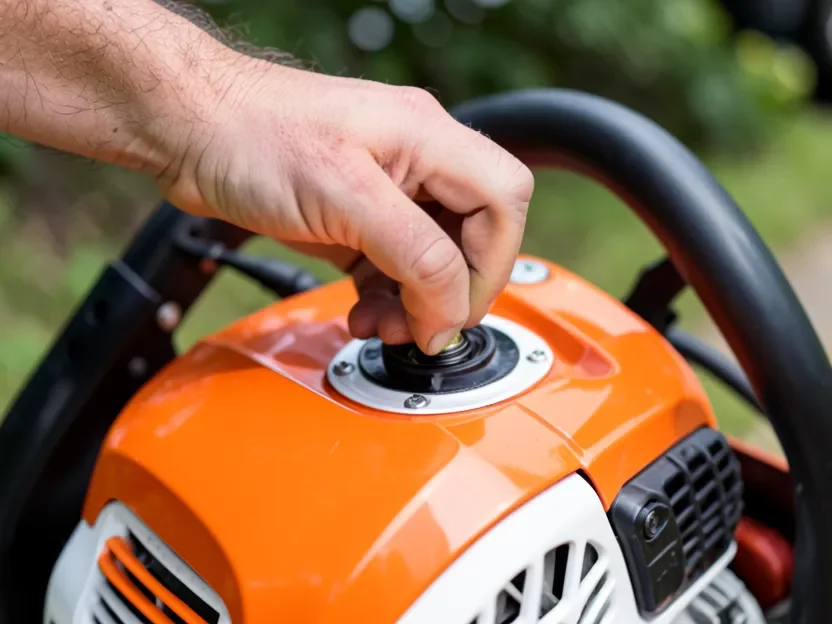
If you’re restarting a saw that’s already run and is still warm – stopping to refuel, moving to a new cutting spot, or restarting after it stalled – skip full choke. Leave the choke lever in the run position (or half-choke at most if the engine stalled and cooled slightly), press the primer bulb only once or twice, keep the chain brake engaged, and pull the starter cord. Using full choke on a warm engine is the most common way to flood it, since the engine doesn’t need the extra fuel a cold start requires.
If It Won’t Start: Flooding and Other Common Culprits
A gurgling or gas smell at the muffler almost always means a flooded engine – usually from using full choke on a warm restart or over-priming a cold one. Push the choke back to run, hold the throttle wide open, and pull the cord several times to clear the excess fuel before trying again; if that doesn’t work, our guide to starting a flooded chainsaw covers the spark-plug-drying steps in more detail. If the saw won’t start at all, check the kill switch position, confirm there’s fresh fuel mixed at the correct ratio, and make sure the spark plug boot is seated – old or wrong-ratio fuel is a frequent culprit on saws that sat unused over winter. If it’s genuinely flooded and the drain-and-pull method above doesn’t clear it, pull the spark plug boot off, remove the plug with the correct socket, wipe the electrode dry with a rag, and let it sit in open air for a few minutes before reinstalling – reinstall the plug and boot, leave the choke off, and pull the cord a few more times with the plug removed first to expel any pooled fuel from the cylinder, then reinstall the plug and try the warm-start sequence.
Common Mistakes That Keep an Echo Chainsaw From Starting
- Using full choke on a warm engine. This is the single most common cause of a flooded saw – the engine already has enough fuel to run, and full choke drowns it.
- Starting with old fuel. Ethanol-blended gas starts breaking down within about 30 to 60 days in the tank or a fuel can. If the saw sat over winter with fuel in it, drain it and mix fresh 50:1 gas before troubleshooting anything else – see our Echo fuel mix ratio guide for the exact ratio and octane Echo specifies.
- Not pulling the starter cord with enough speed. A slow, half-hearted pull often won’t spin the engine fast enough to fire, especially cold. Use a short, brisk stroke rather than pulling the full length of the rope.
- A dirty air filter or fouled spark plug. Both starve the engine of air or spark. If the saw cranks but won’t catch even with fresh fuel and the correct choke setting, check the air filter for sawdust buildup and the spark plug for a wet or blackened tip before assuming it’s a bigger problem.
- Rushing the controls out of sequence. The saw will still start with the chain brake on, but yanking the cord before the choke and primer steps are actually done just wastes pulls and can flood a cold engine. Work through the sequence in order rather than skipping ahead.
Which Echo Model Do You Actually Have?
The sequence above covers Echo’s gas chainsaw line generally – it applies to the homeowner-grade CS-352, CS-400, and CS-490 saws as well as the larger CS-590 Timber Wolf and the professional CS-6800P, since all of them use the same chain brake, choke, and primer bulb layout. What varies is exact placement: on some models the choke lever doubles as the ignition switch’s half-throttle lock, so pushing it back in after starting also releases the fast-idle setting, while on others those are two separate controls. If your saw is specifically the CS-4910, our Echo CS-4910 starting guide walks through that model’s control layout in more detail. Comparing brands rather than models? See how Echo’s starting procedure and overall handling stacks up in our Echo vs. Stihl chainsaw comparison.
Frequently Asked Questions
Why won’t my Echo chainsaw start when it’s cold?
A cold engine needs full choke and more fuel than a warm one. If yours won’t catch, confirm you pulled the choke lever all the way out, primed the bulb 5 to 6 times (7 to 8 in near-freezing weather), and that the chain brake is engaged – a saw with the brake left off can still start, but the manufacturer-recommended sequence assumes it’s on.
How many times should I press the primer bulb on an Echo chainsaw?
5 to 6 presses for a cold start, or 7 to 8 in very cold weather, until you see fuel moving through the bulb. For a warm restart, 1 to 2 presses is usually enough – over-priming a warm engine is a common cause of flooding.
Do I need the choke to restart a warm Echo chainsaw?
No. Leave the choke in the run position for a warm restart. Pulling full choke on an engine that’s already warm is one of the most common ways to flood it, since the engine doesn’t need the extra fuel a cold start requires.
Is it safe to start a chainsaw with the chain brake engaged?
Yes – starting with the chain brake engaged is the manufacturer-recommended method, not an extra precaution. Under ANSI Standard B175.1, a working brake has to stop the chain within 0.12 seconds at 13,500 rpm, so if the engine catches faster than expected, the locked chain can’t spin or bind.
The pattern to remember: chain brake on, full choke and several primer presses cold, little or no choke and one or two primer presses warm. Get that sequence right and most “won’t start” problems on an Echo chainsaw disappear on their own. Once it’s running smoothly, the next thing worth getting right is technique – see our guide on how to cut a tree branch with a chainsaw safely for spring-pole tension, overhead hazards, and kickback-prevention specifics.
Sponsored / affiliate links. As an Amazon Associate I earn from qualifying purchases. I may earn additional commission from eligible campaigns.