Infrared Heater for a Workshop: Is It Worth It?
Yes, an infrared heater is worth it for a small, drafty, or intermittently used workshop if it can heat the bench and machine area directly. It is a poor fit if you need even room-wide warmth everywhere at once. Placement, wattage, and clearances matter more than square footage alone.
This guide is part of our Winter Woodshop Guide: Heat, Humidity, Rust and Safety series.
Verdict

That makes infrared a practical choice for a woodworking shop that is used in bursts, especially when you want fast warmth at the work zone without moving air through dust. It is less convincing for finish curing, glue work, or any shop where you need stable ambient temperature across the full room.
Pros and cons
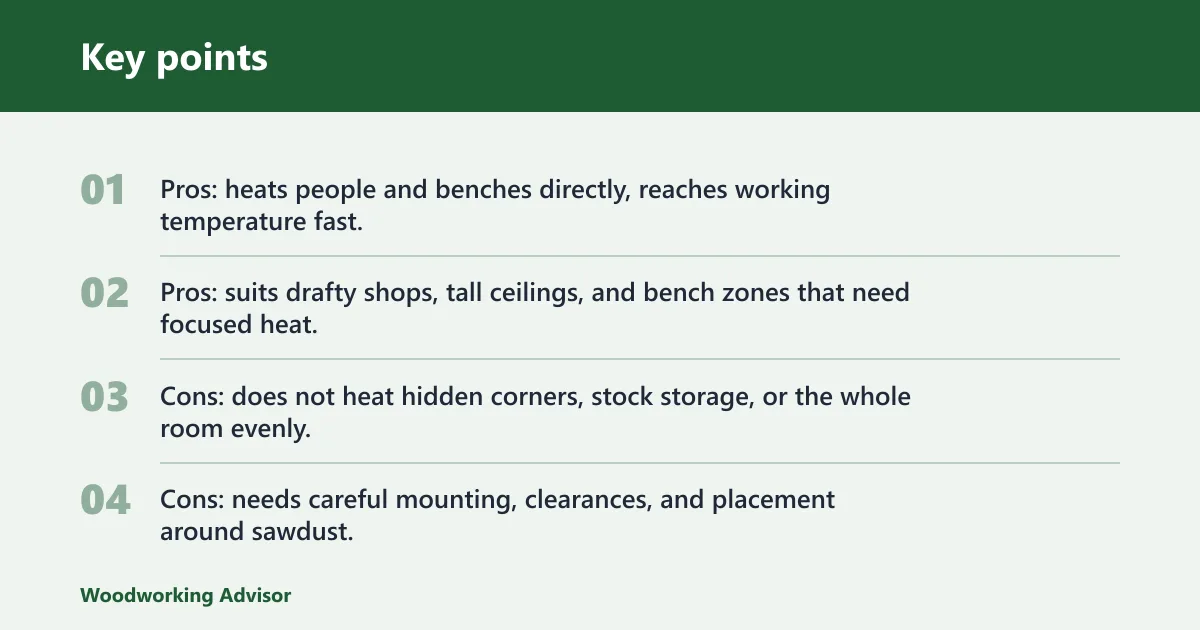
- Pros: heats people and benches directly, reaches working temperature fast, and avoids fan-driven air circulation.
- Pros: suits drafty shops, tall ceilings, and bench zones that need focused heat.
- Cons: does not heat hidden corners, stock storage, or the whole room evenly.
- Cons: needs careful mounting, clearances, and placement around sawdust, solvent containers, and rags.
Specs at a glance
| Item | Details |
|---|---|
| Heater type | Infrared workshop heater |
| Output | 7500W |
| Power | 240V |
| Installation | Hardwired, wall or ceiling mounted |
| Controls | Remote controlled thermostat |
| Heat direction | Adjustable louvers |
| Best use | Large workshop spaces needing directed heat |
| Tradeoff | Requires fixed installation and suitable electrical capacity |

Who it
Infrared heat fits detached workshops, one-bay garages, and semi-insulated outbuildings where you work in one zone at a time. It is a strong fit if you want warmth at the bench, at the table saw, or near a machine bay without waiting for the whole room to equalize.
It is not the best choice if you want uniform ambient temperature for glue-up, finishing, or long sessions across the whole shop. It also becomes less attractive when mounting options are limited or when the only safe location puts the heater too close to stored lumber, dust, or solvents.
How infrared heating works in a workshop
Infrared heaters warm people and surfaces directly instead of relying on air heating. That matters in a workshop because the bench, machine castings, and your body can feel warmer before the whole room does. Silent operation is another advantage, since there is no fan-driven air circulation to stir dust.
Say your 200 square foot garage shop has a workbench near the door and a table saw on the far wall. A ceiling-mounted radiant heater can keep the bench area comfortable while the far end stays cool. That is useful if your work stays in one area.
Workshop decision matrix
| Product | Badge | Best for | Price | ||
|---|---|---|---|---|---|
 |
DR. INFRARED HEATER DR218-1500W Greenhouse Garage WorkshopDR. INFRARED HEATER | Our pick | 1500W · 120V · lightweight · 150 sq ft coverage | $100.74
Price as of 21 Oct 2026
|
View |
|
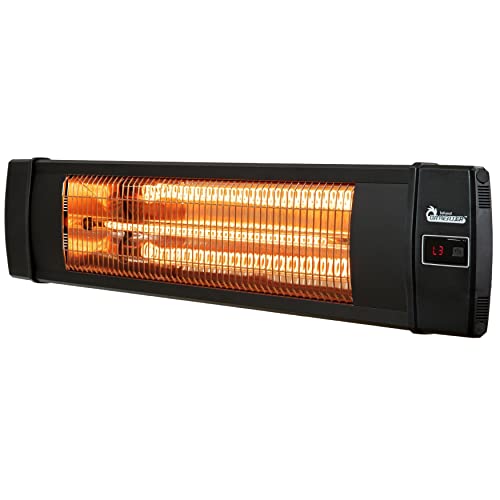
DR. INFRARED HEATER NEW Upgraded DR-975 7500-Watt 240-VoltDR. INFRARED HEATER | Also great | 7500W · 240V · hardwired · with thermostat | $240.00
Price as of 21 Oct 2026
|
View |
 |
DR. INFRARED HEATER Portable Infrared Indoor and OutdoorDR. INFRARED HEATER | Budget pick | 1500W · 120V · portable · IP55 outdoor-rated | $109.98
Price as of 21 Oct 2026
|
View |
| Workshop variable | Infrared | Forced-air | Mini-split | Gas heat |
|---|---|---|---|---|
| Insulation | Good for insulated or partly insulated spaces | Works, but loses heat fast in leaky shops | Good if the building envelope is decent | Works, but loss through leaks can be high |
| Ceiling height | Often better than air heat in high ceilings | Poorer as air volume grows | Less affected than basic space heaters | Can work, but distribution matters |
| Door-open frequency | Less affected because it heats the zone directly | Cold air loss hurts quickly | Recoverable, but slower after big losses | Can recover, but fuel cost rises |
| Dust load | Better because there is no fan | Fan can move dust around | Indoor air movement is limited | Depends on the system and ducting |
| Whole-shop warmth | Poor to fair | Fair to good | Good | Good |
| Electrical capacity | Can be manageable, but high-output units need strong supply | Often lower barrier at modest sizes | Needs dedicated electrical support | May need gas line and electrical hookup |
| Mounting flexibility | Wall, ceiling, portable, or freestanding options | Usually floor or wall mounted | Fixed indoor unit plus outdoor unit | Often fixed installation |
| Safety clearance burden | High, because beam path and hot surfaces matter | Moderate | Lower around the indoor unit | Moderate to high, depending on unit type |
A workshop heater decision should start with those variables, not with a generic coverage claim. A compact, insulated shop with a fixed bench zone is a very different problem from a draughty older industrial unit with open storage and frequent door use.
What works
Infrared heating works best when the goal is to warm the actual work zone instead of the whole air volume. It is quiet, direct, and useful when you spend time at one bench or machine. In a cold garage, that can be the difference between usable and miserable.
Wall and ceiling mounting save floor space, which matters in a shop crowded with saw stands, clamps, and mobile bases. Controls such as a thermostat, remote, timer, variable settings, or PIR control can make zoning easier when you want heat only where you stand.
Formats that fit different shops
- Bar heaters: often the most practical option for larger workshops and garages.
- Panel heaters: suit places where a flatter, more discreet heater is preferred.
- Portable infrared heaters: fit setups where permanent installation is not required.
- Quartz elements: provide instant heat and are often portable.
- Ceramic elements: are quieter and often used in fixed installations.
- Metal-sheathed elements: are durable and common in industrial settings.
What does not?
Infrared is the wrong tool when you need a uniform room temperature. It can make the bench area feel warm while the back wall, lumber rack, or finishing corner stays cool. That is a problem for glue-up and finish work that depend on even ambient conditions.
It is also a poor fit when mounting choices are awkward. If the only available wall puts the heater too close to stored boards, open tool racks, sawdust piles, solvent containers, or oily rags, the clearances become a real constraint rather than a minor detail.
Picture a 240 square foot shop with an open lumber shelf under the only ceiling joist that can take a heater. If that position forces the radiant beam to hit stacked stock or stored finish cans, the heater is in the wrong place even if the wattage is sufficient.
Workshops with poor wiring, low clearances, or no safe mounting surface often do better with another heat source. The better question is not whether infrared is powerful enough. It is whether the shop layout lets that power reach the work zone without creating a hazard.
How much wattage do you need?
Workshop heating depends on total installed wattage, not one simple generic coverage number. A common starting point is about 100 square feet per 1,500 watts in a well-insulated space, though more output is often needed as a building gets leakier, taller, or more open to the weather.
A 3kW heater running for one hour uses 3kWh of electricity. That matters because actual cost is driven by run time, thermostat cycling, and how often you open the door. A heater that cycles off once the bench zone is warm may cost less than a unit that runs flat out in a cold shell.
Worked sizing example
- Start with the shop’s usable heated zone, not the entire building footprint.
- Match output to construction: insulated shop, semi-insulated outbuilding, or draughty building.
- Use 1,500 watts per roughly 100 square feet as a starting point for a better-insulated space.
- Increase output for high ceilings, frequent door opening, and poor insulation.
- Choose multiple zones if one heater cannot cover the bench area and machine area cleanly.
For example, a small insulated shop around 200 square feet may work with a 3kW unit if the goal is bench-zone comfort. The same output will be less convincing in a leaky garage with a roll-up door that opens often. In that case, higher wattage or a second zone is usually the better call.
Safety and clearances
Are infrared heaters safe around sawdust? Only if you treat them as hot equipment with a direct line of sight, not as a casual space heater. Sawdust piles, solvent containers, and oily rags need to stay out of the beam path and away from the unit itself. Hot surfaces and radiant output can ignite nearby combustibles.
Do not assume a generic clearance number applies to every model. Required clearance changes with the heater, the mounting method, and the installation instructions. If a product carries a hazardous-location or dust rating, that helps, but it does not remove the need to keep flammables out of the heat zone.
Placement checklist
- Keep the radiant path away from stacked lumber, cardboard, and open shelving.
- Store solvent containers and finishing materials outside the heater’s immediate zone.
- Keep oily rags in a safe container, not on a bench near the heater.
- Check ceiling height, mount angle, and tool placement before fastening the unit.
- Confirm the electrical supply and mounting hardware before switching it on.
Do infrared heaters work in an uninsulated workshop? Yes, but with limits. They can give direct warmth where you stand, yet the room itself may stay cold, especially if doors leak, the roof is thin, or air exchange is constant. In that case, they are a comfort tool, not a whole-shop heating solution.
Alternatives
The 1500W DR. INFRARED HEATER DR218-1500W is the simplest fit when you need portable heat for a smaller bay or a damp corner. Based on the published specs, its IPX4 splash resistance is useful in a garage-like setting. The drawback is capacity: 1500W is limited for larger or leakier shops.
The portable DR. INFRARED HEATER model with 1500W output and IP55 rating suits readers who want plug-in convenience without hardwiring. Its three power settings help with zoning, but it still has the same small-heater ceiling on output. It is better for spot heat than for a whole shop.
A forced-air heater is the better choice when you need quicker room-wide mixing and more even ambient temperature. It is less precise at the bench, and the fan can move dust, but that tradeoff makes sense in some larger garages or shared spaces.
A mini-split is the cleaner answer for a well-insulated workshop that needs steady comfort through long sessions. It is usually the strongest option for stable temperature control, but it does not solve every dust or placement issue, and it needs a suitable electrical setup and a fixed installation plan.
Gas heat can make sense in larger buildings where electrical capacity is limited or where whole-shop warmth matters more than beam-style heat. It also adds combustion, venting, and clearance concerns, so it is not automatically simpler than electric heat.
Should you buy it?
Buy infrared if your shop is small to medium, drafty but usable, and set up around one or two work zones. Do not buy it as a shortcut to uniform warmth. That is the wrong job for this heater type.
If your real need is bench comfort, instant warmth, quiet operation, and no fan-driven dust circulation, infrared is a sensible choice. If you need the whole room to stay evenly warm for finishing or glue work, start with another heater class.
Frequently asked questions
Is an infrared heater worth it for a workshop?
Yes, if your work is zone-based and you want fast warmth at the bench without heating the whole air volume first. It is less appealing if you need even room temperature everywhere, because infrared warms surfaces and people directly rather than mixing the air.
Will an infrared heater heat a garage workshop enough?
It can heat the working zone enough for many garage shops, especially when the space is modest, partially insulated, and not opened constantly. It will struggle more in a large, leaky garage or where the door opens often and the goal is full-room comfort.
Are infrared heaters safe around sawdust?
They can be safe if sawdust, shavings, cardboard, and finishing supplies stay well away from the heater and its beam path. The risk comes from nearby combustibles and poor placement, not from the heat concept alone. Follow the maker’s installation instructions carefully.
Do infrared heaters use less electricity than space heaters?
Not automatically. A 3kW infrared heater still uses 3kWh for one hour at full output. The savings come when thermostat cycling lets you heat only the occupied zone instead of the whole room, or when a fan heater would need to run longer to feel warm.
Should I mount an infrared heater on the wall or ceiling?
Choose the location that keeps the beam on the work zone while preserving safe clearances from storage and traffic paths. Ceiling mounting often saves floor space, while wall mounting can be easier to aim. The right answer depends on joists, bench placement, and headroom.
What type of infrared heater is best for a garage workshop?
For larger garages, bar heaters are often the most practical option. For a flatter visual profile, panels can work well. If you need no permanent installation, a portable infrared heater is easier to move. The best type depends on layout, electrical supply, and how permanent the setup should be.
Sponsored / affiliate links. As an Amazon Associate I earn from qualifying purchases. I may earn additional commission from eligible campaigns.