Is It Worth Insulating a Garage?
Yes, insulating a garage is worth it when you use it in winter, want steadier temperatures, or need to protect tools and stored wood. For an attached garage, the payoff often arrives sooner. A detached garage usually makes sense only if you heat it or work there often. Skip it or do it badly, and you can pay through higher heating bills, damp air, rust, and a colder shop. This guide gives a practical yes-or-no framework for attached and detached garages, with energy, moisture, and winter woodworking in view.
Garage insulation decision matrix
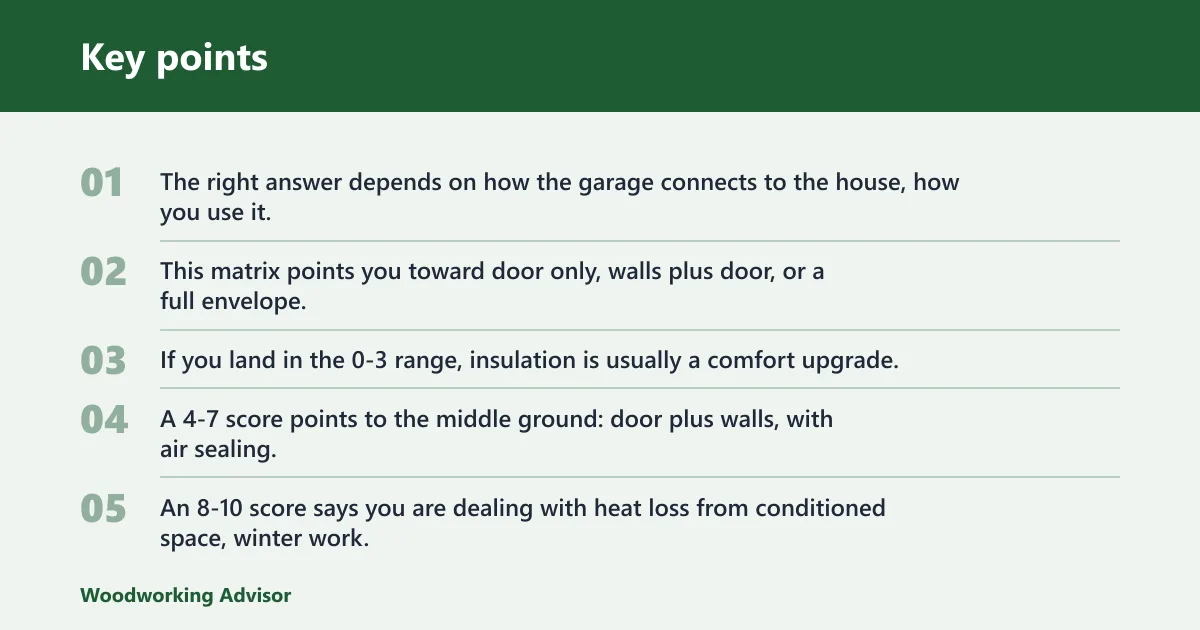


The right answer depends on how the garage connects to the house, how you use it, and how much cold-weather moisture it sees. This matrix points you toward door only, walls plus door, or a full envelope, instead of treating every garage like the same project.
| Factor | Score 0 | Score 1 | Score 2 |
|---|---|---|---|
| Attached vs detached | Detached, no shared wall | Detached, partly conditioned use | Attached or shared wall to house |
| Workshop use | Storage only | Occasional hobby use | Regular winter shop use |
| Room above garage | No room above | Unconditioned space above | Living space above or beside it |
| Climate severity | Mild winters | Mixed heating season | Long, cold, or humid season swings |
| Moisture or rust risk | Low | Moderate | High condensation, rust, or finish storage risk |
| Total score | 0-3 | 4-7 | 8-10 |
| Recommended scope | Door only, or skip for now | Walls + door | Full envelope |
If you land in the 0-3 range, insulation is usually a comfort upgrade, not a strong payback project. A 4-7 score points to the middle ground: door plus walls, with air sealing. An 8-10 score says you are dealing with heat loss from conditioned space, winter work, or moisture control, so a full envelope starts to make sense.
Is it worth insulating a detached garage?
A detached garage is often harder to justify from an energy-saving angle because it does not directly affect the house’s conditioned air. It can still be worth insulating if you store tools, keep finishes there, or use the space as a winter shop, but the payoff usually depends more on comfort and moisture control than on utility bills.
Storage-only detached garages
If the garage holds lawn gear, boxes, or a vehicle and you rarely spend time there, door-only insulation is often the practical limit. A detached space with no heat source and no nearby living area usually gives you smaller bill savings than an attached garage, even though it can still feel less icy and less damp.
Detached garages used as winter shops
If you plane stock, glue joints, or spray finish in winter, the answer changes. Stable temperature matters for wood movement, adhesive cure, and finish storage, and the garage door is a common retrofit target because it is a large heat-loss surface. In that case, walls plus door often beat door-only work by a wide margin.
When a detached garage is not worth full insulation
Skip full insulation when the building is rarely occupied, has no heat source, and only needs basic storage protection. That is especially true in mild climates. A common first-timer mistake is spending on wall insulation before fixing air leaks, so outside air still moves through gaps and the space still feels cold.
Where garage insulation pays first
The first dollar should usually go where heat escapes fastest and where you get the most comfort for the least disruption. In many garages that is the door, but walls and the ceiling can outrank it when the space is used often or sits under living space.
Garage door insulation
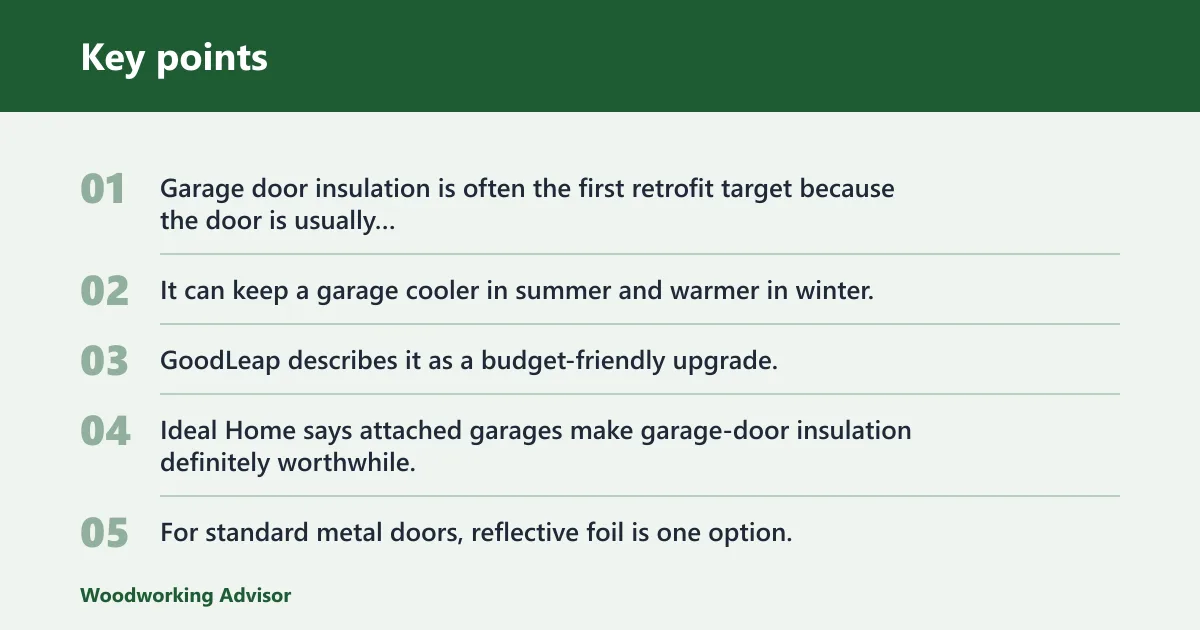
Garage door insulation is often the first retrofit target because the door is usually the largest path for heat loss or gain, and it is often the easiest place to start. It can keep a garage cooler in summer and warmer in winter, and it can reduce noise all year. GoodLeap describes it as a budget-friendly upgrade.
Ideal Home says attached garages make garage-door insulation definitely worthwhile, and it notes that an uninsulated garage can let heating escape. For standard metal doors, reflective foil is one option; Ideal Home says some kits start from £30 at Wickes, and the foil can be cut easily with scissors.
Wall insulation
Walls matter more than the door when you want true temperature control, not just a less drafty garage. That is especially true for a workshop, where you need steadier conditions for tools, lumber, and finishes. Wall insulation usually works best with air sealing and some kind of interior finish so the cavity stays protected.
Ceiling insulation
Ceiling insulation matters most when there is living space above the garage. It reduces heat transfer to the rooms overhead and is usually part of a full garage insulation package. If the garage roof deck is the thermal boundary, the ceiling becomes more important than the door for comfort and bill control.
Is it worth insulating garage walls?
Garage walls are worth insulating when you want the space to act more like a shop than a shed. Door-only work helps, but walls are what make temperature swings smaller and make winter use more realistic. If you need a stable space for wood storage or finishing, wall insulation is often the better investment.
When walls beat door-only upgrades
Walls beat door-only insulation when the garage stays cold from side leakage, slab-edge air, or an exposed shared wall. That is common in winter shops and in garages with a lot of tool storage. If the air inside still feels raw after the door is insulated, the walls and air leaks are the next place to look.
Air sealing before you add insulation
Air sealing matters as much as R-value because moving air carries heat and moisture. Seal rim joists, wall penetrations, gaps around the service door, and any seams around framing or sheathing before you insulate. Without that step, you can trap cold drafts and still get condensation on metal tools and fasteners.
Interior finish and fire protection
Some materials need a finished cavity or proper covering. Cellulose requires a contained wall cavity, and foam products often need a fire-rated interior layer or another approved thermal barrier. If you plan to leave walls exposed, choose a material that fits that finish plan rather than forcing a product into the wrong assembly.
Insulation materials for garage walls and doors
Match the material to the assembly, the moisture risk, and the amount of space you have. R-value is the thermal resistance metric, and the right number depends on climate zone and how much depth your wall or door can accept. More thickness is not always available in a garage.
Fiberglass batts
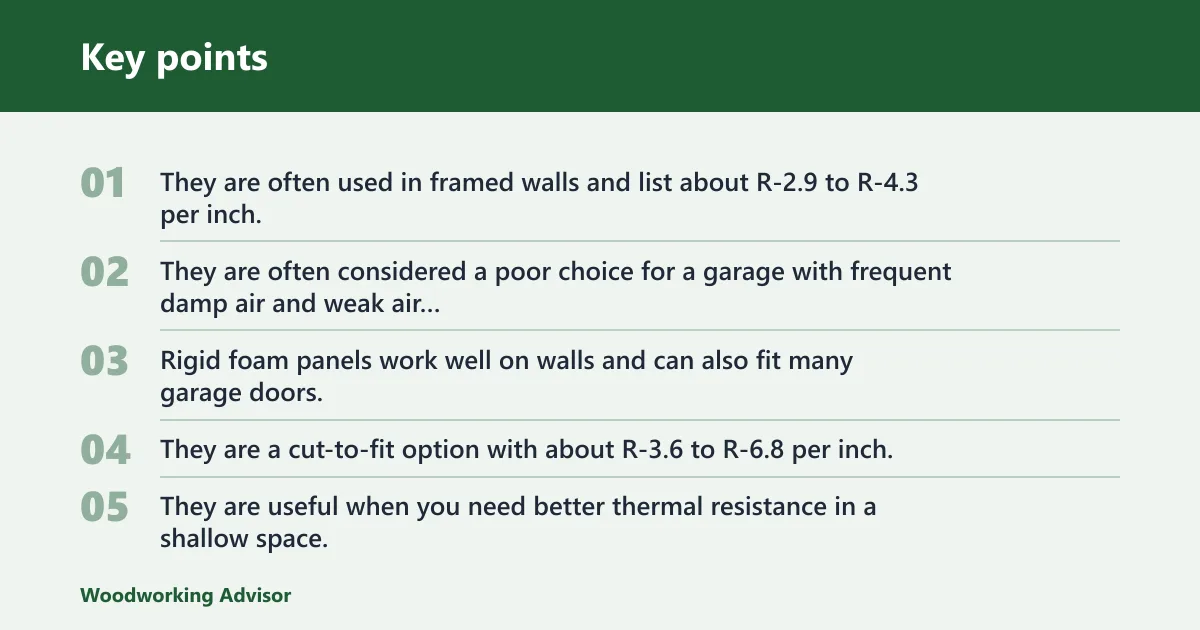
Fiberglass batts are the budget DIY option. They are often used in framed walls and list about R-2.9 to R-4.3 per inch, but they are moisture-sensitive, so they fit best where you can keep the cavity dry and covered. They are often considered a poor choice for a garage with frequent damp air and weak air sealing.
Rigid foam panels
Rigid foam panels work well on walls and can also fit many garage doors. They are a cut-to-fit option with about R-3.6 to R-6.8 per inch, and they need careful handling and fire-rated selection. They are useful when you need better thermal resistance in a shallow space.
Spray foam insulation
Spray foam is the high-end air-sealing option. Open-cell foam is about R-3.5 to R-3.8 per inch, while closed-cell foam is about R-6 to R-7 per inch. It can be the best fit when air leakage and condensation are the main problems, but it usually costs more and should be used with a clear wall or roof assembly plan.
Cellulose insulation
Cellulose is a loose-fill blown-in material with about R-3.2 to R-3.8 per inch. It works best in a finished cavity that can contain it, so it is a better wall choice than an exposed garage door or an open, unfinished bay. It is not the first pick where moisture control is weak.
Garage door insulation kits
Garage door insulation kits are made for door panels and are often sold as DIY kits. They may use reflective foil, foam, or batt materials. For many homeowners, that is the lowest-friction starting point, especially when the door is the main leak and the rest of the garage is still mostly storage.
Moisture, rust, and winter shop comfort
For woodworking, moisture control is not a side issue. Condensation, rust, and finish problems can show up before energy savings do. In cold garages, the aim is not only to hold heat; it is to keep humid air from hitting cold metal and dropping below the dew point.
Condensation and dew point in cold garages
When warm, moist air meets a cold door, wall, or tool, water can condense on that surface. That is why air sealing matters as much as insulation: if humid air keeps entering, even a well-insulated garage can still sweat. Cold-climate garages are especially prone to this problem during temperature swings.
Protecting tools, fasteners, and finish stock
Rust on plane irons, saw blades, clamps, and fasteners is more likely when humidity cycles up and down. Wood finish and adhesive storage also suffer when temperatures swing sharply. A garage that stays closer to stable conditions is easier on stored stock and less likely to leave you with a damp, sluggish setup.
Why air sealing matters as much as R-value
Higher R-value slows heat flow through a material. It does not stop air movement through cracks. If you want a winter shop that starts up quickly and stays workable, seal the leaks first, then add insulation. That sequence usually does more for comfort and moisture control than insulation alone.
Worth insulating garage checklist
This checklist helps you decide whether the project is likely to return enough comfort, bill control, and moisture protection for the effort. A full payback calculation depends on size, climate, and materials, so the right question is whether the upgrade fits your use pattern and the parts of the garage that leak most heat.
- Energy-cost check: Is the garage attached, or does it sit next to conditioned rooms?
- Use-pattern check: Do you work there in winter, or is it mainly storage?
- Moisture-risk check: Do you see condensation, rust, or damp air after temperature swings?
- Project-cost check: Can you insulate the door, walls, or ceiling without gutting the space?
- Assembly check: Do you have room for the R-value you need, plus fire-rated interior protection where required?
Suppose you have an attached two-car garage, a room above it, and you use the space for weekend woodworking. That setup scores high on all five checks, so a full envelope usually beats door-only work. Compare that with a detached garage used for lawn storage in a mild climate; the same money may be better spent on the door and air sealing.
Frequently asked questions
Is it worth insulating a garage?
Yes, when the garage affects your comfort, your tools, or your heating bill. The best cases are attached garages, winter workspaces, and garages with moisture or rust issues. If the space is detached and used only for storage, the return is usually weaker unless you still need temperature control.
Is it worth insulating a detached garage: sometimes, but usually?
Sometimes, but usually for use and comfort rather than utility savings. Detached garages benefit most when they double as a shop, protect finish stock, or need steady temperatures through winter. If it is only for parking and storage, a door upgrade may be enough.
Is it worth insulating garage walls: yes, when you want real?
Yes, when you want real climate control instead of a slightly better door. Walls matter most for hobby spaces, winter shops, and garages with a shared wall or persistent drafts. Pair the insulation with air sealing, or the wall cavities can still leak heat and moisture.
Is it worth insulating a garage roof?
It is worth it when the ceiling is the thermal boundary, especially if there is living space above the garage. In that case, ceiling insulation helps protect the rooms above and usually matters more than the door. If there is no occupied space above, the ceiling need is less urgent.
Is it worth insulating a garage door?
Often yes, because the garage door is usually the largest source of heat loss or gain. It is also one of the easiest places to start, especially with reflective foil or a garage door insulation kit. Door-only work is strongest when the rest of the garage is not used as a shop.
Will insulating an attached garage lower my energy bills?
Usually more than a detached garage, because an attached space affects conditioned air and adjacent rooms. The same source says attached garages make garage-door insulation definitely worthwhile, and it notes that an uninsulated garage can let heating escape. The biggest savings show up when you also seal air leaks.
Which part of a garage gives the biggest insulation payoff first?
Start with the garage door in many homes, because it is often the largest heat-loss surface and often the most cost-effective first upgrade. If the garage is a winter workshop or has living space above it, walls or the ceiling can outrank the door. Use the matrix above to decide.
When is garage insulation not worth the investment?
It is usually not worth full investment when the garage is detached, used only for storage, and sits in a mild climate with little moisture risk. In that case, door-only insulation or simple air sealing may be the better stop. Full wall and ceiling work makes less sense without regular use.
Does insulating a garage help with noise and moisture?
Yes, but those are secondary benefits here. Garage door insulation can reduce noise all year, and insulation can help limit condensation when combined with air sealing. If moisture is the bigger problem, seal leaks and control humid air first, then choose materials that fit the garage’s exposure and finish plan.
Sponsored / affiliate links. As an Amazon Associate I earn from qualifying purchases. I may earn additional commission from eligible campaigns.