Is Willow a Hardwood? Yes, but Softer Than Douglas Fir
Yes, willow is a hardwood, but that label describes the tree, not the wood. Black willow measures just 430 lbf on the Janka hardness scale, which is softer than Douglas fir, a softwood. This page gives the numbers, shows where willow sits among common woods, and explains what the hardwood label does and does not tell you before you buy or cut it.
Is Willow a Hardwood? The Short Answer
Best Soft Hardwood Carving Pick
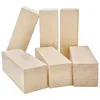 |
Thiecoc 6 Pcs Basswood Carving Blocks, 6x2x2 Inch: $20.98 Willow is a soft hardwood that tears and fuzzes under the knife. Basswood is the soft hardwood carvers choose instead, and this set gives you six blocks to test that difference yourself.
|
As an Amazon Associate we earn from qualifying purchases.
Willow trees are broadleaf, deciduous trees, and that is what makes willow a hardwood in the lumber trade. The word is a botanical category. It does not measure how hard the wood is. The Wood Database makes the same point about balsa, which it says is technically a hardwood because it has broad leaves and is not a conifer, even though balsa is extremely soft.
Willow is the same kind of case, just less extreme. Black willow (Salix nigra), a species native to the eastern United States, is a hardwood that is both lighter and softer than Douglas fir. White willow (Salix alba), the European species known for cricket bats, is a little harder but still soft.
What Hardwood and Softwood Actually Mean
Hardwood and softwood are botanical terms, not hardness ratings. The USDA Forest Products Laboratory defines softwoods as the wood of gymnosperms, which are conifers whose seeds are not enclosed in a fruit, and hardwoods as the wood of angiosperms, the flowering plants whose seeds are enclosed. The Forest Service publication What is meant by hardwoods and softwoods is one place the agency addresses the hardness question directly, and its Wood Handbook gives examples such as the softwoods longleaf pine and Douglas fir being harder than the hardwoods basswood and aspen.
Willow is an angiosperm. Its seeds are carried in small capsules inside catkins, it has broad leaves, and its wood contains vessels, the pore structure that is the anatomical mark of hardwoods. That puts it in the hardwood group no matter how soft the lumber feels.
Another mix-up worth clearing up is the idea that hardwoods are the trees that lose their leaves and softwoods are the evergreens. Leaf drop and wood type are separate traits. Willow happens to be deciduous, but whether a tree is evergreen does not decide whether it is a hardwood. Our page on whether oak trees are evergreen is a good example of how people mix up leaf habit with wood type.
Willow Hardness Compared: Hardwoods and Softwoods Side by Side
The chart below uses values from The Wood Database, so every wood is measured the same way. The point to notice is that the hardwood and softwood columns overlap. A hardwood can be softer than most softwoods, and a softwood can be harder than many hardwoods.
| Wood | Type | Janka hardness (lbf) | Average dried weight (lb/ft3) |
|---|---|---|---|
| Balsa | Hardwood | 67 | 9 |
| Eastern white pine | Softwood | 380 | 25 |
| Basswood | Hardwood | 410 | 26 |
| Black willow | Hardwood | 430 | 26 |
| Yellow poplar | Hardwood | 540 | 29 |
| White willow | Hardwood | 570 | 25 |
| Douglas fir | Softwood | 620 | 32 |
| Northern red oak | Hardwood | 1,220 | 43.8 |
| European yew | Softwood | 1,520 | 42.1 |
Three things stand out in that table. First, black willow is only 50 lbf harder than eastern white pine and weighs about the same as basswood. Second, Douglas fir, which is a softwood, is harder than both willows. Third, European yew is a softwood that is harder than red oak, a hardwood. That is why sorting lumber by the hardwood and softwood label alone will mislead you. For a related case of a hardwood label surprising people in the other direction, see our page on whether zebrawood is a hardwood.
The poplar row is the useful one for a shop comparison. Yellow poplar (540 lbf) is only about 30 lbf from white willow (570 lbf) and sits close to black willow (430 lbf), yet The Wood Database calls poplar “very easy to work in almost all regards” while it rates black willow as having very poor machining characteristics. Two soft hardwoods of similar hardness can behave in opposite ways at the saw and plane, which is another reason a Janka number alone does not tell you how a species will cut.
If you want the same question answered for other woods, we cover cedar, poplar and birch separately, and our types of wood guide puts the main species in one place.
Black Willow Wood Properties
These figures come from The Wood Database entry for black willow, measured at 12 percent moisture content. They are averages, and individual boards vary.
| Property | Black willow |
|---|---|
| Janka hardness | 430 lbf (1,920 N) |
| Average dried weight | 26 lb/ft3 (415 kg/m3) |
| Specific gravity (12% moisture) | 0.36 to 0.42 |
| Modulus of rupture (bending strength) | 7,800 lbf/in2 (53.8 MPa) |
| Elastic modulus (stiffness) | 1,010,000 lbf/in2 (6.97 GPa) |
| Crushing strength | 4,100 lbf/in2 (28.3 MPa) |
| Shrinkage, radial / tangential / volumetric | 3.3% / 8.7% / 13.9% |
| Tangential to radial shrinkage ratio | 2.6 |
| Rot resistance | Non-durable to perishable, susceptible to insect attack |
The shrinkage row is the one that matters most in a shop. A tangential-to-radial ratio of 2.6 means the wood shrinks more than two and a half times as much across the growth rings as along them, and that uneven movement is what drives warping as boards dry. The Wood Database notes that willow tends to develop numerous drying defects, so buy kiln-dried stock and let it acclimate in your shop before cutting joinery.
Color and grain
Heartwood ranges from reddish or grayish brown, sometimes with darker streaks, and the sapwood is white to tan. The grain is interlocked or irregular, and the texture is medium to fine and uniform. Interlocked grain, where the fibers change direction, commonly contributes to tearout under a plane or a router bit. If you want to see the opposite, a hardwood with bold, open grain, our guide to oakwood grain patterns shows how different hardwoods can look next to willow’s plain, even texture.
Is Willow Easy to Work With?
Not particularly. It is light and soft, so you might expect it to cut easily, but The Wood Database rates black willow as having very poor machining characteristics, frequently leaving fuzzy surfaces or tearout. Softness and workability are separate properties, and willow shows the difference: the fibers are soft enough to crush and tear instead of shearing cleanly.
From that description, a few practical steps follow. These are general shop practices for fuzzy, tearout-prone wood, not tested results on willow, so try them on scrap first:
- Keep plane irons and chisels freshly sharpened, because dull edges tear soft fibers instead of cutting them.
- Take light passes and lower the cutting angle on a hand plane, or use a scraper for the final surface.
- Sand progressively rather than jumping grits, because fuzzy grain needs several steps to close up.
- Dust safety: The Wood Database notes reports of skin and respiratory irritation from willow bark sensitizers, with minimal adverse effects reported from the wood itself. Wear a dust mask when sanding, and remove bark before machining.
What Willow Wood Is Used For
The Wood Database lists baskets, utility wood, crates, furniture, carvings and other small specialty items for black willow. White willow is the traditional cricket bat wood: The Wood Database calls it the wood of choice for cricket bats. What these uses have in common is that none needs the wood to be hard or to survive outdoors.
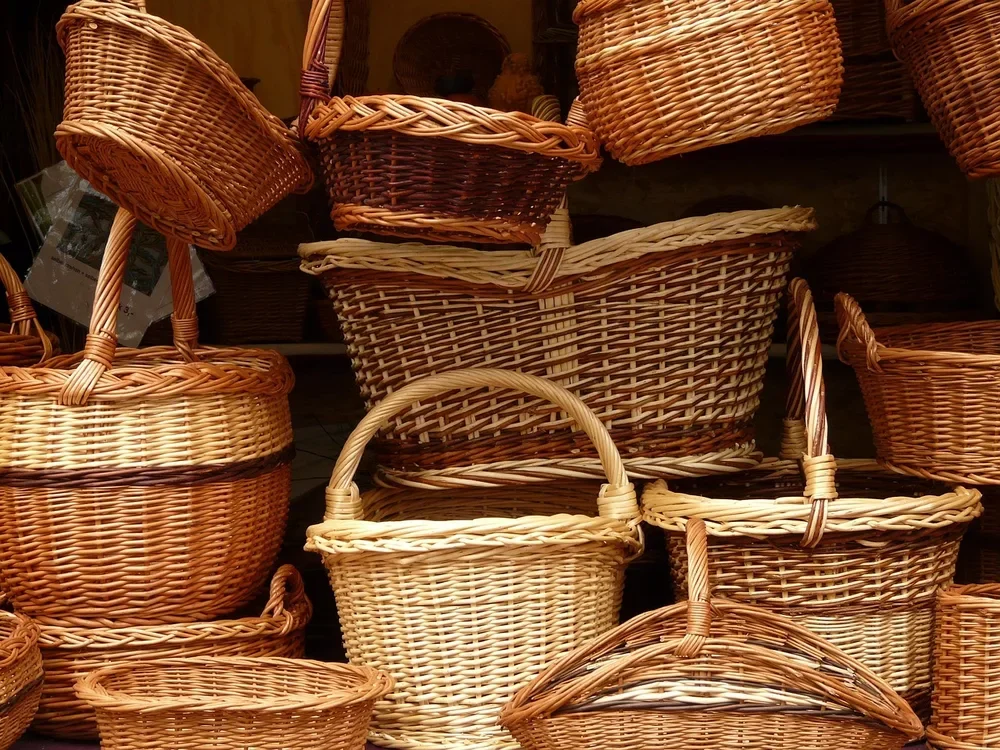
Two of those uses explain why a soft wood can still be valuable. Cricket bats have long been made from white willow, which The Wood Database calls the wood of choice for them, and that is a specialty product where a light, soft species is wanted, not avoided. Basket making is different again: it relies on thin, flexible willow shoots, called withies or osiers, that are woven green or soaked and then woven. That is a use of the plant, not of sawn lumber, so the Janka number is irrelevant to it.
For a closer look at projects and applications, our guide to what willow tree wood is good for goes through them in detail, and if you are trying to confirm you have willow in front of you, how to identify willow wood covers the tree and grain.
What to Check Before Buying Willow Lumber
Willow is not a stocked species at most big-box lumber yards, so you are likely to see it only from a local sawmill or a specialty supplier. Because The Wood Database lists it as prone to drying defects and difficult to season, check the board before you pay:
- Ask whether it is kiln-dried. Air-dried willow is the one most likely to arrive twisted or cupped, given a tangential-to-radial shrinkage ratio of 2.6.
- Sight down the board. Reject stock with bow or twist you cannot plane out, since soft, fuzzy wood does not take heavy surfacing well.
- Look for stain and insect holes. Willow is rated non-durable to perishable and susceptible to insect attack, so stained or pinholed boards are a warning sign.
- Buy extra. Plan for waste from tearout and drying defects, and do a test cut or two on scrap first.
- Check the species. Black willow (430 lbf) and white willow (570 lbf) differ by 140 lbf, so confirm which one you are buying.
Should You Choose Willow Instead of Another Wood?
Choose willow when you need a light, inexpensive wood for indoor craft work and are comfortable with rough machining. The Wood Database expects willow to be quite economical throughout its natural range, and it is not listed by CITES or the IUCN Red List. Skip it for anything that will carry load, get handled hard or sit outdoors.
| If you need | Better choice | Why |
|---|---|---|
| Soft wood that carves cleanly | Basswood (410 lbf) | Same weight class as black willow (26 lb/ft3), and a common carving wood |
| Easy, inexpensive framing or crafts | Eastern white pine (380 lbf) | Softwood, similar hardness, widely available |
| Outdoor use | A rot-resistant species | Willow is rated non-durable to perishable |
| Furniture that has to last | A denser hardwood such as red oak (1,220 lbf) | Nearly three times the Janka rating of black willow |
Frequently Asked Questions
Is willow a hardwood or a softwood?
Willow is a hardwood. Woodworkers sort wood by tree type, not by how hard it feels: hardwoods come from broadleaf trees and softwoods from conifers. Willow is a broadleaf tree, so it is a hardwood, even though black willow rates only 430 lbf on the Janka scale.
How hard is willow wood?
Black willow measures 430 lbf (1,920 N) on the Janka scale and white willow measures 570 lbf (2,530 N), according to The Wood Database. Both are soft. For comparison, Douglas fir, a softwood, measures 620 lbf and northern red oak measures 1,220 lbf.
Is willow harder than pine?
It depends on the pine and the willow. Black willow at 430 lbf is a little harder than eastern white pine at 380 lbf, but softer than Douglas fir at 620 lbf. In practice, willow and soft pine dent about equally easily.
Is willow wood good for furniture?
Only for light-duty pieces. Willow is lightweight and takes a finish, but it is rated non-durable to perishable, machines poorly and is prone to drying defects. It suits baskets, crates, carvings and small specialty items better than tables or chairs.
Can you use willow wood outdoors?
Not without protection. The Wood Database rates willow non-durable to perishable and susceptible to insect attack, so untreated willow will decay quickly in contact with moisture or soil.
Bottom Line
Willow is a hardwood by botany and a soft, light wood by every physical measure: 430 lbf for black willow, 570 lbf for white willow, poor machining, and no rot resistance. Use the hardwood label to tell you what kind of tree it came from, and use the Janka number and shrinkage figures to decide what to build with it.
Sponsored / affiliate links. As an Amazon Associate I earn from qualifying purchases. I may earn additional commission from eligible campaigns.