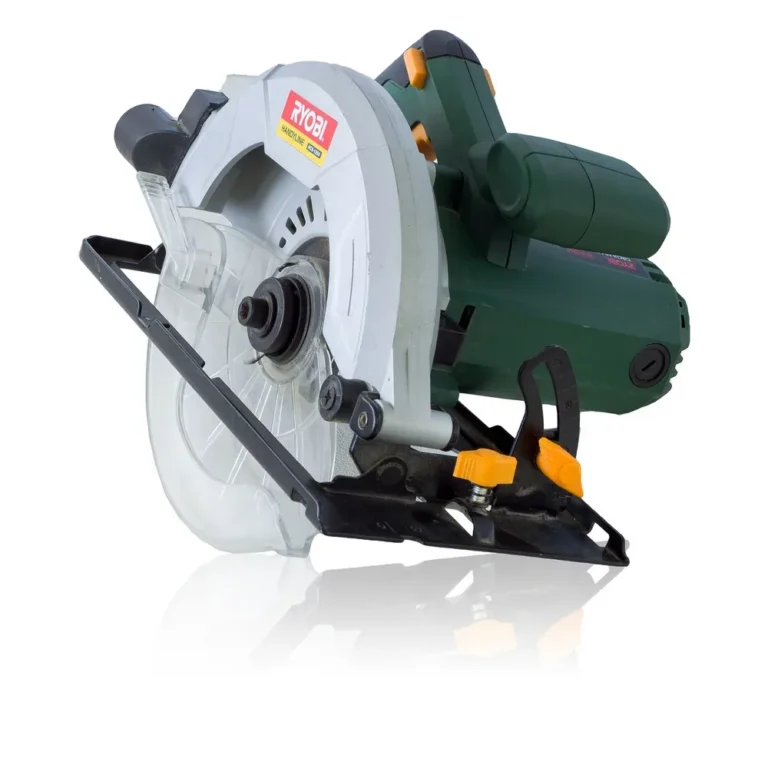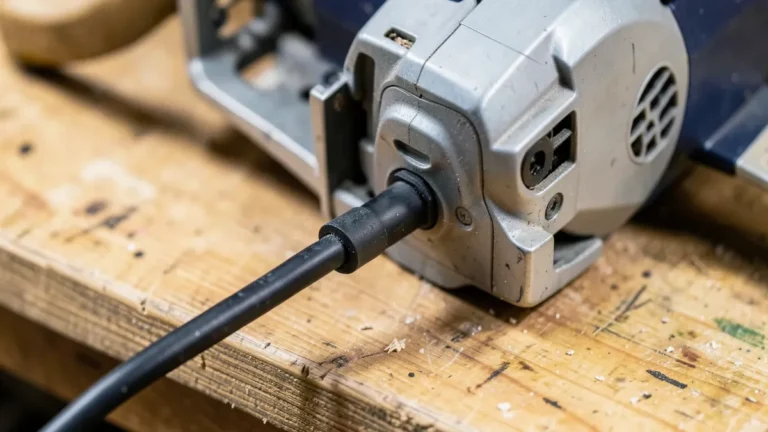
Jigsaw vs. Circular Saw: Which One Do You Need?
A circular saw is the faster, more practical first purchase for most woodworkers — it rips plywood sheets and cuts 2x4s that a jigsaw simply cannot handle well. A jigsaw is the better choice when your projects demand curves, interior cutouts, or intricate shapes — but it cannot substitute for a circular saw on flat sheet goods or framing cuts. This guide covers blade specs, motor amperage, price ranges, and a clear decision framework for which tool to buy first.
Quick Answer
A circular saw (7-1/4 in. blade, 15 Amp) excels at straight cuts through plywood and lumber — it should be your first saw. A jigsaw (T-shank blade, 6 Amp) handles curves, plunge cuts, and tight shapes no circular saw can follow. Most woodworkers need both eventually; buy the circular saw first unless curved work dominates your projects.
What Each Saw Actually Does
Best Circular Saw Pick for Beginners
SKIL 15 Amp 7-1/4 In. Circular Saw with Laser Guide (5280-01)
A 15-amp corded circular saw with a built-in laser guide — the single most useful feature for beginners learning to cut straight without a track. Cuts 2x4s and 3/4-in. plywood cleanly in one pass.
- Best for: First circular saw purchase, ripping plywood, framing cuts
- Why we picked it: Laser guide removes the biggest beginner frustration (drifting cuts) at a mid-range price
- Main drawback: Heavier than 5-1/2 in. trim saws; not ideal for overhead cuts
Compare more circular saw and jigsaw options
 Option 1 DEWALT 7-1/4 In. Circular Saw, 57-Degree Bevel (DWE575SB)
|
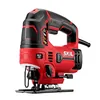 Option 2 SKIL 6 Amp Corded Jigsaw, Tool-Free Blade Change (JS314901)
|
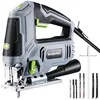 Option 3 WORKPRO 6.5 Amp Corded Jig Saw, 6 Variable Speeds + 7 Blades
|
As an Amazon Associate we earn from qualifying purchases.
A circular saw spins a toothed disc blade at 5,500–6,000 RPM to slice through wood in a single rotating motion. The standard blade size is 7-1/4 inches, which allows a maximum cut depth of about 2-9/16 inches at 90 degrees — enough to cut through two stacked 2x4s or a 3/4-inch sheet of plywood in one pass. The 15-amp corded motor makes quick work of dimensional lumber. You can also adjust the bevel up to 57 degrees for angled cuts.
A jigsaw drives a straight blade up and down at 0–3,000 strokes per minute (SPM). T-shank blades (the modern standard) lock in without tools and come in dozens of tooth configurations — 6 TPI for fast rough cuts in thick wood, up to 20 TPI for smooth cuts in thin material. The orbital action setting adds an elliptical motion on top of the up-down stroke, cutting faster in wood but leaving a rougher edge. The 6-amp corded motor cuts through wood up to about 3-1/2 inches thick, but blade flex increases noticeably past 1-1/2 inches, causing angled cuts in thick stock.
Jigsaw vs. Circular Saw: Side-by-Side Spec Comparison
The table below shows the actual specs that matter when choosing between these tools — not just vague claims about “speed” or “precision,” but the real numbers that determine which saw fits your projects.
| Spec | Circular Saw | Jigsaw |
|---|---|---|
| Blade size | 7-1/4 in. disc (most common) | T-shank, 4–6 in. length |
| Motor (corded) | 13–15 Amp | 5–7 Amp |
| Blade speed | ~5,500–6,000 RPM | 0–3,000 SPM |
| Max cut depth at 90 deg | 2-9/16 in. (two 2x4s stacked) | ~3-1/2 in. (blade flex past 1-1/2 in.) |
| Cut types | Straight, rip, crosscut, bevel, miter | Curved, plunge, bevel, scroll |
| Entry price (corded) | $44–$130 | $28–$60 |
| Weight (typical) | 8–10 lbs | 4–6 lbs |
| Best for | Framing, sheet goods, dimension lumber | Curves, cutouts, detailed finish work |
When to Use a Jigsaw
A jigsaw is the right tool when straight lines are not the goal. Its thin, reciprocating blade can pivot through curves, re-enter cut paths, and follow templates — moves a circular saw physically cannot make. Use a jigsaw for:
- Curved and scroll cuts — cabinet doors, decorative trim, wooden signs, and any shape that curves away from a straight line
- Plunge cuts — cutting a hole in the middle of a panel (for an outlet box or sink cutout) without drilling a starter hole first, a move no circular saw can do
- Interior cutouts — removing a section from the middle of a sheet, like a pass-through window or countertop cutout for tile work
- Tile and laminate cutting — with a fine-tooth blade, a jigsaw handles ceramic tile, laminate flooring, and thin sheet metal without the kickback risk of a circular saw
- Thin stock and delicate material — fretwork, craft wood under 1/2 inch thick, or any cut that needs a slow, controlled approach
The jigsaw’s limitation is straight-line accuracy. Without a fence or guide rail clamped to the workpiece, most users find it hard to follow a chalk line for more than 12–18 inches. For mastering curved cuts in woodworking, the jigsaw is the primary tool.
When to Use a Circular Saw
A circular saw is the workhorse for straight-line cutting. Its rotating blade locks into a consistent cutting plane, making it the fastest and most accurate handheld tool for ripping and crosscutting. Use a circular saw for:
- Ripping plywood — breaking down 4×8 sheets into workable widths is the circular saw’s core job; no other handheld saw matches its speed or accuracy here
- Crosscutting dimensional lumber — cutting 2x4s, 2x6s, and larger framing lumber to length; a single pass with a 15-amp saw cuts cleaner than a jigsaw at full speed
- Deck and framing work — fast, repeatable straight cuts on structural members, where speed matters and curves do not exist
- Sheet goods — OSB, plywood subfloor, MDF, and fiber cement — all cut cleaner with a circular saw at the right blade TPI
- Bevel cuts — adjusting the shoe to 45 degrees lets you cut door casings, picture frames, and stair stringers at precise angles
For beginners learning how to use a circular saw without a table, a straightedge clamped to the workpiece acts as a fence and produces rip cuts as accurate as a table saw. A corded circular saw provides consistent power for long sessions — cordless versions are convenient but lose RPM on thick stock as the battery drains.

Which Should You Buy First?
The answer depends entirely on what you plan to build. Use this framework:
| Your first project involves… | Buy first |
|---|---|
| Framing, decking, or subfloor — straight cuts on lumber | Circular saw |
| Breaking down 4×8 plywood sheets into smaller pieces | Circular saw |
| Installing laminate flooring or cutting tile backsplash | Jigsaw |
| Cutting cabinet door shapes, scrollwork, or decorative curves | Jigsaw |
| General DIY — building shelves, small furniture, boxes | Circular saw first |
| Outlet box cutouts or sink countertop openings | Jigsaw |
If your project list mixes both types of work — and most DIYers’ projects do — the circular saw wins the first purchase because straight cuts in plywood and lumber come up in nearly every project. You can approximate curves with a jigsaw hired for the day; you cannot approximate ripping a 4×8 sheet of plywood with a jigsaw.
“In 12 years of shop work, the circular saw has shown up in 90% of my projects — framing, deck boards, shop jigs, furniture blanks. The jigsaw earned its place the day I needed to notch around a post. Both tools belong in a complete shop, but the circular saw builds the foundation.”
Pros and Cons of Each Saw

Jigsaw Pros and Cons
Advantages: Handles every curved or intricate cut — scrollwork, notches, plunge cuts — that a circular saw cannot follow. T-shank blades swap in seconds without tools and cover wood, metal, tile, and plastic in a single tool. Entry price is lower (corded models start around $28). At 4–6 lbs, it is the lightest handheld saw you can buy. Variable speed and orbital action let you tune the cut for delicate or aggressive work.
Disadvantages: Straight-line accuracy suffers without a fence. Blade flex increases noticeably in stock thicker than 1-1/2 inches, causing angled or bowed cuts. The 6-amp motor is slower through dense hardwood than a circular saw’s 15-amp motor. Cutting speed is 3–5x slower than a circular saw on straight lumber.
Circular Saw Pros and Cons
Advantages: Fastest handheld saw for straight cuts through plywood, OSB, 2x lumber, and sheet goods. The 15-amp motor pushes through dense hardwood, pressure-treated lumber, and engineered wood without bogging down. Bevel adjustment up to 57 degrees handles compound angle cuts. Blade guards and riving knives provide built-in kickback protection on modern models.
Disadvantages: Cannot follow a curve — it is a straight-line-only tool. Without a guide, freehand straight cuts drift quickly, especially in long rip cuts. Heavier than a jigsaw at 8–10 lbs, which matters for overhead or awkward-angle cutting. Rotating blade creates more aggressive kickback potential than a jigsaw if the blade binds.
Safety Tips for Jigsaw and Circular Saw
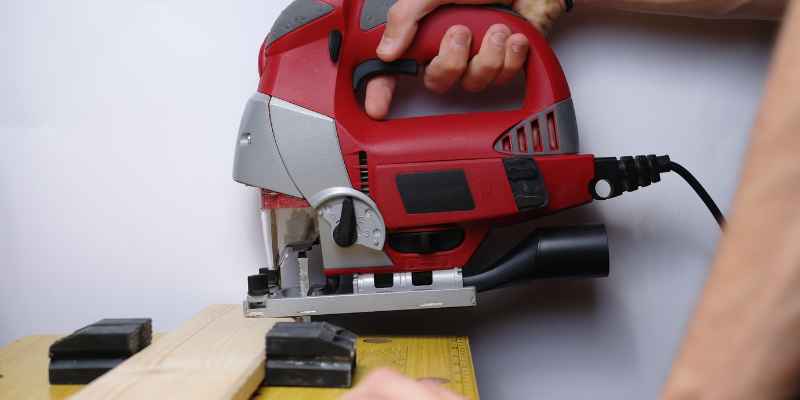
Jigsaw Safety
- Wear safety glasses — the upward stroke throws chips directly toward your face
- Clamp the workpiece to a stable surface; never hold it with one hand while cutting with the other
- Unplug or remove the battery before changing blades
- Keep the blade guard in its lowest functional position — do not defeat or remove it
- Use a dust mask; jigsaws running orbital mode generate fine sawdust at high volume
Circular Saw Safety
- Wear ear protection — circular saws exceed 100 dB at the operator’s ear
- Always use a guide or straightedge for rip cuts; freehand cuts bind and kick back
- Keep the blade guard fully operational — never pin it up or wire it open
- Set the blade depth to just 1/4 inch deeper than the material — a deeper blade exposes more edge and increases kickback severity
- Unplug or remove the battery before adjusting bevel angle or changing blades
Maintaining Your Saws
Both saws need the same basic maintenance: clean after each use, inspect blades for dullness or damage, and store in a dry location. A dull circular saw blade increases kickback risk and burns the wood edge; a dull jigsaw blade wanders and bends under load. Replace blades when cutting slows noticeably or edges become scorched — do not try to push more life out of a blade by increasing feed pressure.
For the circular saw, inspect the base plate for flatness every few months — a warped plate causes bevel inaccuracy and can snag mid-cut. For the jigsaw, check that the blade shank is fully seated and the locking mechanism engages securely before each use; a partially locked T-shank blade can eject during orbital action. Blow out both tools with compressed air after every dusty session to prevent motor overheating.
Frequently Asked Questions
Which is better, a jigsaw or a circular saw?
Neither is universally better — they solve different problems. A circular saw (15 Amp, 7-1/4 in. blade) is faster and more accurate on straight cuts through plywood and 2×4 lumber, making it the better first purchase for most DIYers. A jigsaw is the better choice when your project needs curves, interior plunge cuts, or cuts in thin or delicate material. Most woodworkers eventually own both.
Can a jigsaw replace a circular saw?
No. A jigsaw can make a straight cut along a clamped guide, but its 6-amp motor and tendency toward blade flex make it significantly slower and less accurate than a circular saw on straight lumber and plywood. Trying to rip a 4×8 sheet with a jigsaw takes 3–5x longer and leaves a rougher edge. Use each tool for what it does best.
Is a jigsaw safer than a circular saw?
A jigsaw is generally considered safer for beginners because the blade moves slowly, the tool is lightweight, and kickback is rare. A circular saw’s fast-spinning blade creates more severe kickback risk if the blade binds. That said, both tools are safe when used with blade guards in place, proper workpiece support, and a guide for straight cuts. Respecting either tool’s operating rules matters more than which saw you choose.
Is a jigsaw or circular saw better for cutting plywood?
A circular saw is better for cutting plywood in straight lines — rip cuts and crosscuts on 4×8 sheets are what it is built for. A jigsaw is better for cutting curves or interior shapes out of a plywood panel. For the cleanest straight edge on plywood with a circular saw, set the blade 1/4 inch below the panel, clamp a straightedge as a fence, and cut with the good face down to keep tearout on the hidden side.
Can a jigsaw cut a 2×4?
Yes, a jigsaw can cut through a 2×4 (1-1/2 inches thick). Use a 6 TPI wood-cutting T-shank blade and reduce the orbital action to minimize blade flex. It will be slower than a circular saw and the cut edge will be rougher, but the jigsaw handles the job. For repeated crosscuts on 2×4 framing, a circular saw or miter saw is a much faster and more practical choice.
For more comparisons across the full range of electric cutting tools, see our guide to electric wood-cutting tools covering entry price and skill level for seven tool types. If you are weighing a circular saw against a drop saw, the circular saw vs. drop saw comparison covers the key differences for home shop use.
Conclusion
A circular saw is the right first purchase for most woodworkers — 15 Amp, 7-1/4 in. blade, and a laser guide put you in control of the straight cuts that show up in 80% of DIY projects. A jigsaw earns its place once your work includes curves, plunge cuts, and finish work a circular saw cannot handle. Buy the tool your projects actually need, not the one that sounds more versatile on paper.
Sponsored / affiliate links. As an Amazon Associate I earn from qualifying purchases. I may earn additional commission from eligible campaigns.