Best Electric Wood Cutting Tools for DIY Projects: 7 Compared (2026)
If you only buy one electric wood cutting tool this year, make it a corded circular saw — it costs about $149 to start, runs corded or cordless, and handles roughly 80% of the straight cuts a DIY project throws at you. Everything else on this page is about the other 20%: the seven tools below are compared by real entry price, blade/bit cost, and how much skill each one demands, so you can see exactly which one to add next.
Which Electric Wood-Cutting Tool Do You Actually Need? (Full Comparison)
Every price below is a live Amazon buy-box price for a real, currently-purchasable entry-level model, pulled August 3, 2026. “Real Cost to Start” adds a realistic first blade or bit set to the tool price, because the sticker price on the tool is never the whole story.
| Tool | Best For | Can’t Do Well | Entry Tool Price | First Blade/Bit Set | Real Cost to Start | Skill Level |
|---|---|---|---|---|---|---|
| Circular Saw | Straight crosscuts & rips in framing lumber, plywood sheets | Curved cuts, repetitive precision rips | $149.00 (DEWALT DWE575SB, corded) | $10.48 (24T wood blade) | $159.48 | Moderate — kickback risk |
| Jigsaw | Curved cuts, cutouts, intricate patterns | Long straight rips, stock over ~2″ thick | $59.99 (BLACK+DECKER BDEJS600C, corded) | $7.98 (14-pc T-shank set) | $67.97 | Easy |
| Reciprocating Saw | Rough demolition, cutting through nail-embedded wood | Clean or finish-quality cuts | $79.00 (BLACK+DECKER BDCR20C, cordless kit) | $24.99 (32-pc wood/metal set) | $103.99 | Easy |
| Miter Saw | Precise angled crosscuts (miter & bevel) for trim, framing | Ripping a board to width — no rip fence | $199.00 (CRAFTSMAN V20 CMCS714M1, cordless) | $18.54 (10″ 60T finish blade) | $217.54 | Easy–Moderate |
| Table Saw | Repetitive, precision rip cuts and crosscuts | Curved cuts, large sheet goods alone | $329.00 (SKIL TS6307-00, corded) | $22.97 (10″ 40T finish blade) | $351.97 | Advanced — highest injury risk |
| Router | Edge profiles, grooves, dadoes, joinery | Cutting stock to length or width | $108.99 (SKIL RT1323-00, corded) | $26.99 (15-pc bit set) | $135.98 | Moderate–Advanced — feed direction matters |
| Oscillating Multi-Tool | Flush cuts, plunge cuts in tight spots | Cutting full-size boards or sheet goods | $70.91 (BLACK+DECKER BD200MTB, corded) | $8.99 (7-pc wood blade set) | $79.90 | Easy |
The spread is the real story: a fully equipped jigsaw or oscillating tool costs less than the blade set alone for a table saw. Real cost to start ranges from $67.97 (jigsaw) to $351.97 (table saw) across these seven tools — a 5.2x difference that most “best tools” guides never put on one page.

The 7 Tools, Broken Down
Here’s what each tool in the table above is actually good at, what it’s bad at, and where to go for a full model-by-model buying guide if you decide it’s the one you need.
Circular Saw
A circular saw is a spinning, toothed blade in a handheld body — the closest thing to a do-everything saw for a DIY budget. It rips lumber to width, crosscuts framing to length, and cuts full plywood sheets without a stationary table. Blade size is standardized at 7-1/4″ on full-size models; power is rated in amps (corded) or volts (cordless). A bevel adjustment lets you cut angled edges for trim.
The DEWALT DWE575SB above is the corded entry point at $149.00. If you want to go cordless, our full circular saw buying guide compares 7 corded and cordless models, including budget, worm-drive, and heavy-cutting picks. See also our breakdown of corded vs. cordless circular saws if battery runtime is the deciding factor.
Who it’s for: anyone building a deck, framing a wall, or breaking down plywood sheets who wants one tool that handles most of the cutting list.
- Pro: single tool covers rips, crosscuts and bevels — the highest cuts-per-dollar of anything on this page.
- Pro: lightweight and fully portable; no dedicated bench or floor space needed.
- Con: freehand cuts drift without a guide rail or straightedge clamped to the work.
- Con: kickback risk if the blade binds — this is the tool most beginner safety guides focus on first.
Jigsaw
A jigsaw’s narrow blade moves up and down, which is what lets it follow a curve instead of just cutting straight. It’s the tool for sink cutouts, decorative edges, and any pattern a circular saw physically can’t follow. Variable speed and orbital action (the blade also moves slightly forward and back) both matter — orbital cuts faster but leaves a rougher edge.
At $59.99 entry and $67.97 fully equipped, it’s the cheapest tool on this list to get started with, and the easiest to learn on. If you’re trying to decide between this and a circular saw for your first purchase, our jigsaw vs. circular saw comparison walks through it project by project.
Who it’s for: sink cutouts, curved signage, scroll-style patterns, and anyone whose project has a shape a straight blade can’t follow.
- Pro: lowest real cost to start of any tool on this page ($67.97).
- Pro: the most forgiving tool here for a first-time power tool user — low kickback risk.
- Con: cut depth is limited (roughly 2″ on most consumer models) — not a tool for thick stock.
- Con: blade flex on longer cuts means edges need more sanding than a circular or table saw cut.
Reciprocating Saw
Often called a “recip saw” or by the DEWALT-adjacent nickname “Sawzall,” this tool moves its blade back and forth in a straight line. It’s built for demolition — cutting through old framing, nails, and branches — not for a clean finished edge. If a tear-down or yard cleanup is on the project list, this is the tool; if the project needs a straight, splinter-free cut, it isn’t.
Who it’s for: tear-down and demo work, cutting through old fasteners you can’t see, and rough yard cleanup where finish quality doesn’t matter.
- Pro: cuts through embedded nails and screws that would destroy a circular or table saw blade.
- Pro: cordless models like the BLACK+DECKER BDCR20C above go anywhere, no cord to manage mid-demo.
- Con: the worst finish quality of any saw on this page — expect a rough, wandering cut.
- Con: the blade’s aggressive stroke makes it tiring to hold steady for long cuts.
Miter Saw
A miter saw pivots a blade down onto stationary wood, which is what makes it the most accurate tool on this list for angled crosscuts. Miter cuts (angled across the face) and bevel cuts (angled through the thickness) combine for compound cuts used in trim and picture-frame corners. 10″ and 12″ blade sizes are both common; a laser guide helps beginners see the cut line before the blade drops.
The CRAFTSMAN V20 above is a cordless single-bevel model at $199.00. For a deeper comparison of cordless sliding compound options, see our best cordless sliding compound miter saw guide.
Who it’s for: trim carpentry, picture frames, and any project where the corners have to match — repeatable angled cuts are what it’s built for.
- Pro: the most accurate, repeatable angled cut of any tool on this page.
- Pro: a fixed base and (usually) a laser guide make it easier to cut consistently than a handheld saw.
- Con: no rip fence — it can’t rip a board to width, only cut it to length or angle.
- Con: stationary and bench-bound; less portable than a circular saw or jigsaw.
Table Saw
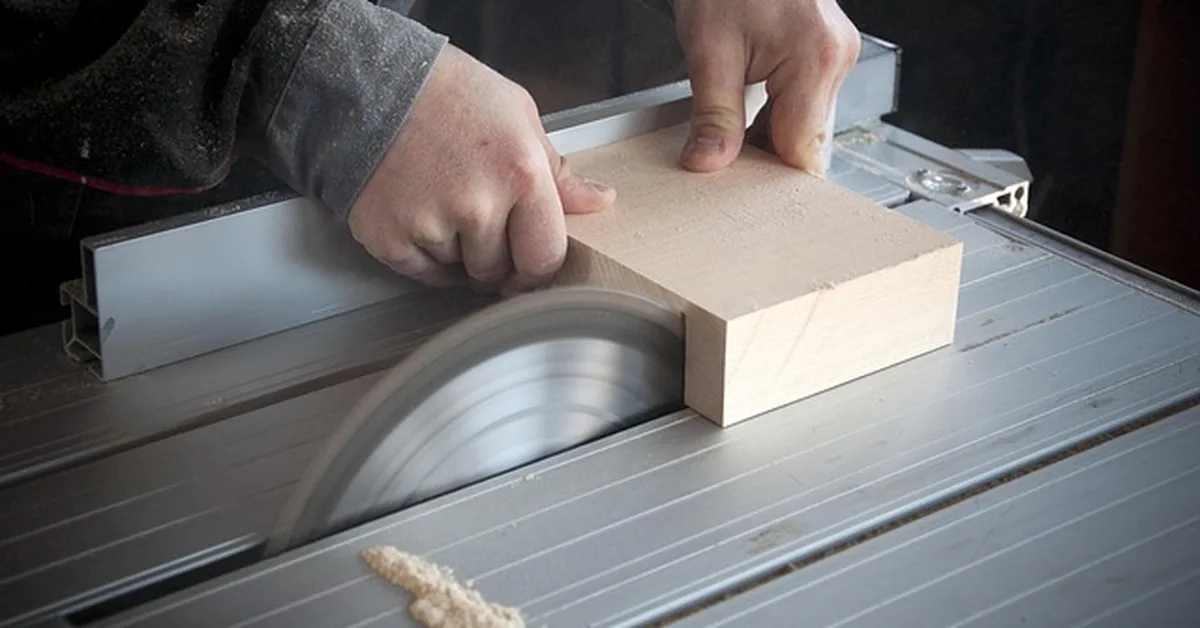
A table saw is stationary — the blade protrudes up through a table surface instead of moving through the wood. That fixed geometry is what makes it the most precise, most repeatable tool on this list for ripping boards to an exact width, and also the reason it carries the highest injury risk of any tool here: an estimated 40,000 Americans are treated in hospital emergency rooms for table saw injuries every year, and about 4,000 of those are amputations, according to CPSC-sourced figures compiled by the National Consumers League.
For DIY use, a benchtop or portable table saw like the SKIL TS6307-00 above ($329.00) is the realistic entry point. See the full table saw buying guide for 8 models spanning benchtop, jobsite, contractor, and cabinet-grade saws, or read table saw vs. miter saw if you’re deciding which stationary-style saw to buy first.
Who it’s for: anyone doing repeated rip cuts — cabinet sides, shelving, furniture parts — where every board needs to come out the exact same width.
- Pro: unmatched repeatability for ripping multiple boards to the same width.
- Pro: a rip fence and miter gauge make cuts far more consistent than any handheld saw.
- Con: highest injury risk of any tool in this comparison — see the safety section below.
- Con: highest real cost to start ($351.97) and needs permanent bench or floor space.
Router
A router doesn’t cut stock to size — it hollows, edges, and joins it. Swap the bit and it rounds over a shelf edge, cuts a decorative profile, or grooves a dado for a drawer slide. Handheld plunge routers push the bit down into the work; fixed-base routers are set to one depth. The SKIL RT1323-00 above ($108.99) is a corded fixed-base entry point. Full wood router buying guide here.
Who it’s for: anyone adding a decorative edge, cutting joinery for cabinets or shelving, or building anything that needs a groove or rabbet.
- Pro: the only tool on this list that shapes wood rather than just separating it.
- Pro: one base tool covers dozens of profiles just by swapping bits.
- Con: feed direction matters — going the wrong way against the bit’s rotation causes the router to grab and lurch.
- Con: not a substitute for a saw — it can’t cut a board to length or width on its own.
Oscillating Multi-Tool
An oscillating tool’s head moves back and forth at high speed rather than spinning or reciprocating in a straight line, which lets it plunge-cut and flush-cut in spots no saw can reach — trimming a door jamb to fit new flooring, for instance. It won’t cut a full board or sheet good; that’s not the job. At $70.91 to start, it’s the second-cheapest tool on this list and one of the safest to learn on.
Who it’s for: flush-trimming door jambs, plunge-cutting drywall or subfloor, and any cut that starts in the middle of a surface instead of at an edge.
- Pro: can start a cut anywhere on a surface — no other tool on this page can plunge-cut like this.
- Pro: low kickback risk and easy one-handed control.
- Con: shallow cut depth — not built for anything thicker than trim or thin panel stock.
- Con: slower than a saw for any cut a saw could also make.
How We Built This Comparison
This is a Tier C comparison — the site has not physically tested every model above side by side. Every price in the table is a live Amazon buy-box price pulled via the Amazon Creators API on August 3, 2026, for a specific, named, currently-purchasable ASIN (not a category average or a manufacturer list price). “Can’t Do Well” and “Skill Level” reflect standard woodworking-shop consensus on each tool’s mechanical limits and injury profile, cross-checked against the site’s own in-depth, ASIN-level buying guides for circular saws, table saws, miter saws, and routers linked throughout this page. The table saw injury figures are attributed to CPSC data as compiled by the National Consumers League, linked above. Prices move — if you spot one that’s drifted, the live buy-box price on Amazon always wins.
What to Consider Before You Buy Your First Electric Wood-Cutting Tool
Corded vs. Cordless (and the Router Exception)
For saws, cordless has mostly caught up: modern high-voltage battery platforms cut about as well as corded for DIY-scale work, and you trade the cord for battery weight and charge time. Routers are the exception worth knowing before you shop — cordless routers exist, but they cost significantly more than a corded equivalent and run for a limited time per charge, so most budget and mid-range router picks, including the one in the table above, are still corded. See our corded vs. cordless circular saw breakdown for the tradeoffs on saws specifically.
Budget Tool vs. Investing in Quality
Cheaper tools usually give up durability, power, or a safety feature to hit their price. For a first tool, one good-quality saw beats three cheap ones that don’t last the season. The entry prices in the comparison table above are all reputable-brand, currently-sold models — not the cheapest listing that turned up in a search.
The Real Cost Includes Blades and Bits
The “Real Cost to Start” column in the table isn’t decoration — a table saw’s tool price ($329.00) understates the real entry cost by nearly 7% once you add a decent blade, and every tool on this list needs a consumable (blade or bit) the sticker price doesn’t include.
Matching the Tool to the Cut, Not the Project
It’s tempting to shop by project name (“tools for a deck,” “tools for a shelf”), but the same project usually needs two or three different cut types. A picture frame, for example, needs an angled crosscut (miter saw or jigsaw) and a straight rip (circular or table saw) — look at the “Best For” column above and match by cut, then check which tools your specific project actually calls for.
Skill Level and Injury Risk
The skill-level column above isn’t about how hard a tool is to hold — it’s about how much can go wrong if you’re inattentive. A table saw or circular saw held wrong can kick back the workpiece violently; a jigsaw or oscillating tool, held wrong, mostly just cuts a crooked line. Start with an easier tool on the list, and don’t move to a table saw until the fundamentals (clamping, stance, blade guard use) are automatic.
Brand Reputation, Warranty and Parts Availability
A 3–5 year warranty is a real signal of a manufacturer’s confidence, and matters more on a stationary tool like a table saw or router table than on a cheap handheld you might replace anyway. Check that replacement blades, brushes, and bits for a specific model are actually still sold before buying — discontinued platforms get expensive to keep running.
Table Saw vs. Circular Saw for Your First Stationary-Style Cut
If precision, repeat rip cuts are the goal, a table saw wins on accuracy but costs over 2x more to get started ($351.97 vs. $159.48) and carries meaningfully higher injury risk for an inexperienced user. Most DIYers are better served starting with a circular saw and a straightedge guide, then adding a table saw once they’re ripping boards often enough to justify it. Full comparison: table saw vs. miter saw.
Storage and Portability
Handheld tools (circular saw, jigsaw, reciprocating saw, router, oscillating tool) store in a drawer or bag. Stationary saws (table saw, and to a lesser extent miter saw) need bench or floor space even when idle — a benchtop or portable table saw is the realistic option for a garage-shop DIYer without a dedicated shop.
Safety First When Using Electric Wood-Cutting Tools

An estimated 40,000 Americans are treated in hospital emergency rooms for table saw injuries alone every year, with roughly 4,000 of those injuries amputations, per CPSC-sourced data compiled by the National Consumers League. The tools above are useful precisely because they’re powerful — that cuts both ways.
Personal Protective Equipment (PPE)
- Safety glasses or goggles: protect against flying sawdust and chips — look for a snug fit with good ventilation.
- Hearing protection: most of these tools run loud enough, long enough, to cause cumulative hearing damage.
- Dust mask or respirator: fine sawdust is a respiratory hazard, not just a nuisance.
- Work gloves: for handling rough stock — remove them before you actually engage the blade on a saw; loose gloves near a spinning blade are their own hazard.
Tool Safety Best Practices
- Read the manual for each specific tool before using it — blade guards and safety interlocks vary by model.
- Clamp the workpiece. Never hold a small piece with your hand while cutting.
- Keep the work area clear of clutter and cut-offs.
- Inspect cords, guards, and blades before every use.
- Unplug or remove the battery before changing a blade or bit.
Understanding Kickback
Kickback is a sudden, violent thrust of the workpiece or the tool, caused by the blade binding or pinching in the cut — it’s the leading mechanism behind the serious injuries cited above. Keep the blade sharp, let it do the work instead of forcing the feed, support the workpiece so it can’t twist, and stand to the side of the blade’s path rather than directly behind it.
Getting Started: Two Beginner Projects
Project 1: A Simple Shelf
- Measure and mark the shelf and bracket pieces with a tape measure and pencil.
- Cut to size — a circular saw or miter saw handles the straight cuts.
- Sand all pieces smooth with an orbital sander.
- Assemble with pilot holes (drill) and screws or nails.
Project 2: A Wooden Picture Frame
- Measure and mark the four frame pieces carefully — the corners have to join cleanly.
- Cut at 45-degree angles — a miter saw is the right tool; a miter box and hand saw work in a pinch, less precisely.
- Sand the cut edges smooth so the joints fit tight.
- Join the corners with wood glue and small finishing nails or brads; a corner clamp holds pieces while the glue sets.
- Cut a thin plywood or hardboard backing to fit and attach it, then add hanging hardware.
Frequently Asked Questions
What is the best electric tool for a first-time DIYer to buy?
Answer: A corded circular saw. It’s $149.00 to start (see the comparison table above), works on both rips and crosscuts, and covers more beginner projects than any other single tool on this page.
Do I need a table saw to start woodworking?
Answer: No. A miter saw and a circular saw cover most beginner projects for a combined real cost under $380. A table saw is the most precise tool for repeat rip cuts, but it also carries the highest injury risk of any tool in this comparison — add it once you’re ripping boards regularly enough to justify the cost and the learning curve.
Are cordless tools as powerful as corded tools now?
Answer: For saws, yes — modern high-voltage cordless platforms perform close to corded for DIY-scale cuts. Routers are the exception: cordless routers cost significantly more and run for less time per charge, which is why most budget and mid-range router picks, including the one in our table, are still corded.
What’s the difference between a jigsaw and a reciprocating saw?
Answer: A jigsaw has a fine, controlled blade built for curved and intricate cuts. A reciprocating saw has a larger, sturdier blade built for rough, fast demolition cuts and cutting through embedded nails — not for a clean finished edge. See our full jigsaw vs. circular saw comparison for more on where a jigsaw fits.
How much should I budget beyond the tool itself?
Answer: More than most people expect. Across the seven tools compared above, a first blade or bit set adds $7.98 to $26.99 on top of the tool price — and real cost to start ranges from $67.97 (jigsaw) to $351.97 (table saw).
Is a router really used for cutting wood?
Answer: Not for cutting stock to length or width — that’s a saw’s job. A router hollows, edges, and joins wood: rounding over an edge, cutting a decorative profile, or grooving a dado for a drawer slide.
How important is safety gear when using electric wood-cutting tools?
Answer: Essential, not optional. CPSC-sourced data compiled by the National Consumers League puts annual U.S. emergency-room table saw injuries alone at roughly 40,000, with about 4,000 of those amputations. Safety glasses, hearing protection, and a dust mask are the minimum for every tool on this page.
Related Guides
- Best Circular Saw: 7 Models Compared
- Best Table Saws: 8 Models Compared
- Best Cordless Sliding Compound Miter Saw
- Best Heavy-Duty Wood Router
- Hand-Held Wood Cutting Tools (Manual & Non-Electric)
Final Thoughts
Start with a corded circular saw ($159.48 real cost to start) if you’re only buying one tool — it covers the widest range of cuts for the lowest combined price on this page. Add a jigsaw next for curves, and hold off on a table saw until you’re ripping boards often enough to justify both its $351.97 real cost to start and the higher injury risk that comes with it.
Sponsored / affiliate links. As an Amazon Associate I earn from qualifying purchases. I may earn additional commission from eligible campaigns.