Mahogany Wood Identification: Real vs African vs Sapele
Genuine mahogany is Swietenia: a pale pinkish to reddish brown hardwood that darkens with age, with large, few pores and a Janka hardness around 900 lbf. African mahogany (Khaya) is the closest match, sapele is about 50% harder, and "Philippine mahogany" is meranti, not mahogany at all. This guide gives you an 8-step check, a species number table, and the CITES facts behind each label.
How to Identify Mahogany Wood: 8-Step Test
Mahogany identification means narrowing a reddish board down to a genus using several clues at once: color, grain, pores, texture, end grain, weight, odor, and paperwork. No single clue is definitive, and the numbers below come from the Wood Database species profiles for Honduran mahogany, African mahogany, sapele and dark red meranti.
- Check the color, but on a fresh surface: Honduran mahogany heartwood runs from pale pinkish brown to a darker reddish brown and darkens with age. African mahogany runs pale pink to deeper reddish brown, sometimes with darker streaks. A stained or finished surface tells you very little, so sand a hidden spot first.
- Read the grain: Honduran mahogany grain is straight, interlocked, irregular or wavy. African mahogany is straight to interlocked. Interlocked grain is what produces a ribbon stripe on quartersawn faces, but sapele shows ribbon stripes too, so stripes alone prove nothing.
- Look at the pores: Honduran mahogany has large, few pores, solitary or in radial pairs, sometimes holding reddish-brown deposits. African mahogany has large to very large, very few pores. Sapele also has large, few pores, so pore size does not separate these three. Dark red meranti has large to very large pores in an irregular pattern, often with resin canals.
- Judge texture and shine: Honduran mahogany has a medium, uniform texture with moderate luster. African mahogany is medium to coarse with strong chatoyance (a shifting sheen). Sapele is fine and uniform. Dark red meranti is coarse with low luster. A coarse, dull board sold as mahogany points to meranti.
- Inspect the end grain with a loupe: Honduran mahogany has vasicentric and banded (marginal) parenchyma, which shows up as light-colored bands at the growth rings. African mahogany has vasicentric and only occasionally banded parenchyma. Cuban mahogany lacks the marginal bands that Honduran shows. A 10x loupe makes this readable.
- Compare hardness and weight: Honduran mahogany is 900 lbf Janka at 36.8 lbs/ft³. African is 850 lbf at 33.9 lbs/ft³. Sapele is 1,360 lbf at 41.6 lbs/ft³. Dark red meranti is only 800 lbf but weighs 42 lbs/ft³, which makes it feel surprisingly heavy for a soft wood.
- Note the odor and resin: Honduran mahogany and dark red meranti have no characteristic odor. Sapele has a distinct cedar-like scent while being worked. White resin streaks are common in dark red meranti. So a cedar smell points to sapele, not mahogany.
- Ask for the botanical name and CITES paperwork: Honduran mahogany, Cuban mahogany and African mahogany are all CITES Appendix II. Sapele and meranti are not CITES-listed. A seller who cannot name the genus is a warning sign.
Best 10x Loupe Pick |
|
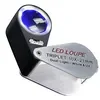 |
Gain Express 10X Hastings Triplet Loupe with LED and UV Light ($19.90) A pocket loupe is the tool for step 5: it lets you see whether the end grain shows the light parenchyma bands at each growth ring that separate Honduran mahogany from look-alikes.
|
As an Amazon Associate we earn from qualifying purchases. | |
Mahogany vs. Look-Alike Species: Comparison
Here is every number from the steps above in one place. Honduran and African mahogany are within 50 lbf of each other, so hardness cannot split them. Sapele is the outlier on hardness, and meranti is the outlier on weight for its hardness.
| Wood | Color | Texture | Janka (lbf) | Weight (lbs/ft³) | CITES |
|---|---|---|---|---|---|
| Honduran mahogany (Swietenia macrophylla) | Pale pinkish brown to darker reddish brown | Medium, uniform; moderate luster | 900 | 36.8 | Appendix II |
| Cuban mahogany | Pale pinkish brown to darker reddish brown | Medium, uniform; moderate luster | 930 | 37 | Appendix II |
| African mahogany (Khaya spp.) | Pale pink to deeper reddish brown, sometimes streaked | Medium to coarse; high chatoyance | 850 | 33.9 | Appendix II |
| Sapele (Entandrophragma cylindricum) | Golden to dark reddish brown | Fine, uniform; good luster | 1,360 | 41.6 | Not listed |
| Dark red meranti (Shorea spp.) | Dark reddish or purplish brown, white resin streaks | Coarse; low luster | 800 | 42 | Not listed |
Source: Wood Database species profiles for each wood, read for this article. Cuban mahogany is included for completeness: the Wood Database says it is for the most part no longer commercially available, and that telling it apart from Honduran mahogany is difficult because of historical depletion.
Sapele is about 51% harder than Honduran mahogany (1,360 lbf vs 900 lbf) – Source: The Wood Database, sapele profile. Sapele also weighs 41.6 lbs/ft³ against 36.8 for Honduran mahogany.
Mahogany Wood Color: What to Look For
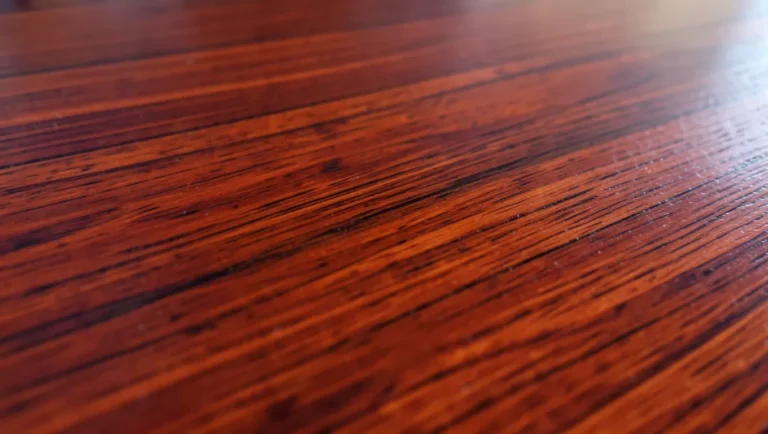
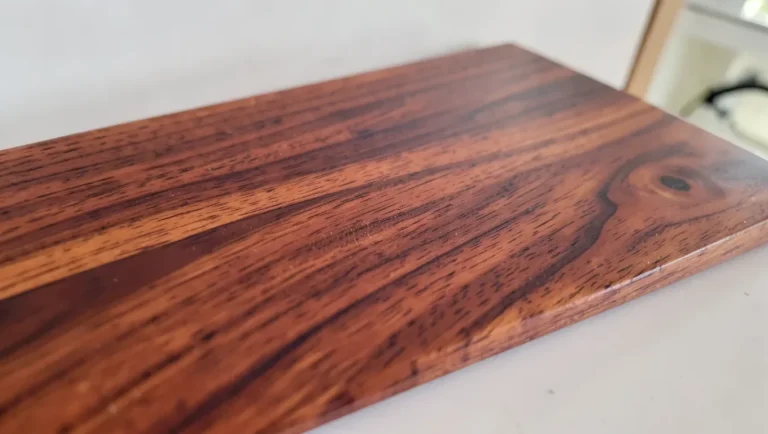
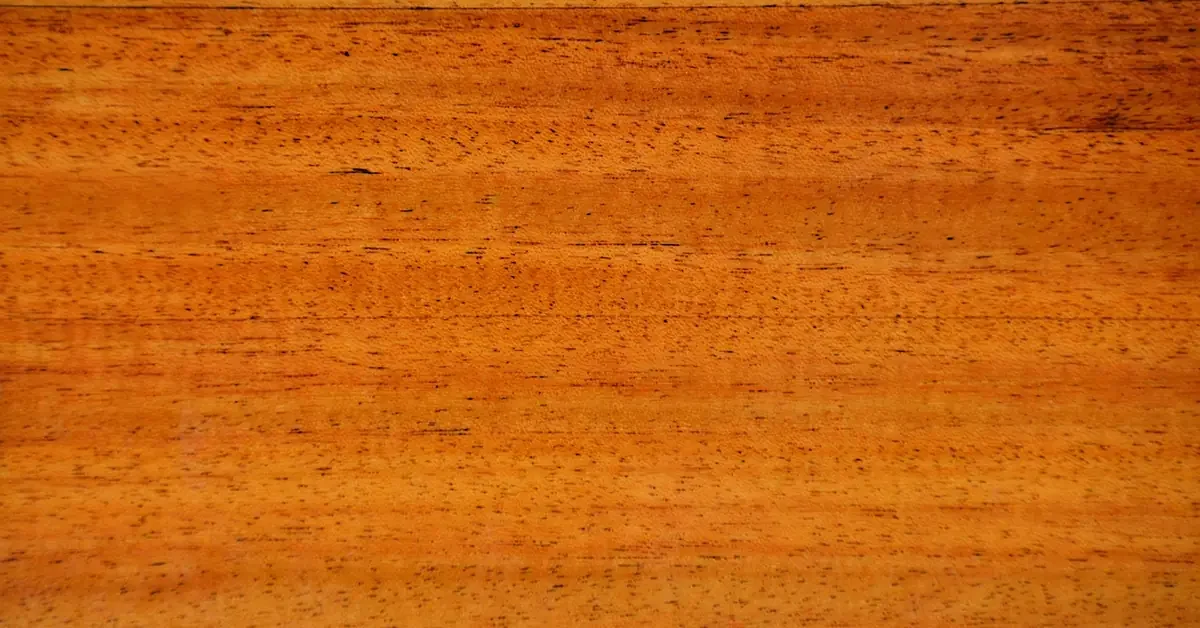
Mahogany wood color ranges from pale pinkish brown on fresh Honduran heartwood to a darker reddish brown as it ages. The color deepens over time, so a 100-year-old table and a freshly milled board can look like different woods. African mahogany sits in the same range but can carry darker streaks, and sapele starts golden and shifts toward dark reddish brown, which is why aged sapele fools people.
Searching for "what color is mahogany" also returns the paint and fabric color. That color name is older than most furniture you will inspect: Wikipedia says its first recorded use in English was in 1737, and lists the standard swatch as hex #C04000 (RGB 192, 64, 0) from a 1930 color dictionary. Real boards are not uniform, so treat that hex as a name, not a test.
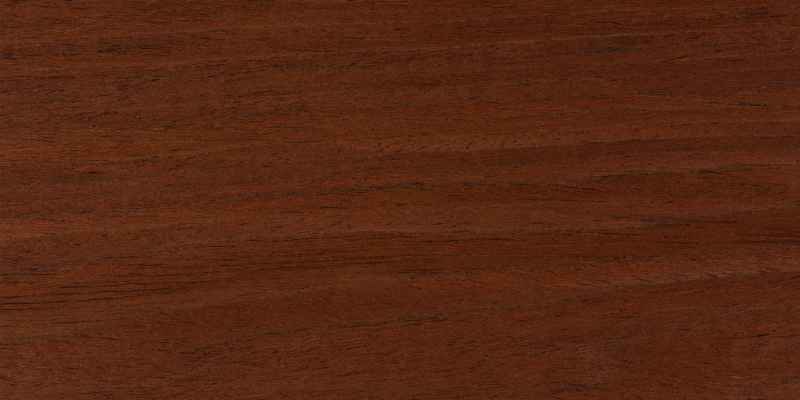
Mahogany Wood Grain Pattern: Ribbon Figure and Interlocked Grain
Mahogany wood grain pattern is straight to interlocked, and Honduran mahogany can also be irregular or wavy. Where the grain interlocks, quartersawn faces can show a ribbon stripe that appears to shift as you tilt the board. The Wood Database describes ribbon stripes for African mahogany and for sapele, and describes sapele’s grain as interlocked and sometimes wavy.
That overlap is the trap: ribbon figure is not a mahogany test. To pick a genus, combine it with texture (medium and uniform for Honduran, medium to coarse for African, fine for sapele), the end-grain bands from step 5, and the Janka numbers above. For a visual comparison across species, see our wood grain comparison chart, and for photos of finished pieces see what mahogany wood looks like.
Characteristics of Genuine Mahogany Wood
- Color: pale pinkish brown to darker reddish brown heartwood, darkening with age
- Grain: straight, interlocked, irregular or wavy
- Texture: medium and uniform, with moderate natural luster
- Pores: large and few, solitary and in radial multiples, occasionally with reddish-brown deposits
- Rays: medium width, mostly invisible without magnification
- Parenchyma: vasicentric and banded (marginal), the end-grain clue for Honduran mahogany
- Janka hardness: 900 lbf, rated low; density 36.8 lbs/ft³
- Workability: very easy to work with hand and machine tools, with only slight cutter dulling and excellent sanding and finishing
- Odor: no characteristic odor
- Health: a sensitizer that can irritate skin, eyes and lungs, so wear a dust mask when sanding
Which Species Did You Actually Get?
Honduran and Cuban mahogany (Swietenia)
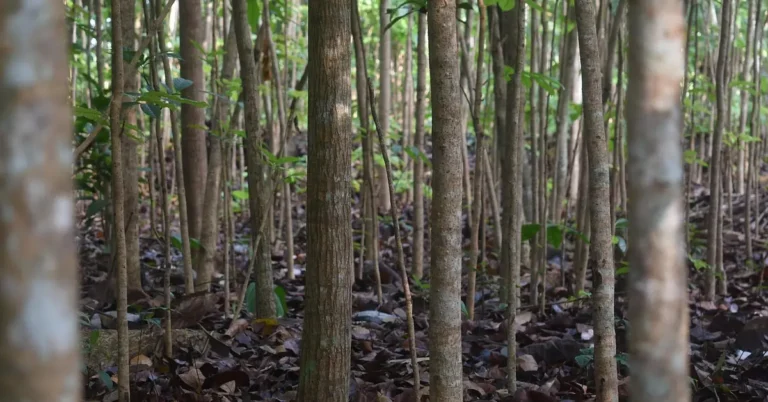
This is the genuine article. Honduran mahogany grows from southern Mexico to central South America and is also plantation-grown. It is CITES Appendix II and listed as Endangered by the IUCN. The Wood Database calls its price mid-range for imported hardwood and typically more affordable than African mahogany, which surprises most buyers. For current price ranges see how much mahogany costs.
African mahogany (Khaya)
African mahogany is the common commercial substitute: the main species are Khaya ivorensis and K. anthotheca, with K. grandifoliola and K. senegalensis also harvested. It is not unregulated. The Wood Database lists African mahogany in CITES Appendix II and its primary species as vulnerable on the IUCN Red List. It is softer (850 lbf) and lighter (33.9 lbs/ft³) than sapele, and it sometimes lacks the deeper reddish brown color of the genuine wood. See types of mahogany wood for how the species are sold.
Sapele (Entandrophragma)
Sapele belongs to a different genus in the same plant family, and is often marketed as a mahogany substitute. It is not CITES-listed, but the IUCN rates it vulnerable. Its cedar-like scent and 1,360 lbf hardness are the quickest giveaways. Our mahogany vs sapele comparison covers which to choose for a project.
Philippine mahogany and lauan (Shorea)
"Philippine mahogany" is a trade name for lauan and meranti, wood from the Shorea genus in Southeast Asia. The Wood Database says lauan bears no relation to true mahogany, and that it is very commonly used in plywood. If you are buying solid wood, ask for the botanical name. Dark red meranti is 800 lbf, coarse, and often streaked with white resin, and the Wood Database reports eye, throat and skin irritation from Shorea species, though severe reactions are uncommon.
When You Cannot Be Sure
Honest answer: with a finished antique, you often cannot get past genus-level confidence without a lab. Cuban and Honduran mahogany are hard to separate even for experts, and a stained sapele panel can pass for either. What you can do cheaply is rule woods out: weigh and compare against the numbers above, check the end grain with a loupe in an inconspicuous spot, and ask for the species on the invoice. If you are buying raw boards, unfinished mahogany wood is easier to verify before it is stained. For other quick references, see our shorter how to identify mahogany guide and mahogany wood advantages. After you have identified a piece, how to clean mahogany wood covers upkeep.
“bears no relation to what is considered to be ‘true’ mahogany”
Frequently Asked Questions
What Are the Characteristics of Mahogany Wood?
Genuine mahogany (Swietenia) has pale pinkish brown to darker reddish brown heartwood that darkens with age, straight to interlocked grain, a medium uniform texture, large few pores, and a Janka hardness of about 900 lbf. It is easy to work and has no characteristic odor.
What Color Is Mahogany Wood?
Mahogany wood is pale pinkish brown when fresh and turns a darker reddish brown as it ages. African mahogany runs pale pink to deeper reddish brown, sometimes streaked. The mahogany color swatch is a separate thing: hex #C04000, a name used in English since 1737.
Is African Mahogany Real Mahogany?
African mahogany (Khaya) is a close relative sold as a mahogany substitute, not genuine Swietenia mahogany. It is softer at 850 lbf, can be coarser in texture, and is listed in CITES Appendix II, so it is not an unregulated wood.
How Can You Tell Mahogany From Sapele?
Sapele is much harder (1,360 lbf vs 900 lbf for Honduran mahogany), heavier (41.6 vs 36.8 lbs/ft3), finer in texture, and gives off a distinct cedar-like scent while being worked. Both can show ribbon stripes, so use hardness and scent rather than figure.
Is Philippine Mahogany Real Mahogany?
No. Philippine mahogany is a trade name for lauan and meranti from the Shorea genus. The Wood Database says it bears no relation to true mahogany. It is coarser, with low luster and white resin streaks in dark red meranti.
Can You Identify Mahogany by Smell?
Not reliably. Honduran mahogany and dark red meranti have no characteristic odor, so smell cannot confirm either. A distinct cedar-like scent while cutting points to sapele instead, which makes smell more useful for ruling sapele in than mahogany in.
Is Mahogany Wood Protected by CITES?
Yes for the genuine and African woods. Honduran mahogany, Cuban mahogany and African mahogany are all in CITES Appendix II. Sapele and meranti are not CITES-listed, although the IUCN rates sapele vulnerable and many Shorea species critically endangered.
Sponsored / affiliate links. As an Amazon Associate I earn from qualifying purchases. I may earn additional commission from eligible campaigns.
 The Hardwood Edge Mahogany Hardwood Planks - 2-Pack Mahogany Wood for Unfinished Wood Crafts - 1/8’’ (3mm) 100% Pure Hardwood - Laser Engraving Blanks - Exotic Mahogany Planks for Crafts and Gifts
 The Hardwood Edge Mahogany Hardwood Planks - 4-Pack Mahogany Wood for Unfinished Wood Crafts - 1/8’’ (3mm) 100% Pure Hardwood - Laser Engraving Blanks - Exotic Mahogany Planks for Crafts and Gifts