Polyurethane Beads: What They Are and How Coatings Use Them
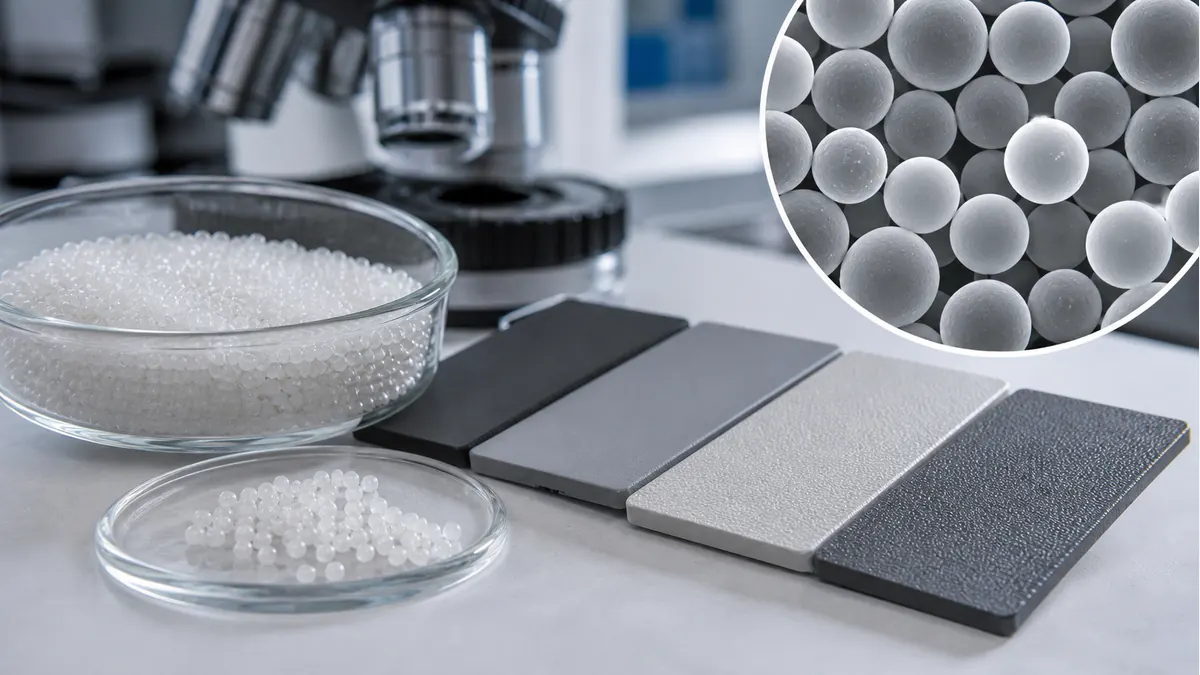
Polyurethane beads are usually crosslinked polymer microspheres used as functional additives in coatings, inks, plastics, leather finishes, and adhesives—not beads for jewelry making. Their controlled size and elastomeric character can change surface gloss, texture, slip, soft-touch feel, burnish resistance, and abrasion behavior.
They are added in relatively small, formulation-specific amounts. Results depend on bead chemistry, particle-size distribution, hardness, density, carrier compatibility, film thickness, and how well the particles disperse.
For woodworkers evaluating a pre-mixed finish rather than formulating one from scratch, the practical takeaway is simpler: a can labeled “soft-touch” or “matte” likely owes its feel to one of these additive families, and matching sheen or texture across a repair or touch-up means matching the original product line, not just the resin type.
What Polyurethane Beads Do
A formulator selects polyurethane microspheres to build a tactile or matte surface without relying only on mineral filler. Larger or more exposed beads create stronger texture; smaller particles can give a finer, more uniform feel. The supplier’s data and application testing control the dosage.
Common Effects and Applications
| Target effect | Where used |
|---|---|
| Soft-touch or rubber-like feel | Consumer coatings, leather, plastics |
| Low gloss and controlled texture | Furniture, flooring, coil and paper coatings |
| Burnish or abrasion behavior | High-touch coated surfaces |
| Slip and print response | Inks and specialty films |
Lamberti describes crosslinked polyurethane microspheres for low gloss, tactile feel, and use in water-, solvent-, and UV-based systems. See its polyurethane microsphere overview.
Beads vs PUD
A polyurethane dispersion is a film-forming resin dispersed in water. Polyurethane beads are discrete solid particles intended to remain as functional inclusions in a film or material. One system can use both, but they serve different jobs. Think of the dispersion as the paint itself and the beads as an ingredient stirred into that paint to change how the dried surface looks and feels — swapping one for the other in a formula, or in your mental model of the product, leads to the wrong expectations about performance.
Read our related explanation of polyurethane dispersion (PUD).
How Formulators Choose Them
- Particle size relative to dry-film thickness
- Hardness and compressibility
- Compatibility with water-, solvent-, or UV-cure binder
- Desired gloss, friction, feel, and abrasion result
- Mixing shear, settling, filtration, and application method
A bead that works in a thick leather coating may plug a fine spray system or protrude too far from a thin print layer. Run drawdowns and application trials on the real substrate.
Polyurethane Beads in Wood Coatings
In wood finishing specifically, polyurethane microspheres show up most often in pre-catalyzed lacquers and conversion varnishes marketed as “soft touch” or “matte flat” cabinet and furniture finishes. The beads scatter light at the surface, which is what drops sheen without the chalky look that mineral flatting agents (like silica) can produce. A finisher choosing between a silica-flatted matte and a bead-flatted matte will usually notice the bead version feels smoother and less powdery to the touch, though it can also show fingerprints and burnishing more readily on high-traffic surfaces like tabletops.
Beads vs Other Flattening Agents
| Flattening agent | Surface feel | Trade-off |
|---|---|---|
| Polyurethane beads | Smooth, soft-touch | Can burnish/shine with heavy rubbing |
| Silica (mineral) flatteners | Slightly powdery, dry feel | Can dull optical clarity if overdosed |
| Wax flatteners | Warm, low-gloss | Weaker abrasion and chemical resistance |
Handling and Testing
- Review the technical and safety data sheets.
- Confirm the bead is compatible with the binder and cure mechanism.
- Add using the supplier’s recommended order and shear.
- Check dispersion, settling, viscosity, gloss, color, and film defects.
- Test abrasion, blocking, chemical resistance, and aging after full cure.
Questions to Ask a Bead Supplier Before Buying
- What is the mean particle size and size distribution (D50, D90)?
- Is the bead crosslinked, and to what hardness or compression-recovery spec?
- Is it rated for water-based, solvent-based, or UV-cure systems?
- What is the recommended loading range by weight for my binder type?
- Does the supplier provide a technical data sheet and safety data sheet on request?
A supplier who cannot answer these specifics, or who only sells generic “matting beads” without chemistry details, is a red flag for a coatings application — even if the same beads might be fine for a lower-spec craft use.
Common Mistakes When Working With Polyurethane Beads
- Assuming “polyurethane bead” always means the same product as a polyurethane dispersion — they are different ingredient categories.
- Overdosing beads to chase a stronger matte effect, which can weaken film integrity and abrasion resistance.
- Skipping a drawdown test on the actual substrate and instead relying only on the supplier’s generic literature.
- Mixing beads into a binder with incompatible cure chemistry (for example, a UV-cure bead added to a solvent-evaporation system).
- Ignoring particle size relative to film thickness, which causes beads to protrude and create a rough, uneven surface.
Bottom Line
Polyurethane beads are precision coating additives, not craft findings. Choose them through formulation data and validated performance testing; do not substitute generic plastic beads and expect the same film behavior. A little supplier due diligence up front avoids a costly re-formulation later, especially on a production run rather than a one-off sample batch.
Frequently Asked Questions
Are polyurethane beads used for jewelry?
The term in coatings usually means industrial polymer microspheres, not drilled craft or jewelry beads.
Do polyurethane beads form the coating film?
Usually they modify a separate binder film; a polyurethane dispersion may be the film-forming resin.
Why add them to coatings?
They can adjust gloss, texture, feel, slip, burnish, and abrasion response.
Are polyurethane beads waterproof?
The beads alone do not make a coating waterproof; the whole formulation and film integrity decide water resistance.
How much should be added?
Use the supplier’s formulation range and test data. There is no universal dosage.
Will a soft-touch bead finish yellow over time?
Yellowing depends on the base resin (aromatic polyurethanes yellow faster than aliphatic ones), not the bead additive itself. Ask the supplier which resin platform the beads are formulated into.
Can I add polyurethane beads to a can of off-the-shelf wood finish?
Not reliably. Beads are engineered for a specific binder, particle loading, and application method; stirring them into an unrelated retail finish risks poor dispersion, settling, or an uneven texture.
Sponsored / affiliate links. As an Amazon Associate I earn from qualifying purchases. I may earn additional commission from eligible campaigns.