Sam Maloof’s Original Designs: The Joint and Techniques Behind Them
Sam Maloof (1916-2009) was a self-taught American furniture maker whose sculptural, hand-shaped chairs made him the first craftsperson ever awarded a MacArthur Foundation “Genius” Fellowship, in 1985. His work is defined less by any single design and more by a joinery technique he developed for connecting a chair’s seat, arm, and leg into one continuous, flowing curve — a detail that’s since become known simply as the Maloof joint, and one that’s genuinely difficult to reproduce well even for experienced woodworkers today.
From Graphic Design to the White House Collection
Straight From Maloof Himself
 |
Sam Maloof, Woodworker (Paperback) – $44.79 Maloof’s own account of his life and work, with photographs of his furniture and workshop — the primary source for anyone studying his actual technique rather than a secondhand summary.
|
Maloof was born in 1916 in Chino, California, to Lebanese immigrant parents, and had no formal woodworking training — he worked in graphic design before taking his first furniture commission around 1948. Working entirely by hand and eye rather than from measured drawings, he built a reputation slowly through direct commissions and word of mouth rather than gallery representation. In 1982, one of his rocking chairs became the first piece of contemporary furniture selected for the White House Collection, a milestone that moved his work from respected craft into recognized fine art in the eyes of major institutions.
The Maloof Joint: What Actually Makes It Difficult
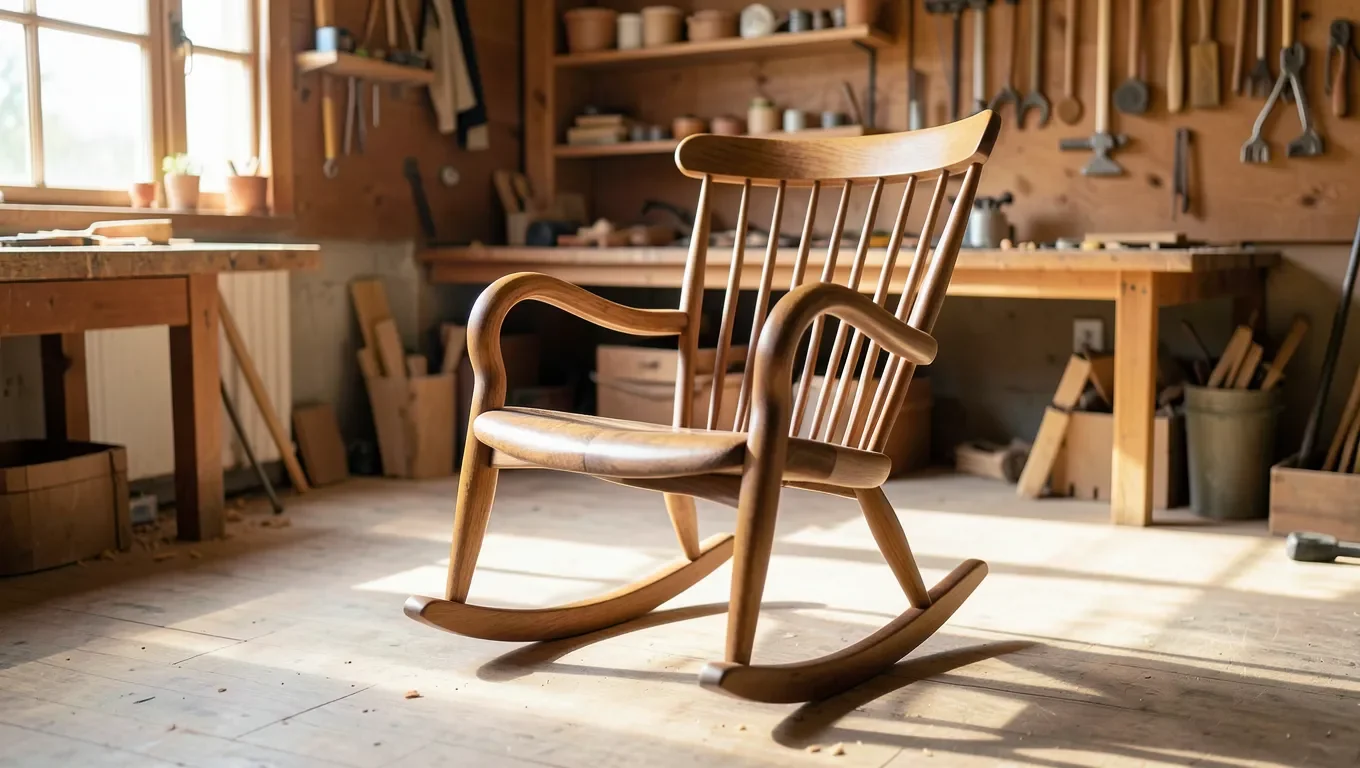
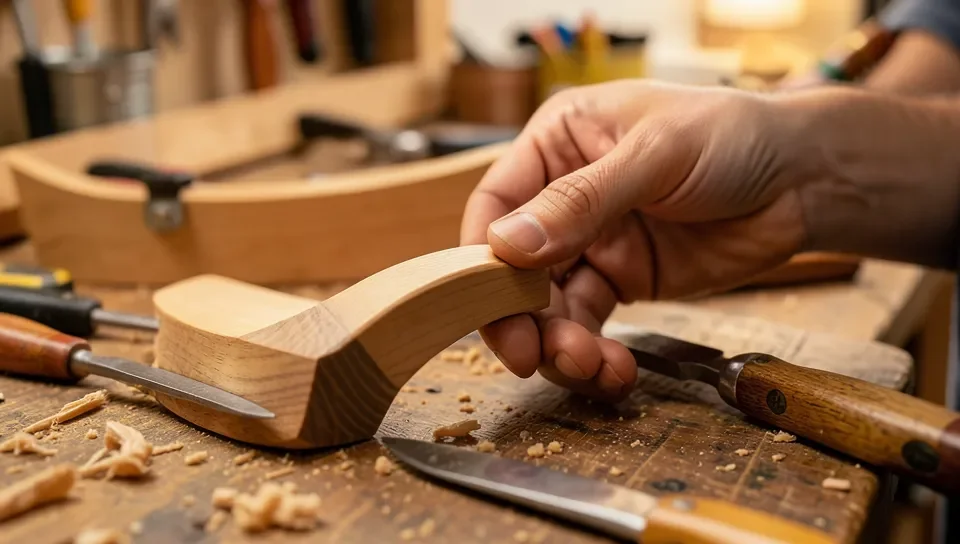
Maloof’s early chairs from the 1950s and 60s used a comparatively simple joint: the side seat rails were clamped together outside-edge to outside-edge, then bored with a centered hole so that, once unclamped, each rail held a half-round socket that a lathe-turned leg could be shaped to match. Over time his technique evolved into the more famous sculpted joint where the seat, arm, and leg blend into a single continuous surface with no visible seam or right angle anywhere in the transition — achieved by shaping each piece by hand with rasps, files, and sandpaper until the surfaces flow into one another, a process that can’t be rushed or fully replicated with power tools alone.
Why the Rocker Runners Don’t Split
A rocking chair’s runners are one of the most failure-prone parts of any chair design — a single piece of solid wood bent into a long curved shape is under constant stress and prone to cracking along the grain over years of use. Maloof solved this by laminating multiple thin layers of wood (commonly cited as seven) together to form each runner, which distributes stress across the glue lines rather than concentrating it in one solid piece, and let him extend the runners further outward than a solid-wood runner could safely support. This lamination technique is part of what makes an authentic Maloof rocker structurally sound enough to actually use for decades, not just display.
Materials: Walnut, Cherry, and Pegged Joinery
Maloof worked primarily in walnut and cherry, both hardwoods that machine and hand-shape predictably and hold a fine finish well — practical choices for the extensive hand-sanding his joints required, not purely aesthetic ones. Beyond the sculpted seat-arm-leg joint, he relied heavily on pegged mortise-and-tenon joints throughout his furniture, where a wooden peg driven through the joint adds mechanical strength on top of the glue bond, and often doubles as a visible design detail rather than something hidden. This combination — genuinely functional joinery that’s also part of the visual language of the piece — is a big part of why his furniture reads as both structurally honest and sculptural at the same time.
The Finish: An Oil-and-Wax Blend He Guarded Closely
Maloof finished most of his furniture with a hand-rubbed oil-and-wax formula rather than a sprayed lacquer or polyurethane film finish — a choice that suited the sculptural, hand-shaped surfaces his joints depended on, since a thick film finish would have obscured the subtlety of the hand-shaping rather than let it show through. He was known for being deliberately vague about the exact formula in interviews and writing, which has led to considerable speculation among woodworkers about the precise ratio of oil, wax, and varnish involved. What’s clear from examining his pieces is the practical result: a low-sheen surface that highlights walnut and cherry’s natural grain and deepens with age and handling rather than yellowing or cracking the way some older film finishes eventually do.
Maloof and the American Studio Furniture Movement
Maloof is usually discussed alongside George Nakashima and Wharton Esherick as one of the founding figures of the American Studio Furniture movement — a separate, earlier regional recognition came via the Pasadena Art Museum California Design exhibitions in the 1950s — a mid-20th-century shift away from purely factory-produced furniture toward individual makers designing and building complete pieces by hand, often emphasizing the wood’s natural form and grain rather than disguising it. All three worked roughly the same era and shared a similar philosophy (function driving form, and visible joinery as a design feature rather than something to hide), but arrived at distinctly different visual languages: Nakashima is best known for live-edge slab tables that preserve a tree’s natural boundary, Esherick for sculptural, almost architectural forms, and Maloof for the continuous, flowing joint that made his chairs instantly recognizable. Together, their work is generally credited with establishing that furniture built by an individual craftsperson could be taken as seriously as fine art by major museums and collectors, not treated as a lesser category of craft.
Recognition Beyond the MacArthur Fellowship
The 1985 MacArthur Fellowship is the honor most often mentioned, but Maloof was also the first woodworker elected as a fellow of the American Craft Council and the first recipient of a Louis Comfort Tiffany Foundation grant — both markers of how seriously the craft world took his work well before the MacArthur recognition brought him wider public attention. His home and workshops in Alta Loma, California were later preserved and relocated as a nonprofit foundation, a project undertaken specifically to keep his working spaces and process visible to future woodworkers rather than letting them be lost to development. That decision to preserve the actual workshop, rather than just the finished furniture, reflects how much of his value as a craftsperson was understood to live in the process itself, not only the end result sitting in a museum.
What Modern Woodworkers Actually Borrow From Maloof
Contemporary studio furniture makers rarely copy Maloof’s designs outright — that would miss the point of work built entirely by eye rather than from a repeatable pattern. What gets borrowed instead is the underlying approach: joints shaped for visual continuity rather than hidden and disguised, structural solutions (like laminated runners) developed specifically to solve a real durability problem rather than for decoration, and a general willingness to let the function of a joint also become the design feature of the piece. That philosophy, more than any specific chair profile, is Maloof’s most-copied legacy in modern furniture design. His output also wasn’t limited to a single chair form — he produced music stands, cradles, settees, and a double rocking chair built for two, all built around the same hand-shaped joinery philosophy rather than a fixed catalog of models, which is part of why no two pieces from his shop are ever quite identical even when the general form repeats.
Frequently Asked Questions
What is the Maloof joint?
A hand-shaped joint connecting a chair’s seat, arm, and leg into one continuous curved surface with no visible seam, developed by Sam Maloof and requiring extensive hand-shaping with rasps and sandpaper rather than power tools alone.
Was Sam Maloof formally trained as a woodworker?
No, he was entirely self-taught. He worked in graphic design before taking his first furniture commission around 1948 and developed his techniques through direct practice rather than formal training.
Why don’t Maloof rocking chair runners crack?
Maloof laminated multiple thin layers of wood together to form each runner instead of using one solid piece. This distributes stress across the glue lines and lets the runners extend further outward without the cracking risk a solid-wood runner would have.
What wood did Sam Maloof primarily use?
Mainly walnut and cherry, both hardwoods that shape predictably by hand and hold a fine finish well, suited to the extensive hand-sanding his signature joints required.
Conclusion
Sam Maloof’s lasting influence isn’t a single chair design, it’s an approach: joints shaped by hand until they flow into one continuous form, structural problems solved with genuine engineering (like laminated rocker runners) rather than disguised, and a body of work built entirely without formal training that still earned him the first MacArthur Fellowship ever given to a craftsperson. That combination of function and sculptural form is what modern furniture makers still study his work to understand. See our Sam Maloof chair hub for his full biography and collection history, the Maloof joint in depth, or his design philosophy for more.
Sponsored / affiliate links. As an Amazon Associate I earn from qualifying purchases. I may earn additional commission from eligible campaigns.