Cost to Take a Wood Carving Class
Pricing review date: October 28, 2026.
A beginner wood carving class usually costs about $40 to $150 for a single session, or about $100 to $400 for a short series, before tools and safety gear. Skip the extras, and a cheap class can turn expensive fast if you still need knives, gloves, wood, and practice materials afterward. This guide breaks down tuition, included supplies, hidden add-ons, and how to judge whether the total price is worth it.
This pricing guide was built from local class listings and current provider pages for beginner carving programs, then checked against posted inclusions, schedules, and shop requirements. We focused on the out-the-door cost a first-time student would actually pay, not just the advertised tuition.
How much does a wood carving class cost?


Price depends on format, length, and what the fee covers. A short demo or one-off workshop usually costs less than a multi-session beginner course, while private instruction costs more because the instructor’s time goes to one student. For beginners, compare the full entry cost, not tuition alone.
Typical beginner price ranges by format
Single-session classes often sit at the low end because they cover one project or a brief skill block. Multi-week courses cost more upfront, but they often spread setup, instruction, and shop access across several sessions. Private lessons usually carry the highest hourly rate, but they can be efficient if you want direct feedback on grip, grain direction, or sharpening.
How session length changes the price
Longer classes usually cost more because they include more carving time, more instructor contact, and sometimes more materials. A class that runs only a few hours may introduce tools and let you start a small project, while a six-session course is more likely to cover progression, sharpening, and finish work. Read the posted tuition with the schedule beside it.
What a beginner should expect at each price tier
At a lower price point, expect a shorter, more limited introduction. Midrange classes often include a guided project, some wood, and supervised practice. Higher prices can make sense when the class includes a tool kit, a place to practice between sessions, or enough instructor attention to correct posture and cutting direction before bad habits set in.
Methodology: To estimate “true beginner total,” we compared tuition listings from local and regional beginner-friendly carving classes, then added the likely first-time purchases a student would need if those items were not included: gloves, eye protection, a sharpening setup, and one basic practice blank or starter material. Markets sampled included maker spaces, woodworking schools, and retail workshop programs in and around the local metro area and nearby regional training hubs. Where a provider listed included membership or tool access, we counted that value only when it was posted on the class page.
| Class format | Tuition | Kit/tools included | Materials included | Safety gear required | Practice access | Estimated true beginner total |
|---|---|---|---|---|---|---|
| Single-session class | $40 to $150 | Often none; sometimes a basic loaner set | Usually one blank or sample wood piece | Often cut-resistant gloves, safety glasses, dust mask | Usually none after class | $60 to $250 |
| 4-session course | $100 to $300 | Sometimes included; often optional add-on | Usually several blanks or project wood | Gloves, eye protection, and dust control are common | May include limited shop time between sessions | $180 to $500 |
| 6-session course | $250 to $550 | More likely to include or discount a starter kit | Usually included for the project sequence | Often required, especially gloves and eye protection | May include membership or practice access | $350 to $750 |
| Private lesson | $75 to $250 per hour | Usually your own tools unless arranged otherwise | Usually separate or billed into the lesson | Bring or buy your own safety gear | Usually none unless added separately | $120 to $400 for the first session |
Say your local class advertises a low tuition rate but requires you to buy gouges, a strop, a sharpening stone, gloves, and a blank before the first session. The class may still be a fair value, but the real entry cost is no longer the posted fee alone.
What is included in the price?
Beginner classes bundle different things. Some include only instruction and a small amount of wood. Others include a loaner tool set, safety gear rules, and access to the shop for practice. Value depends on whether the class removes the main startup purchases or simply shifts them to your cart later.
Tools and kits
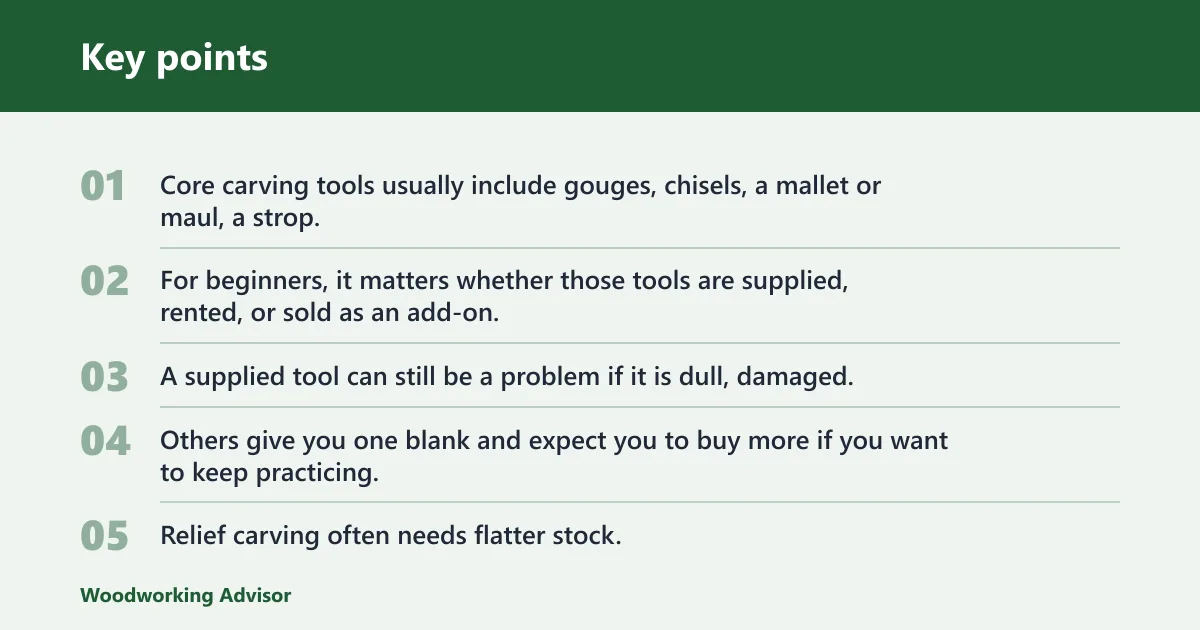
Core carving tools usually include gouges, chisels, a mallet or maul, a strop, and a sharpening stone. For beginners, it matters whether those tools are supplied, rented, or sold as an add-on. A supplied tool can still be a problem if it is dull, damaged, or not suited to the project you are learning.
Materials and wood blanks
Some classes provide all project wood. Others give you one blank and expect you to buy more if you want to keep practicing. Relief carving often needs flatter stock, while whittling and small 3D figures may use smaller blocks. Bowl carving usually demands more material and more time, which can push the overall cost up.
Safety gear and class supplies
Safety gear is part of the real price. Cut-resistant gloves, hearing protection, safety glasses, and a dust mask may be required or recommended depending on the shop setup. Maker Works lists cut-resistant or Kevlar gloves as required on its beginner carving page, so a glove purchase can be part of the first-day cost if you do not already own them.
Practice access or membership
Practice access changes value more than many beginners expect. Maker Works includes a six-week membership with the class, which means the price is not only about instruction; it also buys time to repeat the cuts. Black Forest Wood Co. includes a rental of a carving set, which can reduce the first purchase burden if you are still deciding whether to buy tools.
Do beginner classes include tools and materials?
Sometimes yes, sometimes partly, and sometimes not at all. A beginner class may include loaner tools, a rental carving set, or a starter kit, but that does not guarantee you leave with gear you can keep using at home. Ask whether the tools are included, rented, or sold separately before you book.
Tool kit rental versus included kit
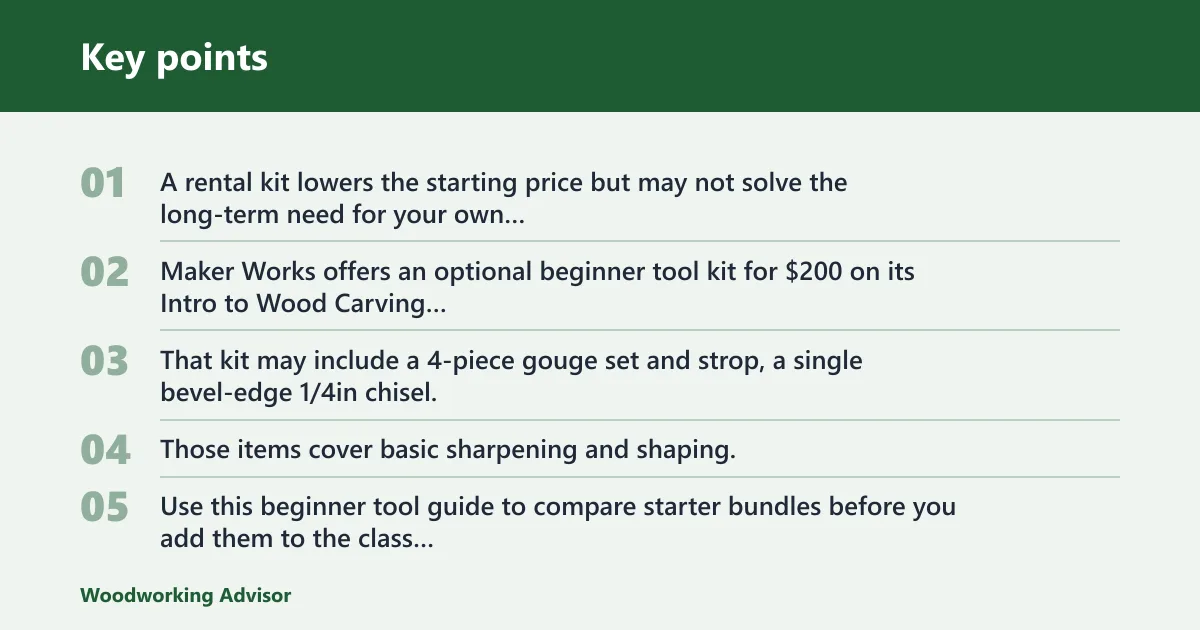
A rental kit lowers the starting price but may not solve the long-term need for your own tools. Maker Works offers an optional beginner tool kit for $200 on its Intro to Wood Carving page. That kit may include a 4-piece gouge set and strop, a single bevel-edge 1/4in chisel, and a 400/1000 diamond stone. Those items cover basic sharpening and shaping, but you still need to know whether the class expects you to arrive with them or buy them later. Use this beginner tool guide to compare starter bundles before you add them to the class total.
Replacement or add-on tool costs
Extra cost often comes from replacement items. If a class includes only one shared gouge or a loaner knife, you may still need your own sharpening stone, strop, or gloves after the first session. A tool that is not sharp enough to use safely is not really a usable inclusion. Beginners should ask who sharpens the tools and whether edge maintenance is part of class time. For a deeper cost check, pair the class price with this sharpening guide.
Sharpness and prep of supplied tools
Supplied tools should be ready for safe use, not just present on a bench. Sharpness matters because dull tools require more force and can slip more easily in soft or knotty wood. Grain direction matters too. Even a good tool can behave badly if the cut runs against the grain or the student is not shown proper body position.
A common first-timer mistake is assuming a “tool included” class means every student gets a full, ready-to-use kit. If the shop supplies only one shared chisel and no strop, the real learning value drops fast once the edge dulls midway through the project.
Why do class prices vary so much?
Prices vary because classes sell different amounts of instruction, access, and equipment. A short demo with a small group costs less than a guided series with a limited class size, shop access, and a tool kit. The instructor’s background also matters, especially when the class is built around a specific carving style or project type.
Instructor experience and teaching background
Instructor experience should include years of experience, teaching background, and course-specific focus. A teacher who knows relief carving may not be the best fit for a bowl carving class. If the class description mentions sharpener setup, grain reading, or safe body mechanics, that usually signals more focused instruction than a general craft night.
Group class size versus private instruction
Smaller classes usually cost more per seat because each student gets more correction and more tool time. Maker Works limits class size to 11 people max on its beginner carving course. That cap can improve feedback during a six-session course, but it also means the class has less room to spread fixed costs across a large group. Private lessons cost more because the instructor’s attention is dedicated to one student.
Workshop access, membership, and follow-up support
Workshop access can justify a higher fee if it gives you time to practice after the lesson. Maker Works includes a six-week membership with the class. That is real value for beginners who need repetition on simple cuts, sharpening, and safe stance before they move to more complex forms. Black Forest Wood Co. says its course runs six consecutive Wednesdays from 6pm to 9pm, which points to a structured progression rather than a one-time demo.
Project type and course depth
Class depth changes value because different projects demand different skills. Relief carving often teaches tool control, grain direction, and depth changes. 3D carving adds round forms and more body movement. Whittling may be simpler to start, while bowl carving can require larger tools and more material. A class that covers sharpening and safe body mechanics is usually a better beginner purchase than one that only shows a finished sample. If you are still choosing a path, compare the course to chip carving vs. relief carving.
Are beginner classes worth it?
Yes, if the class reduces expensive mistakes and gets you carving safely faster than learning alone. Beginner classes are most worthwhile when they include real instruction, sharpened tools, enough practice time, and feedback on grain, grip, and body position. If the class is only a demo with no usable takeaways, the value drops quickly.
Skills and outcomes beginners should expect
A good beginner class should leave you able to hold the tool safely, read basic grain direction, make controlled cuts, maintain a working edge, and finish a simple project without forcing the blade. Many classes also teach how to choose starter wood, which matters because beginner-friendly species are easier to cut cleanly and safely. For that decision, this wood selection guide is a useful companion to class shopping.
When a class is the better buy than self-teaching
Classes are the better buy when you want immediate correction, a safe shop setup, and a way to avoid buying the wrong tools too early. They are especially useful if the course includes practice access or a starter kit, because those pieces lower the cost of getting past the first project. If you only need a one-time intro, a short workshop can be enough; if you want steady progress, a multi-session class is usually better value.
What should you ask before booking?
Ask direct questions before you pay. The best beginner class is the one that tells you exactly what tools, wood, safety gear, and practice access are included. You want to know the full entry cost, not just the tuition line on the page.
- What tools are provided, rented, or sold as an add-on?
- Is the wood included, and how many blanks do you get?
- What safety gear must you bring?
- Are the supplied tools sharp enough to use on day one?
- Does the class include sharpening support or instruction?
- Can you practice after class, and for how long?
- How many students are in the room?
- Does the instructor teach the specific carving style you want?
Suppose you compare two beginner courses at the same tuition. One includes wood, a loaner set, and after-class shop time. The other includes only instruction. The second course looks cheaper at checkout, but it can cost more once you buy gloves, a strop, a sharpening stone, and practice stock.
Frequently asked questions
What is included in the price of a wood carving class?
It depends on the school. Some classes include wood, a rental tool set, and limited practice access. Others include only instruction. Always check whether gloves, sharpening supplies, and membership or shop time are part of the fee or extra.
Can I take a wood carving class with no experience?
Yes. Beginner classes are built for people with no experience. You should still expect to learn safe grip, grain direction, tool control, sharpening basics, and simple project work before moving to more complex carving.
What should I bring to a wood carving class?
Bring the safety gear the instructor requires, plus any tools or blanks listed in the class notes. If the class does not supply gloves, eye protection, or sharpening gear, plan to arrive with those items ready to use.
Why do some wood carving classes cost much more than others?
Price changes with class length, instructor experience, class size, materials, and practice access. A six-session course with a membership or kit can cost more than a one-off demo, but it may offer better value for a true beginner.
How long is a beginner wood carving class?
Beginner classes can run a few hours, several weekly sessions, or a private lesson by the hour. Maker Works’ Intro to Wood Carving track runs 6 sessions of 2 hours each. Black Forest Wood Co.’s course runs six consecutive Wednesdays from 6pm to 9pm.
Sources
- Maker Works, Intro to Wood Carving class page, including pricing, class size, glove requirement, membership, and tool-kit details.
- Black Forest Wood Co., beginner carving class page, including course length, schedule, and rental tool-set details.
- Woodworking Advisor internal guides on beginner carving tools, sharpening, wood selection, and carving styles for cross-checking beginner startup costs.
Sponsored / affiliate links. As an Amazon Associate I earn from qualifying purchases. I may earn additional commission from eligible campaigns.