Sherwin-Williams Deck Stain: SuperDeck Types & Colors (2026)
Sherwin-Williams SuperDeck is a professional-grade line of exterior wood stains covering transparent, semi-transparent, semi-solid, and solid formulas — but the right pick depends on your deck’s condition, since solid stains hide wear that transparent stains reveal. Choosing wrong means recoating in one year instead of three. This guide covers the full product line, real color options, application steps, and how SuperDeck compares to Behr, Olympic, and Ready Seal.
Disclosure: This post contains affiliate links. If you purchase through our links, we may earn a small commission at no extra cost to you.
What Is SuperDeck? Sherwin-Williams SuperDeck Stains Overview
Best Long-Handle Stain Brush Pick | |
 |
PIMEKOY 7-Inch Deck Stain Brush with 60-Inch Handle ($16.79) SuperDeck is sold through Sherwin-Williams, not Amazon, but the application tool decides whether you get the even wet edge the steps below call for.
|
As an Amazon Associate we earn from qualifying purchases.
SuperDeck (officially Sherwin-Williams SuperDeck) is a professional-grade line of exterior wood stains that protects and beautifies decks, fences, siding, and other outdoor wood surfaces. Here’s what the full product line covers:
| SuperDeck Product | Opacity | Wood Grain Visible? | Best For | Expected Life |
|---|---|---|---|---|
| Semi-Transparent Oil Stain | Low | Fully visible | New or lightly weathered decks | 1–3 years |
| Semi-Transparent Waterborne | Low–Medium | Mostly visible | Natural wood look | 2–3 years |
| Semi-Solid Stain | Medium–High | Slight grain shows | Weathered decks with minor flaws | 2–4 years |
| Solid Color Waterborne | Full coverage | Hidden | Old or heavily weathered decks | 3–5 years |
| IR Reflective Semi-Solid/Solid | Medium–Full | Partial or hidden | Decks in direct sun — reflects solar heat | 3–5 years |
| Log Home & Deck Stain | Medium | Shows texture | Log homes, vertical exterior wood | 2–4 years |
📊 Sherwin-Williams says its Cool Feel color technology reduces deck surface temperature by up to 20°F versus conventional color technology, and the solid stain is offered in 20 Cool Feel colors. The separate IR Reflective stains come in only three package colors and are not tintable. Source: Sherwin-Williams SuperDeck Solid Color Deck Stain page and the SuperDeck Deck Finishing System brochure
The SuperDeck line uses Duckback Technology, a water-repellent formula designed to resist cracking and moisture penetration. Sherwin-Williams reformulated SuperDeck from oil-based to water-based in 2020, and industry coverage in 2026 notes Sherwin-Williams has continued refining the formula for better adhesion and elasticity since then. Both oil-based and water-based options remain available depending on the product.
Is SuperDeck a Stain or Deck Paint? Sherwin-Williams Deck Paint Explained
Many people searching for Sherwin-Williams deck paint end up looking at SuperDeck, and for good reason — the line blurs the boundary between stain and paint depending on which product you choose. SuperDeck Solid Color Stain is technically a stain, but it behaves like a deck paint, providing full opaque coverage that hides wood grain completely. Sherwin-Williams also makes true deck coating/paint products beyond the stain line (our Sherwin-Williams exterior wood stain guide covers the vertical-surface lines such as WoodScapes):
| Product | Type | Best Use |
|---|---|---|
| SuperDeck Solid Color Stain | Opaque stain (paint-like coverage) | Wood decks — hides grain, full color |
| SuperDeck Deck & Dock Coating | Elastomeric coating (true deck paint) | Decks and docks — bridges cracks, heavy-duty |
| Porch & Floor Enamel | Enamel paint | Porch floors and steps — hard surface finish |
If you specifically need Sherwin-Williams deck paint rather than stain, the SuperDeck Deck & Dock Elastomeric Coating is the right product — it bridges minor cracks and forms a film coating over the surface. The Porch & Floor Enamel is better suited to concrete porch floors or steps than open wood deck boards.
Why Choose SuperDeck Stains for Your Woodworking Project?
Sherwin-Williams has manufactured paints and stains for over 150 years, and SuperDeck benefits from that manufacturing scale and a wide dealer network. The line covers every opacity level from transparent to full solid coverage, so it fits both a natural-wood look and an older deck that needs imperfections hidden. Sherwin-Williams also runs seasonal sales — typically 30–40% off deck products — and a PaintPerks rewards program that can meaningfully lower the cost of a full deck project.
Types of SuperDeck Stains: Which One Is Right for You?
Transparent Stains
Transparent stains, like Cedar Tone Natural or Heart Redwood, soak into the wood and highlight the grain while adding a hint of color. They work best on new or well-maintained decks — see our full guide on how to stain cedar if you’re working with a cedar fence or deck. Transparent stains offer decent UV and water protection but need reapplication most often, usually within one to two years.
Semi-Transparent Stains
Semi-transparent stains use iron oxide pigments to block UV damage and contain mildewcides to fight mold growth, while still letting the wood’s texture show through. They’re more durable than transparent stains, typically lasting two to three years, but even coverage on large decks takes practice — work in small sections to avoid streaking.
Solid Color Stains
For older decks with imperfections, or for a bold opaque look, solid color stains cover the wood completely while still showing some surface texture, closer to paint than a traditional stain. Solid stains are the most durable SuperDeck option, often lasting three to five years, but they show peeling more visibly than lighter formulas if the surface wasn’t prepped properly first.
Here’s a quick comparison to help you choose:
| Type | Coverage | Durability | Best For |
|---|---|---|---|
| Transparent | Light, shows wood grain | 1-2 years | New or well-maintained wood |
| Semi-Transparent | Medium, some grain visible | 2-3 years | Decks with light wear |
| Solid Color | Full, hides grain | 3-5 years | Older decks or bold color preferences |
Which SuperDeck Stains Can You Apply to Damp Wood?
Sherwin-Williams states that its waterborne SuperDeck semi-transparent, semi-solid and solid stains can be applied to damp wood, so most jobs can be finished in a single day. That is a real advantage after a deck wash, but the oil-based products are marketed differently, so check which one you bought before you start.
| SuperDeck stain | Damp wood? | Cleanup | Other detail Sherwin-Williams states |
|---|---|---|---|
| Waterborne Semi-Transparent | Yes, damp or dry | Soap and water | 3 Year Limited Warranty, premium performance for up to three years |
| Waterborne Semi-Solid | Yes, damp or dry | Soap and water | Some wood grain shows through; IR reflective version in 3 package colors |
| Waterborne Solid Color | Yes, damp or dry | Soap and water | Opaque protection for new, weathered or previously stained wood and composite; 20 Cool Feel colors |
| Oil-Based Semi-Transparent | Not stated | Solvent | One-coat-only coverage on most exterior woods; 550 VOC |
Two cautions. First, “damp” is not “wet”: the product pages say damp or dry, give no moisture percentage, and do not claim that damp wood bonds better. The 15% and 25% limits used elsewhere in this guide are common rule-of-thumb figures, not Sherwin-Williams numbers, so confirm against the product data sheet for your exact can. Second, the oil-based line is the one to keep off wet boards, because Sherwin-Williams makes no damp-wood claim for it.
SuperDeck Stain Colors: Complete Color Guide
One of the biggest reasons people choose SuperDeck is the wide color range. Here are the most popular colors by stain type — these are what Sherwin-Williams stores and online communities recommend most often:
Semi-Transparent Colors
| Color Name | Tone | Best For |
|---|---|---|
| Cedar | Warm reddish-brown | Cedar and redwood decks |
| Redwood | Deep red-brown | Matching natural redwood tone |
| Honey Gold | Warm golden amber | Pine or new pressure-treated wood |
| Canyon Brown | Medium earthy brown | Weathered decks needing warmth |
| Weathered Gray | Cool silver-gray | Modern or coastal deck styles |
Semi-Solid & Solid Colors
| Color Name | Tone | Best For |
|---|---|---|
| English Walnut | Rich dark brown | Older decks, high-end look |
| Banyan Brown | Deep warm brown | Hiding heavy weathering |
| Cape Cod Gray | Classic blue-gray | Coastal or shaded decks |
| Mission Brown | Chocolate brown | Solid full coverage |
| Lodge Brown | Dark forest brown | Rustic or cabin-style decks |
| Hawthorne | Tan-gray neutral | Modern contemporary style |
| Chestnut | Warm medium brown | Traditional deck look |
| Seashell | Off-white | Light, airy deck spaces |
Most SuperDeck colors are available at Sherwin-Williams stores — for the complete color chart beyond SuperDeck, see our full Sherwin-Williams wood stain chart. Always test your chosen color on a hidden section of your deck first, since lighting and wood species can shift how a color reads once it’s applied.
How to Prepare Your Deck for Staining with SuperDeck
Prep work determines whether a SuperDeck finish lasts three years or peels within one. The deck needs to be clear, clean, dry, and smooth before any stain goes on.
- Clear and sweep: Remove furniture, planters, and grills, then sweep away dirt and debris, including in the cracks between boards.
- Clean with a deck brightener: SuperDeck Revive Deck and Siding Brightener removes dirt, mildew, and old stain residue — apply with a pump sprayer, scrub, let sit about 10 minutes, then rinse with a pressure hose. See our guide on the best way to clean a wood deck for the full process.
- Check moisture content: Wood should read below 25% moisture for solid stains and below 15% for transparent or semi-transparent stains. A moisture meter is the only reliable way to confirm this.
- Sand or strip old coatings: If the deck has old stain or paint in poor condition, sand or strip it first — staining over a failing coat is one of the most common causes of early peeling.
Step-by-Step Guide to Applying SuperDeck Stains
- Gather your tools: a brush, roller, or sprayer, plus a metal tray, painter’s tape, and drop cloths — a pad or roller covers open boards fastest, while a brush handles rails and corners.
- Check the weather: pick a day between 50–80°F with no rain forecast; see our guide on what temperature is too cold to stain wood if conditions are borderline.
- Stir, don’t shake: stirring mixes the pigment evenly; shaking introduces bubbles that show up in the finish.
- Test a hidden section first: colors can read differently on your specific wood than on the store swatch.
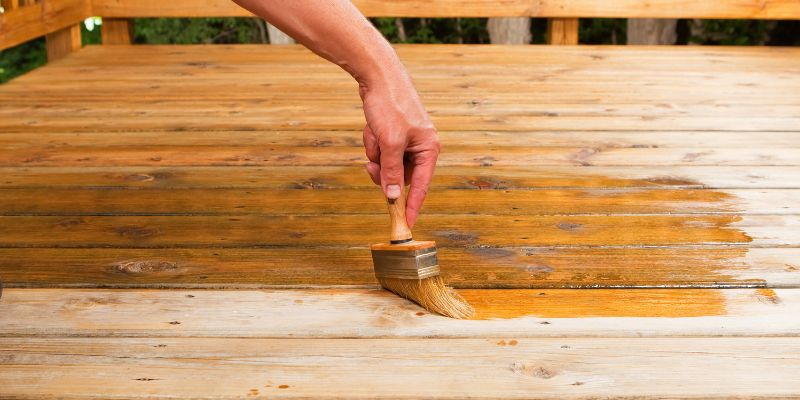
- Work in small sections: keep a wet edge and move in one direction to avoid lap marks and streaks.
- Let it cure fully before foot traffic: check the can for the specific recoat and cure times for your formula.
Pros and Cons of SuperDeck Stains
Pros
- Wide Color Range: From natural tones to bold solids, there’s a shade for most styles.
- Weather Protection: The stains resist moisture, UV rays, and mildew.
- Easy to Find: Sherwin-Williams stores are widespread and run frequent sales.
- Versatile Formulas: Oil-based and water-based options suit different project needs.
Sherwin-Williams’ own Deck Finishing System brochure sorts prep by the deck’s history. A previously coated deck starts with Stain & Sealer Remover, which must be followed by Revive. A new or uncoated cedar, redwood or pressure-treated deck can go straight to Revive. Skipping the remover on an old coating is how the “staining over a failing coat” peeling problem starts.
Cons
- Peeling Risk: Solid and semi-transparent stains can peel if applied over an unprepped or damp surface.
- Formula Changes: Since the 2020 water-based reformulation, some long-time users report the newer formula needs more careful prep than the original oil-based version.
- Application Difficulty: Semi-transparent stains show streaks more easily on large decks than solid formulas do.
Does SuperDeck Stain Peel? What Users Really Experience
Peeling is the #1 complaint in woodworking forums and Reddit threads about SuperDeck — so let’s address it directly. Yes, SuperDeck can peel, but in nearly every reported case the cause traces back to one of three things: insufficient surface prep, applying too thick a coat, or staining wood with high moisture content.
In 2020, Sherwin-Williams reformulated SuperDeck to a water-based formula, and many long-time users noted the new version applies thinner than the original oil-based one. The newer formula is easier to clean up but needs more careful prep to avoid peeling, especially over previously stained surfaces.
How to prevent SuperDeck from peeling
- Strip or sand old stain: applying over a deteriorating existing coat is the most common cause of early peeling.
- Check moisture content: wood must be below 15% moisture for semi-transparent, below 25% for solid — use a moisture meter.
- Apply thin coats: two thin coats outlast one thick coat, which traps moisture underneath.
- Don’t stain in heat: above 90°F, the stain dries too fast and forms a weak surface bond.
- Use SuperDeck Revive brightener first: it opens the wood grain for better penetration.
One rule applies to every formula: never apply a separate clear sealer over an already-cured stain coat expecting extra protection — a topcoat sealer generally will not adhere properly to a stained surface and is likely to peel. If you want the combined stain-plus-sealer approach, use products designed as a coordinated system rather than layering two unrelated products.
Tips for Maintaining Your SuperDeck-Stained Deck
- Sweep regularly: remove dirt and leaves before they trap moisture against the finish.
- Wash gently each spring: a mild cleaner and soft brush removes mildew and grime; avoid aggressive power washing, which can strip the stain.
- Reapply every one to three years: the exact interval depends on stain type and climate exposure.
- Watch high-traffic areas: steps and walkways wear faster than the rest of the deck and often need earlier touch-ups.
- Check annually for fading or wear: catching thin spots early means a touch-up instead of a full strip-and-restain job.
Common Mistakes to Avoid When Using SuperDeck Stains
- Skipping Prep: not cleaning or sanding the deck properly is the leading cause of peeling and uneven color.
- Applying Too Thickly: thick layers dry unevenly and are more likely to peel — stick to thin, even coats.
- Ignoring Weather: staining in extreme heat, cold, or humidity compromises the finish before it can cure properly.
- Not Testing the Color: colors read differently on your specific wood than on a store sample — always test a hidden area first.
- Mixing Formulas: applying a water-based stain over an oil-based one without stripping the old coat first prevents proper adhesion.
Comparing SuperDeck to Other Deck Stains
Here’s how SuperDeck stacks up against the three alternatives buyers compare it to most, based on manufacturer specs and consistent community reporting:
| Brand | Price/Gallon (2026) | UV Protection | Peel Resistance | Best For |
|---|---|---|---|---|
| SuperDeck Semi-Transparent | ~$46 | Excellent | Good (with proper prep) | Most homeowners |
| SuperDeck Solid | ~$58 | Excellent | Good (with proper prep) | Older, weathered decks |
| Behr Solid Stain & Sealer | ~$50 | Fair | Good | Budget-conscious DIYers |
| Olympic Maximum | ~$38–48 | Good | Poor in cold climates | Mild-climate decks only |
| Ready Seal | ~$50 | Excellent | Excellent | Pros & peel-prone decks |
SuperDeck vs Behr
Behr is available at Home Depot — check our Behr wood stain color chart to compare shades. For a head-to-head against another premium brand, see our Cabot vs Sherwin-Williams deck stain comparison. Community reports consistently note SuperDeck outperforms Behr on UV resistance, with Behr fading more noticeably after a full summer in direct sun. For heavy-sun decks, SuperDeck is generally worth the extra cost.
SuperDeck vs Olympic
Olympic Maximum is popular for easy application, but it has a well-documented weakness in freeze-thaw climates — community forums consistently report Olympic peeling and flaking after harsh winters, while SuperDeck holds up better through freeze-thaw cycles. In the Midwest, Northeast, or Canada, SuperDeck is the stronger choice.
SuperDeck vs Ready Seal
Ready Seal is a professional favorite because it virtually never peels — its oil-based formula penetrates deeply with no surface film to lift. The tradeoff is availability and price: it’s harder to find in stores and typically costs more than SuperDeck. For homeowners who want easy store access and a solid balance of durability and cost, SuperDeck remains the more practical pick.
“Below-average durability, with recoats needed every one to two years on horizontal deck floors.”
That independent 2026 test result is worth weighing against the more positive community reports above — horizontal, sun-exposed deck floors see more wear than vertical fences or siding, so expect the shorter end of SuperDeck’s stated lifespan on flat, high-traffic surfaces.
Where to Buy SuperDeck Stains and How to Save
SuperDeck is a Sherwin-Williams store-exclusive product line — it’s sold at Sherwin-Williams stores and sherwin-williams.com, and stocked by some Lowe’s locations, but it is not genuinely available through Amazon (search results for it on Amazon return unrelated third-party stains, not real SuperDeck). Check the Sherwin-Williams website for promotions, which often run 30–40% off deck products, and consider their PaintPerks program for ongoing discounts. A gallon typically covers 150–300 square feet, so measure your deck before buying to avoid running short mid-project.
Does SuperDeck Stain Need a Separate Sealer?
No — SuperDeck stains already contain water-repelling protection through Duckback Technology, so a separate clear sealer isn’t required on top of a properly applied coat. Sherwin-Williams sells SuperDeck Clear Sealer as a distinct product within its Deck Care System, intended for use over bare or previously cleaned wood, not as a topcoat layered over a cured stain. Applying an unrelated sealer over an already-stained deck is a common mistake that leads to poor adhesion and peeling rather than added protection.
If a deck needs extra protection beyond what the stain provides, the better move is a fresh coat of the same SuperDeck product at the recommended recoat interval, not a mismatched sealer on top.
Conclusion
SuperDeck covers every opacity level from transparent to full solid coverage, giving homeowners flexibility to match their deck’s condition and style. It holds up well against UV exposure and freeze-thaw cycles compared to Behr and Olympic, though independent 2026 testing suggests horizontal deck floors may need recoating sooner than the stated three-to-five-year range on solid formulas. With proper prep — clean, dry wood and thin, even coats — SuperDeck delivers durable, good-looking results for most deck and fence projects.
Frequently Asked Questions
What’s the difference between SuperDeck oil-based and water-based stains?
Oil-based SuperDeck stains penetrate deeper into the wood for a richer look but take longer to dry and need mineral spirits for cleanup. Water-based stains dry faster, clean up with soap and water, and resist fading better, though some long-time users find they need more careful surface prep.
How long does SuperDeck stain last?
Transparent stains typically last one to two years, semi-transparent stains two to three years, and solid stains three to five years. Regular cleaning and prompt touch-ups extend the life of any formula, and horizontal deck floors generally wear faster than vertical fences or siding.
Can I apply SuperDeck stain over an old stain?
Yes, but only if the existing stain is in good condition and compatible — water-based over water-based, for example. If the old coat is peeling or a different stain type, it needs to be stripped or sanded off first, and testing a small hidden area first confirms proper adhesion.
How do I know how much SuperDeck stain to buy?
Measure your deck’s square footage; a gallon of SuperDeck typically covers 150–300 square feet depending on wood condition and number of coats. Buying slightly extra covers touch-ups and uneven or porous sections.
Can you apply SuperDeck stain to damp wood?
Sherwin-Williams states that its waterborne SuperDeck semi-transparent, semi-solid and solid stains can be applied to damp wood, so most jobs finish in one day. It makes no damp-wood claim for the oil-based semi-transparent stain. Damp does not mean wet, so let surface water dry off and confirm with a moisture meter.
Is SuperDeck stain good for pressure-treated wood?
Yes, SuperDeck works well on pressure-treated wood once it has dried sufficiently — check moisture content with a meter (under 25% for solid stains, under 15% for transparent or semi-transparent). New pressure-treated wood may need several months of weathering before it’s ready to stain.
Does SuperDeck stain need a separate sealer?
No. SuperDeck already includes water-repelling protection through Duckback Technology, and applying an unrelated clear sealer over a cured stain coat typically causes poor adhesion and peeling rather than added protection.
Sponsored / affiliate links. As an Amazon Associate I earn from qualifying purchases. I may earn additional commission from eligible campaigns.