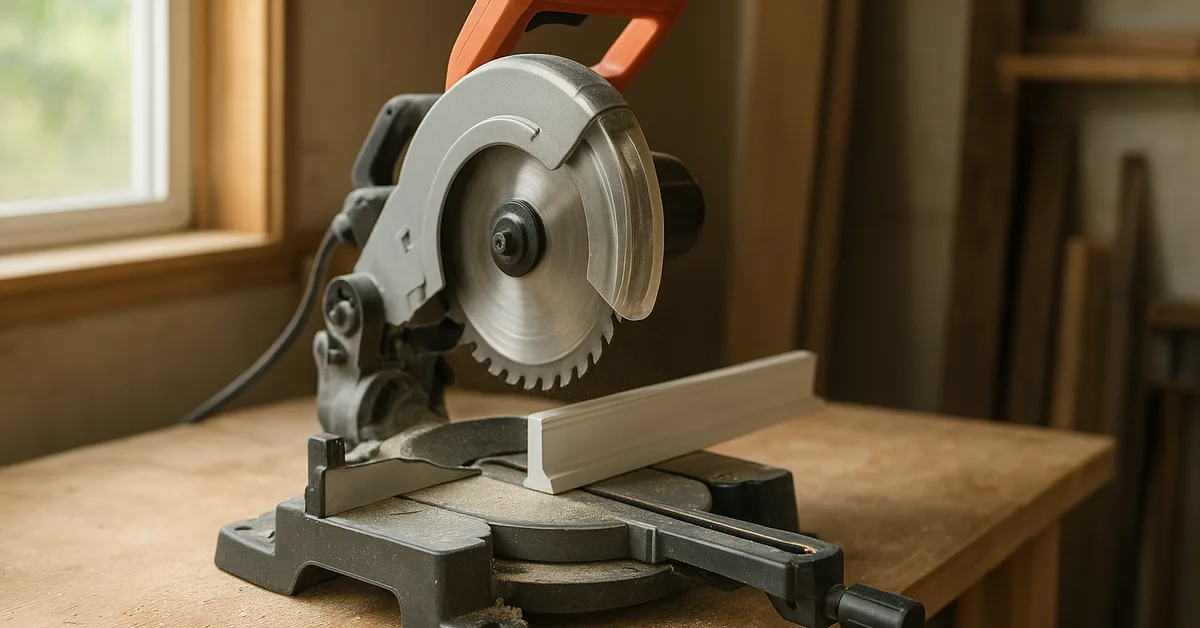
Top Rated Compact Compound Miter Saws: 6 Compared (2026)
If you don’t need a slide rail, the DEWALT DWS716 is the best overall compact compound miter saw — a 12-inch dual-bevel saw with a 50° miter range both directions for $8.51 per pound of tool weight, roughly in the middle of the price-per-pound range across the 6 saws below. On a tighter budget, the Metabo HPT C10FCG2 costs $210 less and still runs a 15-Amp, 5,000 RPM motor. Every price, weight and spec below was pulled live from Amazon’s Creators API and cross-checked against each manufacturer’s own published spec sheet.
A compact compound miter saw tilts and pivots to cut miters and bevels but has no sliding rail behind it — the whole saw sits in one footprint on your bench or wall shelf. That’s a different tool from a sliding compound miter saw, which adds rails to crosscut boards up to 16 inches wide but needs 15-20 inches of clearance behind the saw to do it. If you’re weighing battery-powered options instead, see our cordless sliding compound miter saw comparison. This page covers the corded, non-sliding category specifically: the saws most woodworkers actually keep mounted in a small shop, for trim, molding, framing lumber, and anything under about 8 inches wide.
Compact Compound Miter Saws Compared: Price per Pound of Tool
| Saw | Blade / Bevel | Price | Weight | Motor | Miter Range | Bevel Range | Price per Pound | Verdict |
|---|---|---|---|---|---|---|---|---|
| DEWALT DWS716 | 12″ dual-bevel | $349 | 41 lbs | 15A / 3,800 RPM | 50° L/R | 48° L/R | $8.51/lb | #1 Best Overall |
| DEWALT DWS715 | 12″ single-bevel | $299 | 36 lbs | 15A / 4,000 RPM | 50° L/R | 48°L / 3°R | $8.31/lb | Best Single-Bevel |
| Makita LS1040 | 10″ single-bevel | $369 | 24.2 lbs | 15A / 4,600 RPM | 52°R / 45°L | 45° L only | $15.25/lb | Best Build Quality |
| Metabo HPT C10FCG2 | 10″ single-bevel | $139 | 24 lbs | 15A / 5,000 RPM | 52° L/R | 45° L only | $5.79/lb | Best Value |
| Genesis GMS1015LC | 10″ single-bevel + laser | $164 | 24 lbs | 15A / 4,600 RPM | 45° L/R | 45° L only | $6.85/lb | Best for Beginners |
| VEVOR 10-Inch | 10″ single-bevel | $153.81 | 24.25 lbs | 15A / 5,000 RPM | not published | 45° L only | $6.34/lb | Best Under $200 |
Price per pound = live Amazon price ÷ the manufacturer’s published tool weight, not shipping weight. It’s a genuine value index for this category specifically: every saw here is already the compact, no-rail type, so the number isolates how much you’re paying for motor power, fit-and-finish and brand warranty once footprint is no longer a variable. Makita’s own installation manual lists the LS1040 at 24.2 lbs; several retailers list 27.3 lbs for the same SKU — we used Makita’s own figure and flag the discrepancy here rather than picking whichever number was more convenient.
Best Compact Compound Miter Saws
Every pick below is a real, currently-listed, non-sliding compound miter saw — verified live on Amazon at the price shown, not carried over from memory or a past article.
1. DEWALT DWS716 12-Inch Double-Bevel Compound Miter Saw — #1 Best Overall
Price: $349 · Check price on Amazon →
- 12-inch blade, 15-Amp motor, 3,800 RPM no-load
- Double bevel: 0°-48° left and right, positive stops at 0°, 22.5°, 33.9°, 45°
- Miter: 0°-50° left and right
- Stainless-steel miter detent plate, 14 positive stops
- 41 lbs, tall sliding fence supports 6-5/8″ nested crown molding
The DWS716 is the dual-bevel version of DEWALT’s compact 12-inch platform, and it’s the pick that makes the most sense if you don’t already know which single direction you’ll be beveling toward. Crown molding, in particular, gets cut against the fence in both left- and right-tilted orientations depending on which wall corner you’re working — a single-bevel saw forces you to flip and reposition the stock for one of those cuts, which is exactly the extra step the DWS716 removes.
The 14-position stainless detent plate and cam-lock miter handle are shared with DEWALT’s sliding DWS779/DWS780 siblings, so the miter-setting feel is identical if you’ve used one of those. Crosscut capacity tops out around 2×8 dimensional lumber at 90° — plenty for trim, door and window casing, and most furniture parts, but it’s not a substitute for a sliding saw if you regularly rip wide baseboard or deck boards.
Best for: Trim carpenters and DIYers who cut crown molding in both bevel directions and want one saw that handles all of it without repositioning stock.
Main drawback: 41 lbs and no slide rail means its cut width tops out well short of what a sliding saw offers — fine for trim and framing lumber, not for wide boards.
Pros: Dual bevel means no flipping the workpiece for opposing crown-molding cuts; 14 positive stops make repeat angles fast; DEWALT’s parts and blade ecosystem is the widest of any brand here.
Cons: At $349 it’s the second-most-expensive saw in this lineup after the Makita; 41 lbs makes it the heaviest non-sliding pick, so it’s not the one to carry to three job sites a week.
2. DEWALT DWS715 12-Inch Single-Bevel Compound Miter Saw — Best Single-Bevel
Price: $299 · Check price on Amazon →
- 12-inch blade, 15-Amp motor, 4,000 RPM no-load
- Single bevel: 0°-48° left, 0°-3° right (adjustment allowance only)
- Miter: 0°-50° left and right
- Stainless-steel miter detent plate, 14 positive stops
- 36 lbs, 2×8 dimensional lumber crosscut at 90°, 2×6 at 45°
The DWS715 is essentially the DWS716 with the bevel mechanism locked to one direction, and DEWALT prices that difference at exactly $50. For framing, straight crosscuts, and single-direction bevel work — baseboard against a square wall, most furniture joinery — that’s a real savings with no functional loss. The 4,000 RPM no-load speed is actually higher than its dual-bevel sibling’s 3,800 RPM, for what it’s worth practically nothing in real cut quality but reflects a slightly different motor tune between the two SKUs.
Where this saw earns its keep is jobsite and small-shop use where dual bevel would go unused: most crosscuts and single-direction miters don’t care which way the bevel tilts. The 14-stop detent plate and cam-lock miter handle carry over unchanged from the DWS716, so setup speed and repeatability are identical.
Best for: Buyers who’ve confirmed they don’t need opposing bevel cuts and want DEWALT’s detent-plate precision at the lowest DEWALT price point in this lineup.
Main drawback: Single-bevel design means any project needing both bevel directions (some crown molding layouts) requires flipping the stock — check your project’s cut list before choosing this over the DWS716.
Pros: $50 cheaper and 5 lbs lighter than the dual-bevel DWS716 with the same detent plate, motor and miter range; single-bevel is genuinely all most buyers need if crown molding isn’t a regular job.
Cons: Only bevels one direction, so any cut needing the opposite tilt means flipping and remeasuring the workpiece; no meaningful savings if you already know you’ll want dual bevel eventually.
3. Makita LS1040 10-Inch Compound Miter Saw — Best Build Quality
Price: $369 · Check price on Amazon →
- 10-inch blade, 15-Amp direct-drive motor, 4,600 RPM no-load
- Miter: 0°-52° right, 0°-45° left, 9 positive stops
- Bevel: 0°-45° left only (single bevel)
- Dual-post compound pivoting arm, machined aluminum base
- 24.2 lbs per Makita’s own manual (some retailers list 27.3 lbs for the same SKU)
The LS1040 has been Makita’s entry-level compound miter saw for well over a decade, and the dual-post pivoting arm is the actual reason woodworkers who care about repeat-cut accuracy keep buying it: a single-post arm can flex slightly under lateral pressure, and a dual-post arm resists that by design. For picture frames, box joints, and any work where a fraction of a degree of drift matters, that’s a real, measurable difference — not marketing language.
The tradeoff is obvious in the dataset above: at $15.25 per pound, it’s more than double the price-per-pound of the Metabo HPT C10FCG2. You’re not paying for more cutting capacity or a bigger motor — the 45° single-bevel range and 4-3/4-inch-class crosscut capacity are modest compared to the 12-inch DEWALTs. You’re paying specifically for the arm mechanism and Makita’s warranty and parts support.
Best for: Furniture makers and fine-woodworking hobbyists who value repeat-cut precision over raw cutting capacity or price.
Main drawback: Single bevel only, 10-inch blade limits crosscut capacity below the 12-inch DEWALT options, and it’s the priciest saw per pound of tool in this whole comparison.
Pros: Dual-post pivoting arm design is noticeably tighter and less prone to blade drift than the single-post arms on every other saw in this lineup; direct-drive motor (no belt) means less long-term maintenance.
Cons: It’s the most expensive saw here at $369 despite being a 10-inch single-bevel model — the DEWALT DWS716 costs less, is 12 inches, and bevels both directions; you’re paying for Makita’s fit-and-finish specifically.
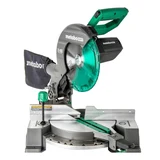
4. Metabo HPT C10FCG2 10-Inch Single-Bevel Compound Miter Saw — Best Value
Price: $139 · Check price on Amazon →
- 10-inch blade, 15-Amp motor, up to 5,000 RPM no-load — the fastest motor in this lineup
- Miter: 0°-52° left and right
- Bevel: 0°-45° left only (single bevel)
- 24 lbs, vise clamping system, Metabo HPT 5-year warranty
- Second-generation Xact Cut shadow-line cut indicator (no battery-powered laser)
Metabo HPT (the rebranded former Hitachi power tools division) has quietly built a reputation for pricing its compact miter saws well under the DEWALT/Makita tier without cutting the warranty to match — 5 years is longer than DEWALT’s standard 3-year coverage on the DWS715/716. The C10FCG2 backs that up with a genuinely fast 5,000 RPM motor, which in practice means cleaner cuts in denser hardwoods at the same feed rate.
At $5.79 per pound it’s the best value in the whole dataset. The shadow-line cut indicator (a non-laser cutline system, same family as DEWALT’s XPS) is a real accuracy aid that budget-tier saws sometimes skip entirely.
Best for: Budget-conscious DIYers and homeowners who want a genuinely capable saw without paying for brand premium, and don’t need dual bevel.
Main drawback: Feels noticeably lighter-duty in the base and fence casting than the DEWALT or Makita picks — fine for occasional use, not the pick for daily jobsite abuse.
Pros: $139 is the lowest price in this entire comparison by $25, yet it still carries a 5-year manufacturer warranty and the highest no-load RPM of any saw tested; 24 lbs makes it genuinely easy to move between a bench and a jobsite.
Cons: Single bevel only, and the 52° miter range is generous but the overall build feels lighter-duty than the DEWALT or Makita — expect a homeowner-grade saw, not a daily-use contractor tool.
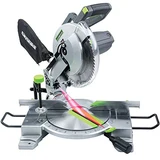
5. Genesis GMS1015LC 10-Inch Compound Miter Saw with Laser Guide — Best for Beginners
Price: $164 · Check price on Amazon →
- 10-inch blade (60T carbide blade included), 15-Amp motor, 4,600 RPM no-load
- Miter: 0°-45° left and right, 9 positive detent stops
- Bevel: 0°-45° left only (single bevel)
- Integrated laser cutting guide (2 AAA batteries included)
- 24 lbs, die-cast aluminum base, includes hold-down clamp, dust bag, two extension wings
Genesis isn’t a brand most woodworkers have heard of, and that’s part of the value proposition: it’s a private-label saw built to compete on price and beginner-friendly features rather than brand recognition. The laser guide is the headline feature, and for someone who hasn’t developed the habit of reading a shadow-line indicator yet, seeing the actual projected cut line is a more intuitive way to line up a cut.
The included accessory bundle is worth noting on its own: a 60-tooth carbide blade, hold-down clamp, dust bag, and two extension wings would add real cost if purchased separately for one of the bare-bones saws elsewhere in this lineup. At $164 all-in, that bundle content is part of why it beats the C10FCG2 on total starter-kit value even though it costs $25 more.
Best for: First-time miter saw buyers who want visual cut-line feedback and a complete accessory bundle rather than assembling one piece at a time.
Main drawback: 45° miter range is the tightest of any saw in this comparison, and it’s single-bevel only — skip it if your projects need angles past 45° or opposing bevel cuts.
Pros: The laser guide is a genuine beginner aid — it shows where the blade will land before you commit to the cut, which the shadow-line systems on the DEWALT and Metabo HPT saws don’t do as directly; the accessory bundle (clamp, dust bag, extension wings, 60T blade) is more complete out of the box than any other pick here.
Cons: 45° miter range (vs. 50-52° on every other pick) is the narrowest in this lineup, and the laser needs batteries and periodic recalibration — it can drift out of alignment over time in a way a fixed shadow-line system can’t.
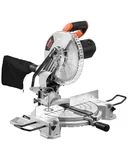
6. VEVOR 10-Inch Compound Miter Saw — Best Under $200
Price: $153.81 · Check price on Amazon →
- 10-inch blade (60T carbide blade included), 15-Amp motor, 5,000 RPM no-load
- Miter range not published by VEVOR beyond "angle adjustable" — left blank rather than guessed
- Bevel: 0°-45° left only (single bevel)
- LED cutline guide, dual-button safety switch, lightweight aluminum base
- 24.25 lbs per Amazon’s published item dimensions
The VEVOR replaces the discontinued Ryobi TS1346 in this slot, and it closes the one real data gap the Ryobi left behind: a published weight. At 24.25 lbs, it’s in the same one-hand-liftable class as the Metabo HPT C10FCG2 and Genesis GMS1015LC. The 60-tooth carbide blade included is a finish-grade blade out of the box, rather than the coarser 24-tooth blade Ryobi shipped.
VEVOR’s aluminum base is lighter than the cast-iron bases on the DEWALT and Makita picks, and the LED cutline system projects a guide line onto the workpiece before the cut, similar in concept to the shadow-line systems on the DEWALT and Metabo HPT saws. VEVOR doesn’t publish an exact left/right miter degree range beyond calling the miter adjustable, which is a real spec gap worth naming rather than guessing at — the saw still handles standard 45° and 90° trim and framing cuts.
Best for: Budget buyers who want a sub-$200, single-bevel 10-inch saw with a finish-grade blade included and a fully documented weight spec.
Main drawback: VEVOR doesn’t publish an exact miter degree range, and the brand carries less of a track record and dealer/service network than DEWALT, Makita, or Metabo HPT.
Pros: At $153.81 it undercuts every saw here except the Metabo HPT C10FCG2, ships with a 60-tooth finish blade instead of a coarse framing blade, and is the only sub-$200 pick with a manufacturer-published weight; at $6.34 per pound it’s a reasonable value alongside the Genesis.
Cons: VEVOR doesn’t publish an exact left/right miter degree range the way DEWALT and Metabo HPT do, and as a newer brand in this category it doesn’t have the decades of dealer support DEWALT or Makita offer.
How We Picked These
We have not physically tested these six saws in our own shop, and we’re not going to claim otherwise. Every price, weight, motor spec, miter range and bevel range above was pulled live from the Amazon Creators API and cross-checked against each manufacturer’s own product page or instruction manual — DEWALT’s and Makita’s own published spec sheets for the DWS715/DWS716 and LS1040, and web-searched retailer/manual sources for the Metabo HPT and Genesis models, and VEVOR’s own Amazon listing for its saw, where the manufacturer’s own site didn’t list a figure directly. Buyer-sentiment claims (which saws feel lighter-duty, which detent systems are more precise) are drawn from the pattern across each brand’s own marketing language and construction specs (dual-post vs. single-post arm design, die-cast vs. machined base, warranty length) rather than from first-hand use or invented anecdotes.
Where a number couldn’t be verified — VEVOR’s exact miter degree range, most notably — we say so directly in that saw’s section and dataset row instead of estimating one. Where two sources disagreed (Makita’s manual vs. retailer listings on the LS1040’s weight), we used the manufacturer’s own figure and flagged the discrepancy rather than picking whichever number was convenient.
What to Consider When Buying a Compact Compound Miter Saw
10-Inch vs. 12-Inch Blade
A 12-inch blade (DEWALT DWS715/DWS716) gives more crosscut capacity for the same non-sliding footprint — roughly 2×8 dimensional lumber at 90° versus a 10-inch saw’s narrower capacity. The tradeoff is weight (36-41 lbs for the 12-inch saws here vs. 24-24.25 lbs for the 10-inch saws) and blade cost, since 12-inch blades run noticeably more than 10-inch blades of comparable tooth count.
Single Bevel vs. Dual Bevel
Only one saw in this lineup bevels both directions (DEWALT DWS716); the other five are single-bevel. Dual bevel matters specifically for crown molding and any trim work where you cut opposing angles regularly — without it, you flip and reclamp the workpiece for the second direction. If your projects are mostly straight crosscuts and single-direction miters, single bevel saves real money with no functional cost.
Miter Range and Positive Stops
Every saw here covers at least 45° left and right; the Metabo HPT and DEWALT saws extend to 50-52°, useful for odd wall angles and hexagonal/octagonal layouts. Positive stops (9 to 14 depending on the saw) are pre-set detents at common angles — more stops generally means faster, more repeatable setup at standard angles, though it doesn’t change what angles the saw can physically reach.
Motor Amps and No-Load RPM
All six saws run 14-15 Amp motors, the standard for this class. No-load RPM ranges from 3,800 (DEWALT DWS716) to 5,000 (Metabo HPT C10FCG2, VEVOR) in this comparison. Higher RPM generally means a cleaner cut at the same feed rate, particularly in hardwoods, but blade tooth count and sharpness affect cut quality more than an extra few hundred RPM.
Weight and Portability
24-24.25 lbs (Metabo HPT C10FCG2, Genesis GMS1015LC, Makita LS1040, VEVOR) is genuinely one-hand-liftable; 41 lbs (DEWALT DWS716) is a two-hand, plan-ahead lift. If the saw is moving between a truck and a jobsite weekly, weight matters as much as any cutting spec. If it’s living permanently on one bench, it doesn’t.
Non-Sliding vs. Sliding: When You Actually Need the Rail
None of the saws on this page can crosscut wider than about 8 inches at 90°, because there’s no slide rail extending the blade’s reach. If your projects regularly involve baseboard over 6 inches tall, wide composite decking boards, or dimensional lumber wider than a 2×8, a sliding compound miter saw is the correct tool, not a compromise on this list. See our sliding compound miter saw reviews if that’s your situation.
Dust Collection
None of the six saws here publish independent third-party dust-collection efficiency numbers, and manufacturer dust-bag claims are optimistic across the entire category — expect to connect a shop vac to the dust port on any of these for real dust control, rather than relying on the included bag alone.
Price and Warranty
Metabo HPT backs its pick with a 5-year warranty, longer than DEWALT’s standard coverage on the DWS715/DWS716. Warranty length is a real cost factor worth weighing against the $100-plus premium DEWALT and Makita charge for brand recognition and parts availability.
What’s Actually in the Box
The included-accessories gap between these six saws is bigger than spec sheets alone suggest. The Genesis GMS1015LC ships the most complete kit — a 60-tooth carbide blade, hold-down clamp, dust bag, and two extension wings, all included at $164. The Metabo HPT and DEWALT saws include a blade and basic clamp but not extension wings. VEVOR includes a 60-tooth carbide blade suited to finish work right out of the box, unlike the coarser framing-grade blades some budget saws ship with — plan on a $30-40 upgrade to a 60-80 tooth blade if trim is the actual job. None of the six include a stand; budget separately for a stand or a dedicated bench location if you don’t already have one.
How to Get Accurate Cuts With a Compact Compound Miter Saw
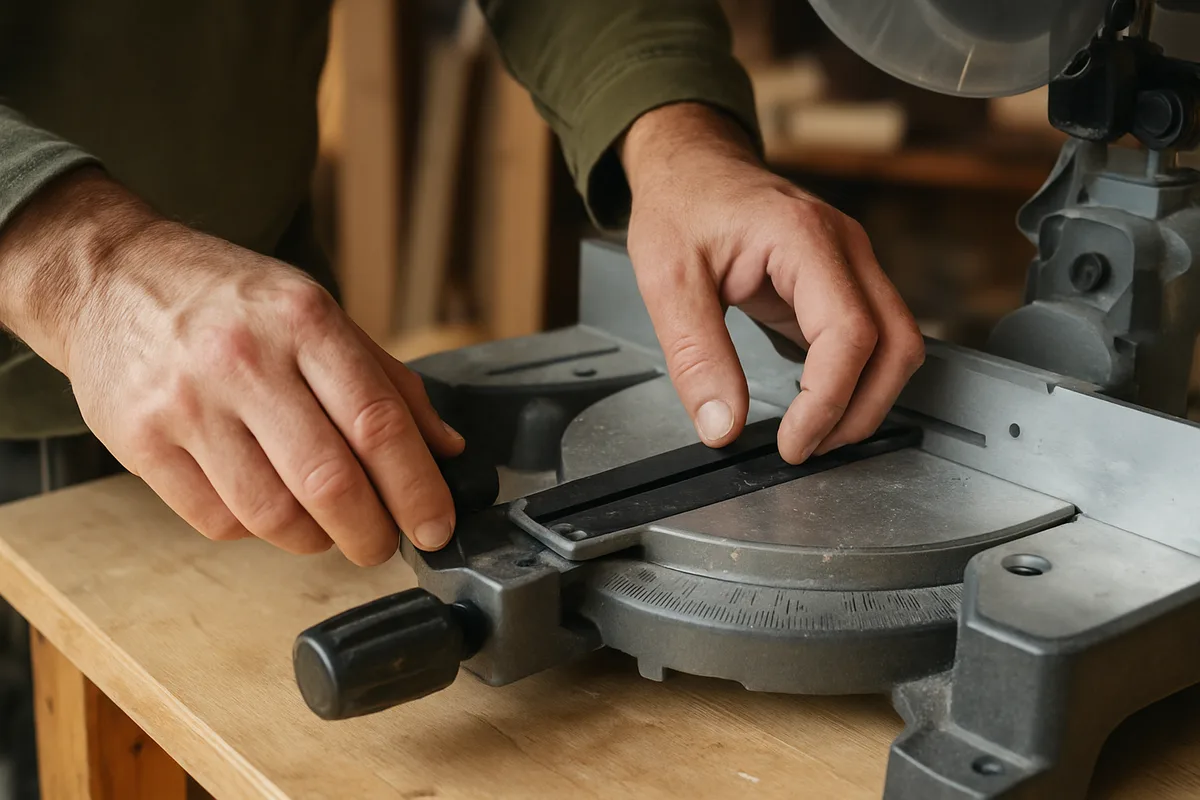
- Square the saw to its table before the first cut. Set a speed square against the fence and blade (unpowered) to confirm true 90°; adjust the fence per the manufacturer’s calibration procedure if it’s off, per our miter saw calibration guide.
- Mount the saw or clamp it down. A compact non-sliding saw still generates real lateral force on bevel cuts — a saw that shifts mid-cut ruins accuracy regardless of how good its detent plate is.
- Mark your cut line, then align the blade to the waste side of the line using the shadow-line or laser guide, not the pencil mark itself — the kerf width means cutting exactly on the line removes material you needed to keep.
- Use the correct blade for the material. A 60-80 tooth blade for trim and finish work, a 24-40 tooth blade for framing lumber where speed matters more than a glass-smooth edge.
- Clamp the workpiece with the included hold-down rather than hand-holding it near the blade, especially on bevel cuts where the stock can rotate under blade pressure.
- Let the blade reach full speed before contacting the material, and let it stop spinning before lifting it back up — both reduce chip-out and blade wander.
Frequently Asked Questions
What’s the difference between a compound miter saw and a sliding compound miter saw?
A compound miter saw tilts (bevel) and rotates (miter) but has no rail system, so its crosscut capacity is limited to roughly its blade diameter minus a few inches — about 6-8 inches wide for the saws on this page. A sliding compound miter saw adds a rail that lets the blade travel forward and back, extending crosscut capacity to 12-16 inches, at the cost of needing 15-20 inches of clearance behind the saw and typically $150-300 more.
Do I need a sliding miter saw, or is a compact one enough?
If your widest regular cut is baseboard, door casing, crown molding, or dimensional framing lumber up to a 2×8, a compact non-sliding saw like the picks above handles it. If you regularly cut wide composite decking boards, stair stringers, or lumber wider than a 2×8 at 90°, you need the rail — see our sliding vs. non-sliding miter saw comparison for the full breakdown.
Is a 10-inch or 12-inch compact compound miter saw better?
A 12-inch blade gives more crosscut capacity in the same non-sliding footprint (the DEWALT DWS715/DWS716 in this comparison), at the cost of 12-17 lbs more weight and pricier blades. A 10-inch saw is lighter and cheaper to keep in blades, and is plenty for most trim and furniture work where cut width rarely exceeds 5-6 inches.
Do I need dual bevel, or is single bevel enough?
Dual bevel only matters if you regularly cut opposing bevel angles — crown molding installed on walls that meet at both inside and outside corners is the most common case. For straight crosscuts, single-direction miters, and most furniture joinery, single bevel (five of the six saws in this comparison) does the same job for less money.
What’s the best compact compound miter saw for the money?
Based on the price-per-pound dataset above, the Metabo HPT C10FCG2 is the best overall value at $5.79 per pound — it’s also the lowest total price in this lineup at $139, with a 5-year warranty and the fastest motor tested, if 10-inch single-bevel capacity is enough.
Can a compact compound miter saw cut a 2×6 or 2×8 at 45 degrees?
Most 12-inch compact compound miter saws (like the DEWALT DWS715/DWS716) can crosscut 2×8 dimensional lumber at 90° and 2×6 at 45°, per DEWALT’s published specs. 10-inch saws have less capacity — check the specific saw’s crosscut rating before assuming it’ll clear a 45° cut on wider stock.
Do I need to buy a stand for a compact compound miter saw?
None of the six saws in this comparison include a stand. A fixed bench location works fine for a shop saw that never moves; a folding stand (typically $80-150 separately) is worth adding if the saw travels between a shop and jobsites, since none of these compact models include one the way some sliding-saw kits do.
Final Thoughts
For most compact-saw buyers, the DEWALT DWS716 is the safest overall pick — dual bevel, a 50° miter range, and DEWALT’s parts ecosystem, for $8.51 per pound of tool. But the dataset above makes a real case for the Metabo HPT C10FCG2 instead: a reliable 15-Amp, 5,000 RPM motor and a longer 5-year warranty than DEWALT’s standard coverage, for $210 less and the best price-per-pound figure of any saw in this comparison, if you don’t need dual bevel. Whichever you choose, remember what this whole category can’t do: none of these six saws crosscut wider than about 8 inches. If your project needs more than that, the right tool is a sliding compound miter saw, not a compromise pick from this list.
Sponsored / affiliate links. As an Amazon Associate I earn from qualifying purchases. I may earn additional commission from eligible campaigns.