Best Sliding Compound Miter Saw Reviews: 5 Corded Picks (2026)
The DeWalt DWS779 is the best corded sliding compound miter saw for most people: it cuts a 2×14 at 90 degrees for $399, but DeWalt now lists it as discontinued, so its $649 DWS780 sibling is the current model. This page compares five corded sliding saws on published capacity, price per inch of cut, and footprint. For battery models see our cordless sliding miter saw comparison.
Best Sliding Compound Miter Saw Overall: DeWalt DWS779
Best Corded Sliding Saw Pick
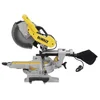 |
DeWalt DWS779 12-Inch Sliding Compound Miter Saw, $399 The same 2×14 crosscut and 2×10 at 45 degrees as DeWalt’s newer DWS780 for $250 less, which makes it the cheapest way into a full 12-inch sliding saw on this page.
|
As an Amazon Associate we earn from qualifying purchases.
The DWS779 uses a 15-amp, 3,800 RPM motor, and DeWalt lists its capacity as a 2×14 at 90 degrees and a 2×10 at 45 degrees, with 7-1/2 inches of nested crown and 6-3/4 inches of base molding standing vertically against the fence. Its stainless detent plate has 10 positive miter stops, and the Amazon listing gives a 60 degree right and 50 degree left miter range. The newer DWS780 lists the same capacities, so the extra $250 buys the XPS LED cut line and a model DeWalt still sells, not more board width.
One disclosure matters more than any spec. DeWalt’s own DWS779 page was marked discontinued when we checked it in October 2026, while the DWS780 page was active. A discontinued saw still works, but parts and replacement guards are easier to source for the current model, so if the price gap does not bother you, the DWS780 is the safer long-term buy.
No saw on this page was bought or tested by us. Every figure below comes from manufacturer spec pages and Amazon listings pulled on October 7, 2026, and the price-per-inch columns are our own arithmetic on those figures.
Corded Sliding Compound Miter Saws Compared
| Saw | Amazon price (Oct 7, 2026) | Blade | Crosscut at 90 degrees | Crosscut at 45 degrees | Amazon stock status |
|---|---|---|---|---|---|
| DeWalt DWS779 | $399 | 12 in | 2×14 board | 2×10 board | In stock |
| DeWalt DWS780 | $649 | 12 in | 2×14 board | 2×10 board | In stock |
| Makita LS1019L | $739 | 10 in | 12 in | 8-1/2 in | Low stock (15 left) |
| Bosch CM10GD | $629 | 10 in | 12 in | Not published in listing | Ship date only, none in stock |
| Skil MS6305-00 | $249 | 10 in | 2×12 board | 2×8 board | In stock, limit 3 |
Prices and stock have moved since the last version of this page. The DWS780, for example, now lists at $649, and Bosch’s CM10GD showed only a future availability date instead of units on hand, so we cannot point you to it today.
DeWalt DWS780: the current-model DeWalt
Same 2×14 and 2×10 capacities as the DWS779, plus DeWalt’s XPS LED shadow line that projects the blade edge onto the board. DeWalt lists it with a 3-year limited warranty, 1 year of free service and a 90-day satisfaction guarantee. Drawback: you pay about 63 percent more than the DWS779 for a cut line, not for extra capacity.
Makita LS1019L: the wall-flush saw
Makita publishes a 12 inch crosscut at 90 degrees, 8-1/2 inches at 45, 6-5/8 inches of nested crown and 5-1/4 inches of vertical base, with a 3,200 RPM motor and a 57.9 lb weight. Its two-rail design is described as running flush against a wall. It is also the most expensive saw here, and Amazon showed only 15 left, so check stock before planning around it. Our full Makita LS1019L review goes deeper on it.
Bosch CM10GD: no rails, but not buyable today
Bosch’s glide arm replaces exposed rails, and the Amazon listing says it cuts the front-to-back footprint by up to 10 inches compared with slide saws of similar capacity. It lists a 12 inch horizontal cut, 5-1/2 inches of vertical base, 6 inches of crown nested, a 4,800 RPM motor and 47 degree bevels each way. It suits a shallow bench, but as of this check there was no unit in stock on Amazon.
Skil MS6305-00: the budget sliding saw
At $249 it is the cheapest saw here and the only one that is both in stock and under $300. It lists a 2×12 crosscut at 90 degrees and a 2×8 at 45, a 4,800 RPM motor, an LED shadow line and 11 positive stops. Drawback: a 2×12 is 11-1/4 inches wide, so it has the smallest crosscut on the page and cannot take a 2×14 or a wide stair tread in one pass.
What Does Each Saw Really Cost per Inch of Cut?
Nobody prints this, and it changes the ranking. Dividing today’s Amazon price by the widest board each saw can cut in one pass gives a fairer price comparison than blade diameter does. We used actual board widths (a 2×12 is 11-1/4 inches, a 2×14 is 13-1/4 inches) rather than nominal sizes.
| Saw | Price | Widest 90 degree cut | Price per inch at 90 degrees | Widest 45 degree cut | Price per inch at 45 degrees |
|---|---|---|---|---|---|
| Skil MS6305-00 | $249 | 11-1/4 in | $22.13 | 7-1/4 in (2×8) | $34.34 |
| DeWalt DWS779 | $399 | 13-1/4 in | $30.11 | 9-1/4 in (2×10) | $43.14 |
| DeWalt DWS780 | $649 | 13-1/4 in | $48.98 | 9-1/4 in (2×10) | $70.16 |
| Bosch CM10GD | $629 | 12 in | $52.42 | Not published | n/a |
| Makita LS1019L | $739 | 12 in | $61.58 | 8-1/2 in | $86.94 |
Price order and value order split apart at the top. The DWS779 works out to about $30 per inch, the DWS780 to about $49, and the Makita to about $62 for 12 inches. That does not make the Makita a bad saw, since you are paying for rail design and not width, but it does mean capacity alone never justifies the premium.
Blade size does not equal capacity
A common assumption is that a 12-inch blade cuts a 12-inch board. The table shows otherwise: the 10-inch Makita and Bosch both list a 12 inch crosscut, not far behind the 12-inch DeWalts, because the sliding rails or glide arm decide how far the blade travels. Blade diameter mainly sets how thick a board you can cut and what a replacement blade costs.
The 45 degree rule of thumb
A miter cut lengthens the blade’s path through the board by a factor of 1 divided by the cosine of the angle, which is about 1.41 at 45 degrees. So a saw’s 45 degree capacity should land near 70.7 percent of its 90 degree capacity. The numbers check out: 13-1/4 inches times 0.707 is 9.4 (DeWalt lists a 2×10, which is 9-1/4), and 12 inches times 0.707 is 8.5 (Makita lists 8-1/2). Use the same math to sanity-check any saw before you buy, and pair it with our miter saw angle chart when planning compound cuts.
Which saw cuts which board in one pass
| Board (actual width) | DWS779 / DWS780 | Makita LS1019L | Skil MS6305-00 |
|---|---|---|---|
| 2×8 at 90 degrees (7-1/4 in) | Yes | Yes | Yes |
| 2×10 at 90 degrees (9-1/4 in) | Yes | Yes | Yes |
| 2×12 at 90 degrees (11-1/4 in) | Yes | Yes | Yes (just) |
| 2×14 at 90 degrees (13-1/4 in) | Yes (listed 2×14) | No (12 in) | No (11-1/4 in) |
| 2×10 at 45 degrees (9-1/4 in) | Yes (listed 2×10) | No (8-1/2 in) | No (2×8 listed) |
| 2×8 at 45 degrees (7-1/4 in) | Yes | Yes | Yes (listed 2×8) |
What to Check Before You Buy a Sliding Miter Saw
Rear and wall clearance
Rail saws need open space behind them for the rails to extend, while Makita and Bosch designs are marketed as needing less. Exact rear-clearance numbers are not on the manufacturer pages we read, so measure your bench depth against the dimensions in the saw’s manual instead of trusting a forum number.
Crown and baseboard height
If most of your work is trim, compare the vertical numbers and not just crosscut width. The DWS779 and DWS780 list 7-1/2 inches of nested crown and 6-3/4 inches of base against the fence, while Makita lists 6-5/8 and 5-1/4 and Bosch lists 6 and 5-1/2. For crown cuts from a plan, see our crown molding calculator.
Power draw and dust
All five saws list 15-amp motors, which can trip a shared 15-amp household circuit if a vacuum or shop light is on the same breaker. See how many watts a miter saw uses for the numbers. DeWalt says its dust system captures over 75 percent of dust, which is a manufacturer figure for a bag and not a measured room result, so connect a vacuum if you work indoors, as covered in our home dust collector guide.
Blade swaps and safe setup
Unplug the saw before changing the blade, clamp the stock, keep both hands outside the blade path, and let the blade stop before lifting the head. If you are weighing a smaller saw instead, our compact compound miter saw comparison covers non-sliding models, and how a miter saw works explains the basic cut.
Sliding Compound Miter Saw FAQ
What is the best sliding compound miter saw for the money?
The DeWalt DWS779 at $399, because it lists the widest crosscut per dollar among the 12-inch saws here: a 2×14 at 90 degrees. The Skil MS6305-00 at $249 is cheaper per inch but tops out at a 2×12. DeWalt lists the DWS779 as discontinued, so the DWS780 is the current model.
Is a 10-inch or 12-inch sliding miter saw better?
Neither is automatically better. A 12-inch blade can cut thicker stock, while the Makita and Bosch 10-inch saws list a 12 inch crosscut, close to the 12-inch DeWalts. Pick on listed crosscut width and the vertical crown capacity you need, not on blade size alone.
How wide a board can a sliding miter saw cut?
Among these five, the widest listed crosscut is a 2×14 at 90 degrees on the DeWalt DWS779 and DWS780, about 13-1/4 inches. At 45 degrees capacity drops to roughly 70 percent of that, which is why DeWalt lists a 2×10.
Do sliding miter saws need space behind them?
Rail-style saws do, because the rails slide backward through the cut. Makita and Bosch market their designs as needing less. The manufacturer pages we read did not give exact clearance numbers, so measure your bench against the saw’s manual.
Should I buy a corded or cordless sliding miter saw?
Corded saws list 15-amp motors with no battery limit and usually cost less. Cordless saws trade price for portability. For battery models, see our cordless sliding miter saw comparison.
Final Thoughts
For most workshops, the DWS779 is still the value pick while Amazon has stock, the DWS780 is the safer current-model choice, and the Skil is the sensible budget saw if you never cut anything wider than a 2×12. Choose the Makita only if wall-flush rails are worth roughly double the price per inch, and wait for Bosch stock before planning around the CM10GD.
Sponsored / affiliate links. As an Amazon Associate I earn from qualifying purchases. I may earn additional commission from eligible campaigns.