5 Best Routers for Dovetail Joints (2026): research shows
For dovetail joints, choose a plunge router with precise depth control: 1/2-inch collet and stout motor for sliding dovetails or large bits; 1/4-inch or 8mm collet can work for jig-cut half-blinds if the bit is short and rigid. A poor match causes tear-out, chatter, ruined pins, and burned or sloppy fit. This guide compares router setups for through dovetails, half-blind dovetails, sliding dovetails, and dovetail jigs by failure risk, plunge depth, and bit stiffness.
This guide is part of our Woodworking joinery and cutting techniques series.
Quick picks
- Top pick: a variable-speed plunge router with a 1/2-inch collet for the widest range of dovetail work, especially sliding dovetails and deeper cuts.
- Best value: a fixed-base router for dovetail jig work and repeat cuts where plunge action is not required.
- Best compact option: a trim router only for light, narrow, shallow dovetail work with short bits and careful setup.
What is the best router for dovetail joints?

The best router for dovetail joints is usually a variable-speed plunge router with a 1/2-inch collet, because it handles through dovetails, half-blind dovetails, and sliding dovetails with the fewest compromises. Plunge travel gives you stopped-cut control, the larger collet holds a stiffer bit, and speed control helps keep hardwood cuts cleaner.
That choice fits the widest range of dovetail work because each joint type asks something different from the router. Through dovetails need repeatable setup. Half-blinds need exact depth. Sliding dovetails need a clean stopped cut and enough bit rigidity to resist chatter and deflection.
Quick picks for different dovetail jobs
- Through dovetails: fixed-base or plunge router with a dovetail jig, depending on the template system.
- Half-blind dovetails: plunge router with a jig, especially if the cut is stopped and depth-sensitive.
- Sliding dovetails: plunge router with strong plunge travel, a stable base, and a larger collet.
Quick comparison
| Product | Badge | Best for | Price | ||
|---|---|---|---|---|---|
 |
Makita RT0701CR 1-1/4 HP Compact Router (Renewed)Makita | Our pick | 1-1/4 HP Compact Plunge Router | $119.99
Price as of 10 Oct 2026
|
View |
 |
Threlaco 2 Pcs Router Collet Kit Replacement 1/4" and 1/2"Threlaco | Also great | 2 Pcs Router Collet Kit | $18.99
Price as of 10 Oct 2026
|
View |
 |
Makita RP2301FC 3-1/4 HP* Plunge Router, with Variable SpeedMakita | Also great | 3-1/4 HP Plunge Router | View | |
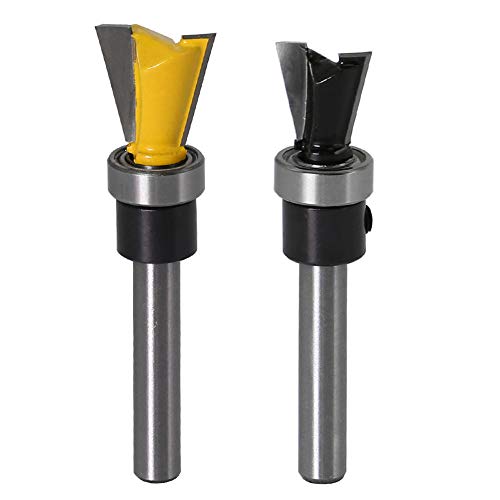 |
Yakamoz 2Pcs 1/4 Inch Shank Dovetail Joint Router Bits withYAKAMOZ | Pair with it | 2Pcs 1/4" Dovetail Bits with Bearings | $9.99
Price as of 10 Oct 2026
|
View |
 |
POWERTEC 12 Inch Dovetail Jig with Templates, Router Bits,POWERTEC | Upgrade pick | 12" Dovetail Jig with Templates | $229.99
Price as of 10 Oct 2026
|
View |
Through dovetails and jig work can be done with less router capacity than sliding dovetails, but the bit and template still have to match. If you plan to cut more than one dovetail type, start with plunge capability and a 1/2-inch collet.
How we chose
We compared routers by plunge depth, collet size, speed control, motor strength, and depth adjustment quality. Those features directly affect tear-out, chatter, fit, and whether the bit can stay rigid under load.
We also weighed jig compatibility, because a router that fits the wrong guide bushing system wastes accuracy. Finally, we separated routers by joint type, since through, half-blind, and sliding dovetails do not stress the tool in the same way.
Plunge router: best for sliding and stopped cuts
A plunge router is the better choice when the cut must start above the work and enter at a controlled depth. That matters for sliding dovetails and many half-blind setups, where plunge depth control, base stability, and repeatable stops directly affect joint fit.
Plunge travel lets you set the bit depth before cutting into the stock, then lock it in place. That reduces the chance of overshooting the shoulder line and helps you fine-tune fit in small steps rather than guessing at depth.
Why plunge travel matters
Look for enough plunge travel to clear the workpiece thickness plus the bit exposure you need. Short travel limits setup flexibility and can make stopped cuts awkward, especially when the dovetail is deep or when the jig template sits high above the work.
Fixed-base router: best for dovetail jigs and repeatability
A fixed-base router is often the simpler choice for jig routing and table use, because the base is stable, the depth setting stays put, and the tool is usually lighter and less complex. For repeat cuts on a dovetail jig, that repeatability is valuable.
The tradeoff is flexibility. A fixed-base router is less convenient for plunge cuts, so it is a weaker fit for sliding dovetails and other stopped work. If your joinery stays inside a jig template and the cut depth rarely changes, fixed base is enough.
When fixed base makes sense
Choose fixed base if most of your dovetail work is through dovetails on a compatible jig, or if the router will live in a table for consistent setups. That path is simpler, but it gives up the depth-control advantage of a plunge router.
How does bit size and collet choice affect dovetails?
Bit size and collet choice affect how much the bit flexes under load. A 1/2-inch collet holds larger shanks more rigidly than a 1/4-inch collet, which helps reduce chatter, deflection, and burned cuts in hardwood. Shorter, stiffer bits usually cut cleaner.
Dovetail router bits also differ by included angle, cut diameter, and whether they use a pilot bearing. Bearing-guided bits ride on a template or edge, while non-bearing bits are common with jigs and guide bushings. The wrong bit style can wreck the fit fast.
1/4-inch collet vs 1/2-inch collet
A 1/4-inch shank can work for light dovetail jig work, especially with smaller cutters and shallow passes. A 1/2-inch shank is better when the bit is larger, the cut is deeper, or the stock is hardwood, because the thicker shank resists vibration and flex.
Most manufacturers list both 1/4-inch and 1/2-inch collets on larger routers, and that flexibility matters. The router body does not make the cut by itself; the bit stiffness and setup are what keep the joint accurate.
How do you match a router to a dovetail jig?
You match the router to the jig by checking guide bushing requirements, template spacing, and offset math before you cut. The jig sets the joint spacing, but the router has to accept the correct bushing and bit combination or the template locations will not transfer accurately.
If the bushing diameter does not match the jig’s intended offset, the tails and pins will not register correctly. That usually shows up as gaps, loose fit, or a joint that binds before it seats. Template compatibility is not optional.
Guide bushing basics
Many dovetail jigs are designed around a specific guide bushing size, often used with a collar mounted to the router base. Measure the bit-to-bushing relationship carefully. Even a small offset error changes the cut geometry enough to affect fit.
- Confirm the jig’s required guide bushing diameter.
- Check that the router base accepts that bushing system.
- Verify the dovetail bit’s shank size and cutting diameter.
- Set the jig spacing according to the template, then test on scrap.
Decision table: pick the right router for each dovetail joint
| Joint type | Router type | Plunge range needed | Minimum collet size | Recommended bit shank | Common failure modes to avoid |
|---|---|---|---|---|---|
| Through dovetail | Fixed-base or plunge router with jig | Moderate; enough for setup and template clearance | 1/4-inch is workable; 1/2-inch preferred for larger bits | 1/4-inch for small cutters, 1/2-inch for deeper or wider cutters | Sloppy fit, burning, template mismatch |
| Half-blind dovetail | Plunge router | Enough to start above the work and stop at exact depth | 1/4-inch minimum; 1/2-inch better for rigidity | 1/4-inch or 8mm for shorter bits | Tear-out at the socket face, overcut shoulders, chatter |
| Sliding dovetail | Plunge router | Higher plunge control for stopped entry and full-length runs | 1/2-inch preferred | 1/2-inch, especially for longer or wider cutters | Bit flex, burning, wandering cut, rough sliding fit |
Use that table as a failure-risk check, not a brand list. The better router is the one that matches your joint type, bit stiffness, and jig system with the fewest weak points.
Makita RP2301FC 3-1/4 HP plunge router: best for the widest dovetail range
This is the strongest fit for woodworkers who need one router for multiple dovetail types, especially sliding dovetails and deeper cuts. Based on the spec sheet and owner feedback, the 15-amp motor, variable speed, and electric brake make it a practical full-size plunge choice when hardwood load and bit size matter.
What stands out is the combination of power and control. Electronic speed control helps hold RPM under load, which matters when a larger dovetail bit enters hardwood and wants to burn or chatter.
The drawback is size and weight. It is more router than a small jig-only setup needs, and that can feel unnecessary if you only cut shallow half-blinds on a bench jig.
Makita RT0701CR 1-1/4 HP compact router: best for light dovetail work
This compact router suits light-duty dovetail tasks where space and control matter more than raw power. The variable speed range from 10,000 to 30,000 RPM and slim body make it a reasonable choice for small half-blind work with short bits, provided the cut is not deep or demanding.
Its strength is maneuverability. That helps when setup space is tight or when the cut is shallow and the router only needs to guide a small cutter cleanly.
The limitation is clear: a compact router is not the best match for heavy hardwood cuts, larger shanks, or long sliding dovetails. It can work, but the margin for flex and overheating is smaller.
Threlaco 1/4-inch and 1/2-inch collet kit: best for collet compatibility
This is for users who already own a compatible router and need both common collet sizes on hand. The steel construction, claimed thickened design, and 1/4-inch plus 1/2-inch coverage are useful when you switch between small jig bits and stiffer larger bits.
The main advantage is flexibility. A router that accepts the right collet can run a much wider range of dovetail bits without forcing a compromise on shank size.
The drawback is obvious: a collet kit does not solve plunge depth, motor strength, or jig compatibility by itself. It only helps if it fits the router model exactly.
Yakamoz 1/4-inch shank dovetail bits: best for small jig setups
These bits fit compact routers and lighter jig work where a 1/4-inch shank is enough for the cut. The included bearing-guided design and the two-bit set make sense for simple furniture and cabinet tasks that do not require a large cutter or deep plunge.
The upside is cost and convenience. A short, carbide-fluted bit can be adequate for through or half-blind work when the stock is not too hard and the jig setup is well matched.
The drawback is rigidity. A 1/4-inch shank is more prone to deflection than a 1/2-inch shank, so chatter and burn marks become more likely as bit diameter and cut depth increase.
POWERTEC 12-inch dovetail jig: best for repeatable template work
This jig is aimed at repeatable half-blind and through dovetails, and its template system is the point. The 12-inch capacity, quick-clamp setup, and included templates suit users who want the jig to handle spacing while the router follows the guide path.
What stands out is how much the jig simplifies joint layout. Once the template and bushing are matched, repeatability improves and setup time drops.
The drawback is that the jig does not replace router selection. If the router cannot accept the needed guide bushing or cannot run the bit cleanly, the jig will not fix the cut.
Which one should you buy

Buy a full-size plunge router if you cut multiple dovetail types, especially sliding dovetails or deeper hardwood joints. That is the safest general choice because it covers the widest range of plunge depth, bit size, and template work.
Buy a fixed-base router if you mainly use a dovetail jig for repeat cuts and do not need stopped cuts often. It is simpler, usually lighter, and often easier to keep set for one task.
Buy a trim router only for light, narrow, shallow work with short bits. It can handle some half-blind or small template work, but it is not the right answer for every dovetail cut.
Say your project is a set of small maple drawers with half-blind dovetails. A compact router may work if the bit is short and the jig fits correctly, but a plunge router gives more depth control and less risk of a bad socket cut.
Suppose you are cutting a sliding dovetail in oak for a shelf support. That is a plunge-router job, ideally with a 1/2-inch collet, a stiff bit, and variable speed set lower to reduce burning.
Common failure modes to avoid
- Burning: often caused by too much RPM, dull edges, or slow feed in hardwood.
- Chatter: usually means the bit is too long, too small, or too flexible for the cut.
- Tear-out: more likely at the exit edge or on the socket face in half-blind work.
- Sloppy fit: often comes from wrong offset, wrong bushing, or depth drift.
Why do my dovetail joints keep gapping?
Gapping usually comes from an offset mistake, the wrong guide bushing, or depth that is off by a small amount. It can also come from bit flex, burned surfaces that prevent full seating, or a template that does not match the bit geometry.
Check the router setup before blaming the jig. A dull cutter, an oversized feed rate, or a 1/4-inch shank bit doing work that really needs a 1/2-inch shank can all leave joints loose on one side and tight on the other.
Frequently asked questions
Do I need a plunge router for dovetails?
You need a plunge router for sliding dovetails and many half-blind cuts, because the bit must enter the work in a controlled way. For basic jig-cut through dovetails, a fixed-base router can be enough if the jig and guide bushing system match correctly.
What router bit size do I need for dovetail joints?
There is no single size that fits every joint. Choose the bit diameter and shank size to match the jig, the template opening, and the stock thickness, then favor a short, rigid bit for cleaner cuts. Larger bits generally work better in a 1/2-inch collet.
Can a trim router cut dovetails?
A trim router can cut some small, shallow dovetails, especially with a short 1/4-inch shank bit and a compatible jig. It is not the best choice for deeper hardwood cuts or sliding dovetails, where motor strength, plunge travel, and bit rigidity matter more.
What is the difference between a dovetail router and a dovetail jig?
A router is the tool that spins the bit. A dovetail jig is the template system that controls spacing and geometry. They solve different problems, and both must be compatible for the joint to fit correctly.
What horsepower router is best for dovetail joints?
For light jig work, a smaller router can be enough, but 1-1/4 HP is the lower end for a serious all-purpose setup. For deeper cuts and hardwoods, a stronger full-size router with more motor headroom is safer because it handles load without bogging down as easily.
Sponsored / affiliate links. As an Amazon Associate I earn from qualifying purchases. I may earn additional commission from eligible campaigns.