Mortise and Tenon vs Dovetail Joints: Which Is Stronger?
Neither joint is always stronger: Mortise and Tenon usually wins for chairs, frames, and any joint loaded in shear or racking, while Dovetail Joints are stronger for drawer corners and pull-apart resistance. Pick the wrong one, and a drawer can split or a chair joint can loosen under repeated load. This guide compares failure modes, reinforcement, and project fit so you can choose the right joint.
This guide is part of our Woodworking joinery and cutting techniques series.
| Decision factor | Mortise and Tenon | Dovetail Joints | Winner |
|---|---|---|---|
| Racking and side load | Very good, especially in chairs and frames | Fair to good, but not its main advantage | Mortise and Tenon |
| Pull-apart resistance | Good when shoulders are large and fit is tight | Excellent because pins and tails lock mechanically | Dovetail Joints |
| Hidden appearance | Strong option for clean, hidden joinery | Usually exposes end grain unless half-blind | Mortise and Tenon |
| Drawer box corners | Works, but is not the first choice | Best fit, especially half-blind at the front | Dovetail Joints |
| Ease of fitting to stock thickness | More forgiving on wider parts and frame members | Needs careful layout on thinner box stock | Mortise and Tenon |
Which joint is stronger?
The stronger joint depends on the load path. Mortise and tenon often works best when the part must resist racking, bending, or side load, while dovetail joints are often preferred when the force tries to pull one board straight off another.
That is why a chair rail and a drawer side do not want the same joinery. The chair rail takes twisting and repeated movement; the drawer corner sees pull-apart force every time the drawer is opened.
Why geometry matters more than the joint name
A joint name tells you the shape, not the job. A through mortise and tenon, a blind mortise and tenon, and a wedged mortise and tenon all behave a little differently because the tenon length, shoulder area, and locking method change the failure point.
Dovetail Joints also vary. Through dovetails suit carcass and box work, while half-blind dovetails hide the joint at drawer fronts. Tight-fitting dovetails are stronger than loose-fitting ones, but fit only helps if the board thickness and grain direction support the layout.
What failure mode matters most
For Mortise and Tenon, the usual weak point is either a loose fit at the shoulders or a split near the mortise walls if the stock is too thin. For Dovetail Joints, the common failure is usually the thin tail or pin breaking before the joint itself slides apart.
Glue changes the picture for both. Modern mortise and tenon joints are often glued for maximum strength and durability, and glue also helps dovetails by increasing the bonded area, but glue does not fix a bad fit or poor geometry.
Mortise and Tenon vs Dovetail Joints comparison table
| Load direction | Mortise and Tenon | Dovetail Joints | Winner |
|---|---|---|---|
| Shear and racking | Excellent in right-angle frames | Moderate unless the joint is heavily supported | Mortise and Tenon |
| Tension and pull-apart | Good, especially when wedged, pegged, or through | Excellent because the geometry resists withdrawal | Dovetail Joints |
| Seasonal wood movement | Usually more tolerant in frame work | Works well in boxes, but movement can affect fit | Mortise and Tenon |
| Visibility | Can be hidden with a blind mortise and tenon | Through dovetails show end grain; half-blind hides the front | Mortise and Tenon |
| Best project type | Chairs, table bases, doors, frame-and-panel parts | Drawers, boxes, small carcasses | Tie, by project |
Shear and racking
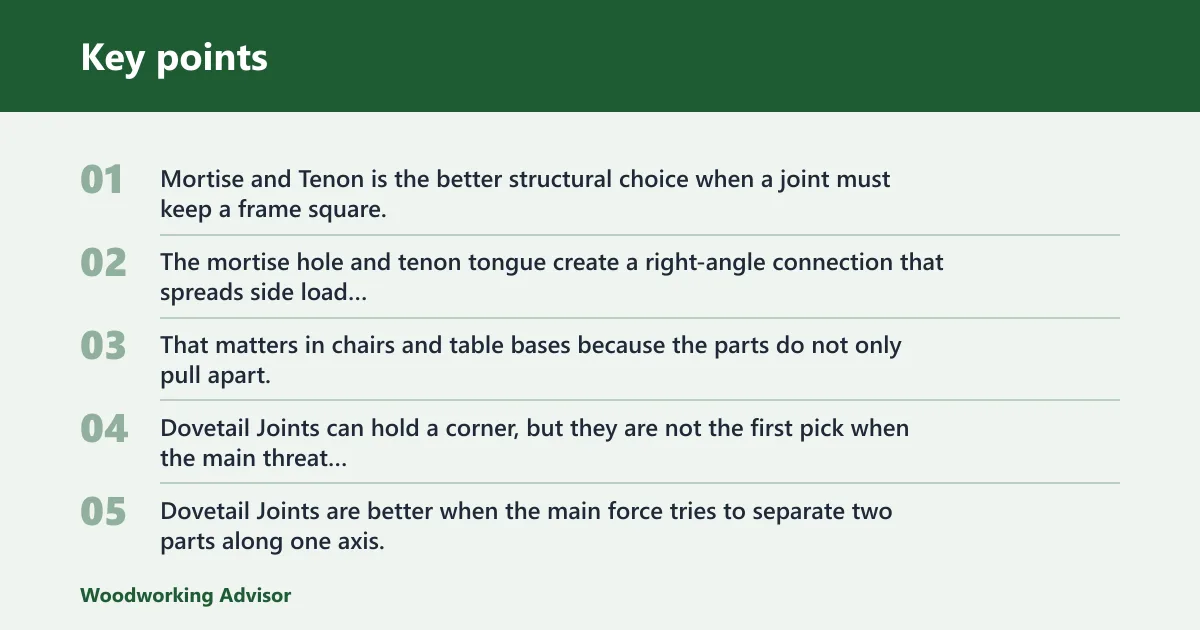
Mortise and Tenon is the better structural choice when a joint must keep a frame square. The mortise hole and tenon tongue create a right-angle connection that spreads side load across shoulders and long-grain glue surfaces.
That matters in chairs and table bases because the parts do not only pull apart; they also twist. Dovetail Joints can hold a corner, but they are not the first pick when the main threat is racking.
Tension and pull-apart
Dovetail Joints are better when the main force tries to separate two parts along one axis. Pins and tails lock together so the joint resists withdrawal even before glue is added.
Mortise and Tenon can still do well here, especially through mortise and tenon joints that are wedged or pegged, but the geometry does not self-lock the way a dovetail does. That is why drawer corners usually favor dovetails.
Seasonal movement
Wood movement changes fit over time. Because wood expands and contracts with humidity, a joint that is tight on day one can loosen, bind, or split later if the grain direction and stock thickness were ignored.
Historically, many timber-frame joints were left unglued so the parts could move without forcing a glue line apart. In modern fine woodworking, glue adds holding power, but you still need room for movement where a board crosses grain.
Visibility and repair
A blind mortise and tenon uses a stopped mortise, so the joint stays hidden. That makes it a strong choice when you want a clean outside face, though it is slightly less strong than a through tenon because the tenon does not pass fully through the work.
Through mortise and tenon joints are visible on the far side and can often be wedged or pegged. That extra length and locking action can improve strength, but the exposed end may not suit a refined face frame.
How each joint fails first
Mortise and tenon failure points
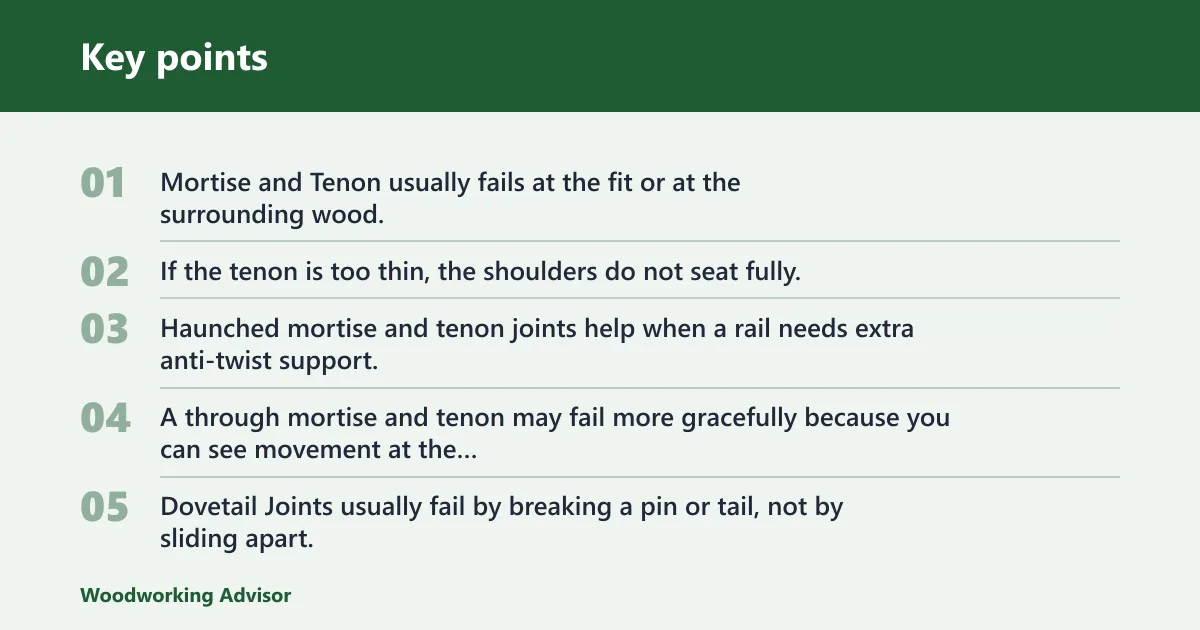
Mortise and Tenon usually fails at the fit or at the surrounding wood, not because the idea is weak. If the tenon is too thin, the shoulders do not seat fully, or the mortise walls are too close to the edge, the joint can crush, loosen, or split.
Haunched mortise and tenon joints help when a rail needs extra anti-twist support, especially near the outer edge of a frame. A through mortise and tenon may fail more gracefully because you can see movement at the exposed tenon before the joint lets go completely.
Dovetail failure points
Dovetail Joints usually fail by breaking a pin or tail, not by sliding apart. That is the point of the shape: it resists pulling apart in at least one direction, so the weak link becomes the thin wood left between cuts.
Half-blind dovetails are common on drawer fronts because they hide the end grain at the front face. The trade-off is that the socket needs accurate chopping, and thin stock can chip or split if the layout is too aggressive.
What glue changes
Glue improves both joints when the surfaces fit well. Mortise and tenon gains from long-grain-to-long-grain contact over a large surface area, and Dovetail Joints gain from the same principle plus the mechanical interlock.
Glue cannot rescue a sloppy fit. Loose-fitting joins reduce contact, weaken shoulder support, and leave less wood to carry load after the first stress cycle.
How stock thickness changes the answer
Thicker stock gives either joint more material around the cut, which usually means better strength. Thin drawer sides tend to favor half-blind dovetails because the geometry works well at small thicknesses, while thin frame parts may not leave enough wood around a large mortise.
Grain direction matters too. Long grain running across the load path gives the joint more support than short grain near the cut, so a strong design can still fail if the layout leaves weak fibers at the edge of the socket or tail.
Which joint works best for your project?
Pick by load, not by habit. A joint that survives a drawer corner may be the wrong answer for a chair rail, and a joint that holds a table leg may look bulky or unnecessary in a box.
Chair rails and stretchers
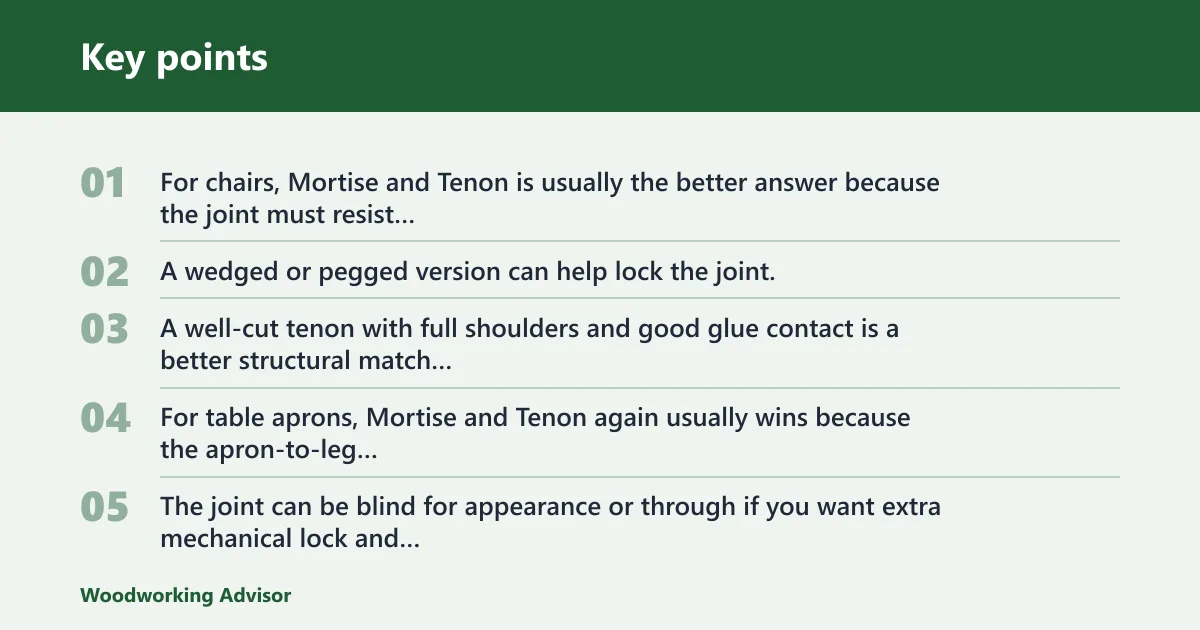
For chairs, Mortise and Tenon is usually the better answer because the joint must resist racking and repeated movement. A wedged or pegged version can help lock the joint, while a blind version keeps the outside face clean.
Suppose a chair side rail is about 3/4 in. thick and the leg is about 1 1/2 in. square. A well-cut tenon with full shoulders and good glue contact is a better structural match than a dovetail, which would add complexity without solving the main load path.
Table aprons and legs
For table aprons, Mortise and Tenon again usually wins because the apron-to-leg connection sees racking and seasonal stress. The joint can be blind for appearance or through if you want extra mechanical lock and do not mind the visible end.
A common first-timer mistake is choosing a dovetail here because it looks “stronger” on paper. The real question is whether the joint must keep a rectangular base square under side load; for that, the mortise and tenon shape is the better fit.
Drawer boxes
For drawer boxes, Dovetail Joints are usually the better choice, especially half-blind dovetails at the front. They resist pull-apart forces well and hide the end grain where it matters most to the eye.
Through dovetails often work well for rear corners and carcass work, where exposed pins and tails are acceptable. If you want the drawer front to look clean, the half-blind version is the standard answer.
Frame-and-panel stiles and rails
For frame-and-panel work, Mortise and Tenon is the usual choice because the frame needs stiffness, alignment, and room for panel movement. The joint carries the frame load while the panel floats, which helps the assembly survive humidity changes.
A blind mortise and tenon keeps the stile-and-rail junction hidden on the outside face. If twisting is a concern, a haunched tenon can help resist rotation where the rail meets the stile.
Choose Mortise and Tenon if… / Choose Dovetail Joints if…
Choose Mortise and Tenon if your joint must resist racking, sit in a chair frame or table base, stay visually quiet, or connect parts at right angles with long-grain glue area. Choose Dovetail Joints if the main threat is pull-apart force, the part is a drawer or box, or you want a corner that locks mechanically before glue fully matters.
Mortise and Tenon is the better hidden joint. A blind mortise and tenon keeps the outside face clean, and the joint can be glued for maximum strength and durability without exposing end grain.
Best fit for pull-apart resistance
Dovetail Joints are the better pick when withdrawal is the concern. Their pins and tails resist separation in one direction even before glue, which is why they suit drawer boxes and small carcasses so well.
Best fit for racking resistance
Mortise and Tenon wins when the assembly has to stay square under side load. That is the failure mode in chairs, door frames, and many table bases, where the joint must fight twist rather than simple pull-apart force.
Best fit for clean appearance
For the cleanest outside face, Mortise and Tenon is usually easier to hide. Dovetail Joints can be neat, but through dovetails display end grain unless you move to half-blind construction, which is more complex to fit cleanly.


Joinery decision matrix
| Project scenario | Load direction | Best joint | Why it wins | Common failure mode |
|---|---|---|---|---|
| Chair rail | Racking and cyclic side load | Mortise and Tenon | Strong right-angle support and good long-grain glue area | Loose shoulders or mortise-wall split |
| Table apron | Racking plus seasonal movement | Mortise and Tenon | Frames the leg cleanly and handles movement better | Tenon too thin or fit too loose |
| Drawer box corner | Pull-apart and corner stress | Dovetail Joints | Mechanical lock resists withdrawal well | Thin tails or pins break first |
| Frame-and-panel stile and rail | Racking with panel movement | Mortise and Tenon | Frame stiffness with room for the panel to float | Overtight fit that restricts movement |
Stock thickness and grain direction
Thicker stock generally gives you more margin for either joint, but the grain still matters. Short grain near the cut weakens both Mortise and Tenon and Dovetail Joints, so layout should avoid putting the thinnest fibers at the loaded edge.
If the part is thin and narrow, use the joint that leaves the most useful wood around the cut. That is usually a half-blind dovetail for drawers or a carefully sized mortise and tenon for frame parts.
Frequently asked questions
Is a mortise and tenon joint stronger than a dovetail joint?
Not in every case. Mortise and Tenon is usually stronger for frames, chairs, and joints that see racking or shear, while Dovetail Joints are usually stronger where the load is trying to pull the parts apart in one direction, such as at a drawer corner.
Which joint is better for chairs and tables, mortise and tenon or dovetail?
Mortise and tenon is often the better choice for chairs and tables because those pieces commonly need resistance to racking and twisting. The joint fits right-angle frame work, and glue adds strength across large long-grain surfaces when the shoulders seat fully.
When should I use a dovetail joint instead of a mortise and tenon?
Use Dovetail Joints for drawers, boxes, and small carcasses where pull-apart resistance matters most. Half-blind dovetails are especially useful at drawer fronts because they hide the end grain while still locking the corner against withdrawal.
Are dovetail joints stronger in tension than mortise and tenon joints?
Usually yes, when tension means one board trying to slide straight away from another. The pins and tails of a dovetail resist that motion better than a simple right-angle mortise and tenon, unless the mortise and tenon is wedged or pegged and well supported.
Is a through mortise and tenon stronger than a blind mortise and tenon?
Usually a through mortise and tenon is a little stronger because the tenon passes completely through the mortised piece and can be wedged or pegged. A blind mortise and tenon hides the joint better, but the stopped mortise gives up some length and visibility of the lock.
Do glued mortise and tenon joints hold better than unglued ones?
Yes, in modern fine woodworking glue usually increases holding power because it bonds the long-grain surfaces of the mortise and tenon. But glue works best only when the fit is tight and the shoulders seat fully; it cannot make a poor joint reliable.
Sponsored / affiliate links. As an Amazon Associate I earn from qualifying purchases. I may earn additional commission from eligible campaigns.