Where Can You Go to Do Woodworking? 7 Places to Find Shop Access
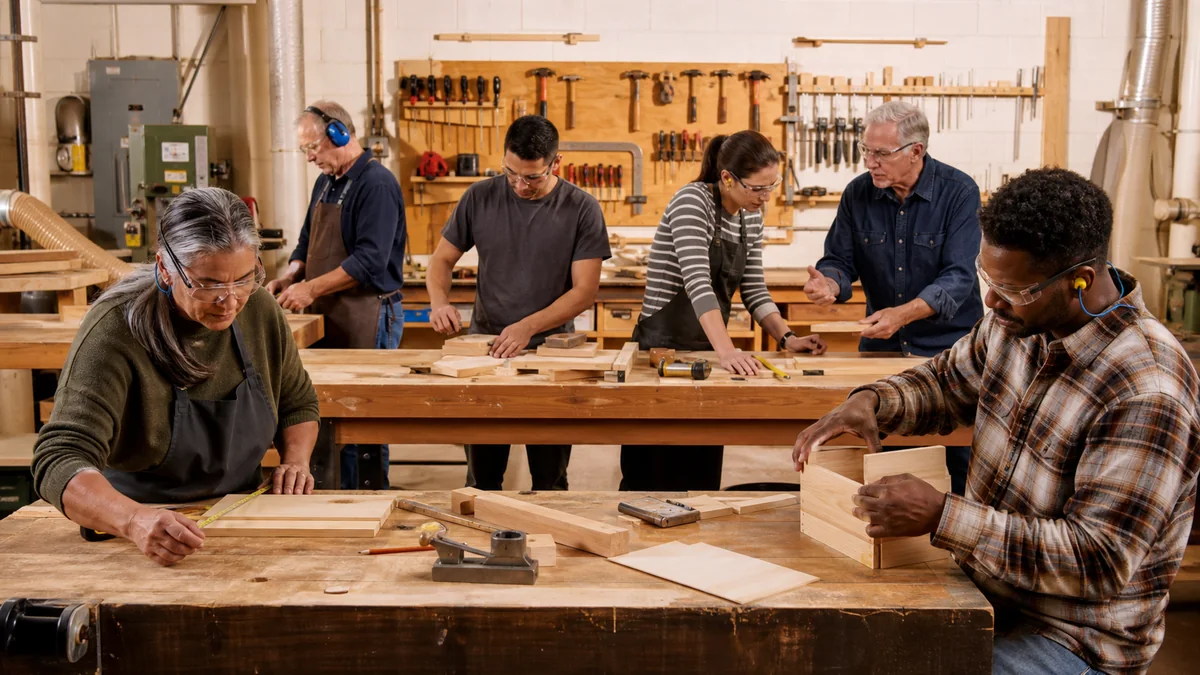
You can do woodworking without building a home shop by joining a community makerspace, enrolling in a community-college or adult-education class, booking a commercial open woodshop, or taking project classes at a woodworking school or retailer. The best option is the one that permits your project, provides training on the exact machines, and offers enough supervised shop time to finish it.
Search for “makerspace woodshop,” “open woodshop,” “adult woodworking class,” and “community college woodworking” plus your city. Then call before paying—many facilities use the word makerspace but have no table saw, jointer, planer, dust collection, or finishing area.
Seven Places to Find Woodshop Access
The fastest starting point is a local makerspace directory, followed by community colleges and specialty schools. Availability is local, so treat directories as leads and verify every listing directly.
| Place | Best for | Typical access gate |
|---|---|---|
| Community makerspace | Independent projects and shared machines | Membership, orientation, machine sign-offs |
| Community college | Structured fundamentals and instructor access | Course enrollment; open lab may be limited |
| Adult education or parks program | Beginner classes and small projects | Class registration and scheduled sessions |
| Woodworking school | Focused furniture, turning, carving, or joinery training | Tuition and prerequisite skills |
| Commercial open shop | Hourly or monthly access for personal projects | Orientation, reservation, liability agreement |
| Retailer classes | Short project or tool-specific instruction | Class fee; independent shop time may not be included |
| Tool library with workspace | Low-cost community access | Membership; machine selection varies widely |
How to Find a Real Woodshop Near You
- Search the Make: makerspace directory and local maps using woodworking-specific terms.
- Check community-college continuing-education catalogs, not only degree programs. Some labs offer non-credit classes or supervised open lab after training.
- Open each facility’s equipment list. Look for the machines your project needs and a working dust-collection system.
- Read the access rules for orientation, certifications, reservations, guests, age limits, project storage, and finishing products.
- Tour the shop before joining. Ask who supervises open hours and how machine damage or unsafe behavior is handled.
Northampton Community College’s Fab Lab, for example, advertises woodworking equipment, non-credit classes, and open lab for properly trained users. Phoenix Forge describes public memberships with training and reservable equipment. These are examples of the access model—not promises that a similar program exists in every city.
Compare the Real Cost
A low monthly price can be misleading if required classes, machine certifications, storage, consumables, or reservation fees are separate. Estimate the full cost for the months your project will occupy the shop.
- Membership, day pass, class, and machine-certification fees
- Wood, blades, abrasives, glue, finish, and disposal charges
- Project storage and maximum stock dimensions
- Parking, travel time, reservation limits, and missed-session policies
- Required PPE and whether hearing, eye, and respiratory equipment is supplied
Safety Training Is a Feature, Not an Obstacle
A trustworthy shared shop will not hand a new member the keys to every machine after one general tour. Expect separate instruction or sign-off for table saws, jointers, planers, bandsaws, lathes, CNC machines, and finishing areas. Ask whether staff are present during open shop and whether dust collection and emergency-stop procedures are enforced.
If you eventually create a personal workspace, our guide to setting up a woodworking shop explains layout, tools, and safety basics. A storage unit is not automatically a legal or safe workshop; lease, fire-code, ventilation, noise, and power rules still apply.
Questions to Ask During a Tour
- Which machines can I use after orientation, and which require separate certification?
- Can I work independently, or only during classes and staffed open hours?
- May I store a project, sheet goods, finishes, batteries, and personal tools?
- Are reclaimed lumber, pallet wood, pressure-treated wood, MDF, or epoxy allowed?
- Is there a spray booth or approved finish area, and which products are prohibited?
- What happens if a blade is damaged or an injury occurs?
Places That Usually Do Not Provide Open Shop Access
Home-improvement stores may cut purchased sheet goods, but that is not the same as letting customers use shop machines. Online classes provide instruction but no workspace. Craft fairs and exhibitions can help you meet woodworkers, yet they should not be listed as places where a beginner can complete a project unless the organizer explicitly offers a supervised shop.
Bottom Line
Start with a community makerspace or community-college class, verify that it has a real woodshop, and tour it before paying. Choose based on training quality, supervised access, the machines your project needs, total cost, storage rules, and realistic open-shop hours—not the shortest drive alone.
What to Bring to Your First Session
- Closed-toe shoes and clothing without loose sleeves or drawstrings that could catch on a spinning blade or bit
- Your own safety glasses and hearing protection if the shop doesn’t guarantee loaners are available or sanitized
- A tape measure, pencil, and your project plans or cut list, even if the shop has shared tools
- A USB drive or printed files if you plan to use a CNC or laser that needs a design file
- A bag or bin for scraps and offcuts — many shops require you to haul away your own waste
- Cash or card for consumables (glue, sandpaper, finish) the shop doesn’t stock for free
Call ahead to confirm what the shop supplies versus what you need to bring — policies vary widely, and showing up without required PPE is a common reason beginners get turned away from their first session.
Frequently Asked Questions
Where can I do woodworking without owning tools?
Start with community makerspaces, community-college or adult-education woodshops, recreation programs, woodworking schools, tool libraries with shop access, and commercial open-shop studios. Confirm that the location has an actual woodshop, not only digital-fabrication tools.
Can beginners use a makerspace woodshop?
Often, but most spaces require orientation and separate sign-offs for specific machines. Some allow beginners only during classes or supervised open-shop hours.
Pricing varies by city and access model. Compare the full cost of membership or class fees, safety training, machine certification, storage, consumables, dust collection, and required insurance or deposits.
Can I bring my own lumber and finish?
Policies differ. Ask about approved lumber, reclaimed wood, nails or screws hidden in stock, sheet-goods limits, drying requirements, finishes, solvent storage, spray areas, and disposal before arriving.
What should I ask before joining?
Ask which machines are included, how training works, when supervised open shop is available, whether projects can be stored, what PPE is required, and how damaged tools or emergency incidents are handled.
Sponsored / affiliate links. As an Amazon Associate I earn from qualifying purchases. I may earn additional commission from eligible campaigns.