Best Dovetail Jigs Reviewed for Hobbyists
For most hobbyists, the best first dovetail jig is a template-style model with self-centering guides, adjustable pin spacing, and clear setup marks, because it gives clean, repeatable joints without a steep learning curve. Choose the wrong jig and you waste stock, fight loose or tight tails, and spend extra time tuning instead of cutting. This guide compares the best dovetail jigs for first drawers, small boxes, and occasional joinery, with a focus on setup speed, simple operation, and value.
Top pick for hobbyists


Porter-Cable 4216 12-Inch Dovetail Jig Kit is the best overall benchmark for hobbyists because it covers the broadest range of common projects without pushing you into a narrow workflow. It handles boards up to 12 inches wide and 1⅛ inches thick, supports through, half-blind, rabbeted, sliding, box, mini through, and mini box joints, and works with a free router.
That mix matters in a real shop. A beginner can start with drawer fronts and sides, then move to small boxes, rabbeted fronts, and light furniture repairs without buying another jig. Cheaper models often cut joint choices to save cost. Pricier systems may do more, but they also ask more from setup discipline and budget.
For most first-time buyers, this is the safest middle ground: enough joint variety to stay useful, enough capacity for common hobby work, and enough support for learning without requiring a router-table-only setup.
Quick picks: the best jigs by need
| Need | Pick | Why it fits |
|---|---|---|
| Best overall | Porter-Cable 4216 | Broad joint range, 12-inch width, free-router use, and strong all-around hobby value. |
| Best budget | General Tools 861 E-Z Pro | Lower-cost entry point with through, half-blind, and box joints for simple builds. |
| Best for beginners | Rockler Complete Dovetail Jig | Clear first-project focus with through and half-blind joints and a simpler board-width target. |
| Best for router-table users | Leigh RTJ400 | Made for router-table workflow, with wider board capacity for larger drawers and panels. |
| Best for versatility | Leigh Super12 | Adjustable fingers and support for half-blind, rabbeted half-blind, and sliding dovetails. |
| Best for small workshops | Keller 1500 Journeyman | Through-dovetail focus, phenolic template, and unlimited board width with a ¾-inch stock limit. |
How a dovetail jig works
A dovetail jig guides a router so you can cut matching pins and tails with repeatable spacing. The jig holds the boards, controls the cutter path, and keeps the parts aligned while you route the joint. That turns a freehand task into a controlled one.
Through, half-blind, and box joints
Through dovetails show the joint ends on both faces, so they suit boxes and visible casework. Half-blind dovetails hide the joint on one face, which is why they are common on drawer fronts. Box joints use straight fingers rather than angled tails, and they are a practical choice for utility boxes and simple carcasses.
Picture a 6-inch-wide drawer side and front. A jig with enough board width and thickness capacity can cut the half-blind joint in one setup if the bit depth and template spacing are correct. If those settings drift, the joint can come out too loose or too tight, which is why test cuts matter.
Dovetail jig decision matrix
This matrix translates hobbyist realities into a short buying filter. Higher scores mean a better result for that factor. The recommendation column ties each model to one common scenario instead of a vague “best” label.
| Model | Setup difficulty | Adjustment flexibility | Workshop footprint | Joint versatility | Hidden ownership cost | Best scenario match |
|---|---|---|---|---|---|---|
| Porter-Cable 4216 | 3/5 | 4/5 | 3/5 | 5/5 | 3/5 | First drawer project |
| General Tools 861 E-Z Pro | 4/5 | 3/5 | 4/5 | 3/5 | 4/5 | Occasional box making |
| Rockler Complete | 4/5 | 3/5 | 4/5 | 3/5 | 4/5 | First drawer project |
| Leigh RTJ400 | 2/5 | 4/5 | 2/5 | 4/5 | 2/5 | Large drawer or cabinet parts |
| Leigh Super12 | 3/5 | 5/5 | 3/5 | 5/5 | 3/5 | One-tool multi-project use |
| Porter-Cable 4210 | 4/5 | 3/5 | 3/5 | 3/5 | 4/5 | Budget first jig |
| Keller 1500 Journeyman | 3/5 | 2/5 | 5/5 | 2/5 | 3/5 | Limited-space shop |
Setup difficulty reflects how many variables you must control before the first good joint. Adjustment flexibility reflects whether the jig can move from drawers to boxes to other joint types without major compromise. Hidden ownership cost includes extra bits, guide bushings, router-table dependence, and the time cost of learning the setup.
Which dovetail jig is easiest to use?
The easiest jig to use is usually the one with the fewest setup variables and the clearest marking system. For hobbyists, that usually means a fixed-pattern design with straightforward spacing, a stable clamping method, and a setup routine you can repeat without constant re-reading. A forgiving jig still needs test cuts, but it should reward careful setup instead of punishing small errors.
Where setup goes wrong most often
Most failures come from tail board misalignment, wrong template spacing, bit depth errors, and skipping the test-joint stage. If the board shifts even slightly, the pins and tails will not register correctly. If the bit is too shallow, the joint binds. If it is too deep, gaps show up at the shoulders.
A common first-timer mistake is cutting project parts after one “close enough” test. Suppose a drawer side is clamped 1/16 inch off center on the template. The joint may still assemble, but the drawer front will show uneven shoulders, and the fix usually means recutting stock or living with a visible mismatch.
How to tune a test joint
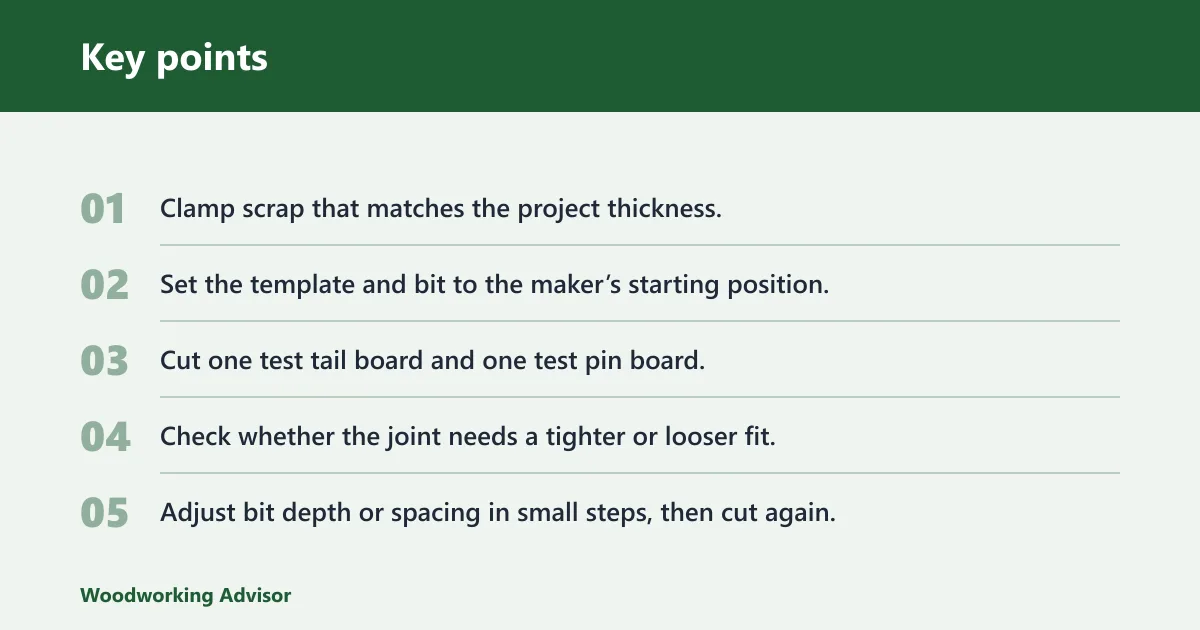
- Clamp scrap that matches the project thickness.
- Set the template and bit to the maker’s starting position.
- Cut one test tail board and one test pin board.
- Check whether the joint needs a tighter or looser fit.
- Adjust bit depth or spacing in small steps, then cut again.
- Do not start on the project boards until the test joint closes with hand pressure and no forcing.
Porter-Cable 4216 12-Inch Dovetail Jig Kit
This is the broadest all-around choice for hobbyists who want one jig for drawers, small boxes, and light furniture work. It handles boards up to 12 inches wide and 1⅛ inches thick, and it supports through, half-blind, rabbeted, sliding, box, mini through, and mini box joints. The aluminum templates and free-router compatibility keep it usable in a typical small shop.
Best for: hobbyists who want one jig that can stay useful across several project types.
General Tools 861 E-Z pro dovetail jig
This is the budget pick for simple joinery. It works with a free router or router table, handles material up to 1 inch thick, and supports through, half-blind dovetails, and box joints. That narrower scope keeps setup simpler, but it also means less room for future project variety.
Best for: occasional boxes, small utility drawers, and buyers watching cost first.
Rockler complete dovetail jig
This is a good beginner-friendly option for hobbyists who mainly want through and half-blind joints. It fits boards up to 11 inches wide and 1⅛ inches thick, and its phenolic template points it toward straightforward drawer and case work. The narrower width cap is less ideal for wider carcass parts, but it is enough for many small-shop projects.
Best for: first drawer projects where the board size stays modest.
Leigh RTJ400 router table jig
This is the router-table-only option in the group. It handles boards up to 16 inches wide and material up to 1 inch thick, and it supports through and half-blind dovetails plus box joints. The tradeoff is direct: you gain width and a table-based workflow, but you give up free-router flexibility.
Best for: hobbyists who already own a router table and want bigger parts.
Leigh Super12 12-Inch dovetail jig
This is the most versatile choice for hobbyists who expect the jig to cover more than one project type. It is commonly described as supporting half-blind, rabbeted half-blind, and sliding dovetails, with adjustable fingers and compatibility with a free router. The 1⅛-inch material limit keeps it in the same general class as many hobby jigs, but the adjustable layout is what sets it apart.
Best for: one-tool buyers who want to move from drawers to more varied joinery.
Porter-Cable 4210 12-Inch Dovetail Jig
This is the more affordable entry model for hobbyists who want a familiar fixed-pattern path into dovetailing. It supports through, half-blind, and sliding dovetails, uses an aluminum template, and works with material up to 1⅛ inches thick. It gives up some joint variety versus the 4216, but it keeps the core hobby jobs covered.
Best for: beginners who want a lower-cost start with room to grow.
Keller 1500 journeyman dovetail jig
This is the small-shop option for through dovetails only. It uses a phenolic template, works with unlimited board width, and is limited to ¾-inch stock. That makes it a practical fit when storage and bench space matter more than joint variety.
Best for: compact shops that mainly build boxes, trays, and narrow case parts.
How do you use a dovetail jig?
You place the boards in the jig, clamp them square, set the template and bit depth, then route the pins and tails in separate passes. The key is to keep the workpiece registered exactly the same way each time. If the board moves, the joint changes.
For most hobbyists, the process is simple in outline and demanding in execution. The first pass should always be on scrap. After that, the real work is repeating the same clamp pressure, router depth, and template position across every matching part.
How do you set up a dovetail jig?
Setup starts with choosing the board thickness the jig can handle, then matching the template spacing and bit depth to that stock. After that, clamp a scrap pair and cut a test joint. The test tells you more than the manual because it shows how your router, bit, and stock actually behave together.
Free-router jigs usually ask you to control more of the setup on the bench. Router-table-only jigs shift more of the routing motion into the table itself. That can be steadier for some users, but it also means the table becomes part of the ownership cost.
How do you choose between a router jig and a router-table jig?
Choose a free-router jig if you want flexibility, easier storage, and fewer shop changes. Choose a router-table jig if you already own a stable table and want that workflow for larger parts or repeat production. The right choice depends less on the joint itself and more on how much bench space and setup time you can spare.
Free-router setup
Free-router jigs work well for hobbyists with limited space because they do not depend on a dedicated router table. That keeps the footprint smaller and the setup more portable. They are often the better first choice if the shop has to serve multiple tools and tasks.
Router-table-only setup
Router-table jigs make sense when the table is already part of the shop routine. They can feel steadier for wider stock and repetitive work, but the table requirement is a real constraint. If the table is crowded or stored away, that convenience disappears fast.
Frequently asked questions
What is the best dovetail jig for a hobbyist?
The best all-around pick for most hobbyists is the Porter-Cable 4216 because it supports a wide mix of joint types, handles common board sizes, and works with a free router. That combination covers first drawers, small boxes, and light furniture repairs without forcing a specialized setup.
What dovetail jig is best for beginners?
The Rockler Complete Dovetail Jig is a strong beginner choice if your projects stay within its 11-inch width limit. It keeps the focus on through and half-blind dovetails, which helps reduce setup complexity while you learn spacing, bit depth, and clamping order.
How does a dovetail jig work?
A dovetail jig holds the boards and guides a router so the cutter follows a matching pin-and-tail pattern. The jig does the alignment work. Your job is to clamp the stock square, set the bit correctly, and cut test joints until the fit is right.
What dovetail jig works best for small workshops?
The Keller 1500 Journeyman is the best fit for a compact shop if you mainly need through dovetails and work with ¾-inch stock. Its unlimited board width can still be useful, but the real advantage is that it stays focused and avoids the footprint and complexity of broader systems.
How do you use a dovetail jig video or YouTube guide safely?
Use video guides as a visual check, not as a replacement for the manual. Confirm the board thickness, template spacing, and bit depth against the jig’s own settings before cutting. If a video skips the test-joint step, treat that as a warning sign rather than a shortcut.
Sponsored / affiliate links. As an Amazon Associate I earn from qualifying purchases. I may earn additional commission from eligible campaigns.