5 Best Compact Routers for Trim Work (2026): we compared
The Makita RT0701CX7 is a strong compact router option for trim work because it offers a compact form, variable speed in roughly the 10,000 to 30,000 RPM range, and a slim body that suits edge profiling, flush trimming, and small detail cuts across shop and site work.
Quick comparison
| Product | Badge | Best for | Price | ||
|---|---|---|---|---|---|
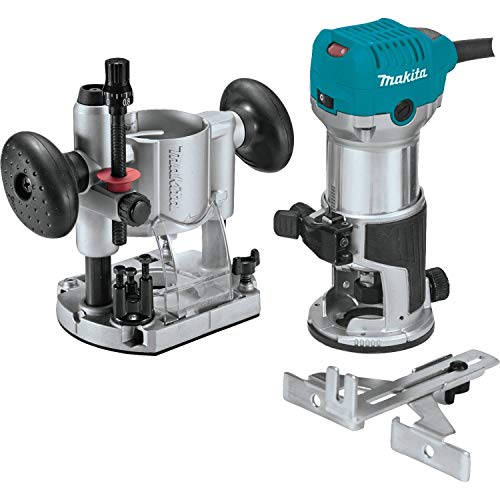 |
Makita RT0701CX7 1-1/4 HP* Compact Router KitMakita | Our pick | Makita 1-1/4 HP Compact Router Kit | $221.68
Price as of 13 Oct 2026
|
View |
 |
DEWALT 20V MAX XR 2-1/4 Peak HP Plunge Router (Tool Only)DEWALT | Upgrade pick | DEWALT 20V MAX XR Plunge Router | $274.37
Price as of 13 Oct 2026
|
View |
 |
RIDGID 18V BRUSHLESS Cordless Compact Router Tool ONLYRIDGID | Budget pick | RIDGID 18V Brushless Cordless Compact Router | $142.95
Price as of 13 Oct 2026
|
View |
 |
Milwaukee Cordless Compact Router,18.0 VoltageMilwaukee | Also great | Milwaukee 18.0V Cordless Compact Router | $177.99
Price as of 13 Oct 2026
|
View |
 |
Festool 577986 OFKC 500 R3 EB-Basic Cordless Edge RouterFestool | Our pick | $399.00
Price as of 3 Nov 2026
|
View |
Use the table to match the router to the job first, then compare power source and base style. For trim work, bit control and visibility matter more than raw horsepower alone.
📊 The router delivers best-in-class 31,000 RPM. Source: Calranch.
How we chose
The main filter was task fit: flush trimming, edge profiling, laminate cleanup, and small detail routing. After that came control features, because variable speed, good depth adjustment, and clear sight lines reduce burn marks, chatter, and tearout.
Power source matters too. Corded compact routers suit repeated bench and shop work because runtime stays constant and you do not stop for charging. Cordless models suit site trim, but battery platform cost and runtime become part of the buying decision.
Bit and material fit matter. A compact router should handle 1/4-inch shank bits well, and the bit profile has to match the cut, whether that is flush trim, roundover, chamfer, or laminate work, along with the motor class.
Quick picks
- Best cordless for mobile trim: Milwaukee M18 Fuel compact router for site trim, with 31,000 RPM and a brushless motor.
- Best corded all-around choice: Makita RT0701CX7 for steady edge work, variable speed, and fine depth control.
- Best for precision edge profiling: Makita RT0701CX7, especially with a fixed base and small roundover or chamfer bits.
- Best for laminate and light flush trimming: Milwaukee cordless compact router or Bosch Colt, depending on battery ownership and task size.
- Best plunge-style option for routing beyond trim: DEWALT DCW620B if you need plunge capability more than trim-router simplicity.
Milwaukee M18 Fuel compact router: best for cordless trim work
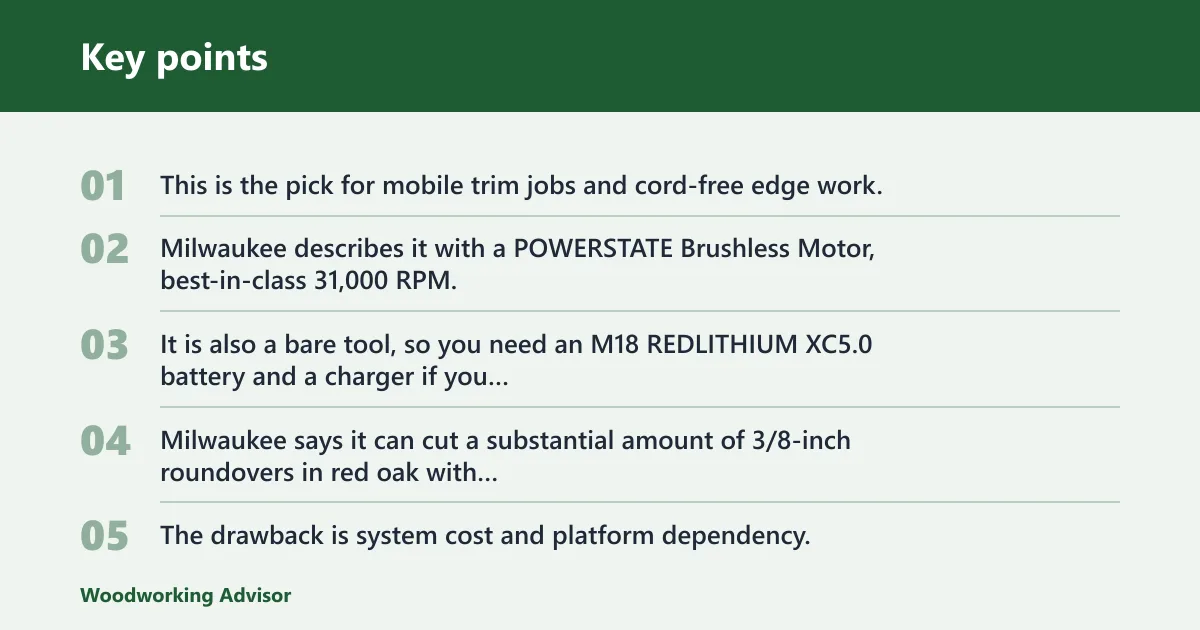
This is the pick for mobile trim jobs and cord-free edge work. Milwaukee describes it with a POWERSTATE Brushless Motor, best-in-class 31,000 RPM, and power equal to corded 1.25 horsepower trim routers, which puts it in the right class for fast setup and light site trimming.
It is also a bare tool, so you need an M18 REDLITHIUM XC5.0 battery and a charger if you do not already own the platform. Milwaukee says it can cut a substantial amount of 3/8-inch roundovers in red oak with that battery, which is the kind of stated output that can help make cordless trim routing easier to judge.
The drawback is system cost and platform dependency. If you are not already on M18, the tool-only price is only part of the bill, and cordless runtime will always depend on battery size and condition.
DeWalt DWP611: best for corded all-around trim work
A corded compact router still makes a lot of sense for repetitive edge work because it gives you stable runtime and avoids battery changes mid-task. For bench work, cabinet edging, and repeated profile cuts, that consistency matters more than cordless mobility.
With any corded compact router in this class, check that the speed control is easy to set and that the base gives you enough visibility at the cut line. Those two features do more for trim quality than a higher headline RPM number.
The main drawback is obvious: the cord gets in the way on site. If you are trimming installed laminate, touching up stairs, or working far from outlets, a corded unit is less convenient.
Makita RT0701C: best for precision edge profiling
This style is a strong fit for controlled passes with small bits. The variable speed dial from 10,000 to 30,000 RPM and the slim body are well matched to chamfers, roundovers, and finish passes where you want steadier control rather than brute force.
The fixed-base setup is usually the right place to start on a compact router because most trim tasks do not need plunge travel. A plunge add-on matters more for stopped cuts, hinge work, or operations where you need to start the bit away from the edge.
The drawback is that precision does not excuse technique. On hardwoods and plastics, the wrong feed rate or a poor speed setting can still leave burn marks, chatter, or edge fuzz that needs cleanup.
Bosch Colt: best for laminate trim and light flush trimming
The Bosch Colt fits light-duty edge cleanup, laminate trim, and small flush passes where a lighter compact router is easier to control. That kind of work benefits from a small footprint, good sight lines, and bits sized for delicate edge finishing.
For laminate, bit choice matters as much as the router. A laminate trim bit or flush trim bit with a bearing is the usual starting point, and speed control helps limit chipping and burn marks on plastic-faced material.
The drawback is capacity. Once the work shifts to harder woods, wider profiles, or longer cut lengths, a light compact router can feel undersized compared with a more rigid model in the same class.
Which one should you buy
Choose cordless if you work away from outlets, move often between installs, or already own the battery platform. Choose corded if you do repeat edge work on the bench or in the shop and care more about steady runtime than portability.
Choose a fixed base for most trim tasks. Add plunge only when the job truly needs it, such as stopped cuts or mortises. A combo base matters when one tool must cover both edge work and plunge work, but it is not mandatory for everyday trim routing.
A common first-timer mistake is choosing a compact router based on the label alone instead of matching it to the trim profiles, edge cleanup, and light-duty shaping the job actually requires. Suppose you need to flush-trim 1/2-inch hardwood edging on cabinet parts, then profile 3/8-inch roundovers on red oak, then clean laminate edges on site. That mix points to speed control, a fixed base, and the right 1/4-inch shank bits before anything else.
Trim router vs compact router
A trim router and a compact router are usually the same class of tool: a small one-handed router built for edge trimming, laminate cleanup, and detail work. The practical buying question is less about the label and more about base style, speed control, and whether the motor and collet match the bits you plan to use.
Some manufacturers emphasize “trim router” for flush work and edge finishing. Others use “compact router” for the same palm-style form factor, often with a 1.25 HP-class corded motor or an 18V cordless equivalent.
What is a trim router used for
A trim router is used for flush trimming, edge profiling, chamfers, laminate cleanup, and other small precision cuts. It excels when the bit is small and the cut is shallow enough that one-handed control and clear visibility matter more than bulk or plunge depth.
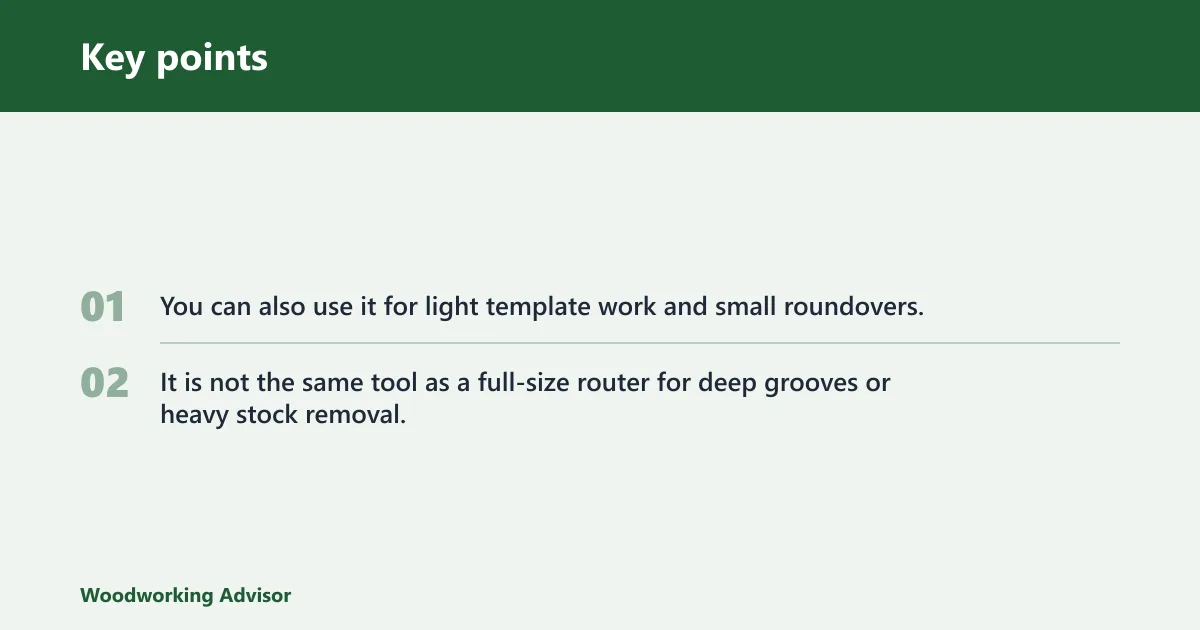
You can also use it for light template work and small roundovers, as long as the bit shank, speed setting, and base stability match the job. It is not the same tool as a full-size router for deep grooves or heavy stock removal.
What does a compact router do
A compact router handles small trim and edge work with a one-handed palm-style form factor. It is built for jobs where the cut is short, the bit is usually 1/4 inch shank, and you want quick control along an edge rather than the mass of a larger router.
It is a practical tool for cabinet edging, laminate trimming, small chamfers, and detail passes. Compact size helps on tight workpieces, but you still need the right base style and a bit matched to the material.
Trim router vs router
A trim router is a small router designed for edge and detail work, while “router” often means a larger full-size tool with more power and deeper capacity. For trim work, the smaller tool is usually easier to control and less likely to remove too much material by mistake.
If the task is flush trimming, edge profiling, or laminate cleanup, a compact router is usually the better starting point. A full-size router makes more sense for larger bits, heavier cuts, and operations that need more depth or mass.
Trim router vs plunge router
A trim router is usually a fixed-base edge tool first, while a plunge router is made to start cuts in the middle of a workpiece. If you need stopped grooves, mortises, or recessed pockets, plunge travel matters; if you need edge trim and profiles, it usually does not.
That is why many trim tasks do not need a plunge base. A plunge add-on is worth considering only when the work crosses into joinery or stop-cut routing.
Fixed base vs trim router
For most trim work, a fixed base is the right choice because it keeps the bit height stable and makes edge control easier. Fixed bases also tend to offer better visibility at the work surface and simpler setup for repetitive profile cuts.
Choose plunge only when the cut requires it. On a compact router, plunge capability is useful but not essential for flush trimming, edge profiling, or chamfer work.
How to make trim with a router
To make trim with a router, clamp or steady the work, choose the right bit, set the depth so the bearing or cutter follows the reference surface, and make multiple light passes when the material is hard or brittle. Keep the router moving to avoid heat buildup and edge damage.
For edge trim on laminate or hardwood edging, a flush trim bit is the usual starting point. For decorative edges, use a roundover or chamfer bit and slow the feed if the bit diameter is large for the tool class.
How to use a compact router
Use a compact router by matching the base and bit to the task, setting the depth carefully, and controlling speed for the material. Start with a test pass on scrap when possible, especially on hardwoods, MDF edges, and plastic laminate where burn marks or chipout can appear quickly.
Keep your hands clear of the bit path and support the work so the router does not tip at entry or exit. Visibility and micro-adjust capability matter because compact routers depend on precise setup more than raw size.
How to use a trim router video
A video can help you see feed direction, base contact, and bit entry, but it should not replace the setup steps. Watch for how the cutter approaches the edge, how the work is supported, and how the operator prevents chatter at the start and exit of the pass.
For practical use, the important cues are still the same: correct bit choice, the right speed, and a stable base. Those details matter more than the format of the lesson.
How we chose
Trim-task fit came first. The tool had to make sense for flush trimming, edge profiling, laminate work, and small detail cuts instead of being judged only by popularity.
Control features came next. Variable speed, clear base visibility, accurate depth adjustment, and micro-adjust capability all reduce the kinds of errors that show up on small routers.
Power choice and system cost were also part of the decision. Corded models avoid battery overhead; cordless models add mobility, but the battery platform and runtime become part of the real cost.
Trim-work decision matrix
This matrix ties the job to the router type, base style, and bit choice first. That is the simplest way to avoid buying a tool that looks right on paper but is wrong for the cut.
| Job | Material | Worksite condition | Best router type | Base style | Bit choice | Buying note |
|---|---|---|---|---|---|---|
| Flush trimming edging | Hardwood edging, plywood veneer | Bench or shop | Corded compact router | Fixed base | Flush trim bit, 1/4-inch shank | Choose stable RPM and good visibility for repetitive passes |
| Edge profiling | Red oak, maple, other hardwoods | Bench or assembly table | Compact router, corded or cordless | Fixed base with micro-adjust | Roundover bit or chamfer bit | Speed control matters to reduce burn marks on harder woods |
| Laminate cleanup | Laminate, plastic-faced sheet goods | Jobsite install | Cordless compact router | Fixed base or edge base | Laminate trim bit or flush trim bit | Use lighter passes and careful feed to limit chipout |
| Small detail chamfers | MDF, softwood, paint-grade parts | Shop or site | Compact router | Fixed base | Chamfer bit | Visibility and depth control matter more than top RPM alone |
| Site trim with no cord access | Mixed trim stock | Stairs, remodels, punch-list work | Cordless compact router | Fixed base | Flush trim bit or small roundover bit | Check battery Ah, bare tool vs kit, and platform cost |
Bit and material fit
Flush trim bits are the workhorse for edging and template cleanup. Roundover bits shape softened edges, chamfer bits cut bevels, and laminate trim bits help on brittle plastic-faced surfaces where a cleaner edge matters.
Check shank compatibility before buying. Compact routers commonly use 1/4-inch collets, which fits the small-bit focus of this tool class.
Speed control and failure cases
Speed control matters because bit diameter and material density change the cut. Slower settings help reduce burn marks on hardwoods and plastics, and they also support cleaner entry and exit on delicate edges.
Chatter usually points to a poor feed rate, loose setup, or too aggressive a cut for the bit size. Tearout and edge blowout are more common on unsupported grain, brittle laminate, or when the cutter exits too fast. A light pass often solves more than a stronger motor does.
Corded vs cordless compact routers
Corded compact routers are the better choice for consistent runtime and repetitive work on the bench. They also avoid battery burden, which keeps the tool lighter in use and lowers the total system cost if you already have outlets nearby.
Cordless compact routers buy mobility. The tradeoff is battery-platform dependency, bare tool versus kit decisions, and runtime tied to battery Ah. That is why a cordless router should be chosen as a system, not as a stand-alone tool.
Battery checklist for cordless buyers
- Check whether the tool is bare tool only or sold as a kit with battery and charger.
- Confirm the battery platform you already own, if any.
- Compare battery Ah, since runtime rises with capacity.
- Include the charger and spare battery in total system cost.
- Match the router to the tasks you actually need away from an outlet.
Say your job is trimming laminate countertop edging in a kitchen with no outlet within reach. A cordless compact router with a flush trim bit and variable speed is the sensible choice, because mobility matters more than endless runtime.
Suppose you are profiling 20 cabinet doors with 1/4-inch roundovers on red oak. A corded compact router with a fixed base and speed control is the better fit, because repeated edge work rewards stable power and consistent setup.
Frequently asked questions
How to use a trim router
Use a trim router by locking in the bit, setting depth carefully, and moving at a steady feed rate that matches the material. For hard woods and plastics, lower speed and lighter passes help reduce burn marks, chatter, and edge damage on entry and exit.
What is the best router for woodworking
There is no single best router for all woodworking. For trim and edge work, a compact router is usually the best starting point; for larger cuts or deeper joinery, a full-size router may be more appropriate. The right pick depends on the job, the bit, and the material.
Sponsored / affiliate links. As an Amazon Associate I earn from qualifying purchases. I may earn additional commission from eligible campaigns.