What to Put Under a Wood Stove: Floor Protection Options
Under a wood stove, use the floor protection assembly your stove manual specifies: ember protection only, or ember plus thermal protection with the listed R-value and required clearances. Skip that requirement and you can char framing, overheat flooring, or fail inspection. This guide shows how to read the manual, separate ember protection from thermal protection, and choose the right pad, board, or built-up hearth for your room layout.
Why your stove manual decides the answer


The stove or insert manual is the starting point because floor protection is model-specific. One appliance may need only a non-combustible surface. Another may need a listed insulated assembly. Required floor protection varies enormously between stove models.
Find the model number and listing label first
Look for the appliance model number, then find the listing label on the stove or insert. The manual should state the required R-value, the needed extension in front of the loading door, and the side clearances for the hearth. If the manual is missing, check the listing label, contact the manufacturer, and confirm the plan with the local AHJ or inspector before you build or buy.
What to confirm before buying a pad
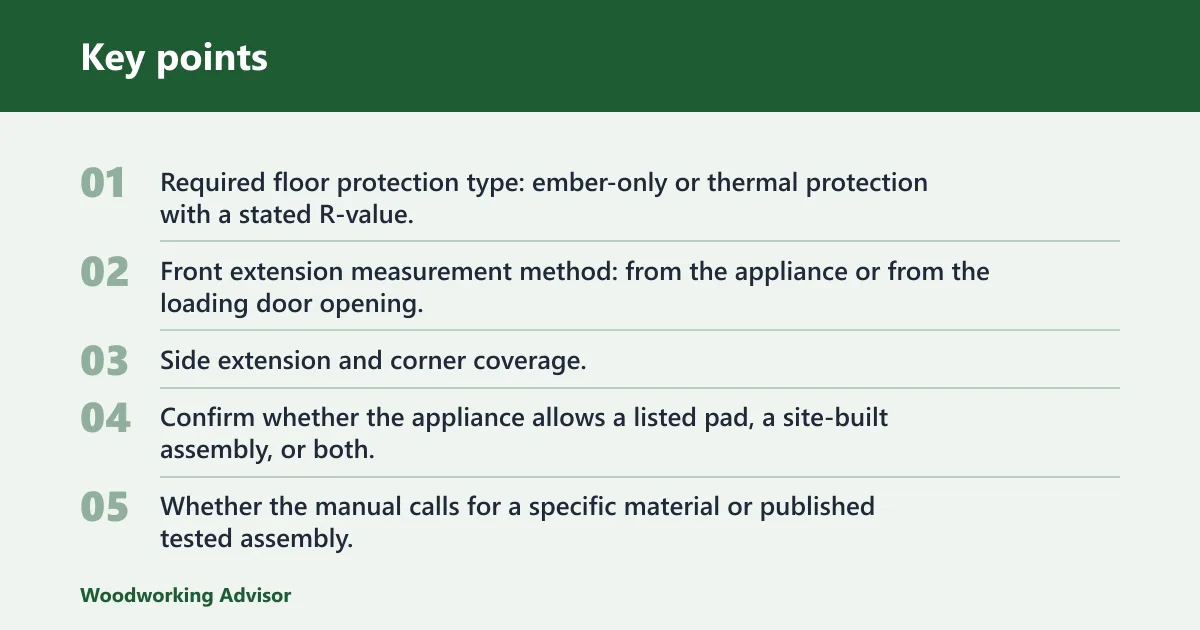
- Required floor protection type: ember-only or thermal protection with a stated R-value.
- Front extension measurement method: from the appliance or from the loading door opening, as the manual states.
- Side extension and corner coverage.
- Confirm whether the appliance allows a listed pad, a site-built assembly, or both.
- Whether the manual calls for a specific material or published tested assembly.
When to ask the manufacturer or local AHJ
Ask before purchase if the manual is unclear, the stove is older, or the room layout forces a custom shape. That matters even more when a floor is uneven, the subfloor is questionable, or a stone hearth will add weight. A pad that looks correct can still fail if the approved assembly is undocumented.
Ember protection vs thermal protection
Ember protection stops hot coals and falling ash from reaching a combustible floor. Thermal protection also slows heat transfer through the hearth assembly. A non-combustible surface alone may satisfy one need and miss the other, so you have to match the assembly to the manual, not the appearance.
What ember-only protection can cover
An ember-only path may use a listed hearth pad or a non-combustible surface that the manufacturer approves for that model. It protects against sparks and embers, but it is not automatically enough when the manual asks for insulation value.
When an insulated assembly is required
If the manual names an R-value, the assembly has to meet that number. R-value comes straight out of the appliance’s manual. It is not universal, and it is not optional for models that require it.
Why a non-combustible surface may still fail
A beautiful tile laid straight onto a wood subfloor has an R-value close to nothing. Tile is a surface, not a thermal barrier. A steel sheet alone is not enough where the manual asks for insulating value.
Stove floor protection table
This table compares common paths by the requirement they satisfy, the material types that can work, and the failure mode that most often causes trouble.
| Requirement path | Approved material types | When it is sufficient | When a custom board assembly is needed | Common install mistake |
|---|---|---|---|---|
| Ember-only protection | Listed hearth pad; non-combustible surface approved by the manual; stone, tile, or steel if the listing allows it | When the manual asks for ember protection only and the listed pad matches the appliance shape and extension | When the room needs a custom outline, such as a corner cut or a front clip shape, and no listed pad fits | Buying by appearance and missing the required extension or door-opening measurement |
| R-value required | Listed pad with published R-value; non-combustible board assembly built to the required R-value; layered site-built hearth with documented values | When the published assembly meets or exceeds the manual’s required R-value and the size requirement | When stock pads do not provide the needed R-value or do not fit the room | Assuming a decorative tile top is enough because the surface is non-combustible |
| Custom opening or unusual floor | Site-built non-combustible board; solid stone hearth; listed custom pad | When the assembly is documented, matches the manual, and the floor can carry the load | Often needed for odd room shapes, older floors, or a stove location that demands a nonstandard outline | Building a hearth with no published R-value or no inspector sign-off |
How to read R-value and extension requirements
Read the R-value and the extension as separate requirements. The stove can need both at the same time. A pad that meets the insulation number but is too small is still wrong, and a large pad with no thermal rating can also be wrong.
How manuals state R-value
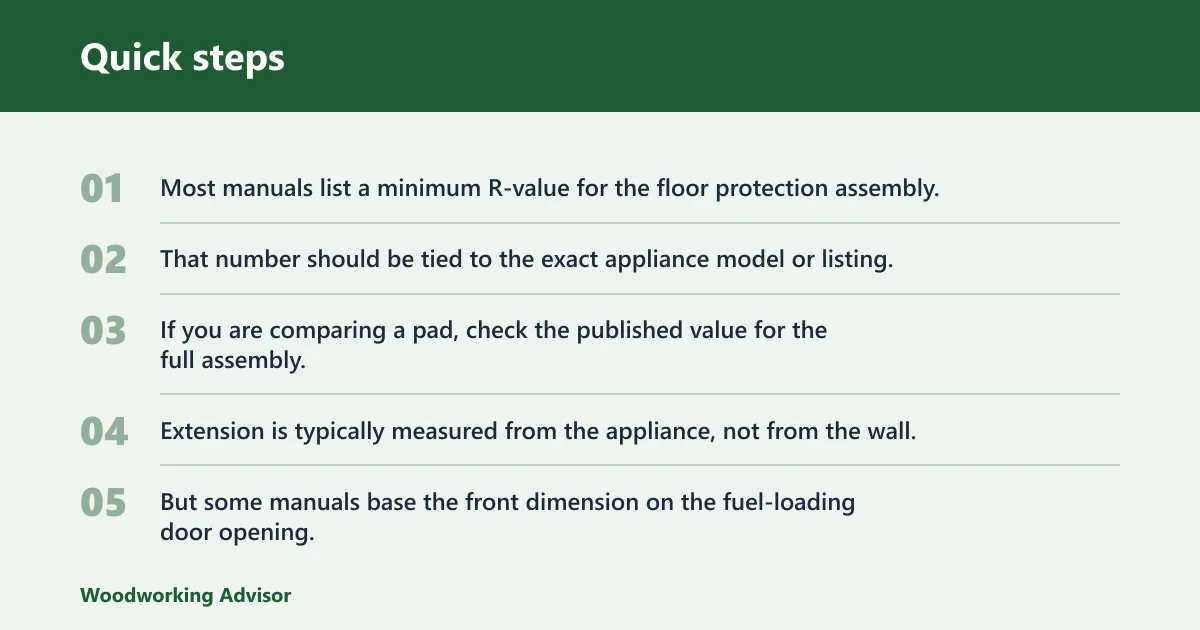
Most manuals list a minimum R-value for the floor protection assembly. That number should be tied to the exact appliance model or listing. If you are comparing a pad, check the published value for the full assembly, not just the top layer.
How front and side extensions are measured
Extension is typically measured from the appliance, not from the wall. But some manuals base the front dimension on the fuel-loading door opening, so read the stove’s wording closely. The side dimensions usually start from the appliance body or the same reference point named in the manual.
Say your manual calls for a front extension measured from the loading door opening and the opening is 16 inches wide. If the required front extension is 18 inches from that opening, the pad has to reach that distance from the door line, not from the wall behind the stove.
Worked example: comparing a stove to a pad
If the manual requires an R-value of about 1.0 and a front extension of about 18 inches from the loading door opening, follow that guidance. A listed pad with R-value 1.25 clears the thermal requirement, but only if its shape also reaches the required front and side distances. If it stops short at the front, it fails even though the insulation number is better than needed.
Picture a stove in a corner where the wall shape makes a standard rectangle too small on one side. A corner pad or a custom non-combustible board assembly may fit the room better than forcing a rectangular pad into place. The shape still has to match the manual.
What materials work under a wood stove?
Stone, tile, and steel can all appear in stove floor protection, but none of them is automatically enough on its own. The right answer depends on the manual, the published R-value, and the support beneath the visible surface.
Hearth pad options: stone, tile, and steel
Manufactured pads may come in stone, tile, and steel. Some pads are standard rectangles, corner pads, or pads with a front clip. A solid stone hearth is offered as an option, but it still has to meet the required assembly and extension for the appliance.
A steel hearth pad can work for some models, especially when the manual only asks for ember protection or when the pad has a published R-value that matches the appliance. It is not enough if the manual asks for insulating value that the steel layer alone does not provide.
When a non-combustible board assembly is the better fit
Choose a non-combustible board assembly when the stock pad will not fit, or when the manual needs a specific R-value that a listed pad does not provide. A site-built non-combustible board can be built to a specified R-value and finished on top with stone, tile, or another approved surface.
What to know about custom stone or tile hearths
Tile hearths can be decorative, but a decorative tile layer over combustible framing is not a complete answer unless the tested assembly beneath it is approved for the stove. The same caution applies to slate and other stone finishes. The top layer may look permanent while the hidden assembly remains unverified.
Older floors need extra attention. A heavy stone hearth can add load to joists and subflooring, so check the structure before you commit to a thick custom build. If the floor bounces, slopes, or shows water damage, confirm the substrate first.
What if the manual is missing or the floor is unusual?
If the manual is missing, do not guess from appearance or from a different model. Check the listing label, contact the manufacturer, and ask the local AHJ or inspector what they will accept before you buy materials. For unusual floors, the structure and the documentation matter as much as the finish.
Older floors, substrate condition, and load concerns
Old subfloors may hide weak framing, patchwork repairs, or uneven surfaces. That matters for stone hearths and for layered assemblies that add weight. A pad that is safe on paper can still be a poor choice if the floor cannot support it or if the substrate is not flat enough for a stable installation.
When to pause and confirm with the AHJ
Pause when the hearth is site-built, the appliance manual is vague, or the installer cannot document the R-value of each layer. That is also the right time to confirm with the AHJ before demolition or finish work starts. Documentation can affect inspection, resale, and liability if the appliance is later moved or replaced.
Frequently asked questions
What can I put under a wood stove on a wood floor?
Use the floor protection assembly the manual calls for. That may be a listed hearth pad, a non-combustible board assembly, or a custom hearth with a published R-value. Do not assume stone, tile, or steel is enough unless the appliance listing says it is.
Do I need an R-value hearth pad for my wood stove?
Only if your manual asks for thermal protection. Some appliances need ember-only protection, while others require a minimum R-value from the floor assembly. The number comes from the appliance manual, so the safest move is to verify the exact model before buying.
How far should a stove hearth extend in front of the door?
Follow the manual for the exact front dimension. Many manuals measure from the appliance, but some base the front extension on the fuel-loading door opening. That wording matters because a pad that is too short at the front can fail even if the material is correct.
Is tile enough protection under a wood stove?
Not by itself in many cases. Tile is a surface, not a thermal barrier, and a tile layer over a wood subfloor has little insulating value on its own. If the stove manual calls for R-value, you need a tested assembly beneath the tile, not just a decorative finish.
Can I use slate, steel, or stone under a wood stove?
Sometimes, but only if the stove manual and listing allow it. A steel sheet alone is not enough where insulation is required. Slate and stone may work as part of a listed pad or layered hearth, but the published assembly has to match the appliance requirements.
What happens if the floor protection under a stove is wrong?
The assembly can overheat the floor, leave combustible materials too close to the stove, or fail inspection. A wrong pad can also create a resale problem if there is no documentation for the hearth build. If the requirement is unclear, stop and verify it before installation.
Sponsored / affiliate links. As an Amazon Associate I earn from qualifying purchases. I may earn additional commission from eligible campaigns.