Is a Domino Joiner Worth It for a Hobbyist?
A Domino joiner can be worth it for a hobbyist who builds furniture or cabinets regularly, about monthly or more, or needs fast, repeatable mortise-and-tenon joints; for occasional small projects, it often costs too much and takes too much space. Buy it for rare projects and you pay for speed you won’t use, plus shop space you may need for something else. This guide weighs project frequency, joint type, and total cost against cheaper alternatives.
Verdict at a glance
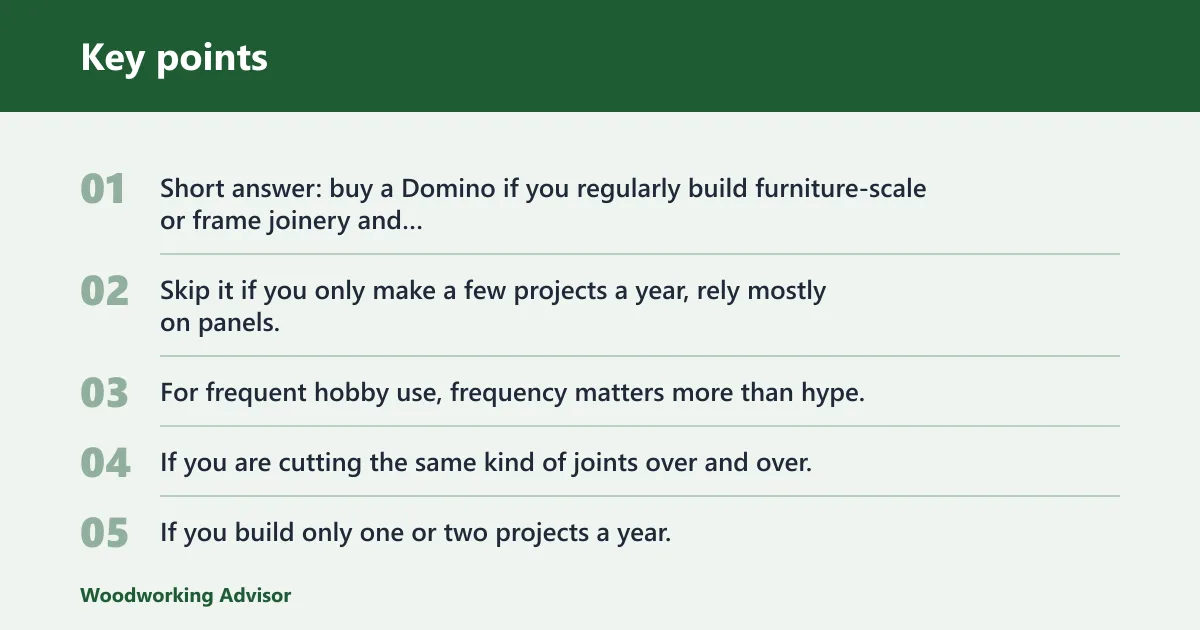

Short answer: buy a Domino if you regularly build furniture-scale or frame joinery and you value repeatable layout more than the tool’s price. Skip it if you only make a few projects a year, rely mostly on panels, or are still better served by clamps, a dowel jig, or a pocket-hole setup.
Bottom-line recommendation by project frequency
For frequent hobby use, frequency matters more than hype. If you are cutting the same kind of joints over and over, the Domino’s speed and consistent alignment become useful fast. If you build only one or two projects a year, the time saved rarely offsets the purchase price, cutter costs, and the space the tool occupies.
When the price makes sense
The Domino makes the most sense when you need hidden structural joints in chairs, tables, cabinets, small casework, or frame assemblies and you want the work to go quickly without giving up fit. That is especially true if you already spend time setting up mortisers, dowel jigs, or hand-cut joinery and want less layout repetition.
When you should skip it
Skip it if most of your projects are panel glue-ups, shop fixtures, simple utility work, or one-off builds where a biscuit joiner, dowels, or pocket screws will do the job more cheaply. It is also a weak buy if your shop is tight and the tool would crowd out clamps, storage, or a machine you would use more often.
Domino ownership cost table
The first-year cost question is not just the sticker price. You also need cutters, Festool tenons, and enough project volume to make the setup time worthwhile. The table below keeps the math simple and ties the purchase to likely hobbyist use.
| Scenario | Tool | Year-one consumables | Likely project count | Keep or skip? |
|---|---|---|---|---|
| Light-use hobbyist | DF 500, over $1,000 | One or two tenon sizes, one cutter size, ongoing tenon stock | 1-3 furniture projects | Skip |
| Regular furniture builder | DF 500, over $1,000 | Several tenon sizes, more than one cutter for mixed work | 4-8 furniture projects | Keep |
| Cabinet and frame builder | DF 500, over $1,000 | Multiple tenon sizes, cutters matched to common stock thicknesses | 8+ projects | Keep |
| Occasional large joinery | DF 700 XL, over $1,000 | Larger tenons and cutters for heavier work | 1-3 large projects | Skip |
| Frequent large joinery | DF 700 XL, over $1,000 | 8, 10, 12, or 14 mm cutters plus matching tenons | 4+ large projects | Keep |
DF 500 hobbyist scenarios
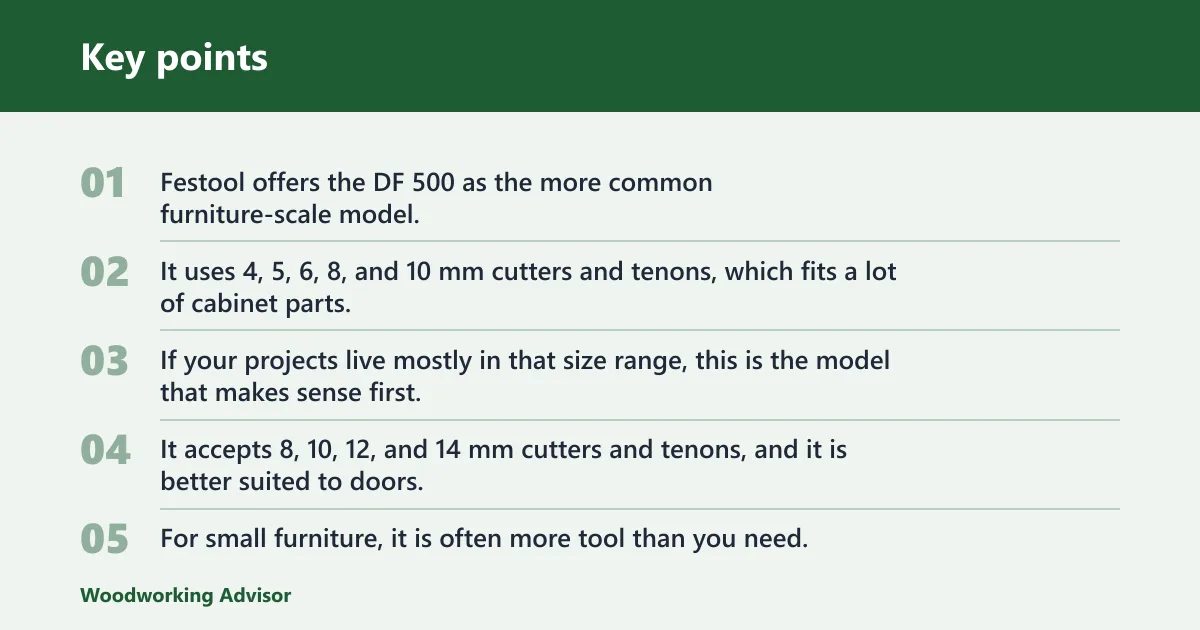
Festool offers the DF 500 as the more common furniture-scale model. It uses 4, 5, 6, 8, and 10 mm cutters and tenons, which fits a lot of cabinet parts, small casework, and furniture rails. If your projects live mostly in that size range, this is the model that makes sense first.
DF 700 XL hobbyist scenarios
The DF 700 XL is built for larger joinery. It accepts 8, 10, 12, and 14 mm cutters and tenons, and it is better suited to doors, timber-frame furniture, bed frames, and workbenches. For small furniture, it is often more tool than you need.
What consumables add in year one
Festool’s own tenon stock creates ongoing consumable costs. The real issue for a hobbyist is not one cutter or one box of tenons; it is the steady need for the right size on hand, especially if you do mixed work. Low-volume users often feel that cost more sharply because the tool sits between projects instead of earning its keep every week.
Pros and cons
Where the Domino saves time
- It cuts mortises for loose-tenon joinery quickly and repeatably.
- It reduces layout friction on furniture parts that need many similar joints.
- It keeps the joint hidden, which is helpful on fine furniture and frame work.
- It works well when you need strong alignment without full traditional mortise-and-tenon setup time.
Where the Domino falls short
- The base model is priced at over $1,000.
- You must buy Festool tenons, so consumable cost continues after purchase.
- It is not ideal for panel glue-ups, where biscuits often make more sense.
- It does not replace every joinery method, especially custom mortises or joints with unusual dimensions.
Costs and setup tradeoffs
The tool is fast only after you account for setup, cutter choice, and stock handling. On a repeat job, those steps are manageable. On a one-off project, they can feel like extra overhead, especially if a simpler jig or hand-cut joint would finish the task with less cash tied up in the shop.
Say your project is a small bookcase with four shelves and two face frames. A Domino can make the joinery fast and neat. Say the same project is a one-off pine shop cart with visible screw heads and lots of cross-bracing. Pocket screws are probably the better fit because speed matters more than hidden joinery.
Is a Domino joiner worth it for a hobbyist?
Yes, but only for the right hobbyist. It is worth it when you build furniture or frame assemblies often enough that speed, repeatability, and hidden joints pay back the purchase price. It is usually not worth it for occasional builders, especially if your projects are small, simple, or mostly made from panels.
Best fit for repeatable furniture joints
The strongest case is regular furniture work: tables, chairs, cabinets, shelves, and casework with consistent stock thickness. The Domino helps you place joints quickly and keep them aligned. That matters when you repeat the same joint type across a run of parts and want fewer layout mistakes.
Best fit for larger frame joinery
If you build doors, beds, or workbenches, the DF 700 XL is the more relevant machine. Its larger cutters and tenons suit heavier assemblies that need more meat in the joint. For that kind of work, the price can make more sense than forcing a smaller tool to do a bigger job.
When low volume weakens the value
Low volume weakens the value because the tool sits idle while still tying up money and storage space. If you only build a couple of projects a year, the time saved on each build may not justify the cost of a tool that is designed to speed up repeated joinery. That is where simpler methods stay attractive.
Domino vs biscuit joiner, dowels, and mortise and tenon
The Domino is not a universal winner. It is one option in a joinery stack, and the right choice depends on how much strength you need, how visible the joint can be, and how often you will repeat the same operation.
Domino vs biscuit joiner
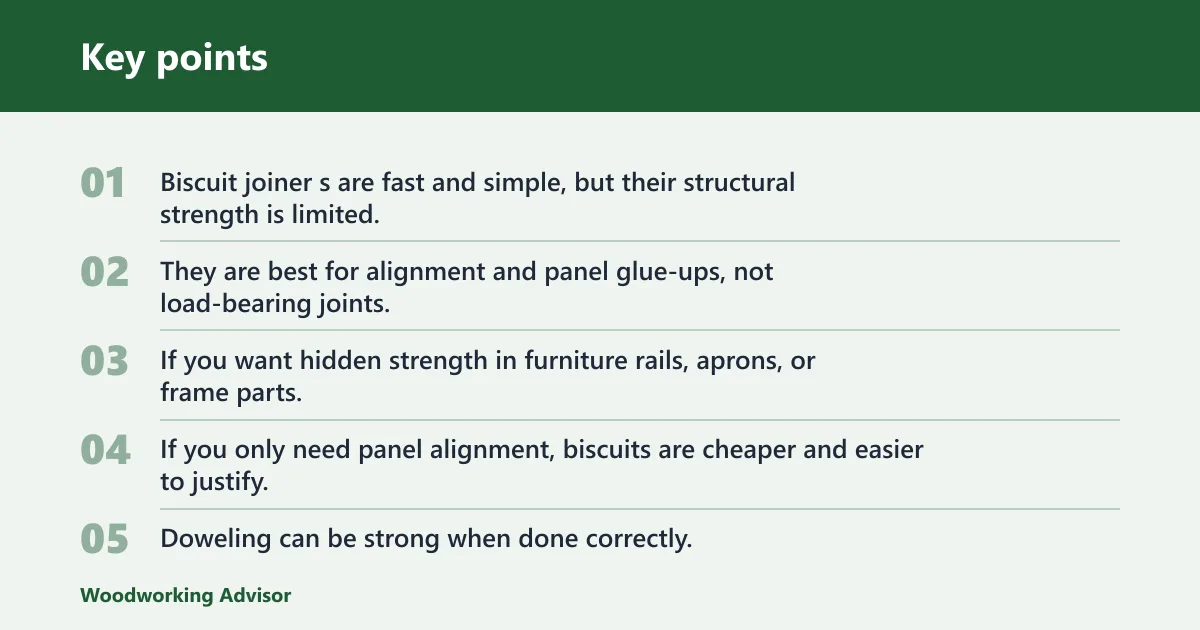
Biscuit joiners are fast and simple, but their structural strength is limited. They are best for alignment and panel glue-ups, not load-bearing joints. If you want hidden strength in furniture rails, aprons, or frame parts, the Domino is the stronger choice. If you only need panel alignment, biscuits are cheaper and easier to justify.
Domino vs doweling
Doweling can be strong when done correctly, but alignment is harder and setup is more demanding. A good dowel jig or precise drill setup matters a lot. The Domino usually wins on repeatability and speed, while dowels can win on cost if you already own the jig and can hold tight tolerances.
Domino vs traditional mortise and tenon
Traditional mortise and tenon remains the benchmark for strong joinery. It can be cut by hand or with a mortiser, but it usually takes more time. The Domino is faster and often easier to repeat, but it does not replace the flexibility of a hand-cut or machine-cut mortise when you need a custom width, thickness, or depth.
Picture a chair rail that needs six identical joints. The Domino can save a lot of layout time. Now picture a one-off trestle leg that needs a deep, wide, custom mortise to match a particular design. Traditional mortise and tenon still has the edge because you can size it to the joint instead of the cutter.
Can a hobbyist replace a mortiser?
Sometimes, yes. A Domino can replace a dedicated mortiser for many furniture-scale joints, especially if your work stays within the cutter sizes the tool supports. It can be a practical substitute when you want clean hidden joinery without buying, storing, and setting up a separate mortising machine.
Where the Domino can replace one
For chairs, tables, cabinets, and many case goods, the Domino can handle the joinery that a hobbyist would otherwise cut on a mortiser. It is especially useful when you want fast repeatable mortises in parts that are not unusually thick or wide. In that role, it is often more convenient than a separate machine.
Where a mortiser still wins
A mortiser still makes more sense when you need custom mortises, unusual sizes, or joints that go beyond the Domino’s cutter limits. Traditional mortises can be made any width, thickness, or depth. That flexibility matters on restoration work, heavier frames, or designs that do not fit the Domino’s standard tenon stock.
Width, depth, and custom mortise limits
The Domino’s mortise width is limited by the cutter and tenon system. That is fine for standard furniture work, but it becomes a constraint when the design calls for a wider or deeper joint than the machine can make. If your projects regularly demand custom mortises, a mortiser or hand-cut approach stays more flexible.
Who it’s for
Buy the DF 500 if you mainly build furniture, cabinets, and casework and you want a hidden joint system that speeds up repeatable work. Buy the DF 700 XL if you regularly make large assemblies such as doors, bed frames, timber-style furniture, or workbenches.
Skip both if you mostly build occasional shop projects, panel glue-ups, or simple utility pieces, or if your budget is better spent on clamps, a dowel jig, or a better mortising setup. The Domino is a value tool only when your project mix gives it something to do.
Frequently asked questions
Domino vs biscuit joiner: which should you buy?
Buy a biscuit joiner if your main job is panel alignment and you want a cheaper, simpler tool. Buy a Domino if you need structural loose-tenon joints for furniture or frames. Biscuits are mainly for alignment; Domino joints are better when strength matters more.
Is a Festool Domino stronger than traditional mortise and tenon?
It can be strong enough for many furniture joints, but traditional mortise and tenon remains the benchmark. The better answer is that the Domino is usually strong enough for its intended use, while a well-made traditional mortise and tenon still has the edge when maximum joint size and customization matter.
What projects justify buying a Domino joiner?
Furniture, cabinets, bookcases, chairs, bed frames, doors, and workbenches are the clearest justifications. The tool earns its keep when you repeat similar joints across multiple parts and want hidden, consistent alignment. One-off projects, simple utility builds, and panel work usually do not justify it.
How much does a Domino joiner cost with tenons and cutters?
The base model is priced at over $1,000, and the real first-year cost is higher once you add cutters and Festool tenon stock. A hobbyist should budget for the machine itself plus ongoing consumables, because the proprietary tenons are part of normal ownership, not a one-time purchase.
Can a hobbyist replace a mortiser with a Domino?
Yes, for many furniture-scale jobs. No, not for everything. A hobbyist can replace a mortiser when the work fits the Domino’s cutter sizes and standard tenon choices. A mortiser still makes more sense for custom mortises, unusual sizes, and joints that need dimensions outside the Domino system.
Sponsored / affiliate links. As an Amazon Associate I earn from qualifying purchases. I may earn additional commission from eligible campaigns.