Milwaukee Batteries on Bauer Tools: Why They Don’t Fit (+ Fix)
Milwaukee batteries do not fit Bauer tools directly — the two brands use different voltage ratings, cell counts, and connector shapes, so a Milwaukee M18 pack will not lock into a Bauer 20V tool on its own. Forcing the connection can damage the battery’s contacts or the tool’s terminals and voids both warranties. This guide covers why the two systems are incompatible, how a roughly $19 battery adapter makes one-way compatibility possible, and the safety rules for using one.
Quick Answer
No — Milwaukee batteries do not fit Bauer tools out of the box. Milwaukee’s M18 packs and Bauer’s 20V MAX packs use different voltage math and physically different battery mounts. A separate battery adapter (about $19) lets a Milwaukee M18 battery power a Bauer 20V tool, but only in that one direction, and it must never be connected to a charger.
Why Milwaukee and Bauer Batteries Aren’t Directly Compatible
Battery cross-compatibility is a system built by the manufacturer into a matching pair of parts — the pack’s physical mount, its electrical contacts, and its communication chip — and it exists specifically so tools from other brands cannot use it. Milwaukee’s M18 line and Bauer’s 20V MAX line (sold through Harbor Freight) are each proprietary in exactly this way, and neither company designs for cross-brand fit.
Both platforms are built from 5 lithium-ion cells wired in series, each rated at roughly 3.6V nominal — that math is why Milwaukee calls its pack “18V” (nominal) while Bauer markets its as “20V MAX” (peak, fully charged). In practice both packs sit around 20–21V fully charged and drop to about 15V near empty, so the voltage gap is smaller than the labels suggest. The real blocker is physical: Milwaukee’s rail-and-latch mount, contact spacing, and thermistor pin layout are shaped differently from Bauer’s slide-on mount, so the two simply will not click together.
If you’re also weighing a different brand pairing, the compatibility logic is the same across the industry — see is Ryobi compatible with other brands and do HART batteries fit other brands for how those platforms handle the same proprietary-mount problem.
Best Milwaukee-to-Bauer Adapter Pick
|
X-Adapter Milwaukee M18 to Bauer 20V Battery Adapter Snaps onto a Milwaukee M18 RED Lithium battery and adds a Bauer 20V MAX mount on top, so the M18 pack can power Bauer tools without any tool modification.
|
As an Amazon Associate we earn from qualifying purchases.
How a Milwaukee-to-Bauer Battery Adapter Actually Works
A battery adapter is a small molded shell that snaps onto one brand’s battery and recreates the other brand’s mount and contact layout on top of it — it does not change the battery’s chemistry or voltage, it just gives it the right shape and pinout to physically lock into a different tool. Several sellers make one for this specific pairing, including X-Adapter (the model tested for this guide), PowerToolsAdapters.com, and Powuse. All work the same direction: Milwaukee M18 battery in, Bauer 20V MAX tool powered.
Here’s how to use one correctly:
- Confirm your battery generation: the adapter fits Milwaukee’s M18 RED Lithium slide-pack design, not the older V18 style — check the battery’s shape against the listing photos before buying.
- Snap the adapter onto the Milwaukee battery: line up the rails and press until the release latch clicks fully home.
- Slide the assembled unit into the Bauer tool: it should seat and lock exactly like a factory Bauer pack.
- Run a short no-load test first: squeeze the trigger away from any material and watch for unusual heat, sparking, or a tool that won’t spin up at all before using it on a real job.
- Remove the battery from the adapter before charging: never place the adapter-and-battery combo on a charger of any kind.
Critical Safety Rules Before You Use One
Using a third-party adapter is the single biggest factor in whether Milwaukee-to-Bauer power ever causes a problem, so a few rules matter more than the adapter brand itself.
- Never charge through the adapter. Every adapter maker explicitly states the adapter does not support charging — remove the battery and charge it on its original Milwaukee charger only.
- Expect a warranty gap, not a warranty transfer. Using a non-OEM adapter is outside both Milwaukee’s and Bauer’s intended use, so if the tool or battery fails while the adapter is attached, don’t expect either manufacturer to honor a warranty claim on that failure.
- Watch the tool’s power ceiling. A high-draw tool (a large angle grinder or a hammer drill under heavy load) can pull more current than the adapter’s contacts are rated for; save cross-brand power for lighter-duty tools like drivers, lights, and small saws.
- Inspect the contacts before every use. Corrosion, bent pins, or a loose fit at the adapter-to-tool interface is the most common cause of a battery reading full but a tool that won’t run.
In practice, we treat a cross-brand adapter as a stopgap for finishing a job with a charged spare, not a permanent battery strategy — keeping one platform per job type avoids the adapter question entirely, and we only reach for one when the alternative is stopping mid-task with a dead pack.
Can Bauer Batteries Power Milwaukee Tools? (Reverse Direction)
No — the adapters sold for this pairing only run one direction: Milwaukee battery into a Bauer tool. There’s no equivalent adapter that lets a Bauer 20V MAX battery power a Milwaukee M18 tool, because Milwaukee’s REDLINK communication protocol on M18 tools checks for a Milwaukee-specific handshake before it will draw power, and a Bauer pack behind an adapter can’t replicate that signal. Bauer tools have no such lockout, which is exactly why the Milwaukee-to-Bauer direction works and the reverse doesn’t.
| Spec | Milwaukee M18 | Bauer 20V MAX |
|---|---|---|
| Nominal / marketed voltage | 18V nominal | 20V MAX (peak) |
| Cell configuration | 5 cells in series, ~3.6V each | 5 cells in series, ~3.6V each |
| Fully charged voltage | ~20–21V | ~20–21V |
| Battery mount | Rail-and-latch slide mount | Slide-on mount (different geometry) |
| Tool-side lockout | REDLINK handshake required | No handshake required |
| Adapter available? | Yes — powers Bauer tools only | No adapter powers Milwaukee tools |
If You Own Both Brands: What Actually Makes Sense
For most people who own tools from both lines, the adapter is worth keeping in a drawer as a backup, not buying as a daily habit. If you’re mostly running Bauer tools and only occasionally have a charged Milwaukee pack on hand, a single ~$19 adapter costs less than a spare Bauer battery and covers that gap. If cross-brand power is a regular need — not an occasional rescue — buying a second Bauer battery is usually the better long-term move, since it avoids the contact wear and current-limiting that comes with running everything through an extra connector.
Whichever route you pick, buying tools within a single platform going forward — rather than mixing brands and relying on adapters — is what actually reduces battery headaches over time. If you’re deciding between platforms for a new tool purchase, who makes Bauer power tools covers where the Bauer line fits compared to name-brand options, and can you use M18 batteries on M12 tools answers the same compatibility question within Milwaukee’s own lineup.
Frequently Asked Questions
Do Milwaukee batteries fit Bauer tools without an adapter?
No. Milwaukee M18 batteries and Bauer 20V MAX tools have physically different battery mounts and contact layouts, so a Milwaukee pack cannot lock into a Bauer tool on its own, regardless of voltage similarities.
Can I use a Milwaukee M18 battery on a Bauer 20V tool?
Yes, but only with a separate battery adapter (roughly $19) that snaps onto the Milwaukee battery and adds a Bauer-compatible mount. Without the adapter, the two are not compatible.
Can I charge a Milwaukee battery through the Bauer adapter?
No. Every Milwaukee-to-Bauer adapter on the market explicitly does not support charging. Remove the battery from the adapter and charge it only on its original Milwaukee charger.
Will using an adapter void my tool’s warranty?
It can. Neither Milwaukee nor Bauer designs for or endorses third-party adapters, so a failure that occurs while an adapter is attached is unlikely to be covered under either brand’s standard warranty.
Can Bauer batteries power Milwaukee tools the same way?
No. Milwaukee M18 tools require a REDLINK communication handshake before they’ll draw power, which a Bauer battery behind an adapter cannot replicate. Adapters for this pairing only work in the Milwaukee-battery-to-Bauer-tool direction.
Conclusion
Milwaukee batteries do not fit Bauer tools out of the box — the voltage systems are close, but the physical mounts and Milwaukee’s REDLINK handshake are not. A roughly $19 adapter makes one-way compatibility possible, letting a Milwaukee M18 battery power a Bauer 20V tool, but it should never be used for charging and works in that single direction only. For most owners of both brands, the adapter is a smart backup to keep on hand rather than a full-time substitute for owning batteries in the platform you actually use most.
Sponsored / affiliate links. As an Amazon Associate I earn from qualifying purchases. I may earn additional commission from eligible campaigns.
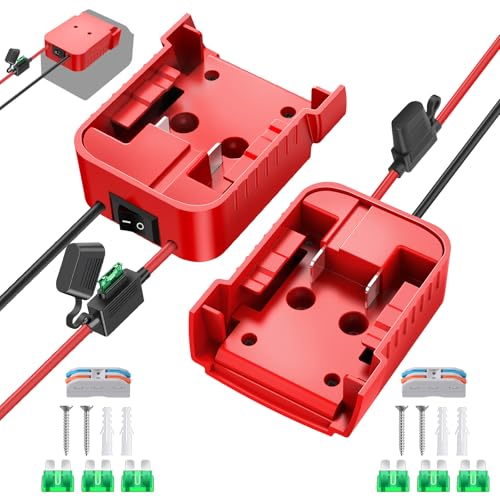 2 Packs 18V Adapters Compatible with Milwaukee M18 Battery for Power Wheel Adapter, Ride On Toy Car, DIY Power Projects, Battery Connector Conversion Kit with Switch & Fuse, 12AWG Wire, Wire Terminal
 2 Pack Battery Adapter for Milwaukee M12 12V Tools, Compatible with DeWalt 20V MAX and Milwaukee M18 18V Batteries, M18 to M12 Battery Converter for Cordless Power Tools, Adapter Only