1/2 vs 3/4 Pipe Clamps: Which Size to Buy (With Deflection Math)
Use 3/4 inch pipe clamps for panel glue-ups, tabletops and any span over about 36 inches; 1/2 inch clamps are fine for face frames, drawers and small boxes. The reason is stiffness, not the fixture: standard 3/4 inch pipe resists bending about 2.2 times better than 1/2 inch pipe. This guide covers the real pipe dimensions, a span-by-span bow calculation, and when each size makes sense.
Which Is Better: 1/2 Inch or 3/4 Inch Pipe Clamps?
Best 3/4 Inch Pipe Clamp Pick | |
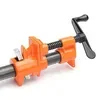 |
PONY 50 Clamp Fixture for 3/4 Inch Black Pipe, $19.49 The head and tail-stop set that turns any length of 3/4 inch pipe into a clamp, which is the stiffer size this guide recommends for panel glue-ups and long spans. Pipe is sold separately.
|
As an Amazon Associate we earn from qualifying purchases. | |
If you only buy one set, buy 3/4 inch. It costs a little more and weighs more, but it clamps thicker stock, bows less on wide panels, and you will not outgrow it. The 1/2 inch size earns its place as a second, lighter set for cabinet and case work.
Woodworkers in long-running threads on LumberJocks, WOODWEB and the Fine Woodworking forum keep repeating the same advice: 3/4 inch for glue-ups, 1/2 inch when weight and cost matter. The rest of this article checks that advice against actual pipe dimensions instead of taking it on faith.
What 1/2 Inch and 3/4 Inch Really Mean: Nominal Pipe Size
Neither number is a measurement you can take with a tape. Pipe is sold by nominal pipe size (NPS), a trade label that started as an inside diameter and drifted away from it decades ago. Put calipers on a 1/2 inch pipe and you read 0.840 inch across the outside; a 3/4 inch pipe reads 1.050 inch.
| Spec (Schedule 40 black pipe) | 1/2 inch pipe | 3/4 inch pipe |
|---|---|---|
| Actual outside diameter | 0.840 in | 1.050 in |
| Wall thickness | 0.109 in | 0.113 in |
| Inside diameter | 0.622 in | 0.824 in |
| Bending stiffness factor (moment of inertia) | 0.0171 in4 | 0.0370 in4 |
| Pony fixture model / clamping face | No. 52 / 1-1/2 in | No. 50 / 1-3/4 in |
Two details in that table explain almost everything. The 3/4 inch pipe is only 0.21 inch wider, yet its stiffness factor is more than double, because bending resistance depends on diameter to the fourth power. And the fixtures are matched to those diameters, so a 1/2 inch head will not fit 3/4 inch pipe. Pony’s own guidance for its fixtures is to cut the pipe about seven inches longer than the work, which leaves room for the head, the tail-stop and the crank.
A related trap: do not confuse pipe with conduit or tubing. Electrical EMT sold as 1/2 inch measures 0.706 inch outside and copper “1/2 inch” water tube is 5/8 inch outside, so neither will fit a pipe-clamp fixture. Ask for threaded black steel pipe.
How Much Stiffer Is 3/4 Inch Pipe? (Deflection by Span)
Most comparisons stop at “3/4 is stronger.” Here is the number. Treating the pipe as a simple beam supported at both ends with a 100 lb load at the middle, steel’s modulus of elasticity of 29,000,000 psi and the stiffness factors above give the bow shown below.
| Pipe span | 1/2 inch pipe bow | 3/4 inch pipe bow |
|---|---|---|
| 24 in | 0.058 in | 0.027 in |
| 36 in | 0.196 in | 0.090 in |
| 48 in | 0.465 in | 0.215 in |
| 60 in | 0.908 in | 0.419 in |
Data point: the ratio is a constant 2.17 to 1 at every span, and doubling the span multiplies the bow by eight. Notice that 3/4 inch pipe at 60 inches (0.419 in) bows slightly less than 1/2 inch pipe at 48 inches (0.465 in). Moving up one pipe size buys roughly a foot of extra reach at the same flex. Source: standard Schedule 40 pipe dimensions and the Euler-Bernoulli beam formula.
Real clamps load the pipe off-center, so absolute bow will differ from this idealized model, and pipe steel varies. The relative comparison is the useful part. It also shows why a bowed pipe matters: as the pipe flexes, pressure stops being even across the width of the joint, which is one common source of glue-line gaps. If you fight squeeze-out or starved joints, see our guide to clamp pressure and glue squeeze-out.
1/2 Inch vs 3/4 Inch Pipe Clamps: Side-by-Side
| Factor | 1/2 inch | 3/4 inch |
|---|---|---|
| Stiffness at equal span | Baseline | About 2.2x stiffer |
| Clamping face | 1-1/2 in | 1-3/4 in |
| Reach and thick stock | Fine for stock under about 1-1/2 in | Deeper reach for thicker stock |
| Weight and handling | Lighter, easier to hang and carry | Heavier, more pipe steel per foot |
| Fixture and pipe cost | Generally lower | About $19.49 per set (live listing) |
| Crank handle | Often a slip-through rod that can catch neighboring clamps | Solid crank that needs swing clearance |
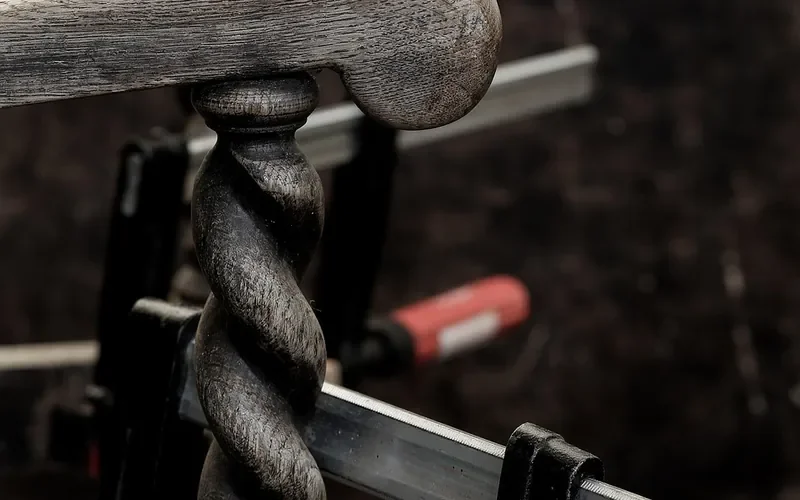
Weight is a real factor at the shop, not just in the spec sheet. A rack of 3/4 inch clamps at 48 inches is a lot of steel to lift onto a bench, while 1/2 inch sets are easier to move around for one-person assemblies. The crank difference is small but real: rows of 3/4 inch cranks need space to swing, so you cannot pack them shoulder to shoulder.
When 1/2 Inch Pipe Clamps Are Enough
- Face frames and door frames: spans are short, so bow stays small.
- Drawers, small boxes and cases: light pressure and narrow assemblies.
- Picture frames and trim work: low force, and lighter clamps are easier to position.
- A budget first set: two or three 1/2 inch clamps handle most beginner projects, and they double as light-duty helpers later.
Keep the pipe as short as the job allows, since bow rises with the cube of the span. Cutting a 36 inch pipe from a 48 inch one is free insurance.
When You Should Step Up to 3/4 Inch
- Panel glue-ups and tabletops: wide panels need even pressure across many boards, and the stiffer pipe keeps it even.
- Thick stock over about 1-1/2 inches: the 1-3/4 inch faces give deeper reach.
- Long spans over 36 inches: the bow table shows why the smaller pipe struggles here.
- Benchtops and laminated beams: jobs where a bowed pipe means a gap you cannot fix later.
For clamp spacing and how long to leave pressure on, use our wood glue clamp time chart. If your glue-ups outgrow the pipe you own, extending a clamp covers workable ways to reach further. And if you are also weighing this style against a parallel-jaw bar clamp, read pipe clamps versus bar clamps.
Mistakes That Ruin Pipe Clamp Glue-Ups
Letting bare steel touch wet glue
Iron, moisture and the tannins in woods like oak react to leave gray-black stains that sand out only with effort. Slip wax paper or scrap strips between pipe and work, and wipe drips right away.
Leaving mill oil on new black pipe
New black pipe ships coated in oil. Wipe it down with mineral spirits before it goes near a joint, or the oil transfers to your boards and can interfere with finishing.
Over-cranking to close a bad joint
A clamp is meant to hold a fitted joint, not force a poor one shut. Extra cranking bows the pipe further, and that is the failure the table above quantifies. Fix the fit first.
Mixing pipe sizes in one set
Because heads, tail-stops and pipe must match, a mixed set gives you clamps that fit nothing. Buy a full run of fixtures for one size before you buy pipe, then threaded pipe to length.
Is It Worth Owning Both Sizes?
Eventually, yes, but not on day one. A sensible path is to start with three or four 3/4 inch clamps for glue-ups, since that size handles the widest range of jobs, and add lighter 1/2 inch clamps when you notice yourself hauling heavy steel for a small frame. Owning both also keeps you from tying up your good long clamps on quick assemblies.
Frequently Asked Questions
Can I use a 1/2 inch clamp fixture on 3/4 inch pipe?
No. The fixture is machined and threaded for one nominal pipe size, so a 1/2 inch head will not thread onto or grip 3/4 inch pipe, and the reverse is just as true. Pick one size per set of clamps, because heads and tail-stops are not interchangeable between sizes.
Are 3/4 inch pipe clamps stronger than 1/2 inch pipe clamps?
They are stiffer, which is the part that matters in a glue-up. Standard 3/4 inch black pipe resists bending about 2.2 times better than 1/2 inch pipe. We found no published clamping-force rating for either Pony fixture size, so treat any exact pounds-of-force claim skeptically.
How long can a pipe clamp be before it bows too much?
There is no fixed limit, because bow grows with the cube of the span. In our beam calculation, 1/2 inch pipe at 48 inches bows about as much as 3/4 inch pipe at 60 inches. For wide glue-ups, choose 3/4 inch pipe and keep the pipe only as long as the work requires.
Do I need black pipe or galvanized pipe for pipe clamps?
Either works with standard fixtures, and Pony lists both for its 1/2 inch fixture. Black steel pipe is the usual choice and is easy to find threaded. Wipe off the mill oil first, and keep bare steel off wet glue and tannin-rich woods like oak, which can leave dark stains.
Is 1/2 inch enough for cabinet doors and face frames?
Yes. Short spans under about 36 inches keep bow small, so 1/2 inch clamps are a reasonable, lighter and cheaper choice for face frames, drawers, small boxes and door frames. Step up to 3/4 inch when you start gluing wide panels or thick stock.
Pick 3/4 inch for glue-ups and 1/2 inch for light frame work, and keep the pipe as short as the job allows.
Sponsored / affiliate links. As an Amazon Associate I earn from qualifying purchases. I may earn additional commission from eligible campaigns.