How to Heat a Garage Workshop Without Starting a Fire
Heat a garage workshop with electric heat only when you can control dust, keep combustibles 3 feet away, and use a thermostat. Unvented gas, open coils, and fuel-fired salamanders need extra separation or should stay out. Used carelessly, they can ignite dust, solvents, or stored finishes and cost you tools, the building, or both. This guide sorts safe heat sources by risk and shows what setup changes make each one acceptable.
This guide is part of our Winter Woodshop Guide: Heat, Humidity, Rust and Safety series.
Garage workshop heat-safety table
Use this table first. It separates heater choice from garage type, because attached garages have a different hazard profile than detached ones, and combustion heat has different requirements than electric heat.
| Heater type | Ignition risk | Ventilation need | CO risk | Clearance burden | Dust sensitivity | Best-fit workshop conditions | Do not use if |
|---|---|---|---|---|---|---|---|
| Electric unit heater | Low if listed, installed, and kept clear | None for heat source itself | None at point of use | Manufacturer-specific, often moderate | Moderate; keep dust off elements and motor parts | Detached or attached garage with enough electrical capacity and controlled dust | Do not use if you cannot meet the listed circuit, mounting, and clearance requirements |
| Infrared electric heater | Low to moderate, depending on mounting and aim | None for heat source itself | None at point of use | Usually less than open-flame units, but still model-specific | Moderate; hot surfaces still matter | Spot heating for work zones, especially where you do not need to warm the whole volume | Do not use if stored lumber, solvents, or rags sit in the beam path |
| Mini split heat pump | Low | None for combustion; outdoor unit still needs clear space | None at point of use | Low at the indoor head, with code-compliant electrical work | Low to moderate; keep filters and coils clean | Conditioned garages or shops where you want steady heat and lower fire exposure | Do not use if the garage is too leaky or uninsulated for the unit to hold set temperature |
| Propane heater | High if unvented or poorly placed | Required only as listed by the exact appliance and code | High for unvented types | High | High near open flame or hot surfaces | Only when the exact listed appliance, combustion air, exhaust, and clearance requirements are met | Do not use if you plan to “just crack a door” instead of following the listing and code |
| Natural gas heater | High if unvented or installed wrong | Required only as listed by the exact appliance and code | High for unvented types | High | High near dust, finishes, and storage | Spaces with a properly sized, vented, code-compliant installation | Do not use if the appliance is not listed for the location or if exhaust and make-up air are not provided |
| Other combustion heater | High | Required by the appliance listing and code | High | High | High | Only where a code-compliant vented installation is planned from the start | Do not use if you are treating it like a temporary shop heater |
What is the safest way to heat a garage workshop?
The safest option for most woodworkers is an electric heater or mini split, paired with dust control, proper clearances, and thermostat control. Attached garages deserve the most caution because heat, fire, and carbon monoxide can move into the house. Detached garages reduce that migration risk, but they still need dust cleanup and safe spacing.
Detached versus attached garages
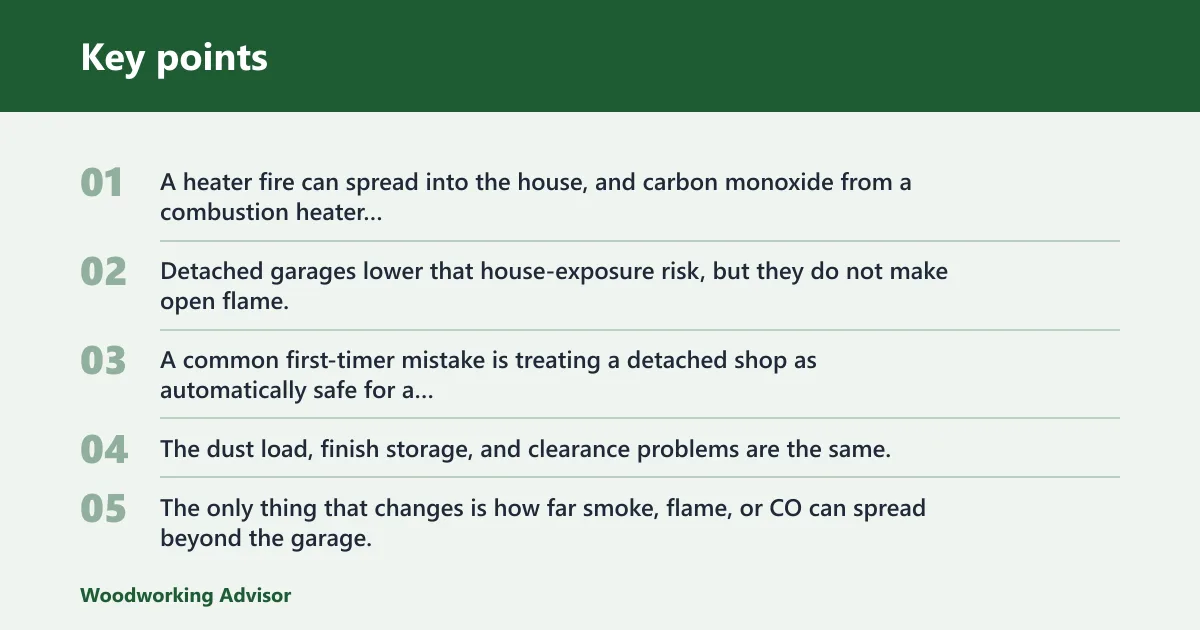
An attached garage changes the risk profile. A heater fire can spread into the house, and carbon monoxide from a combustion heater can migrate through doors, wall penetrations, or shared air leaks. Detached garages lower that house-exposure risk, but they do not make open flame, dusty surfaces, or solvent vapor safe.
A common first-timer mistake is treating a detached shop as automatically safe for a propane salamander because the building is separate. The dust load, finish storage, and clearance problems are the same. The only thing that changes is how far smoke, flame, or CO can spread beyond the garage.
Heat source choices ranked by fire risk
For a woodworking garage, electric resistance heat and mini split heat pumps usually create the lowest fire risk because they do not burn fuel at point of use. Infrared electric heat can also be reasonable when mounted and aimed correctly. Combustion heaters are higher risk, and unvented portable units are the least forgiving.
Solid-fuel appliances, including wood stoves, usually fit poorly in a garage workshop. Many garages and workshops face code and insurance limits on solid-fuel appliances, and wood smoke, embers, and ash create hazards that are hard to control around dust, finishes, and stored lumber.
When insulation should come first
If the garage loses heat quickly, insulation and air sealing may matter more than heater size. Wall and ceiling R-value, door weatherstripping, and air sealing around penetrations reduce heat loss and can make a smaller heater practical. Without that work, even a larger heater may run constantly and still leave cold corners.
For rough sizing, many electric heaters are counted in watts and many fuel heaters in BTU per hour. A common planning step is to size the heater after you account for garage dimensions, insulation level, and leakage, not before. A leaky uninsulated garage can need far more capacity than a sealed and insulated one of the same size.
How do you keep dust from becoming a fire hazard?
Clean the shop before you heat it, and keep it clean while the heater runs. Fine sawdust is the main concern near hot surfaces, open flame, or glowing elements. Nuisance dust on the floor is a housekeeping problem; airborne fine dust, packed dust on heater parts, and dust around ignition sources are a fire problem.
Cleanup before heating
Sweep or vacuum the floor, machine bases, and shelf tops before turning on heat. Empty dust collection bins, clear piles from around motors and cords, and remove chips from under benches and behind cabinets. The goal is not perfection; the goal is to keep fine fuel away from the heater and away from hot surfaces.
- Remove rags, solvent cans, aerosol finishes, and finish wipes from the heater zone.
- Empty visible dust from floors, tool stands, and machine guards.
- Check under benches, behind saws, and around dust ports for packed debris.
- Make sure air intakes, filters, and heater faces are free of buildup.
- Leave a clear path to the door and to the extinguisher.
Fine dust, rags, finishes, and solvents
Dust is only part of the ignition picture. Solvent vapors from finishes, adhesives, and cleaners can ignite at heaters, switches, and relays. Oily rags add another hazard because they can self-heat in the wrong storage conditions. Put oily rags in a proper lidded metal container and keep all finishing materials away from the heater.
Say your bench sits six feet from a wall-mounted electric heater and you keep sanding sealer on an open shelf below it. The heater may still be unsafe, not because of dust alone, but because vapor and storage are now too close to a hot appliance. Move the finish storage first, then reassess clearances.
Clearance around tools and storage
Keep a storage exclusion zone around the heater. The exact distance comes from the manufacturer label, and it can differ by model, output, and mounting method. Do not use a blanket 3-foot rule as a substitute for the listed rear, side, and overhead clearances.
That clearance zone also needs to stay free of scrap lumber, cardboard, solvent containers, extension cord coils, and hanging rags. If the heater is near a bench, rack, or rolling cabinet, make sure moving the cabinet does not shrink the protected zone later.
Heater types that fit a woodworking garage
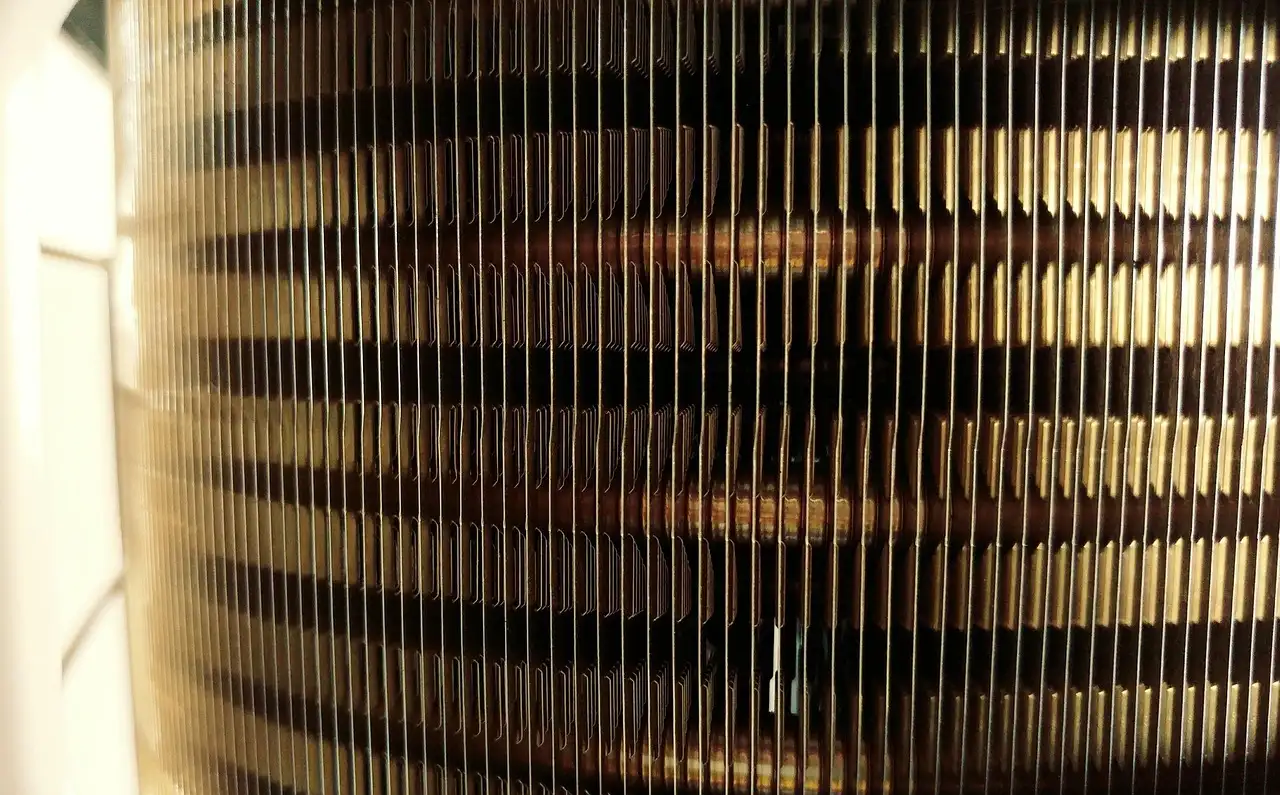
Choose the heat source by fire risk first, then by operating cost and installation effort. In a dust-prone shop, the safer heater is often the one with the simplest ignition profile, the fewest hot exposed parts, and the easiest control over temperature.
Electric unit heaters and infrared heat
Electric unit heaters work well when mounted to code, wired correctly, and kept away from dust buildup. Infrared electric heaters warm objects and people more directly, which can help when you only need comfort in one work area. Both still need manufacturer-specified clearances and a thermostat.
The 11-gauge steel plate example used for a workbench top is equal to 1/8-inch, and a separate example described a steel top costing $180 with the plate itself at $92. Those kinds of durable surfaces matter because a heater placed near a flimsy bench cover or cardboard storage system creates an unnecessary ignition path.
One garage upgrade example used a sheet metal workbench cover and described the top as costing under $300 and assembling in under an hour. Another suggested upgrade was a grease gun holder made from 1-inch and 3-inch PVC pipe sections, and PVC drawer organizers using 1- or 2-inch PVC pipe. Those are useful shop-storage examples, but PVC still belongs outside the heater’s clearance zone.
Mini split heat pumps
A mini split is often safer than a gas heater for a workshop because it avoids combustion at the point of use. That means no burner flame, no flue gas from the appliance itself, and no carbon monoxide from the heating cycle. It still needs proper installation, electrical work, and clean indoor filters.
Mini splits fit best in garages that have some insulation and air sealing. If the building leaks too much air, the unit may short-cycle or struggle to hold temperature. The safer choice can still be the wrong choice if the shop cannot retain heat.
Propane and natural gas heaters
Can you use a propane heater in a garage workshop safely? Sometimes, but only with the exact listed appliance, the required combustion air, and the exhaust provisions for that heater. An open door is not a universal fix. The installation details and code requirements depend on the unit and on whether it is vented or unvented.
Carbon monoxide is the key hazard with fuel-burning heaters. Use a CO alarm placed according to the alarm manufacturer’s instructions and local code, and treat it as a warning device, not a substitute for ventilation. If the heater is unvented, installed incorrectly, or used in a tightly closed garage, it does not belong there.
Condensation matters too. Cold garages can build moisture when fuel-burning heat runs, which can add corrosion and damp surfaces to the fire-risk list. Make-up air and exhaust routing should be part of the plan before the heater is installed, not after it is already in service.
How far should a heater be from combustibles?
Follow the manufacturer’s clearance label, not a generic distance. Rear, side, and overhead clearances vary by model and listing, and some heaters need much more space than others. The area around the heater should also remain free of stored materials, even if the walls themselves are far enough away.
Reading the manufacturer’s clearance label
The label or installation manual is the controlling document for clearances to combustibles. It should tell you how many inches or feet the heater needs at the rear, sides, and above the unit. If the manual requires a mounting height or a specific orientation, that matters as much as the distance numbers.
If the label is missing, unreadable, or unavailable, do not guess. Replace or document the heater before use. A heater with uncertain clearances is not a safe shop appliance.
Rear, side, and overhead clearances
Hot air rises, and many heater failures begin with an overhead clearance problem. Shelves, joists, cords, and storage totes above the heater can catch heat long before the wall does. Side clearances matter too, because tools, lumber, and ductwork can sit within the hot envelope of the appliance.
Storage exclusion zone around the heater
Keep the area around the heater empty, even if it is wall mounted. Do not hang dust masks, rags, gloves, spray bottles, or extension cords nearby. If you need storage where the heater wants to sit, move the storage. Do not compromise the protected zone.
Do you need ventilation for a garage workshop heater?
Ventilation is required for fuel-burning heaters unless the exact appliance listing and code say otherwise, and even then the installation must match the listing. Electric heaters and mini splits do not burn fuel at point of use, so they do not create combustion products, but the garage still needs air movement for comfort and dust control.
Combustion air and exhaust for fuel-burning units
Propane, natural gas, and other combustion heaters need the air supply and exhaust arrangement their listing requires. That may mean direct venting, room air for combustion, or a dedicated flue path. Do not assume that opening a garage door gives the appliance what it needs. The appliance instructions and local code control.
Make-up air and condensation control
Fresh air exchange helps control combustion byproducts and moisture. In a cold garage, poor make-up air can leave the space damp, which encourages corrosion and can create slippery floors around machines and cords. Vent routing should also avoid dumping hot exhaust near stored materials or dust collection equipment.
Why an open door is not a universal fix
An open door can change temperature and airflow, but it does not automatically make a heater safe. It may still leave CO accumulation, backdrafting, or hot exhaust near combustibles. Use the listed venting method for the appliance, then add ventilation only as the installation requires.
What safety controls should you require?
Buy and install only heaters with the right safety controls for a workshop. Tip-over shutoff, overheat cutoff, flame-failure protection, thermostat control, and an indoor-use rating are not extras. They are the minimum features that reduce the chance of a heater fault turning into a shop fire.
Tip-over and overheat protection
Portable heaters need tip-over shutoff and overheat protection. Even a stable garage floor can shift under cords, carts, or stored wood. If the heater can fall, it should shut off immediately. If internal temperature rises too high, it should stop heating before nearby dust or materials are affected.
Flame-failure protection and limit switches
Combustion heaters should include flame-failure protection so gas does not keep flowing if ignition is lost. Limit switches and similar thermal safeties matter too, because they shut the unit down when temperatures exceed safe operating limits. These controls do not replace clearance and ventilation, but they do add a critical layer.
Thermostat control and indoor-use rating
A thermostat reduces runaway heat and helps you avoid overheating a dry, dust-prone shop. Look for an indoor-use rating on the appliance. Outdoor-rated equipment belongs outdoors, not in a garage workshop, even if the garage door is open.
Keep an ABC extinguisher within quick reach, mounted where you can grab it without stepping past the heater. It should be accessible from the exit path, not buried behind lumber or cabinets. In a workshop fire, fast access matters more than capacity.
Frequently asked questions
How do I heat a garage workshop without starting a fire?
Start by removing dust, moving finish storage, and checking the heater’s clearance label. Then choose a low-ignition heat source, keep combustibles out of the storage exclusion zone, and use a thermostat. If the heater burns fuel, follow the exact venting and combustion-air requirements for that model.
Can I use a propane heater in a garage workshop safely?
Only if the heater is specifically listed for that use and installed exactly as the manufacturer and code require. Propane units raise ignition and carbon monoxide risk, so you need proper combustion air, exhaust provisions, clearances, and CO protection. A casual “open the door” approach is not enough.
How far should a heater be from sawdust and flammables?
Use the manufacturer’s clearance label for the real distance. Do not rely on a universal 3-foot rule. Keep sawdust, scrap, rags, finishes, cardboard, and extension cords out of the heater’s protected zone, and clean dust from the heater itself before each heating season or major session.
Should I insulate before adding heat to my garage workshop?
Usually yes. Insulation, air sealing, and door weatherstripping reduce heat loss and can keep heater sizing reasonable. If the garage is leaky or uninsulated, even a stronger heater may run too hard and still leave cold zones. Better enclosure often makes the safest heater easier to use.
Sponsored / affiliate links. As an Amazon Associate I earn from qualifying purchases. I may earn additional commission from eligible campaigns.