Shop Door Insulation Kit
Reach Barrier 3009 is a practical starting point for a single overhead shop door because its eight 24-inch-by-48-inch precut panels are light, simple to place, and easier to remove than heavy board stock. Choose heavier or more rigid kits only after you verify panel depth, side clearance, and door balance.
A shop door insulation kit works best when it matches the door’s motion and clearance: use light adhesive foam or reflective panels on overhead doors with enough clearance for the door’s hardware and travel, and avoid heavy batts or rigid boards that may bind rollers, tracks, or springs. Badly chosen insulation can jam the door, tear seals, and waste heat or AC. This guide explains which kit fits roll-up and overhead shop doors, how much clearance you need, and when seals matter more than added R-value.
Must-have
You need three things before you buy: a kit that fits the door width and panel pattern, a fastening method that will stay put during opening cycles, and enough clearance for the added thickness at tracks, hinges, and side rails. If those three do not line up, the insulation choice is wrong no matter how good the R-value looks.
Door fit and width limits
Most garage door insulation kits are generally aimed at single doors around 8–9 feet wide or double doors around 16–18 feet wide. That range matters because precut panels, strips, and roll goods are built around common door modules, not every custom opening. A kit that is too short leaves gaps, and one that is too wide can interfere with hinges or jamb seals.
Clearance around tracks, rails, and slats
Roll-up and overhead shop doors need more clearance checks than a fixed wall. Measure the space behind the door skin, beside each track, and above any top strut or operator arm. Panel depth, slat profile, and fastener thickness can all create a bind point, especially on older doors with shifted tracks or worn rollers.
Fastening method and added weight
Most kits attach with adhesive fasteners or tape, while some include nails or track hardware for weather stripping. Adhesives are usually the least intrusive option for removable seasonal use, but they depend on clean metal or painted surfaces. Heavier foam-core or spray options can change door balance, so the spring system should be checked after installation.
Nice-to-have
These items matter when you care about comfort, dust, or appearance, but they are not the first buying filter. A shop door that already leaks at the perimeter will still feel drafty if the seal line is poor, even when the panels themselves are insulated.
Seasonal removability
If you only need winter help, pick a kit that comes off cleanly. Precut reflective panels and taped foam panels are easier to remove than spray foam or permanently mounted weather-strip systems. A removable kit also gives you access for maintenance when the door needs adjustment, lubrication, or spring service.
Condensation and moisture resistance
Moisture resistance matters in a shop because cold metal skins can sweat. Reflective foil and closed-cell foam handle moisture better than exposed fiberglass in many garage-door uses. Cellofoam’s washable installed product is aimed at that kind of duty, while fiberglass is better treated as a temperature-control option rather than a wipe-clean surface.
Appearance and light control
Panelized products can look cleaner on the inside face of the door and hide fewer seams than loose strips. That matters in a visible shop, especially when the door faces a finished work area. Matador is positioned around appearance and thermal retention, while brush seals help cut light and dust at the edges.
Consumables and spares
Keep the install simple. You need the right seal pieces, cutting tools, and a way to clean the door skin before tape or adhesive goes on. Missing prep is one of the fastest ways to make a kit fail early.
Measuring tape, cleaner, and cutting tools
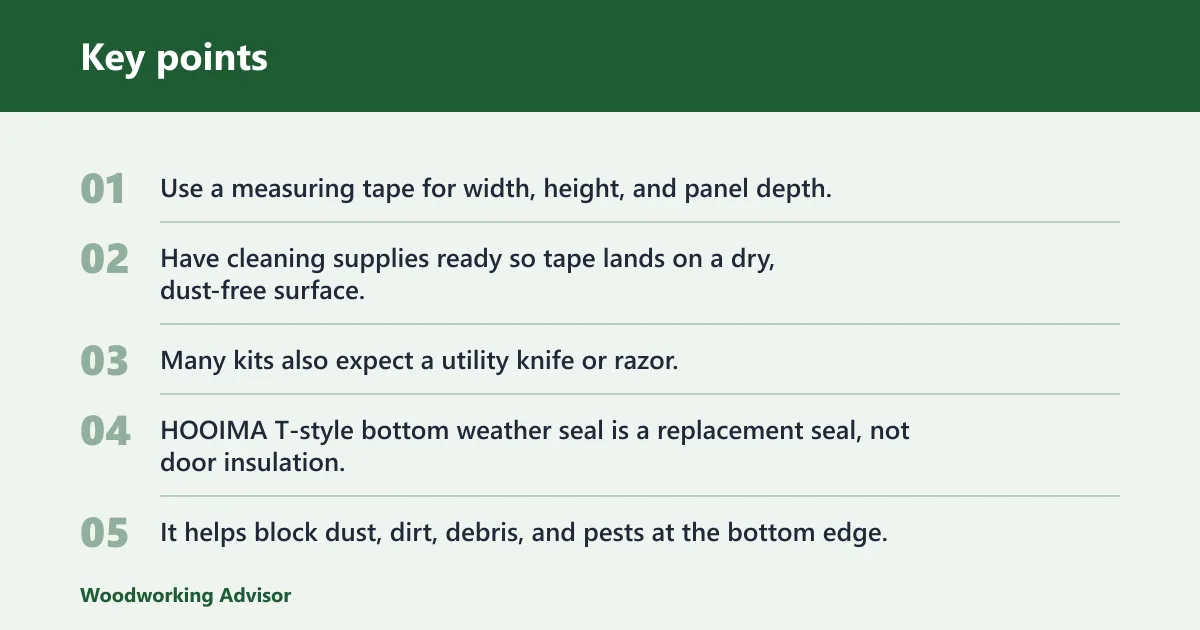
Use a measuring tape for width, height, and panel depth. Have cleaning supplies ready so tape lands on a dry, dust-free surface. Many kits also expect a utility knife or razor, and reflective products often go smoother with a squeegee to press out bubbles and improve tape contact.
 As an Amazon Associate we earn from qualifying purchases. Prices and availability are accurate as of the date shown and are subject to change

HOOIMA T-style bottom weather seal is a replacement seal, not door insulation. It helps block dust, dirt, debris, and pests at the bottom edge, which matters because insulation cannot fix a leaky threshold. The drawback is that it only works if your door already uses the same T-end profile and the existing bottom retainer is in good shape.
As an Amazon Associate we earn from qualifying purchases. Prices and availability are accurate as of the date shown and are subject to change

DoubleFill 10 x 10 ft Garage Door Brush Seal Kit fits commercial openings and roll-up doors that need edge sealing more than panel insulation. The aluminum track and nylon brush help reduce drafts, dust, and light gaps. Its limit is clear: it seals the perimeter, but it does not add much thermal resistance by itself.
As an Amazon Associate we earn from qualifying purchases. Prices and availability are accurate as of the date shown and are subject to change

DuraSeal garage door weather stripping kit is a perimeter seal set for top and sides, with nails included. That makes it useful when air leaks matter more than panel insulation. The tradeoff is installation effort, because the strip has to be measured and cut to fit, and nail-on strips are less forgiving on painted or thin trim.
As an Amazon Associate we earn from qualifying purchases. Prices and availability are accurate as of the date shown and are subject to change

DGSL garage door threshold seal helps cover floor gaps up to 0.7 inches and is useful when water or wind sneaks under the door. It includes two adhesives for DIY installation. The drawback is obvious: threshold seals help the bottom edge, but they cannot correct a twisted door or a bent bottom panel.
Quick picks
For a single overhead door, precut reflective panels are the easiest budget-safe move. For a wider double door, a trimmable roll kit gives you more coverage. For a shop that sees moisture or washdowns, look to closed-cell foam or EPS. For appearance, panelized kits look cleaner inside the bay.
- Best overall for many single doors: Reach Barrier 3009, because the precut 24-inch-by-48-inch panels simplify fit and reduce cut time.
- Best value for wider doors: US Energy NASATech, because it uses trimmable rolls, includes tape and tools, and fits up to 18 feet wide.
- Cellofoam: EPS resists moisture and is aimed at single garage doors up to 9 feet wide.
- Matador: panelized insulation looks cleaner and is designed for comfort and thermal retention.
- Kraken Bond FastCoat: spray foam can fill odd spaces, but it is the least seasonal and most dependent on careful application.
How do you choose a kit?
Start with the door itself, not the product box. Check the panel depth and slat profile, then decide whether you need a removable seasonal kit or a more permanent setup. After that, use R-value as a comparison tool, not as a promise of a certain room temperature.
Check panel depth and slat profile
Sectional residential doors have flat or lightly ribbed panels that can take precut squares or foam-core inserts more easily. Roll-up and overhead shop doors often have tighter slats, more flex, and less back clearance. Some rolling steel doors cannot accept panel-style inserts at all, so for those doors measure slat depth and use light, low-profile options. If the door skin bows inward when opened, thick inserts can rub the frame or the drum assembly.
Match material to budget and removability
Reflective foil is usually the lightest path, especially when you want easy removal and a lower price. Foam-core panels sit in the middle, with better stiffness and often better comfort than thin foil alone. Fiberglass is useful for temperature control, but dust control and retention at the edges still matter.
Use R-value as a comparison, not a promise
R-value is a rating of a material’s ability to resist heat transfer. Higher numbers usually mean better thermal resistance, but the finished result still depends on air sealing, fit, and door motion. Family Handyman lists the US Energy NASATech kit with an R-value of eight, which is useful for comparison, not a guarantee of a fixed room temperature. (Familyhandyman)
Say your shop has a 16×7 sectional door and only a 1/2 inch gap behind the panel face near the top strut. A thick board or poorly trimmed panel can rub every time the door lifts. In that case, a lighter precut or trimmable reflective kit is the safer choice.
Suppose your roll-up door is 10 feet wide and the bottom edge leaks dust during windy weather. Adding insulated panels alone will not fix the draft if the side seals and threshold are worn. A brush seal or bottom seal may do more for comfort than a thicker panel pack.
Door fit decision table
Use this table as a fit check before you buy. The right kit depends on how the door moves, where the panel depth is, and whether the door still has safe clearance after insulation goes on.
| Door type | Panel depth and width | Clearance and installation difficulty | Likely failure points | Right kit style |
|---|---|---|---|---|
| Sectional residential door | Shallow to moderate panel depth; single doors around 8–9 feet wide | Moderate difficulty; enough back clearance for precut panels if tracks are square | Perimeter air leaks, hinge rub, panel seams | Precut reflective or foam-core panels |
| Double sectional door | Wider opening, often 16–18 feet wide | Higher difficulty; more pieces, more chance of edge mismatch | Added weight, sagging in the center, poor tape hold | Trimmable roll kit or wide-panel kit |
| Roll-up shop door | Slatted profile with limited flat panel depth | High difficulty; clearance changes as the door rolls | Binding, interference at slats, brush or roller contact | Light reflective kit or dedicated brush seals |
| Overhead commercial door with tight tracks | Variable depth; often limited room behind the skin | High difficulty; must preserve spring balance and track travel | Track rub, opener strain, door imbalance | Low-profile foam or removable foil |
Which kit works for your door?
For roll-up and overhead shop doors, the best kit is the one that stays clear of moving parts and does not add enough weight to upset the springs. For sectional residential-style doors, you have more room for precut panels. If hardware is damaged or clearances are tight, fix the door first, then insulate.
Roll-up and overhead shop doors
How to insulate a roll up shop door starts with measuring slat depth, side clearance, and the path of the curtain as it coils or lifts. Light reflective foil is usually the best first pass. If the door already drags, squeaks, or sits out of balance, adding thick insulation can make the problem worse.
Sectional residential-style doors
For a sectional door, choose a kit that matches each panel bay and stays within the door’s flex range. Precut foam-core or reflective panels are usually simplest. A single garage door often accepts kits up to 8 feet wide, while many double doors can handle wider, trimmable layouts if the tracks are sound.
Doors with tight clearances or damaged hardware
If tracks are bent, rollers are worn, or seals are missing, insulation should wait. A door that already binds will bind more once you add thickness. In that case, fix the alignment, replace the bottom seal, and recheck spring balance before you commit to any panel system.
Product picks by use case
The best product depends on the failure mode you are trying to avoid. If you want the lightest install, look at precut reflective panels. If you need full-width coverage, a trimmable roll fits better. If moisture and dust are constant, closed-cell or EPS products deserve attention.
As an Amazon Associate we earn from qualifying purchases. Prices and availability are accurate as of the date shown and are subject to change

BEEST FULLSTOP Garage Door Insulation Kit fits 16×8 and 16×7 double doors with 16 pre-cut foam-core panels. The included tape, cutter, and squeegee make layout simpler on a wide opening. The drawback is that a full double-door load can be heavier and more sensitive to balance than a lighter foil kit.
HOOIMA T-style bottom weather seal belongs in the seal-first category. It is useful where dust, pests, and bottom-edge drafts are the real problem. The limitation is that it does nothing for panel heat loss, so it should be paired with insulation rather than treated as a substitute for it.
As an Amazon Associate we earn from qualifying purchases. Prices and availability are accurate as of the date shown and are subject to change

AKDDEZOE 8-panel garage door insulation kit fits 8×8 and 8×7 doors and uses foam-core with a double reflective aluminum foil barrier. That makes it a practical fit for smaller overhead doors where reflective performance and panel stiffness both matter. The drawback is simple size: it is not the answer for wider doors.
: duraSeal garage door weather stripping
DuraSeal garage door weather stripping kit is the perimeter solution for top and side leaks. It makes sense when you can feel air at the jambs even after panel insulation. The drawback is that it takes measuring and careful fit work, and it will not correct thermal bridges in the metal door skin.
: dGSL threshold seal
DGSL threshold seal is the bottom-edge fix when water, wind, or dust enters under the door. Its adhesive setup is convenient, but it depends on a clean, level slab. If the floor is uneven or the door gap varies across the width, threshold sealing may be partial rather than complete.
: doubleFill brush seal kit
DoubleFill brush seal kit is useful for roll-up doors and commercial openings where dust control matters as much as heat loss. The brush design helps with motion clearance better than thick rigid panels. Its weakness is thermal performance: it reduces leakage, but it is not a high-insulation product.
: bEEST FULLSTOP is a strong
BEEST FULLSTOP is a strong double-door option when you need pre-cut coverage and a complete accessory set. It fits 16×8 and 16×7 doors, which is helpful for common two-car shop openings. The drawback is that pre-cut size is less flexible than a trimmable roll when your door is out of square or custom-sized.
: aKDDEZOE is the clean fit
AKDDEZOE is the clean fit for smaller doors that want reflective foil plus foam-core structure. It is easier to sort on a single bay than a wide double opening. The limit is coverage size, so wider doors need a different product class.
: reach Barrier 3009 garage Door
Reach Barrier 3009 Garage Door Insulation Kit uses eight precut 24-inch-by-48-inch panels and a reflective air-radiant barrier. The same source lists it as best overall, and the fixed panel size makes layout straightforward. The main drawback is fit: Family Handyman says it works best for single garage doors 8 feet wide or less, so wider openings need another plan.
: uS energy NASATech Garage Door
US Energy NASATech Garage Door Reflective Insulation Kit uses four trimmable rolls, includes tape, a squeegee, and a utility razor knife, and is listed by Family Handyman as best value. It has an R-value of eight and fits doors up to 18 feet wide. The drawback is that roll material takes more measuring and cutting than precut panels.
: cellofoam garage Door Insulation Kit
Cellofoam Garage Door Insulation Kit is the budget pick, and its EPS material is durable and moisture-resistant. It is suited to single garage doors up to 9 feet wide and the installed product is washable. The tradeoff is that EPS is more about practical durability than premium appearance or maximum thermal performance.
: owens Corning Garage Door fiberglass
Owens Corning Garage Door Fiberglass Insulation Kit is the fiberglass-format choice for temperature control. Fiberglass can help when you want a familiar insulating material and are less concerned about wipe-clean surfaces. The drawback is that fiberglass is usually less friendly to dusty shop conditions and more dependent on careful containment.
: matador Garage door Insulation Kit
Matador Garage Door Insulation Kit is a panelized product aimed at appearance, comfort, and thermal retention. Panelized systems often look cleaner than loose roll goods and can be more orderly on the inside of the door. The drawback is that rigid-looking panels are less forgiving when the door has limited clearance or flex.
: kraken Bond FastCoat Spray foam
Kraken Bond FastCoat Spray Foam Insulation Kit is the splurge option. Spray foam can fill odd spaces and seal around irregularities, which sounds attractive for a shop door with many small gaps. The drawback is that it is a poor match for seasonal removal and can create trouble near moving parts if used without restraint.
What can go wrong?
The biggest failures are mechanical, not thermal. A kit can have a strong R-value and still be a bad buy if it changes door balance, blocks motion, or leaves the perimeter leaky. That is why the door’s moving envelope matters as much as the insulation material.
Balance problems after adding weight
Adding weight can make a spring-balanced door feel heavier, lift unevenly, or fail to stay put when partly open. That risk is highest with foam-core, rigid, or spray products. After installation, the door should move smoothly and stay balanced through its travel range.
Condensation and thermal bridges
Metal door panels, frames, and rails can still conduct heat even when the face is insulated. That is a thermal bridge. Condensation can also form on cold metal if the shop air is humid. Reflective foil can help at the face, but perimeter seals and moisture-resistant materials still matter.
Insulation that blocks movement or access
Insulation should never block hinges, rollers, emergency release hardware, or service access. A common first-timer mistake is covering a panel corner so tightly that the door scrapes every cycle. If the door has a damaged track or misaligned hinge, fix that first and then remeasure the available clearance.
Frequently asked questions
How to insulate a roll up shop door
Use a light, low-profile kit and measure slat depth, side clearance, and the travel path before you buy. Brush seals or reflective panels are usually safer than heavy boards. If the door binds, fix the track alignment and balance first, because added weight can make a roll-up door behave worse.
What is door insulation?
Door insulation is a layer or panel that slows heat transfer through the door surface and, when it is fitted well, helps cut drafts at a moving opening. In practical use, the material, fit, and seal all matter. R-value helps compare products, but it does not replace a good fit.
What size garage door insulation kit do I need?
Match the kit to the door width and panel layout. Many kits fit single doors up to 8–9 feet wide, while double-door products often cover 16–18 feet. For roll-up and sectional doors alike, measure the usable panel area, not just the rough opening.
Is reflective foil or foam better for a shop door?
Neither is always better. Reflective foil is lighter, easier to remove, and often a better fit for tight clearances or seasonal use. Foam usually gives a sturdier feel and can be better for comfort and moisture resistance. The right choice depends on space, dust, and how often you open the door.
Can I insulate a roll-up door without replacing it?
Yes, if the door is sound and has enough clearance for a light kit. A roll-up door can often take reflective panels or brush-style sealing without replacement. If tracks are damaged, springs are out of balance, or slats are bent, repair those problems before insulating, or the kit may fail early.
What tools do I need to install a garage door insulation kit?
Most installs need a measuring tape, cleaning supplies, and a utility knife or razor. Reflective kits often benefit from tape and a squeegee, while some weather-stripping kits use nails or included adhesive. A balance check after installation is important if the kit adds meaningful weight.
Sponsored / affiliate links. As an Amazon Associate I earn from qualifying purchases. I may earn additional commission from eligible campaigns.