Humidifier or Dehumidifier in Winter?
In a winter woodshop, a common rule of thumb is to use a humidifier if indoor RH falls below about 35% and a dehumidifier if it rises above about 50%; the season alone is not the rule. Wrong moisture control can shrink stock, open joints, or leave concrete and tools sweating. This guide explains how to read RH, spot the signs, and choose the right machine for your shop.
Winter shop humidity: add or remove?
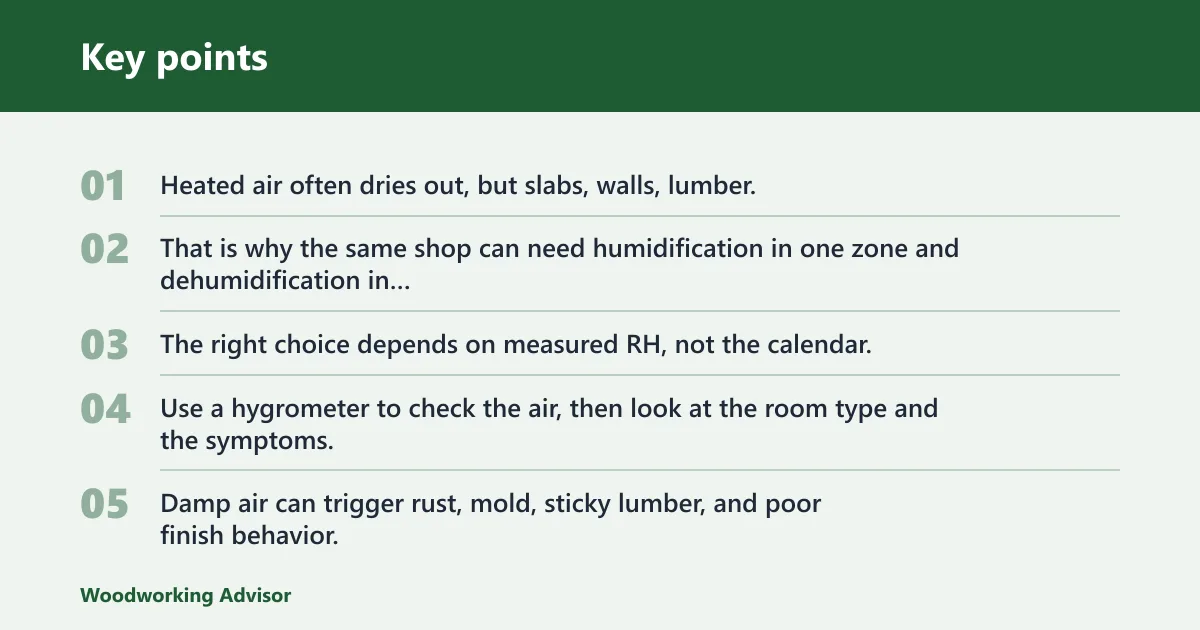


Winter pushes a woodshop in two directions. Heated air often dries out, but slabs, walls, lumber, and incoming meltwater can still add moisture in garages and basements. That is why the same shop can need humidification in one zone and dehumidification in another.
The right choice depends on measured RH, not the calendar. Use a hygrometer to check the air, then look at the room type and the symptoms. Dry air pulls moisture from wood. Damp air can trigger rust, mold, sticky lumber, and poor finish behavior.
How winter affects wood, steel, and finish work
Wood movement follows moisture content. If RH stays too low, lumber and assembled parts can shrink, joints can loosen, and small cracks can open in panels or end grain. If RH stays too high, wood can swell, glue lines can be stressed, and steel tools can corrode faster.
Finish work also reacts to humidity. Very dry air can speed some surface drying and add static, while high humidity can slow cure and leave a cloudy or tacky result on some finishes. In a shop, either extreme can create avoidable problems.
Winter woodshop humidity targets
Many shops do best when RH stays in a middle band. A practical winter target is roughly 30% to 50% RH in most living spaces, and most homes should have a relative humidity level of 40 to 50 percent. For woodshop use, the key point is the same: stay in range and avoid both dry-air shrinkage and damp-surface problems.
Target RH, low RH, and high RH
Below 30% RH is too dry for a winter shop and usually calls for a humidifier. Above 50% RH is the point where a dehumidifier becomes the better choice. Indoor humidity above 60% can help mold spores grow, so that upper end deserves prompt attention.
Condensation is a separate warning sign. Persistent moisture on windows, walls, or metal surfaces means excess moisture is present, even if the air feels cool or the room does not seem obviously damp.
How to read a hygrometer
A hygrometer measures indoor relative humidity, so you are not guessing. Put one in each zone that behaves differently, then read it at the same time of day for several days. A humidistat or dehumidistat can hold the setting steady and stop the unit from running past the target.
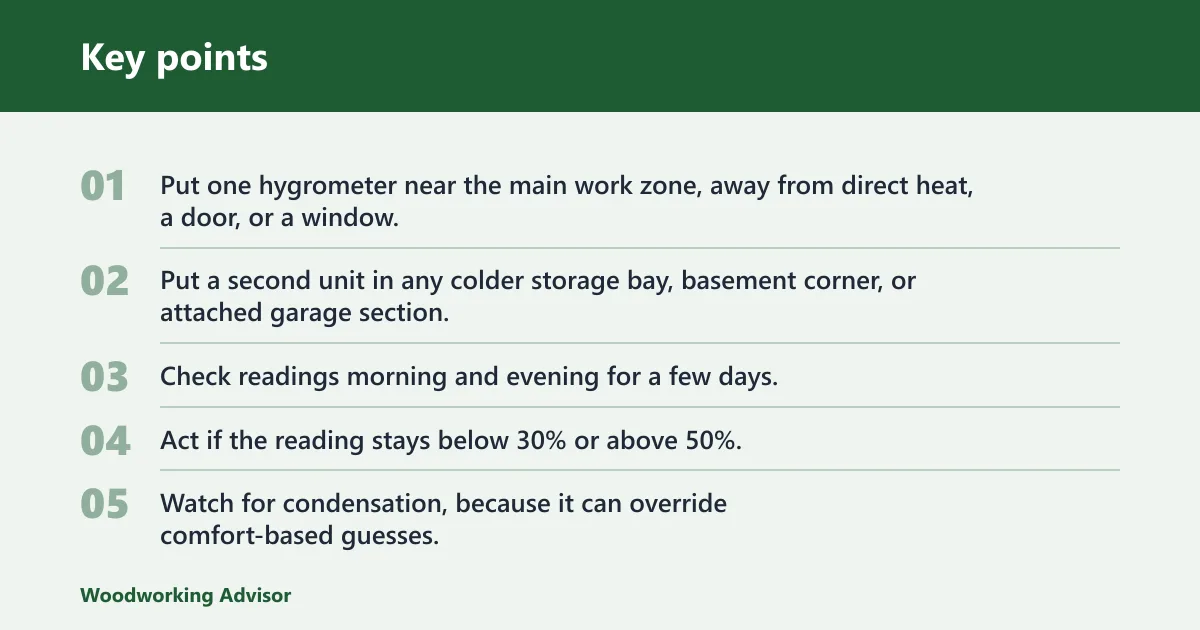
- Put one hygrometer near the main work zone, away from direct heat, a door, or a window.
- Put a second unit in any colder storage bay, basement corner, or attached garage section.
- Check readings morning and evening for a few days.
- Act if the reading stays below 30% or above 50%.
- Watch for condensation, because it can override comfort-based guesses.
Winter humidity decision table
| Room type | Measured RH | Visible symptoms | Likely cause | Recommended device | Do nothing threshold |
|---|---|---|---|---|---|
| Heated shop | Below 30% | Static, dry skin, throat irritation, nosebleeds, shrinking stock | Heating is drying the air | Humidifier | Do nothing if RH holds near 30% to 50% and wood stays stable |
| Attached garage | Above 50% | Condensation on windows, metal, or cold walls | Meltwater, damp slab, cold surfaces | Dehumidifier, often desiccant in colder air | Do nothing if RH stays below 50% and no condensation appears |
| Basement shop | Above 50% to 60% | Musty odor, damp concrete, rust, sticky storage | Ground moisture and winter humidity retention | Dehumidifier, usually desiccant if the space is cool | Do nothing only if RH stays in the 30% to 50% band with no damp surfaces |
| Lumber storage | Below 30% | Checking, cupping, loose sticker stack joints | Dry air pulling moisture from stored stock | Humidifier or tighter climate control for the storage zone | Do nothing if stored wood remains stable and RH stays between 30% and 50% |
| Finishing area | 30% to 50% | Slow cure or haze at higher RH, static at lower RH | Humidity outside the finish-friendly band | Humidifier if below 30%; dehumidifier if above 50% | Do nothing if the finish area stays within target and surfaces stay dry |
When should you use a humidifier in winter?
Use a humidifier when measured RH stays below 30%. That is the clearest sign that winter air has become too dry for wood, people, and many shop tasks. Dry skin, throat irritation, cough, nosebleeds, and static electricity are common clues, but the hygrometer reading should make the call.
Humidifier types for a shop
Humidifiers add moisture to dry indoor air. Common types include ultrasonic, evaporative, steam or boil-type, warm-mist, and cool-mist units. The best fit depends on room size, cleaning burden, and whether you want a cool output or a warmed mist.
A humidistat keeps the RH from running past target. If the space already sits near range, automatic control stops the unit from pushing the room from dry to damp.
Dry-air symptoms that matter in a woodshop
Dry skin and a scratchy throat are not the only signs. In a shop, low RH can also show up as static on dust collection hoses, shrinking drawer parts, or small gaps opening in face frames and panels. Those are practical warnings, not just comfort issues.
Suppose a 12-by-16-foot heated shop sits at 27% RH for three mornings in a row. A humidifier is the right correction, especially if lumber movement or static cling is starting to show up on tools and dust collection.
When should you use a dehumidifier in winter?
Use a dehumidifier when RH stays above 50%, and act quickly if it climbs toward 60% or more. That is the range where mold risk rises, steel rust becomes more likely, and concrete or masonry surfaces can stay wet. In winter shops, this is common in basements and attached garages.
Condensation and damp concrete
Persistent condensation on windows, walls, or metal surfaces is a direct warning sign of excess moisture. In attached garages, road salt, meltwater, and cold slab surfaces can keep RH high even while outdoor air is dry. Basements can do the same because the slab and foundation stay cool.
Compressor vs desiccant dehumidifiers
Compressor dehumidifiers are the most common type and work well in typical warmer spaces. They are less effective in very cold conditions and can frost up sooner. Desiccant dehumidifiers perform better at lower temperatures, which makes them a better match for basements and cooler winter spaces.
A common first-timer mistake is putting a compressor dehumidifier in a 45-degree garage and expecting summer performance. In that setting, a desiccant unit is usually the more practical choice.
Choose a humidifier if… / Choose a dehumidifier if…
Use the reading, the room type, and the symptoms together. Winter does not decide for you. A heated shop with dry stock and static needs moisture added; a basement with sweating metal and damp walls needs moisture removed.
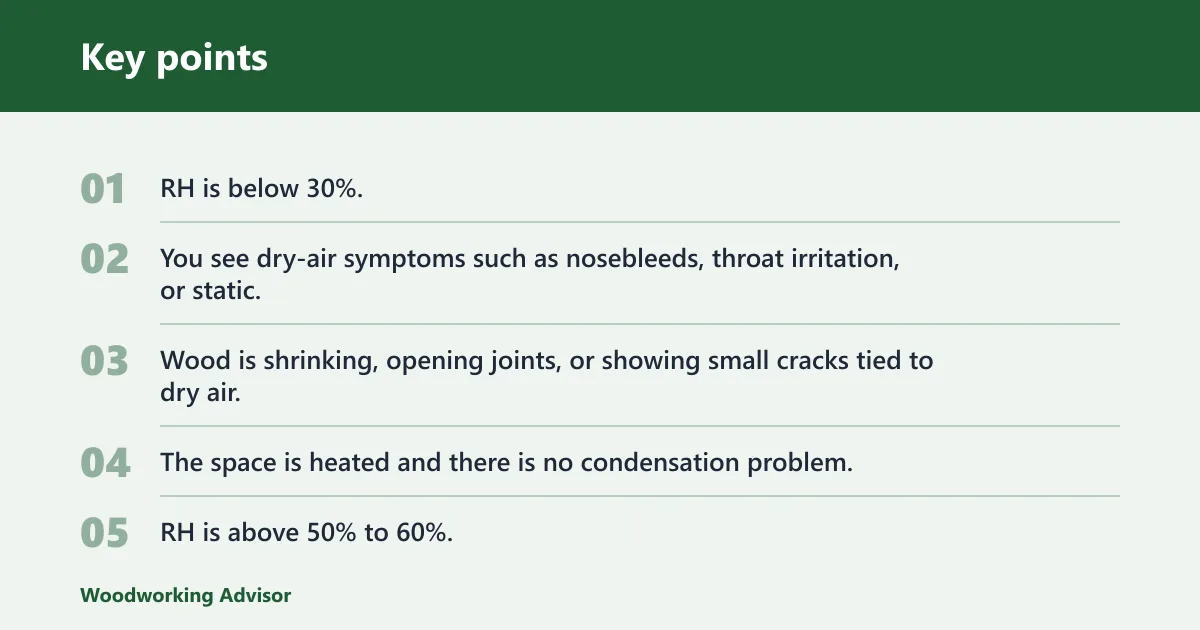
Choose a humidifier if:
- RH is below 30%.
- You see dry-air symptoms such as nosebleeds, throat irritation, or static.
- Wood is shrinking, opening joints, or showing small cracks tied to dry air.
- The space is heated and there is no condensation problem.
Choose a dehumidifier if:
- RH is above 50% to 60%.
- Windows, walls, tools, or metal surfaces show condensation.
- The shop sits over concrete, in a basement, or in a cold attached garage.
- You need to reduce rust, mold risk, or damp storage conditions.
Mixed spaces need zone-by-zone control
Some shops have a warm work zone and a cold storage bay. Treat them separately. A heated bench area may need a humidifier while the unheated corner or garage apron needs a dehumidifier. One device rarely solves every zone in a mixed shop.
Picture a basement shop with a 42% RH work area and a 58% RH lumber corner near the slab. The work area can stay put, while the storage corner needs moisture removal. That split reading is the reason to use more than one hygrometer.
Placement, monitoring, and maintenance
Put hygrometers where the shop actually behaves, not where they are easiest to see. Keep them away from heaters, open doors, direct sun, and fresh air blasts from dust collection or HVAC. In a mixed shop, place one unit high in the work zone and one near the coldest problem area.
How often to check readings
Check at least daily during weather swings, then less often once the shop stabilizes. If you are diagnosing a problem, morning and evening readings are more useful than a single glance. That pattern shows whether the shop dries out after heat runs or gets damp overnight.
Cleaning, drainage, and filter care
Humidifiers need regular cleaning to avoid mold or mineral buildup. Follow the maker’s cleaning schedule, and do not let standing water sit in the tank. Dehumidifiers need reservoir emptying or drainage and filter care, especially when they run often in basements or garages.
A humidistat or dehumidistat keeps the unit from pushing the room too far in either direction, but it does not replace maintenance. Set the control, then verify that the shop stays in range and that the device is actually moving moisture in the right direction.
Frequently asked questions
Humidifier vs dehumidifier in winter
The right choice depends on the reading, not the season. Use a humidifier when RH is below 30% and a dehumidifier when RH is above 50% to 60%. In a winter woodshop, dry air can shrink wood, while damp corners, concrete, and condensation point to moisture removal.
Do I need humidifier or dehumidifier in winter?
Check RH with a hygrometer first. If the shop is dry, static-prone, and below 30%, add moisture. If the shop has condensation, rust, or damp concrete and sits above 50%, remove moisture. Mixed shops may need both devices in different zones.
Should I use humidifier or dehumidifier in winter?
Use the device that moves you toward 30% to 50% RH. That band is the practical winter target for most spaces. A heated workroom often needs a humidifier, while a basement or garage often needs a dehumidifier, especially if surfaces are cold enough for condensation.
Should I use a humidifier in the winter?
Yes, if the RH is low enough to justify it. Cold winter air is dry, and a humidifier is usually preferred in winter when indoor RH drops below 30%. It is useful for dry skin, throat irritation, and woodshop shrinkage, but avoid pushing the room above target.
Can we use humidifier in winter?
Yes, winter is a common time to use one. The key is measured RH and room type. A humidifier belongs in a dry heated shop, not in a garage that already has window condensation or a basement with damp walls. Automatic control helps keep the setting in range.
Is it ok to use dehumidifier in winter?
Yes, and it is often the right tool in basements and garages. Dehumidifiers are especially useful in basements during winter, and desiccant models tend to perform better at lower temperatures. A compressor unit is common, but it can be less effective in very cold conditions.
Sponsored / affiliate links. As an Amazon Associate I earn from qualifying purchases. I may earn additional commission from eligible campaigns.