10 Elegant MDF Jali Designs for Decorative Interiors
MDF jali panels are decorative carved screens made from Medium-Density Fiberboard, available in 4mm to 35mm thickness — 6mm works for wall accents and 12mm for freestanding room dividers. Getting the thickness wrong means panels that flex, crack at mounting points, or look cheap in frame. This guide covers 10 elegant design types, the right thickness for each application, finish options including duco paint, and a 5-step install method.
Quick Answer
MDF jali designs range from classic geometric and floral to traditional Mughal and Moroccan patterns. Use 6mm boards for wall panels and accent features, 8mm for cabinet door fronts, and 12mm for freestanding room dividers. Most panels accept duco paint, acrylic, or laminate finish and install with construction adhesive or screw-and-plug in about 2 hours.
What Is MDF Jali?
Best MDF Jali Carving Tool Pick

Dremel Stylo+ Craft Rotary Tool Kit (15 Accessories)
A compact craft-focused rotary tool designed for fine detail work — ideal for carving decorative patterns into MDF panels, cleaning up CNC jali cuts, and engraving custom motifs.
- Best for: Detailing MDF jali panels, adding custom engravings, and cleaning router bit marks from jali edges
- Why we picked it: The slim pen-style grip gives more control than a full-size rotary tool on intricate lattice patterns; includes 15 accessories for carving and sanding
- Main drawback: Not for cutting thick MDF sheets from scratch — use a table saw or CNC router for the initial jali cut, Stylo+ for finishing work
Compare more MDF carving tool options
 Option 1 Dremel 4000-2/32 Rotary Tool Kit
|
 Option 2 Dremel 729-01 11-Piece Carving Kit
|
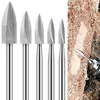 Option 3 Wood Carving Drill Bits Set (5Pcs, 1/8″ Shank)
|
As an Amazon Associate we earn from qualifying purchases.
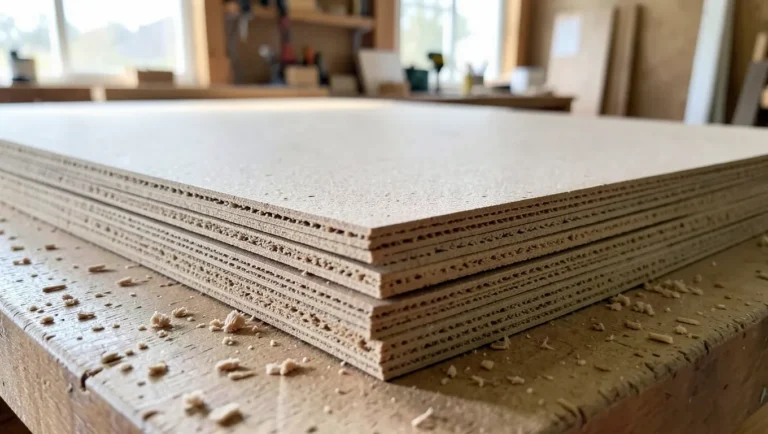
MDF jali is a decorative carved panel made from Medium-Density Fiberboard — a composite wood product made from wood fibers, wax, and resin, pressed under high heat and pressure into a dense, smooth sheet. The word “jali” comes from the Sanskrit for “net” or “lattice,” and refers to the intricate perforated patterns cut through the panel using CNC routers or laser cutters.
Why Choose MDF for Jali Work?
MDF outperforms solid wood for jali panels because its uniform density allows CNC routers to cut intricate lattice elements below 6mm without grain tear-out — a common problem with teak, oak, and other solid species when cutting thin jali elements. MDF also resists the seasonal expansion that affects solid timber: solid teak jali can expand up to 1.5% across the grain in humid conditions, distorting tight geometric patterns. The tradeoff is that MDF edges must be sealed before painting, and panels thinner than 6mm can flex if mounted without a perimeter frame.
Key benefits of MDF jali over solid wood jali:
- Affordability: MDF jali panels typically cost $15-$30 per square foot vs. $40-$80 for equivalent solid teak jali
- Design precision: CNC routers cut cleaner patterns in MDF than in solid wood at intricate scales
- Stability: Resists warping better than solid wood in stable indoor conditions
- Customization: Can be painted, stained, or laminated in any finish or color

1. Classic Geometric Patterns
Timeless Appeal
Geometric jali uses repeating shapes — squares, diamonds, hexagons, and interlocking stars — arranged in precise mathematical grids. These are the most CNC-friendly jali designs because straight lines allow faster router passes, keeping production costs around $15-$25 per square foot for 6mm panels. Geometric patterns have featured in Indian palace architecture since the Mughal period and translate naturally into modern minimalist interiors.
Versatile Applications
MDF geometric jali works as room dividers (creating privacy without blocking light), TV backdrop panels, corridor accent walls, and false ceiling inserts. The structured pattern holds its form in frameless applications better than organic designs, making geometric jali the best choice for spans wider than 36 inches without intermediate support.
2. Floral and Nature-Inspired Designs
Bringing Nature Indoors
Nature-inspired MDF jali features leaves, vines, and trees sculpted into the panel at varying depths. These designs work by mimicking the dappled light effect of foliage, creating a tranquil, biophilic atmosphere in the room. Living rooms and bedrooms benefit most: the organic shapes soften hard architectural lines and create a visual focal point without needing artwork or wall color.
Popular Floral Patterns
Floral MDF jali typically features roses, lilies, and lotuses. Lotus designs carry cultural weight in South Asian interiors and are a popular choice for pooja rooms and mandirs. Rose and lily patterns suit more general living spaces. Because floral patterns have thin curved elements, they require 8mm minimum thickness for structural integrity — 6mm panels can develop hairline fractures at thin curved sections if the design is complex.
3. Contemporary Abstract Designs
Modern Aesthetic
Abstract MDF jali uses non-repeating fluid forms, diagonal cuts, and asymmetric negative space to create modern, one-of-a-kind panels. These designs avoid the predictability of geometric patterns while maintaining CNC precision. Abstract jali suits contemporary apartments, boutique offices, and hotel lobbies where the interior design language is intentionally irregular.
Creative Uses
Beyond walls, abstract MDF jali works in ceiling panels with backlighting (LED strips placed behind the panel project the pattern as shadow art on surrounding surfaces), furniture accents on sideboards and headboards, and as decorative window screens. A backlit abstract jali panel transforms at night into a completely different design element.
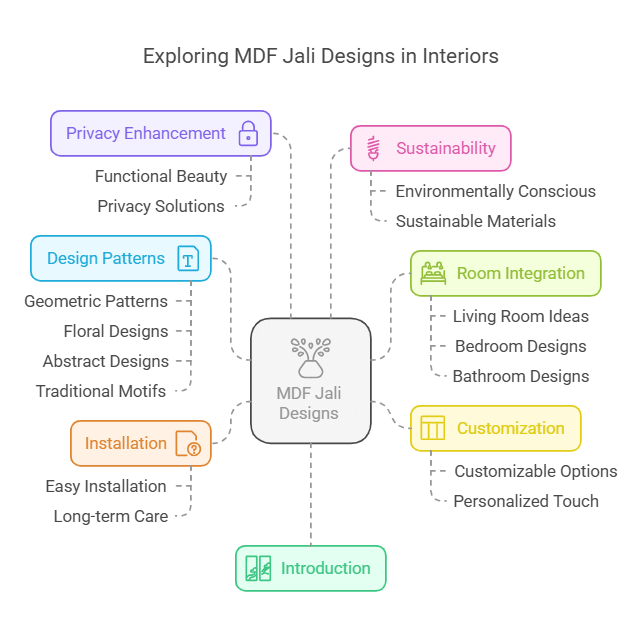
4. Traditional Motif Designs
Mughal Motifs
Mughal-inspired jali draws from Persian court art, featuring stylized flowers, vines, and arabesques arranged in symmetrical compositions. These designs originated in the sandstone screens of Mughal architecture — the Taj Mahal’s inner screens are jali work — and were adapted into MDF in modern CNC manufacturing. Mughal jali suits traditional and Indo-colonial interior styles, particularly in dining rooms and entrance foyers.
Moroccan Jali Patterns
Moroccan jali uses bold eight-pointed stars and interlocking geometric tiles derived from Islamic geometric art. The defining feature is the seamless repeat — unlike Indian jali which often has a central medallion, Moroccan patterns tile continuously across the full panel surface. This makes Moroccan jali ideal for large accent walls where visual rhythm across a wide span is the goal. Use 8mm minimum thickness for structural stability at the thin connecting points between geometric stars.
5. Customizable MDF Jali Options
Size and Shape Customization
MDF jali panels can be custom-cut to any dimension — from 6-inch accent tiles to full 8×4 foot sheets. Standard sheet sizes are 8×4 feet (2440x1220mm); for larger installations, panels are joined with concealed butt joints or thin aluminum frames. Custom shapes — arched panels, hexagonal frames, curved room dividers — are achievable with CNC routing but add 20-40% to the base cost due to material waste.
Finish Options: Duco Paint, Acrylic, and Laminate
Three finish options dominate MDF jali applications:
- Duco paint (NC lacquer): The most popular finish for MDF jali — spray-applied, dries to a hard glossy or matte surface, available in any RAL color. Duco requires 2 coats of MDF primer first. Best for: intricate geometric patterns where a clean, paint-like finish is needed.
- Acrylic emulsion: Water-based, lower VOC, and easier for DIY application. Slightly less durable than duco but perfectly adequate for interior panels away from direct touch. Best for: floral and abstract designs in living rooms.
- PVC laminate or vinyl wrap: Applied over sealed MDF, laminate adds a wood-grain or stone-effect texture. Useful when the jali design is simpler and the finish texture does the decorative work. Best for: modern minimal geometric designs in high-traffic areas.
Whichever finish you choose, seal all exposed MDF edges with undiluted PVA or an MDF edge sealant before applying the topcoat. Unsealed edges absorb paint unevenly and swell with humidity — the most common cause of MDF jali looking cheap within a year of installation.
MDF Jali Thickness Guide: Which to Choose
Thickness is the single most important specification for MDF jali — it determines whether your panel is structural, decorative, or somewhere between. Most suppliers offer 4mm to 35mm; here is what each range is actually useful for:
| Thickness | Best For | Notes |
|---|---|---|
| 4-6mm | Accent wall panels, ceiling inserts, cabinet fronts | Lightweight; must be fully glued or framed; avoid for spans wider than 18 inches without support |
| 8mm | Cabinet door fronts, wardrobe panels, furniture accents | Good rigidity; handles most CNC jali patterns without hairline fractures at thin sections |
| 12mm | Freestanding room dividers, window screens, structural partitions | Self-supporting up to 48-inch spans; heavier but rigid and durable under repeated handling |
| 18mm+ | Partition frames, heavy-duty base structures | Rarely used for the jali face panel itself; typical for the structural frame holding thinner jali |
Mistake to avoid: Choosing 4mm for a freestanding room divider. At 4 feet wide with no perimeter frame, a 4mm MDF panel will flex noticeably from foot traffic vibration and can crack at screw holes within 6-12 months. For any freestanding application, 12mm is the minimum that holds up reliably.
How to Install MDF Jali (5-Step Method)
Most MDF jali panels install in 2-3 hours with basic tools. The method below covers wall-mounted panels; freestanding room dividers require a base frame (typically 18mm MDF or steel square tube) before the jali face is fixed.

- Measure and mark: Measure the installation area and subtract 2mm on each side for expansion clearance. Mark the panel position on the wall with a pencil line and spirit level — a crooked line shows through the lattice pattern once the panel is up.
- Seal the edges: Apply undiluted PVA or MDF edge sealant to all cut edges before painting. Sealed edges prevent moisture absorption that causes swelling at the panel perimeter and paint peeling — skip this step and the panel will visibly bubble within a humid season.
- Apply construction adhesive: For wall-mounted panels, apply construction adhesive (no-nails type) in a zigzag pattern on the panel back. For 12mm panels wider than 24 inches, supplement with 4 pilot-hole screws at corners using a 3mm pilot bit to prevent splitting at the screw entry point.
- Mount and level: Press the panel firmly against the surface. Check level immediately with a spirit level. Use temporary support (a spare strip of timber or painter’s tape loops) to hold position while adhesive sets to initial tack — typically 20-30 minutes.
- Prime and paint: Once mounted, apply 2 coats of MDF primer. Sand lightly between coats with 220-grit paper. Finish with duco paint, acrylic emulsion, or your chosen topcoat. Spray application gives a noticeably smoother finish than brush on intricate lattice patterns, especially inside the cut-through sections where a brush leaves visible strokes.
6. Enhancing Privacy With MDF Jali
Functional Beauty
MDF jali panels are a blend of function and aesthetics — the perforated pattern blocks direct sightlines while allowing light and air to pass through freely. This balance makes jali uniquely suited to open-plan layouts where you want spatial separation without the claustrophobia of a solid wall. A 12mm jali partition in a living-dining space provides visual privacy at seated height while keeping the room airy above.
Privacy Solutions
Practical privacy applications for MDF jali:
- Room dividers: Freestanding 12mm jali panels mounted in a steel base channel divide large rooms into defined zones without blocking ceiling height or natural light
- Window screens: 6mm jali panels installed inside window frames filter views from outside while reducing direct glare — position 2-3 inches proud of the glass for the best visual effect
- Balcony privacy screens: Use moisture-resistant MDF or exterior-grade MDF with a waterproof topcoat for semi-outdoor balcony applications; standard interior MDF will delaminate in direct rain exposure
7. Incorporating MDF Jali in Different Rooms
Living Room Ideas
In living rooms, MDF jali works best as a partition between the seating and dining areas, a TV backdrop with integrated LED backlighting, or an accent panel behind a sofa. For TV backdrops, use 6mm geometric jali with warm LED strips tucked behind the panel edges — the shadows cast through the lattice pattern shift with the light direction and add depth the room otherwise lacks. Avoid placing jali panels directly behind seats where repeated contact with cushion backs will mark the finish.
Bedroom and Bathroom Designs
Bedroom applications include jali headboards (6-8mm, fixed flush to the wall), wardrobe door fronts (8mm inset into a flat frame), and ceiling medallions in traditional-style rooms. In bathrooms, use MDF jali only in the dry zone — away from direct water splash. For wet zones, substitute PVC jali panels which share the same visual language but resist moisture completely. If you do use MDF near the shower, apply a waterproof topcoat and seal every edge to prevent warp.
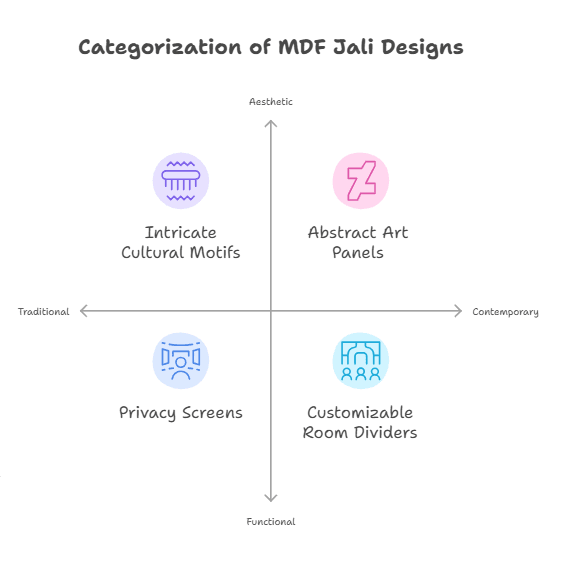
8. Sustainable and Eco-Friendly Choice
Environmentally Conscious
MDF is made from wood fiber residues — sawmill offcuts and wood waste — bonded with resin and pressed under heat. This manufacturing process uses wood that would otherwise be discarded, making MDF a more resource-efficient choice than solid timber jali cut from large-diameter logs. For indoor air quality, look for MDF rated E0 or E1 for formaldehyde emissions (the European standard): E1-rated MDF emits less than 0.1 ppm formaldehyde, well within safe indoor air limits.
Sustainable Materials
MDF Jali designs use sustainable materials from managed forests that replenish harvested wood through replanting programs. Many MDF manufacturers now use low-VOC adhesives and water-based resins that significantly reduce chemical emissions compared to older formaldehyde-heavy formulas. When sourcing MDF jali panels, ask your supplier for the emission rating and FSC (Forest Stewardship Council) certification — these are standard credentials for responsible MDF manufacturers and add nothing to the cost of a standard panel order.
Frequently Asked Questions
What are MDF jali designs?
MDF jali designs are decorative perforated panels made from Medium-Density Fiberboard, cut into intricate lattice patterns using CNC routers or laser cutters. The word “jali” comes from the Sanskrit for “lattice” or “net.” Modern MDF jali comes in geometric, floral, abstract, Mughal, and Moroccan pattern styles, sized from small accent tiles to full 8×4 foot sheets, and finished in duco paint, acrylic, or laminate.
What thickness MDF should I use for jali?
Use 6mm MDF for wall-mounted accent panels and ceiling inserts, 8mm for cabinet door fronts and furniture applications, and 12mm for freestanding room dividers and structural partitions. Thinner than 6mm risks flexing or cracking at mounting points; thicker than 12mm is rarely necessary for jali face panels (that thickness is typically used for the structural frame, not the decorative panel itself).
How do you use MDF jali in interiors?
MDF jali installs as wall-mounted panels (using construction adhesive and pilot-hole screws), freestanding room dividers (mounted in a steel or timber base frame), window screens (fitted inside the window reveal), TV backdrop panels (fixed flush to the wall with LED lighting behind), cabinet door inserts, headboards, and ceiling feature panels. The installation method depends on the application — wall mounting takes 2-3 hours; a freestanding framed divider is a half-day project.
Are MDF jali designs durable?
Yes, MDF jali designs are durable for dry indoor applications. MDF is denser than particleboard and resists warping better than solid wood in stable climate conditions. The main durability risk is moisture: sustained humidity above 70% causes MDF to swell at unsealed edges, and direct water contact delaminates the panel. Sealed edges, a quality primer, and a topcoat appropriate for the room’s humidity level give MDF jali panels a lifespan of 10-15 years in normal interior conditions.
Can MDF jali be customized?
Yes. MDF jali can be custom-cut to any size, shape, and pattern via CNC routing. Common customizations include panel dimensions (from 6-inch tiles to full 8×4 sheets), pattern type and scale, depth of cut (surface engraving vs. full cut-through), and finish color. Custom jali orders from most manufacturers take 5-10 working days and can match specific RAL or Pantone colors for duco finishes. Minimum order quantities vary by supplier — local workshops often do single-panel orders; large manufacturers typically require a minimum 10-square-foot order.
Can MDF jali be used in bathrooms?
Standard MDF jali should only be used in the dry zone of a bathroom — away from direct water splash, condensation sources, or shower spray. For wet zones, substitute PVC or WPC (wood-plastic composite) jali panels, which share the same aesthetic but are fully moisture-resistant. If you install standard MDF jali in a bathroom, seal all edges with waterproof PVA and apply 2 coats of bathroom-grade waterproof paint — this reduces but does not eliminate the moisture risk.
Conclusion
MDF jali designs combine decorative appeal with genuine practical function — from geometric TV backdrops and privacy partitions to floral headboards and Moroccan accent walls. Choosing the right thickness (6mm for panels, 12mm for dividers), sealing the edges before painting, and selecting the right finish for your room’s humidity level are the three decisions that determine how well your jali installation holds up over years of use. Whether you source ready-made panels or commission custom CNC work, MDF remains the most cost-effective and design-flexible material for intricate jali work in modern interiors.
Sponsored / affiliate links. As an Amazon Associate I earn from qualifying purchases. I may earn additional commission from eligible campaigns.