12-Inch Miter Saw Buying Guide: Compound vs. Sliding vs. Dual-Bevel
A 12-inch miter saw is the size to buy when you regularly cut wide crown molding, thick baseboard, deck framing, or anything over about 6 inches wide – a 10-inch saw will get there eventually, but a 12-inch blade gets you a bigger crosscut in one pass and more bevel clearance under the fence. Prices for a real 12-inch model run from roughly $250 for a basic non-sliding compound saw up to $900+ for a dual-bevel slider with a laser guide, and the size alone tells you less than the saw’s type does.
That’s the part most buying guides skip: “12-inch miter saw” covers three genuinely different machines – a basic compound saw, a sliding compound saw, and a dual-bevel slider – and picking the wrong one for your actual projects is a more common mistake than picking the wrong brand. This guide breaks down what the 12-inch size actually buys you, which type fits which kind of work, and the specs worth checking before you spend $600+ on one.
Deciding on a miter saw is only half the shop-building decision. Our table saw and miter saw combo guide covers which saw to buy first and how to run both in a small shop.
What the 12-Inch Size Actually Buys You
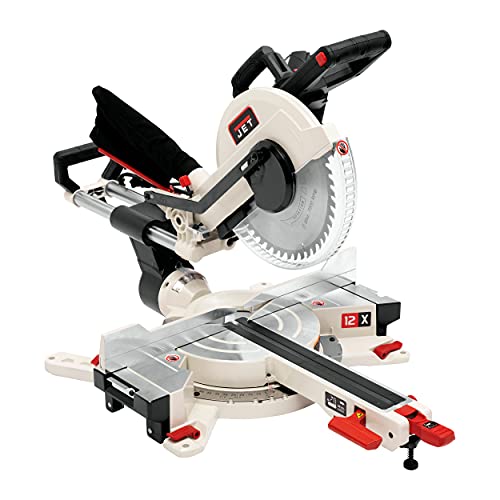
A 12-inch blade has roughly 2 extra inches of diameter over a 10-inch blade, and that difference shows up in two places: vertical cutting capacity (how tall a piece of trim or baseboard you can stand against the fence) and crosscut width when the saw slides. On a non-sliding 12-inch compound saw, expect a 90-degree crosscut capacity around 6 inches wide by roughly 4.5 inches tall. Add a sliding rail system – most 12-inch dual-bevel sliders, including the Makita LS1219L below, are built this way – and that crosscut jumps to 15-16 inches wide at 90 degrees, with vertical capacity up to 6.75 inches for baseboard and around 8 inches for crown molded flush against the fence.
Best Dual-Bevel Slider Pick
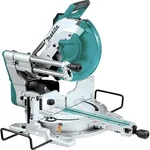 |
Makita LS1219L 12-Inch Dual-Bevel Sliding Compound Miter Saw – $989 A compact 2-rail slider that gets full 15-inch crosscut capacity without the deep footprint most sliders need, so it can sit flush against a wall.
|
Compound vs. Sliding vs. Dual-Bevel: Which Type You Need
All three types cut miters and bevels – the difference is capacity and how much you’ll fight the saw on wide or angled material.
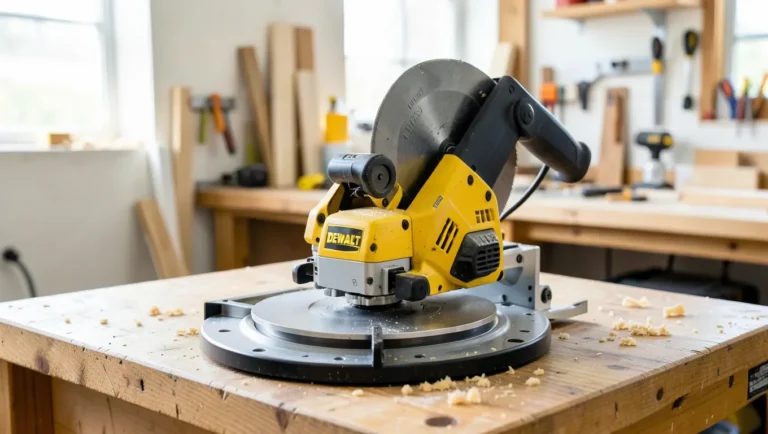
Basic compound saw: the head pivots straight down, no sliding rails. Cheapest option, smallest footprint, but crosscut width is limited to the blade diameter minus the guard – around 6 inches on a 12-inch saw. Fine for baseboard, door casing, and most furniture trim.
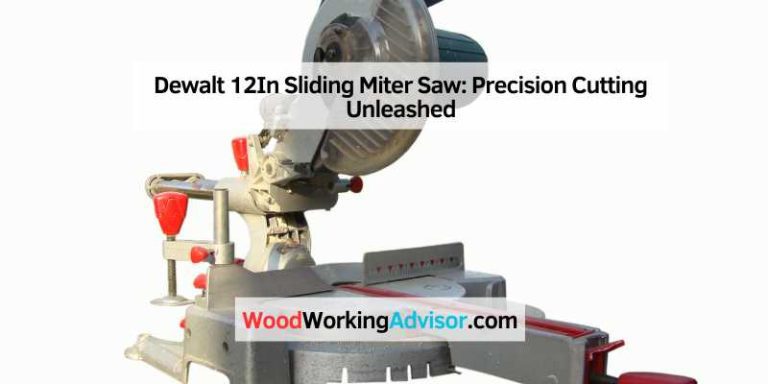
Sliding compound saw: adds rails so the head pulls forward and pushes back through the cut, turning that 6-inch capacity into 15-16 inches. This is the jump that matters for anyone cutting deck boards, wide window casing, or stair stringers – material a non-sliding saw simply can’t crosscut in one pass.
Dual-bevel slider: everything above, plus the head tilts both left and right instead of just one direction. On a single-bevel saw, beveling the opposite direction means flipping the board over and re-marking your line – workable, but slow and a source of measurement errors on crown molding runs. Dual-bevel costs more but pays for itself the first time you’re cutting matched pairs of angled trim.
Specs Worth Checking Before You Buy
Motor amperage on corded 12-inch saws typically runs 15 amps – that’s close to the max a standard 15-amp household circuit allows, so it’s less a differentiator between models than you’d think. What actually varies model to model:
- Miter range and stops: most 12-inch saws cover 0-45 or 0-60 degrees each direction, with positive stops at the common angles (0, 15, 22.5, 31.6, 45). More stops means less time squinting at a protractor.
- Bevel range: single-bevel saws typically tilt 0-45 or 0-48 degrees one direction only; dual-bevel saws mirror that range both ways.
- Dust collection: a single port with the stock bag catches roughly 40-60% of dust in real use; a saw with dual ports run to a shop vac does noticeably better, which matters more indoors than in a garage with the door open.
- Cut-line guidance: either a simple laser line or a shadow-line system that projects the blade’s shadow onto the workpiece before it spins up. Shadow systems need no calibration and don’t drift the way a laser can after the saw gets bumped.
- Blade included: the stock blade on most 12-inch saws is a 40-tooth general-purpose blade. For clean trim and molding cuts, budget for an 80-100 tooth finish blade separately – it’s the single biggest upgrade for cut quality on a new saw.
Do You Actually Need 12 Inches, or Would 10 Be Enough?
The practical rule: buy for the largest material you cut regularly, not the smallest material you cut most often. If your projects are mostly picture frames, door casing, and standard baseboard under 5.5 inches, a 10-inch sliding saw handles all of that with a smaller, lighter, cheaper tool. Step up to 12 inches when you’re regularly working with wide crown molding, deck framing lumber, stair stringers, or anything where a 10-inch saw would force you to flip the board and cut from both sides to finish a crosscut – that workaround is slower and less accurate than a single pass on a bigger saw.
One tradeoff worth knowing before you upgrade: 12-inch blades cost more to replace and re-sharpen than 10-inch blades, and the saws themselves run 15-25 pounds heavier – relevant if the saw needs to come on and off a truck for jobsite work rather than staying bolted to a bench.
Safety and Setup Basics
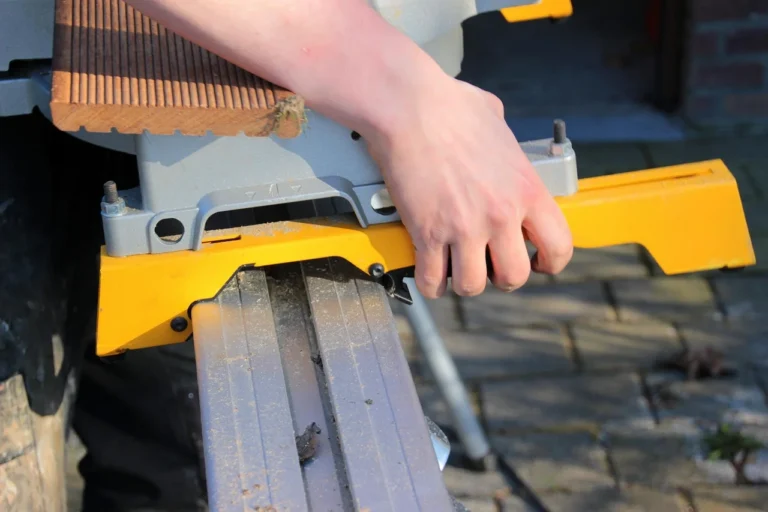
A few habits matter more on a 12-inch saw than a smaller one, simply because the blade carries more momentum and the swept area is bigger. Keep both hands outside the blade’s cutting path at all times – one hand holding the workpiece against the fence, the other on the trigger handle, never reaching across the blade to steady a cutoff piece while it’s spinning. Let the blade come to a complete stop before lifting the head, and check that the workpiece is fully supported on both sides of the cut so it can’t pinch the blade as it finishes the pass. If the saw is going on a stand rather than a bench, bolt it down – a 12-inch slider’s head has enough forward reach during a slide cut to tip an unsecured stand.
Accessories Worth Adding
A rolling stand with extendable material supports pays for itself quickly if you’re cutting long stock alone – it holds the far end level so the saw isn’t fighting gravity mid-cut. A dedicated finish blade (as mentioned above) makes a bigger visible difference in cut quality than most other upgrades. For anyone cutting indoors regularly, a shop vac hooked to the dust port instead of the stock bag cuts airborne dust noticeably more than the bag alone.
Frequently Asked Questions
Why would I need a 12-inch miter saw instead of a 10-inch?
The extra 2 inches of blade diameter gives you more crosscut width and vertical capacity – useful for wide crown molding, thick baseboard, deck framing lumber, and anything else where a 10-inch saw would require flipping the board to finish the cut. If your work stays under about 5.5 inches wide, a 10-inch saw usually covers it.
What size wood can a 12-inch miter saw cut?
It depends on whether the saw slides. A non-sliding 12-inch compound saw crosscuts about 6 inches wide at 90 degrees. A 12-inch sliding compound saw extends that to roughly 15-16 inches wide at 90 degrees, with vertical capacity around 6.75 inches for baseboard set flat and up to 8 inches for crown molding nested against the fence.
Can I use a 10-inch blade on a 12-inch miter saw?
No. Blade size has to match what the saw is built and guarded for – a smaller blade won’t reach full depth of cut and throws off the saw’s safety guard clearance, and a blade larger than rated can contact the guard or housing. Always use the blade diameter the manufacturer specifies for that model.
Can a 10-inch miter saw cut a 4×4?
Not in a single pass at 90 degrees on most 10-inch saws – their vertical capacity typically tops out around 3.5 inches, short of the 3.5-inch actual dimension of a 4×4 measured on the diagonal you’d need for a square cut. A 12-inch saw, especially a slider, has enough vertical clearance to get through a 4×4 in one pass; on a 10-inch saw you’d typically need to cut partway through, flip the piece, and finish from the other side.
Conclusion
The right 12-inch miter saw comes down to matching the type to your actual projects: a basic compound saw for narrower trim work on a budget, a sliding compound saw once you’re regularly crosscutting wider material, and a dual-bevel slider if you’re cutting angled trim in both directions often enough that flipping boards has become a real time cost. If you’ve already narrowed it down to DeWalt specifically, see our DeWalt DWS780 vs. DWS779 comparison for a direct look at their two combination sliders. For more on how the sliding mechanism itself changes capacity, our 12-inch sliding compound miter saw guide covers that in more depth, and our compact compound miter saws compared by price and weight page is worth a look if 12 inches turns out to be more saw than you need.
Sponsored / affiliate links. As an Amazon Associate I earn from qualifying purchases. I may earn additional commission from eligible campaigns.