Baltic Birch Plywood Review: Is It Worth the Price?
Baltic birch plywood is worth the price when void-free edges, stable machining, or exposed cores matter; for painted cabinet boxes and hidden parts, standard birch or utility plywood usually wins on cost. Skip the wrong grade and you pay twice: once at the sheet store, again in sanding, patching, or rebuilding weak edges and blown-out joints. This guide compares cost, edge quality, stiffness, and the break-even cases for cabinets, drawers, jigs, shelves, and visible-edge work.
This guide is part of our Plywood sizes, cuts and prices guide series.
Baltic birch plywood in one sentence

Baltic birch is a multi-ply panel built with many thin veneers, consistent core layers, and clean edges that are often left exposed on purpose. It earns its higher price when those edges, cut quality, and fastener zones matter more than the sheet price alone.
What buyers are paying
The value is not generic “better plywood.” The payoff comes from fewer internal voids, more predictable thickness, and edges that can stay visible without heavy banding. That matters most when a bad cut, a weak screw bite, or a ragged edge would force rework.
What makes Baltic birch different from regular plywood?
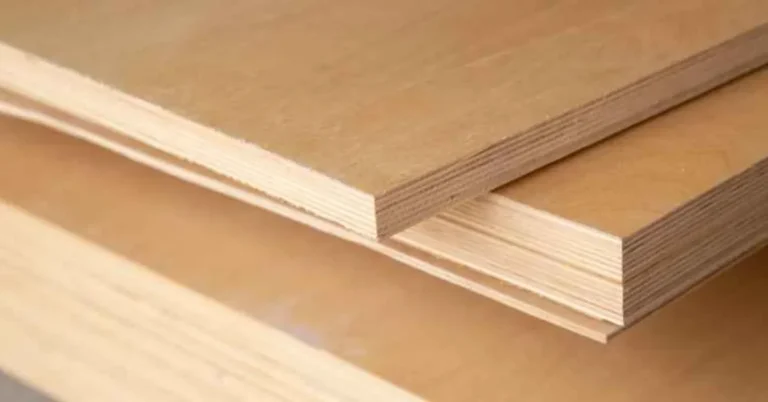
Baltic birch usually has more plies, thinner face and core veneers, and a more even core than common birch-faced plywood. That construction makes the edge look layered and tidy, and it cuts the odds of hitting a hidden void near a fastener or a dado. It is still plywood, though. Poor cutting, poor grading, and bad storage can still ruin a sheet.
Multilayer core and face quality
Most true Baltic birch panels are built with many thin layers rather than a few thick core plies. More plies usually mean a cleaner edge and more even support through a cut edge. Face quality also matters: better face veneers sand and finish more predictably, while lower-grade birch-faced panels may have patches, footballs, or rougher grain.
Common thicknesses and sheet formats
Typical thicknesses include about 1/4 in., 1/2 in., 5/8 in., and 3/4 in. Many suppliers list nominal imperial sizes, and imported metric panels are also commonly available in sizes such as 6 mm, 9 mm, 12 mm, 15 mm, 18 mm, and 21 mm. Standard 4×8 availability is common in North America, though some importers also stock 5×5 or metric sheets that can affect yield and waste.
How to spot true Baltic birch versus birch-faced plywood
- Check the edge. True Baltic birch should show many thin, even plies with few obvious voids.
- Read the label for grade and origin. “Birch-faced plywood” is not the same promise as a true Baltic-style panel.
- Look for thickness consistency across the sheet stack. Large variation often points to a lower-grade import or a different construction.
- Inspect a cut-off corner if the seller allows it. Hidden gaps near the core are a warning sign.
Label confusion matters. Some panels sold as birch are only birch-faced on the outside, with a rougher core inside. That difference shows up after cutting, routing, or driving screws near an edge.
Baltic birch vs cheaper plywood
Baltic birch usually costs more because the panel is built for cleaner edges, tighter core consistency, and better yield in joinery-heavy work. Cheaper plywood can still be the better buy when the sheet will be hidden, covered, or cut into parts where edge appearance and internal voids do not affect the result.
| Panel type | Cost | Stiffness | Void risk | Edge quality | Finish readiness |
|---|---|---|---|---|---|
| Baltic birch | High | High | Low to moderate | High | High |
| Standard birch plywood | Medium | Medium | Moderate | Medium | Medium to high |
| Cabinet-grade plywood | Medium to high | Medium to high | Low to moderate | Medium | Medium to high |
| ACX | Low to medium | Medium | Higher | Low | Low to medium |
| Prefinished panel | High | Medium | Moderate | Medium | Very high |
Nominal thickness, actual thickness, and fit
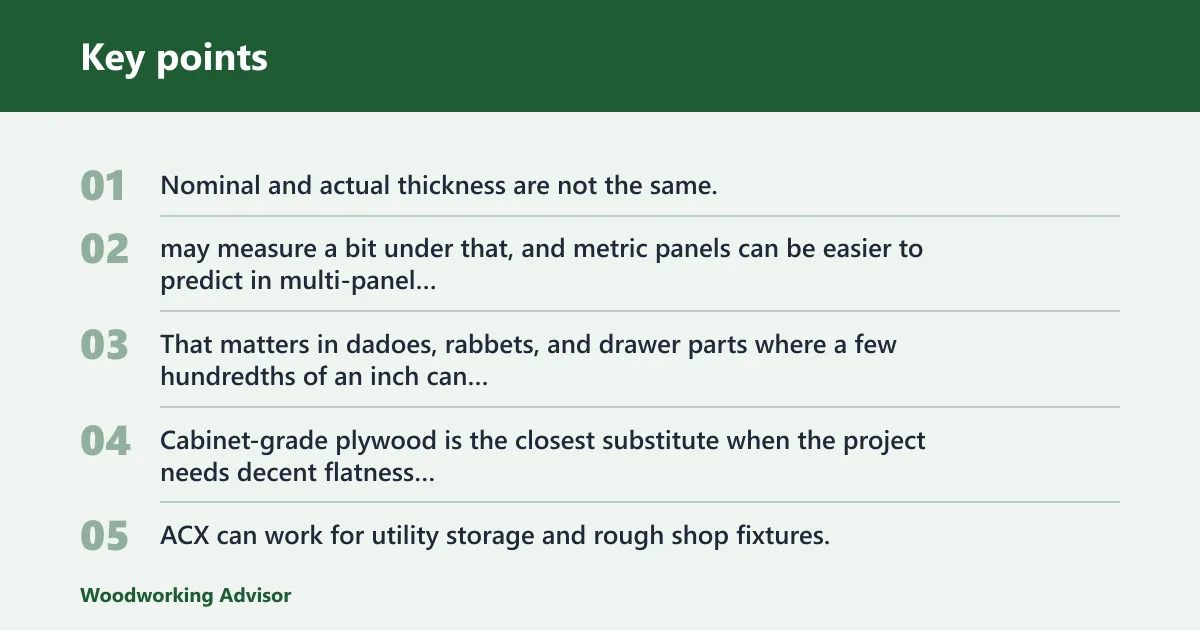
Nominal and actual thickness are not the same. A sheet sold as 3/4 in. may measure a bit under that, and metric panels can be easier to predict in multi-panel casework. That matters in dadoes, rabbets, and drawer parts where a few hundredths of an inch can change fit and clamp pressure.
Where cabinet-grade, ACX, and prefinished panels fit
Cabinet-grade plywood is the closest substitute when the project needs decent flatness and screw-holding, but the edges will be covered with banding or a face frame. ACX can work for utility storage and rough shop fixtures, though voids and face quality vary more. Prefinished panels save time on paint or clear topcoats, but they are usually a poor choice when you need exposed raw edges.
Baltic birch decision matrix
This table uses a simple 1 to 5 score, where 5 is best for that criterion. The goal is not to crown a winner for every task. It is to show where Baltic birch earns back its premium and where a cheaper sheet does the same job.
| Project type | Stiffness | Void risk | Edge quality | Finish readiness | Cost efficiency |
|---|---|---|---|---|---|
| Drawers | 4 | 5 | 5 | 4 | 4 |
| Cabinet carcasses | 4 | 5 | 4 | 4 | 3 |
| Shelves | 4 | 4 | 3 | 3 | 3 |
| Jigs | 4 | 5 | 5 | 3 | 4 |
| Painted furniture | 3 | 4 | 3 | 4 | 2 |
| Utility storage | 3 | 3 | 2 | 2 | 5 |
| Curved parts | 3 | 4 | 4 | 3 | 3 |
| Visible-edge projects | 4 | 5 | 5 | 4 | 4 |
How to read the table
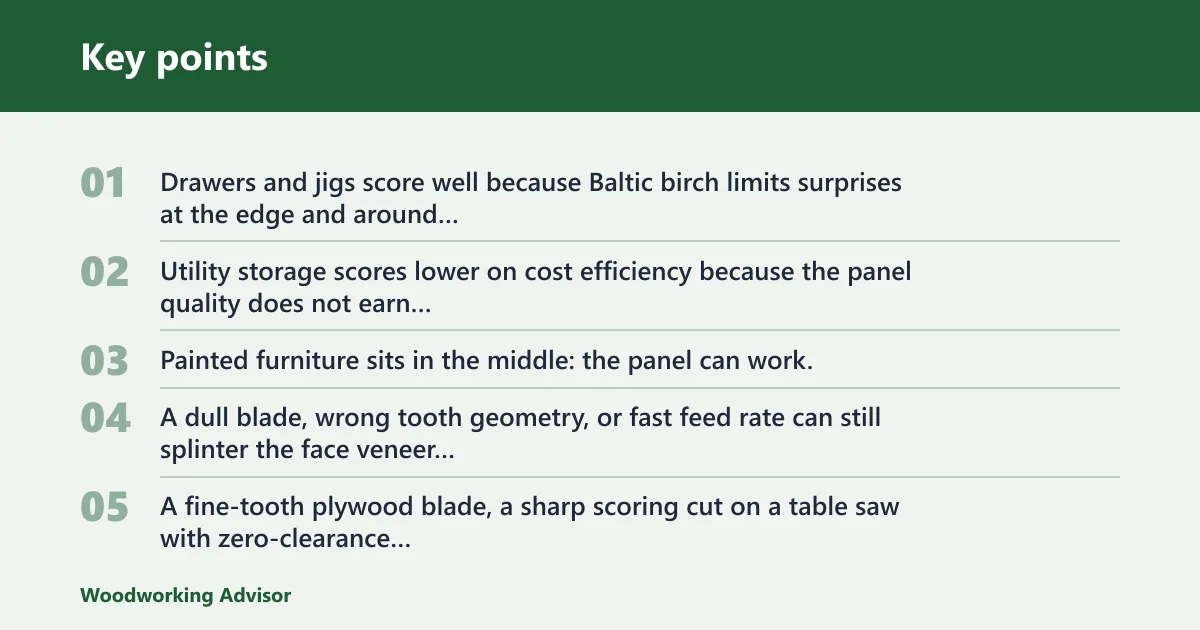
Drawers and jigs score well because Baltic birch limits surprises at the edge and around fasteners. Utility storage scores lower on cost efficiency because the panel quality does not earn much back when the sheet stays hidden. Painted furniture sits in the middle: the panel can work, but the premium often disappears under primer and filler.
Cut quality and edge prep
Higher ply count does not remove tearout. A dull blade, wrong tooth geometry, or fast feed rate can still splinter the face veneer and leave ragged edges. A fine-tooth plywood blade, a sharp scoring cut on a table saw with zero-clearance support, and light sanding or edge sealing after the cut all help. On exposed edges, plan for banding, veneer tape, or careful finish sanding.
Say your cabinet side is a 24 x 30 in. carcass with three dados for shelves. If one sheet has hidden voids near the dado line, the groove can break into a cavity and weaken the joint. A cleaner core avoids that repair, which is where Baltic birch starts to pay back.
The premium pays off when the sheet saves labor, prevents failures, or reduces finishing work enough to offset the higher purchase price. If the panel avoids one patch, one rebuilt edge, or one failed screw zone, the total job cost can move in Baltic birch’s favor even though the sheet itself costs more.
Best-fit projects
Use Baltic birch for drawers, shop jigs, visible-edge furniture parts, router templates, and cabinet components where fasteners sit near the edge. It is also a strong choice for curved laminations and parts that need predictable cut edges for dry assembly before final glue-up.
When cheaper plywood is enough
Choose a cheaper sheet when the panel will be hidden, fully painted, heavily veneered, or covered by face frames and trim. Utility shelves inside a garage cabinet, case backs, and temporary shop fixtures usually do not need the same core quality. In those cases, cost efficiency beats edge beauty.
Suppose you are building six 30-inch-wide shop cabinets with fully enclosed faces and painted fronts. If the edges are never visible and the hardware lands in solid framing, a cabinet-grade or even utility panel may be the better buy. The premium on Baltic birch buys little there.
Choose Baltic birch if… / Choose cheaper plywood if…
Choose Baltic birch when the edge matters, the cut line will be seen, or the joinery depends on clean material around fasteners. Choose cheaper plywood when the sheet will be hidden, painted over, or replaced easily if it gets damaged. That split keeps the premium where it can earn its keep.
Choose Baltic birch
- You need exposed edges that still look orderly after sanding.
- You are cutting dados, rabbets, or screw joints near the panel edge.
- You want fewer voids around clamps, screws, or hinge hardware.
- You are building jigs or templates that need repeated accuracy.
Choose cheaper plywood
- The panel will be hidden behind a face frame or wall.
- You will paint the surface and cover the edges with filler or banding.
- The part is disposable, temporary, or low consequence.
- Sheet waste matters more than edge appearance.
What are the downsides of using Baltic birch?
The main downsides are price, variable import quality, and edge work that still requires care. Some sheets arrive flat and consistent; others vary enough that the label alone is not enough. Baltic birch also does not turn a panel into outdoor plywood, and it will still swell, stain, or fail if moisture exposure is high enough.
Price swings and import inconsistency
Prices can move fast, especially on imported sheets. That makes the break-even point project-specific. A higher sheet price may be fine on a drawer front or jig plate, but not on a hidden partition. Import inconsistency also means two sheets with the same label can cut differently, so inspect the edge before you buy if possible.
Moisture limits
Baltic birch is generally used as an interior panel unless it is specifically rated for harsher exposure. The glue line may handle ordinary indoor humidity, but it is not a substitute for marine or exterior plywood in wet service. For basement storage, unheated shops, or seasonal humidity swings, allow for movement and seal exposed faces and edges.
Failure cases to watch
Edge blowout can happen if the blade exits the face veneer too aggressively. Warped sheets can ruin an otherwise good layout. Voids near a hinge screw or drawer slide screw can cause fastener failure. Finish defects also show up after cutting if the raw edge is fuzzy or the face veneer has shallow tearout.
Frequently asked questions
Is Baltic birch plywood worth the extra cost over standard birch plywood?
It is worth the extra cost when edge quality, void control, and machining reliability save labor or prevent failure. Standard birch plywood is usually better value for painted or hidden parts. The right choice depends on whether the sheet will be seen, loaded, or cut into joinery-critical parts.
Is Baltic birch strong enough for cabinets and shop furniture?
Yes, it is strong enough for those uses when thickness and layout are appropriate. Strength still depends on span, panel thickness, support spacing, and fastener placement. A 1/2 in. sheet that is over-spanned will sag regardless of species, while a properly supported 3/4 in. panel generally performs well.
How many plies does Baltic birch usually have?
Many sheets have a higher ply count than standard plywood, and the exact number depends on thickness and supplier. Thin panels often show fewer plies than thicker ones, but the key point is the thin, even layering. Count the edge plies if you need to verify construction before buying.
Does Baltic birch hold screws better than other plywood?
It usually holds screws more reliably near the edge because the core is more consistent and voids are less common. That does not make it immune to split-out or strip-out. Pilot holes, proper screw length, and decent edge distance still matter more than the panel label alone.
How can I tell if the sheet I’m buying is true Baltic birch or just birch-faced plywood?
Inspect the edge for many thin plies and minimal voids, and read the product description for origin and construction details. If the seller only says “birch plywood,” that is not enough. A clean edge sample, a thickness check, and a look at the core are the fastest checks.
When should I choose cheaper plywood instead of Baltic birch?
Choose cheaper plywood when the panel will be hidden, painted, or covered by trim, face frames, or laminate. It also makes sense for rough utility storage and temporary shop fixtures. If edge beauty and void control will never be seen or stressed, the premium is usually wasted.
Sponsored / affiliate links. As an Amazon Associate I earn from qualifying purchases. I may earn additional commission from eligible campaigns.
 Baltic Birch Plywood Sheets Box of 45 - Laser Engraving Cutting, Scroll Saw Nature Veneer Color, Stronger Than Basswood, A/A Grade,12 x 12 x 1/8”, 3mm Thickness Perfect for Wood Burning
 Baltic Birch Plywood 1/8'' x 12'' x 18'', 6 Pack, B/BB Grade, Void-Free Core, Laser Cutting Ready, Flat Sheets for CNC, Engraving, DIY Crafts, Art Painting, Wood Burning, Staining