Marine Plywood vs Regular Plywood: Is It Worth the Price?
Marine plywood is worth the extra cost only when moisture exposure, hidden failure, or replacement labor would cost more than the price gap; for dry interiors, Regular Plywood plus sealing is usually the better buy. Choose wrong and you can pay twice: once for the panel, again for swelling, delamination, rot, or tear-out repairs. This guide compares price, durability, sealing needs, and best uses for marine, regular, and protected regular plywood.
This guide is part of our Plywood sizes, cuts and prices guide series.
| Decision factor | Marine Plywood | Regular Plywood | Winner |
|---|---|---|---|
| Moisture resistance | Built for moisture-resistant use with waterproof phenolic glue and tighter construction | Interior plywood; not waterproof and weaker in damp or wet conditions | Marine Plywood |
| Core quality and voids | Minimal or no core gaps; higher-grade veneers | More grade-dependent; larger core gaps can exist | Marine Plywood |
| Upfront cost | Usually more expensive | More economical for dry indoor projects; typically costs 35-60% less than marine grade | Regular Plywood |
| Delamination risk in wet use | Lower risk when water gets to edges or fastener holes | Higher risk when moisture reaches edges, voids, or thin veneers | Marine Plywood |
| Best value in dry interiors | Usually overkill | Best fit for furniture, cabinets, partitions, and general construction | Regular Plywood |
Marine plywood vs regular plywood
Marine Plywood wins where water exposure or hidden failure would be expensive; Regular Plywood wins when the project stays dry and the panel is easy to replace. The core difference is not just strength. It is moisture resistance, adhesive type, veneer quality, and how well the panel resists delamination after water reaches an edge or fastener hole.
What each panel is built
Marine plywood is made for wet-service jobs where moisture resistance and long service life matter, such as boat hull parts, dock boxes, sink bases, shower-adjacent cabinetry, and outdoor panels that may see splash or trapped humidity. It uses a waterproof adhesive system and higher-grade veneers, with minimal or no core gaps.
Regular Plywood is a more economical choice for dry indoor projects. It is also known as interior plywood, and it is suited to furniture, cabinets, partitions, and general construction where water exposure is limited.
Why labels cause buying mistakes
Buyers often confuse true marine plywood with exterior plywood or vague “marine-type” labels. That mistake matters because exterior plywood has limited water resistance, while marine plywood is built for water-related and high-moisture use. A label that sounds close is not the same as a panel built with waterproof glue, better veneers, and tighter core construction.
Side-by-side comparison
The real trade-off is simple: pay more up front for a panel that tolerates wetting better, or save money now and accept more sealing work and more failure risk later. The best choice changes with moisture exposure, edge access, and how costly replacement would be once cabinets, flooring, or built-ins are installed.
Water resistance and adhesive type
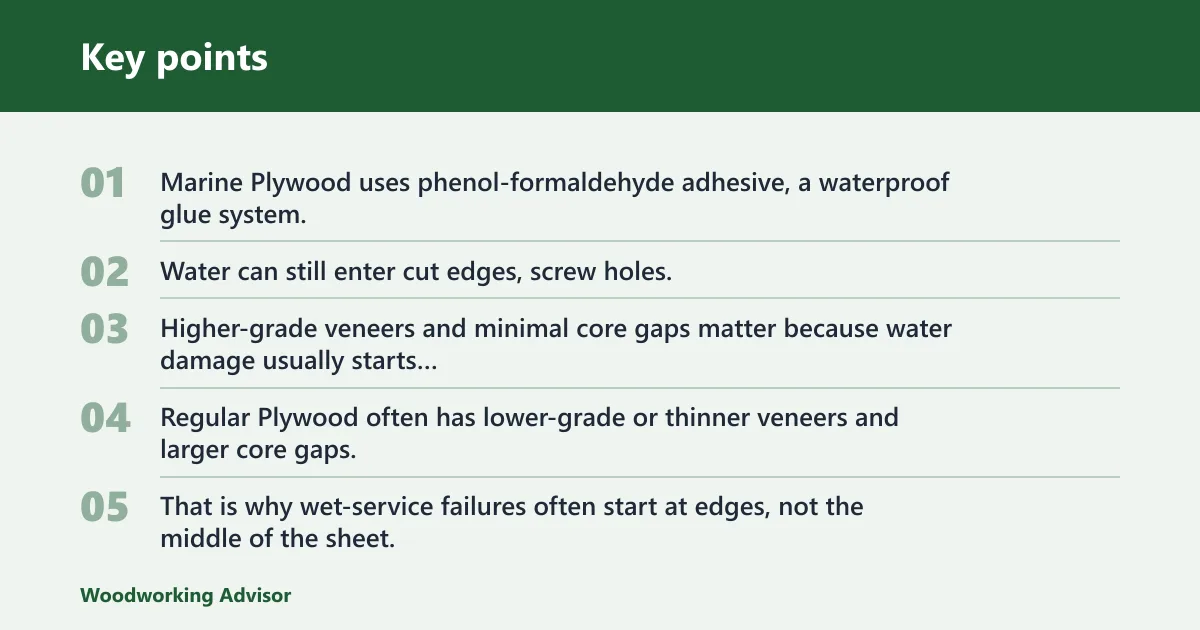
Marine Plywood uses phenol-formaldehyde adhesive, a waterproof glue system, so it tolerates moisture far better than regular interior plywood. That does not make it waterproof. Water can still enter cut edges, screw holes, and exposed faces if you leave them unsealed.
Veneer quality and core gaps
Higher-grade veneers and minimal core gaps matter because water damage usually starts where construction quality is weakest. Regular Plywood often has lower-grade or thinner veneers and larger core gaps, which can give moisture more paths into the panel. That is why wet-service failures often start at edges, not the middle of the sheet.
Cost and replacement risk
Regular Plywood is usually much cheaper, and ACEALL WOOD says it typically costs 35-60% less than marine grade. That price gap can be the right answer for a shelf or utility bench. It becomes less attractive when failure means pulling apart finished work, replacing trim, or rebuilding a panel hidden behind plumbing.
Best-fit use case
Marine Plywood fits boat parts, dock storage, trailer floors, sink bases, and outdoor assemblies where repeated wetting is likely. Regular Plywood fits dry interiors and protected assemblies. The in-between choice is protected regular grade: acceptable where splash is occasional, the panel can be sealed on all sides, and replacement would be straightforward.
Why does marine plywood cost more?
Marine Plywood costs more because the material spec is tighter in three places: adhesive, veneers, and core construction. That extra cost buys better resistance to moisture-related failure, not magic waterproofing. It is a materials-and-risk price, not just a premium label.
Phenol-formaldehyde adhesive
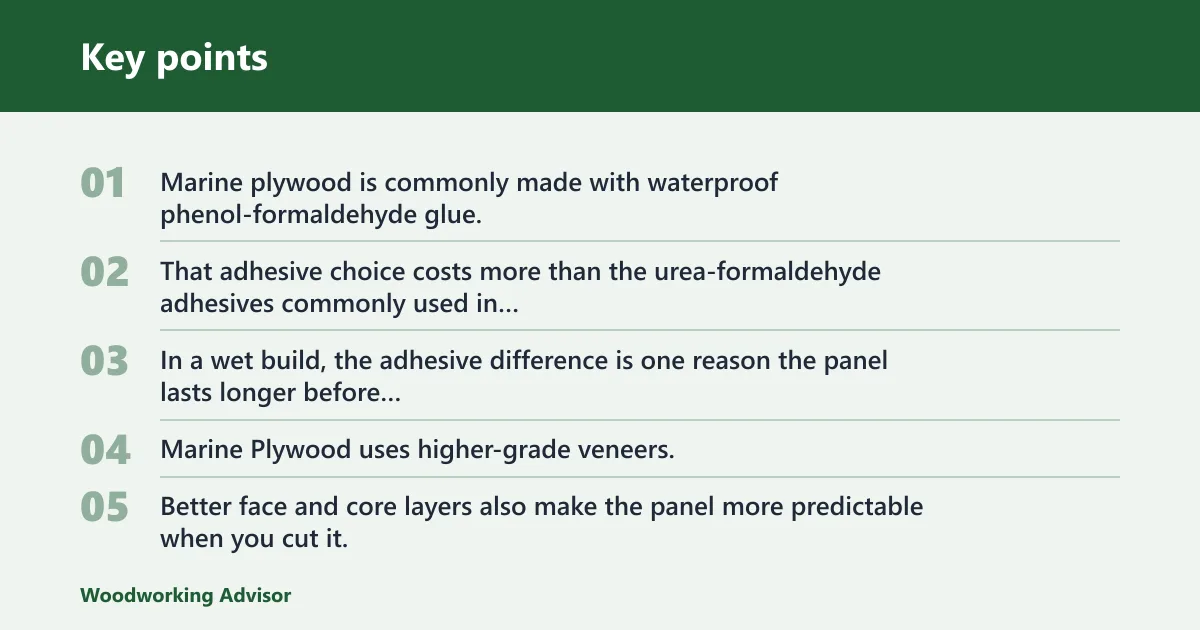
Marine plywood is commonly made with waterproof phenol-formaldehyde glue. That adhesive choice costs more than the urea-formaldehyde adhesives commonly used in regular plywood, which are not waterproof and have limited moisture resistance. In a wet build, the adhesive difference is one reason the panel lasts longer before lines open up.
Higher-grade veneers
Marine Plywood uses higher-grade veneers, which are less likely to leave weak spots that let moisture move into the sheet. Better face and core layers also make the panel more predictable when you cut it, fasten it, or seal it. That predictability matters more when the sheet will be hidden after installation.
Minimal core gaps and tighter construction
Core gaps are one of the quiet reasons plywood fails. If a lower-grade sheet has voids, water can sit there and spread damage inward. Marine Plywood is built with minimal or no core gaps, so it resists that path better and reduces the chance of early delamination.
Does marine plywood stop delamination better?
Yes, marine plywood is generally more resistant to delamination than regular plywood, especially when moisture reaches cut edges, fastener holes, or exposed end grain. It is still not failure-proof. If you leave any plywood unsealed in a wet assembly, water can still get in and start damage over time.
Where delamination starts
Delamination usually begins where moisture can work between layers. Edges, corners, screw penetrations, and saw-cut openings are the usual entry points. In lower-grade plywood, larger core gaps and weaker veneers give that moisture more room to spread.
How moisture reaches edges and voids
A cabinet side under a sink, a planter wall, or a trailer floor sees repeated wetting at exactly the places that are hardest to seal perfectly. Once water reaches a weak seam, the panel can swell, separate, or lose fastener holding. That is why delamination is often a service-life issue before it becomes a full structural one.
Why regular plywood fails sooner in wet use
Regular Plywood is not waterproof and should not be used in damp or wet environments without protection. It can survive brief exposure if carefully sealed, but once the finish fails, damage can move quickly. The lower the grade, the less forgiving the panel usually is around exposed edges and joints.
Can regular plywood work in wet areas?
Yes, in limited cases. Regular Plywood can work when moisture is occasional, the surface is fully sealed, and the project is protected from standing water or constant humidity. It is the wrong choice for permanently wet, high-splash, or fully exposed exterior use.
When sealing helps
Sealing helps most when the exposure is minor and predictable, such as occasional splash near a vanity side panel or light humidity in a powder-room cabinet. You still need to seal cut edges, fastener holes, and any raw face that might collect moisture. Skipping those spots is where many failures begin.
When protected regular plywood is enough
Protected regular grade is often the better value for indoor shelving, a utility bench, or a cabinet that stays out of direct wetting. If the panel stays dry most of the time and is easy to replace, spending for marine grade usually adds cost without much payoff.
When it is the wrong bet
Suppose a kitchen sink base sees small leaks over time. A sealed regular sheet may hold for a while, but hidden water at the sink cutout or toe-kick edge can still trigger swelling and delamination. In that kind of hidden-risk build, the lower purchase price can be a false savings.
Marine plywood decision matrix
This matrix treats plywood as a total-risk purchase, not a material upgrade. The best value depends on exposure, failure cost, sealing labor, and how hard replacement would be after finish work or installation.
| Project | Moisture exposure | Failure consequence | Sealing effort | Best value |
|---|---|---|---|---|
| Bathroom cabinet | Moderate humidity, occasional splash | Moderate | Medium | Protected regular grade |
| Kitchen sink base | Frequent hidden splash and leak risk | High | High | Marine Plywood |
| Exterior planter | Repeated wetting and soil contact nearby | High | High | Marine Plywood |
| Dock box | Constant wetting and outdoor exposure | High | High | Marine Plywood |
| Indoor shelving | Dry | Low | Low | Regular Plywood |
| Trailer floor | Road spray and weather exposure | High | High | Marine Plywood |
| Utility bench | Mostly dry, occasional spill | Low to moderate | Medium | Regular Plywood |
| Boat component | Repeated wetting and constant moisture risk | High | High | Marine Plywood |
Say your bathroom cabinet sits under a sink but away from the tub. A protected regular sheet can be the better buy if every edge is sealed and the cabinet is easy to service. Move that same cabinet under a chronic drip, and Marine Plywood becomes the safer value.
Say your trailer floor is built from a 4-by-8 sheet and will see road spray. The material that saves money up front can cost more later if water starts at a bolt hole and the floor softens. In that case, Marine Plywood often wins because replacement labor is the expensive part.
Choose Marine Plywood if… / Choose Regular Plywood if…
Choose marine plywood if the panel will face repeated wetting, hidden leaks, dock-style exposure, or any situation where failure would mean pulling apart finished work. Choose Regular Plywood if the project stays dry, is easy to replace, or lives behind a finish schedule where spending extra on moisture resistance would not change the outcome.
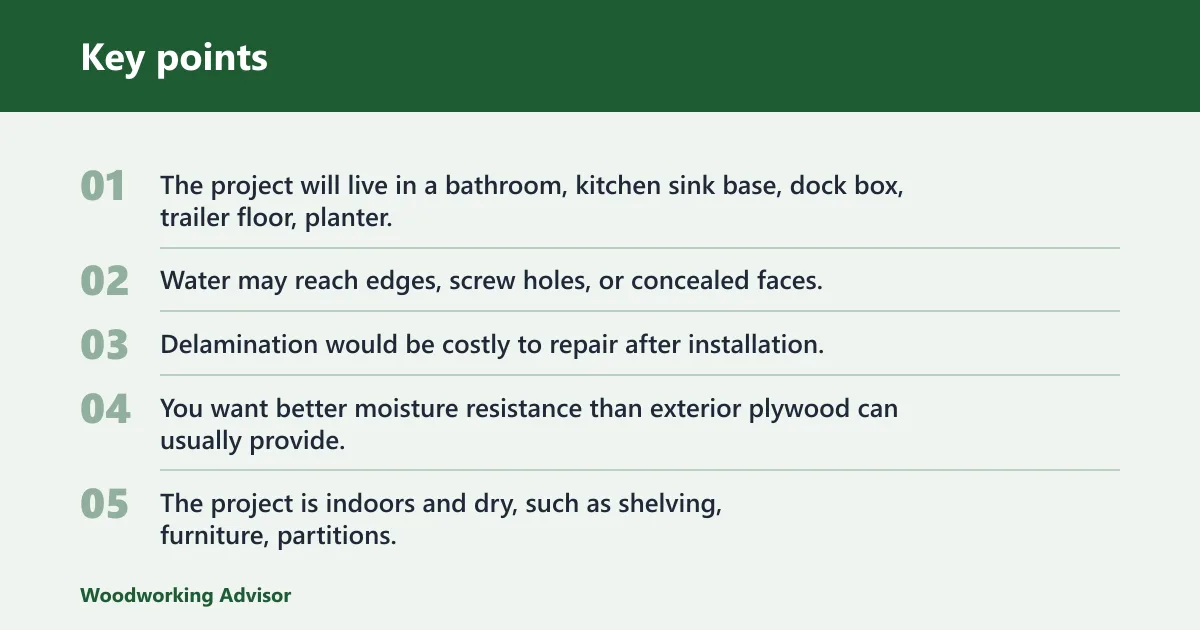
Choose marine plywood if…
- The project will live in a bathroom, kitchen sink base, dock box, trailer floor, planter, or boat component.
- Water may reach edges, screw holes, or concealed faces.
- Delamination would be costly to repair after installation.
- You want better moisture resistance than exterior plywood can usually provide.
Choose regular plywood if…
- The project is indoors and dry, such as shelving, furniture, partitions, or a utility bench.
- You can seal exposed edges and keep the panel out of standing water.
- Replacement would be easy and inexpensive.
- You are buying for value, not for long-term wet-service durability.

Frequently asked questions
Is marine plywood worth it for bathroom cabinets?
It is worth it when the cabinet sits near frequent splash, hidden leaks, or a sink base where failure would be expensive to fix. For a dry vanity with good finishing and no direct wetting, protected regular grade is often the better value. Moisture exposure, not room name, should decide.
What is the difference between marine plywood and regular plywood?
Marine Plywood uses water-resistant bonding, higher-grade veneers, and minimal or no core gaps, while Regular Plywood is a more economical interior material with lower moisture resistance. Marine Plywood is built for wet or high-humidity use; Regular Plywood is best for dry indoor projects.
Can regular plywood be used outdoors if it’s sealed?
Sometimes, but only for limited exposure and only if you are willing to seal every cut edge, face, and fastener hole. Even then, Regular Plywood is not waterproof and should not be treated as equal to marine grade for constant wetting, exterior weather, or hidden leaks.
Does marine plywood stop delamination better than regular plywood?
Yes. Marine Plywood resists delamination better because it uses waterproof adhesive, better veneers, and tighter core construction with minimal gaps. That matters most when water reaches edges or voids. Regular Plywood can survive in dry settings, but wet-service delamination is a bigger risk.
Why is marine plywood so expensive?
The higher price comes from the glue system, veneer quality, and tighter core construction. ACEALL WOOD says Regular Plywood typically costs 35-60% less than marine grade. That spread is easier to justify when hidden water damage would be costly to repair or replace.
What grade of plywood should I use for wet areas?
Use Marine Plywood for areas with repeated wetting, high humidity, hidden plumbing risk, or exterior exposure. If the moisture is occasional and you can seal all exposed surfaces, a protected regular grade may work. Exterior plywood is not the same as marine plywood and should not be treated as a substitute.
Sponsored / affiliate links. As an Amazon Associate I earn from qualifying purchases. I may earn additional commission from eligible campaigns.