Best Bandsaws for Resawing (2026): Based on Specs and Reviews
For light resawing and thin veneers, a 14-inch bandsaw with a riser block and at least about 1 hp is commonly considered the minimum. For hardwood over about 6 inches thick, a common recommendation is an 18-inch class saw with around 2 hp or more, a wide blade, and a rigid frame. Too-small frames, weak motors, and poor blade support leave you with drift, burn marks, stalled cuts, and wasted stock. This guide compares the best bandsaw for resawing by stock thickness, hardwood load, and shop power, then lists the specs that separate light duty from serious work.
Quick comparison
| Product | Badge | Best for | Price | ||
|---|---|---|---|---|---|
 |
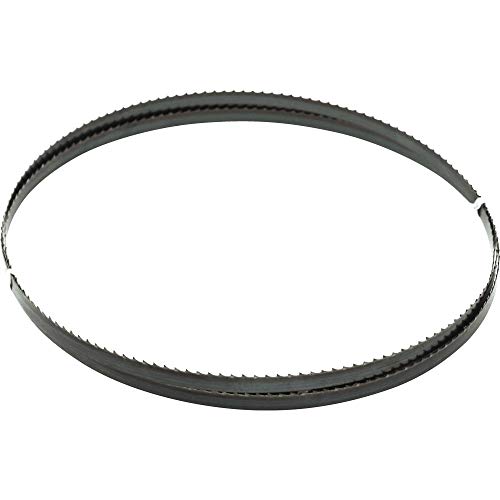
Dark Stone 93-1/2" Carbide-Tipped Resaw Bandsaw Blade, 3/4"Dark stone | Our pick | 93.5" · 2 TPI · 3/4" wide | $99.98
Price as of 19 Oct 2026
|
View |
 |
Grizzly Industrial H7587 – Resaw Fence Complete for 14"Grizzly Industrial | Pair with it | 14" · Complete · Retrofit compatible | $184.95
Price as of 19 Oct 2026
|
View |
The split is plain. Light resawing can work on a smaller saw, but regular hardwood work needs more motor, more height, and a stiffer frame. The other dividing line is power supply; repeated thick-stock work points you toward 230V machines faster than a benchtop or light 115V saw.
How we chose
Resawing performance starts with resaw height, the maximum cut height. That is not the same as throat depth, which tells you how wide a board fits from blade to frame. A saw can have decent throat and still run out of height for thick stock.
Motor class matters next. Thin stock and softwood tolerate less power, but hardwood resawing loads the blade hard and exposes weak tensioning, slow feed, and poor chip clearing. For that reason, the cut category matters more than the marketing label on the saw.
Fence quality, guide quality, frame rigidity, and table flatness all affect the cut. A tall fence supports the board vertically. Ball-bearing guides, upper and lower support, and solid tracking keep the blade from wandering as feed pressure rises.
We also weighed electrical fit and setup range. A saw that wants 230V and a wide blade belongs in a shop that will actually use it. A lighter saw can make straight cuts, but it should not be sold as a regular hardwood resaw machine.
WEN 3962: best for light resawing
The WEN 3962 fits light resawing where you need a compact saw for thin stock, small veneers, or occasional board breakdown. It has a 3.5-amp motor, cuts up to 6 inches deep, and cuts 9-3/4 inches wide. That puts it in the short-reach category for home shops that do not need large slab capacity.
What stands out is how clearly its limits line up with the job. A 6-inch maximum cut height is enough for thin boards and small parts, but it is short of what most woodworkers want for routine hardwood resawing. Use it for lighter work, not for repeated thick hardwood cuts.
The drawback is simple: it is undersized for serious resawing. A narrow machine with a 3.5-amp motor will run out of steam and blade support sooner than a larger floor-standing saw when you ask it to split dense stock.
JET JWBS-14SFX: best for 14-inch resawing
The JET JWBS-14SFX is the strongest 14-inch class option here for users who want real resaw capability without stepping into a larger floor-standing frame. It offers 13.5-inch throat capacity, over 13 inches of resaw capacity, a 1.75HP single-phase motor, and dual 4-inch dust ports. It also runs on 115V or 230V single phase.
That combination matters. The throat depth gives you room for wide boards, while the high resaw capacity gives you room for thick stock. The dual dust ports help clear chips during long cuts, which improves visibility at the cut line and keeps the lower guides from filling up as fast.
The drawback is that it is still a 14-inch class saw. It can do a lot, but the frame and table size still set a ceiling. For regular hardwood over 6 inches thick, a larger machine with more rigidity is the safer long-term choice.
JET JWBS-15: best for regular hardwood resawing
The JET JWBS-15 fits the buyer who wants a floor-standing step up from 14-inch machines and expects to resaw hardwood often. It uses a 1.75HP motor and has a 14-inch resaw capacity, which makes it a stronger fit for thick boards, matching work, and repeatable shop setups than a light benchtop saw.
Its main strength is margin. A 14-inch resaw height lets you work above the common 6-inch home-shop threshold with less strain, and the higher-capacity frame gives a wider setup envelope for tension, guide adjustment, and fence alignment. That extra room helps when the cut must stay straight over a long run.
The drawback is that it wants to be treated like a real stationary machine. If your shop space or electrical setup is limited, this class can be more saw than you need for occasional thin stock.
Laguna Tools 220v model: best for thick slabs and bookmatching
The Laguna Tools 220v model is aimed at thick-stock work where 230V power is available and the cut must stay controlled across hardwood. It uses a 2.5 HP motor and has a 12-inch resaw capacity. That makes it a better match for serious resawing than a light 115V saw, especially when you want stable feed through dense material.
For bookmatching, the value is not only height. A 2.5 HP motor gives more reserve under load, which helps keep blade speed and feed rate steadier in hard maple, walnut, and similar stock. That steadiness matters when both halves of a split board need to match.
The drawback is that 12 inches of resaw capacity is not the tallest number in this group. If your work regularly exceeds that height, you should move up to a saw with more resaw room rather than asking this class to do oversized slab work.
Dark Stone 93-1/2" carbide-tipped blade: best for straight hardwood cuts
This blade is for users who already have a bandsaw with enough height and power, and want a stiffer resaw setup for straight hardwood cuts. Based on the published specs, it is 3/4" wide, 2 TPI, and uses carbide-tipped teeth with hook geometry. That combination suits fast chip clearing and long edge retention.
The wide body helps resist twist during resawing. The 2 TPI tooth pattern is aggressive enough to move material, which is useful when you want a cleaner feed on thicker boards without forcing the cut. A carbide-tipped blade can stay sharp longer than a typical carbon blade, which is useful for repeated hardwood work.
The drawback is that this is not a universal blade. A 3/4" resaw blade needs good tension, proper tracking, and a saw that can support it. On a weak machine, the blade cannot compensate for poor frame stiffness or inadequate motor power.
Grizzly Industrial H7587 resaw fence: best for repeatable setup
This fence is for users who want a taller, more controlled resaw setup on a 14" bandsaw. It is a complete retrofit fence for 14" bandsaws, and it is meant to replace standard fences that do not give enough vertical support for resawing. The removable design also lets you switch back to normal work settings.
What stands out is the resaw-specific approach. A tall fence helps keep a board upright, which matters for bookmatching and for avoiding lean as the cut progresses. If your stock is wide and the saw is otherwise capable, a proper resaw fence can improve repeatability more than a generic low fence.
The drawback is that it is still a fence, not a fix for a weak saw. If the blade wanders because tension is poor or the motor stalls in hardwood, a better fence will not solve the root problem.
Resaw decision table
This table turns stock thickness, wood type, and shop power into a minimum-spec target. Use it as a floor, not a wish list. If your stock lives near the top of a range, move up one class.
| Stock and wood | Shop power | Minimum resaw height | Minimum motor | Blade width | Fence height | Best bandsaw class |
|---|---|---|---|---|---|---|
| Up to 3 inches, softwood or light hardwood | 115V | 6 inches | 1 hp | 1/2 inch to 3/4 inch | Medium-height fence | Benchtop or light 14-inch saw |
| 3 to 6 inches, mixed hardwood and softwood | 115V | 10 to 12 inches | 1.5 hp to 1.75 hp | 3/4 inch | Tall resaw fence | 14-inch class with riser or stronger floor saw |
| 6 to 8 inches, hardwood | 230V | 12 inches or more | 2 hp or more | 3/4 inch to 1 inch | Tall, rigid fence | Floor-standing saw |
| 8 inches and up, dense hardwood or bookmatching | 230V | 13.5 inches or more | 2.5 hp or more | 1 inch preferred | Tall fence with micro-adjustment | High-frame floor-standing saw |
What is bandsaw resawing?
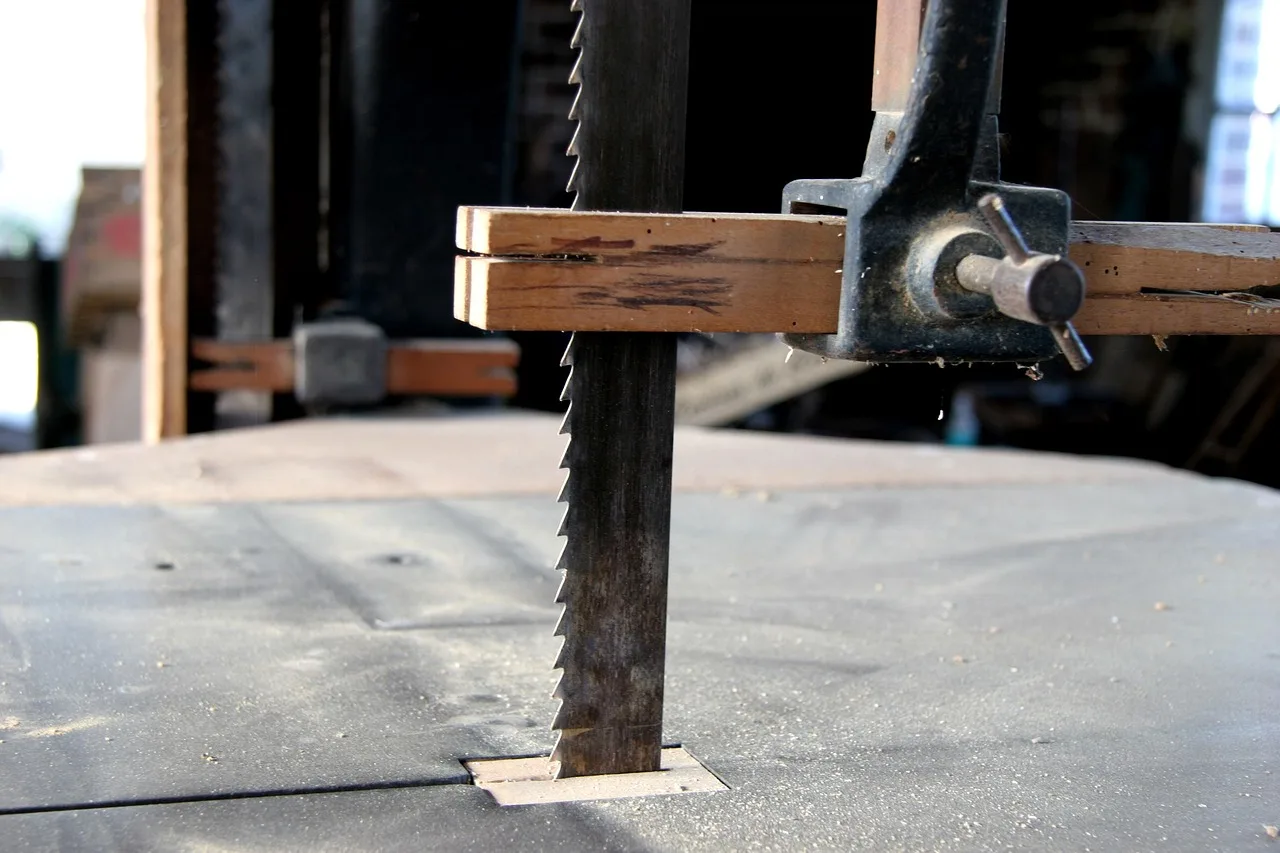
Bandsaw resawing is the process of cutting thick lumber into thinner boards or veneers along its thickness. The blade stays on a straight vertical path while the board is fed upright against a fence. The goal is flat, repeatable slices with minimal waste and minimal wander.
The key point is that resawing asks more from a saw than simple curve cutting. You need height, blade support, and enough motor reserve to keep the cut moving. Without those, the blade drifts and the surface comes out rough.
What type of bandsaw blade is best for resawing?
A wide blade is the usual choice for resawing. Common picks are 3/4-inch and 1-inch blades, because the wider body resists deflection and helps control drift. Tooth count matters too: lower TPI clears chips faster, while finer teeth can improve finish at the cost of slower feed.
For hardwood, a 3/4-inch resaw blade is a strong baseline. A 1-inch blade makes sense when the saw can tension it properly and the frame is stiff enough to support it. If the machine cannot hold tension, the blade will wander even if the tooth pattern is right.
Good setup starts with the blade and ends with a test cut. Install the widest blade your saw can tension correctly, set tracking so the blade runs stable under load, square the fence to the table, and adjust the guides close to the blade without binding. If the saw has upper and lower guide support, set both.
From there, tension matters. Too little tension lets the blade twist and wander in hardwood. Too much can stress the blade and make tracking unstable. A straight resaw cut depends on a balance of tension, feed rate, and a fence tall enough to keep the stock upright.
- Choose a 3/4-inch or 1-inch blade that matches the saw’s tension range.
- Set the blade tracking and check that it runs cleanly through the guides.
- Align the fence so it is square and rigid.
- Set the upper and lower ball bearing guides close to the blade.
- Make a short test cut in scrap stock and inspect for drift, burn marks, or twist.
Say your 7-inch maple board starts cutting cleanly for the first foot and then the blade drifts into the waste side. That usually points to insufficient tension or a blade that is too narrow for the load, not a fence problem alone.
A common first-timer mistake is pushing too hard to help a slow cut. That increases heat, makes burn marks more likely, and can pull the blade off line on dense hardwood.
Which one should you buy?
If your stock stays under 3 inches and you only resaw occasionally, a light saw with a narrow capacity is enough. The WEN 3962 fits that role, but it should stay in the light-duty lane.
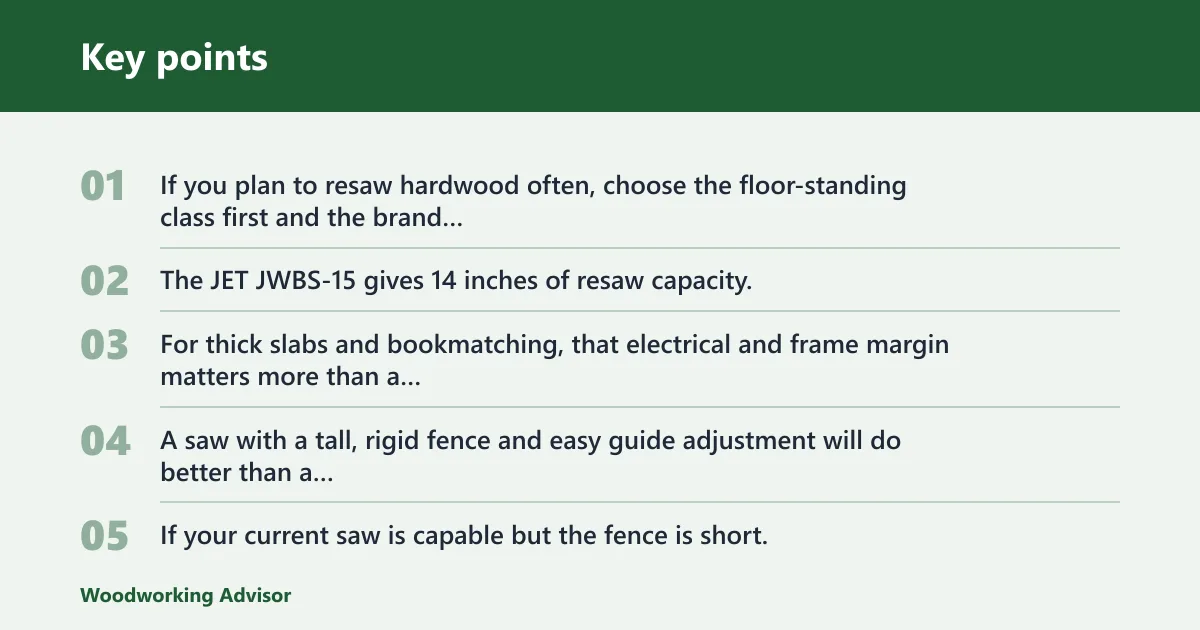
If you plan to resaw hardwood often, choose the floor-standing class first and the brand second. For thick slabs and bookmatching, that electrical and frame margin matters more than a low purchase price.
Choose by fence and blade support as well. A saw with a tall, rigid fence and easy guide adjustment will do better than a larger-looking machine with poor support. If your current saw is capable but the fence is short, the Grizzly Industrial H7587 can improve resaw control. If the blade itself is the weak link, the Dark Stone 3/4-inch carbide blade is a stronger fit for straight hardwood work.
Do you need a 14-inch bandsaw for resawing? For light work and some hardwood, yes. For routine thick hardwood over 6 inches, a 14-inch saw is the minimum class to consider, and a floor-standing saw is the better buy when you want less strain, more repeatability, and better results over time.
Frequently asked questions
What size bandsaw do I need for resawing?
For light resawing, a 14-inch bandsaw with a riser block can be enough. For hardwood over 6 inches thick, target an 18-inch class saw or a strong floor-standing machine with 12 inches or more of resaw height, plus a 3/4-inch or 1-inch blade.
What resaw height is enough for hardwood slabs?
For most hardwood slabs, 12 inches is a practical floor, and 13.5 inches or more gives better margin. That extra room matters because real stock is not perfectly uniform, and the saw needs clearance for both the board and the setup tolerances of the fence and guides.
Do I need a 14-inch bandsaw for resawing?
You need a 14-inch bandsaw if your work is light to moderate and you want a compact machine that can still do real resaw cuts with the right blade and fence. If you expect regular thick hardwood, a floor-standing saw is the safer choice because it gives more height, power, and stability.
Sponsored / affiliate links. As an Amazon Associate I earn from qualifying purchases. I may earn additional commission from eligible campaigns.